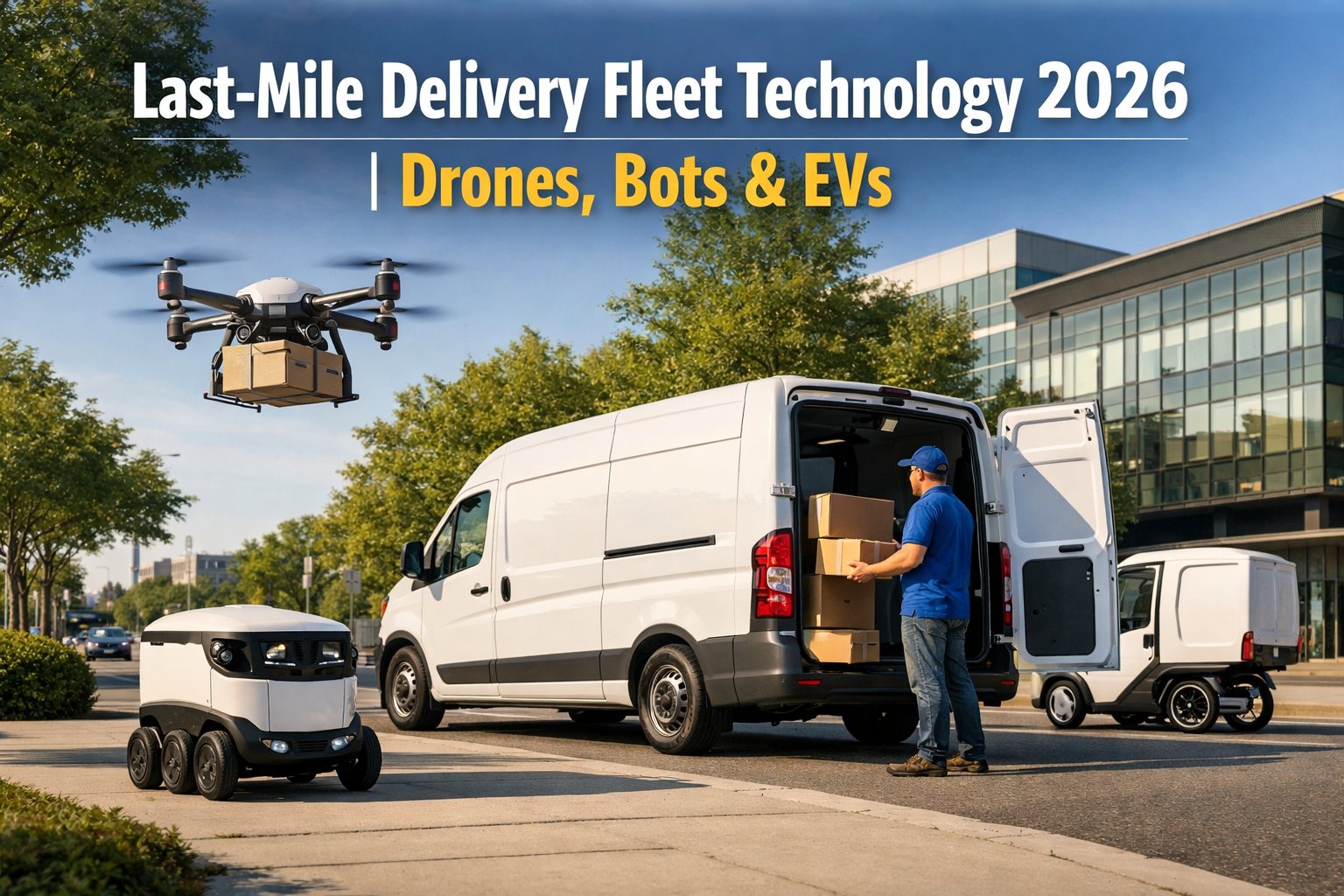
Last-mile delivery technology is experiencing its most dramatic transformation since the invention of the delivery van. In 2026, the final stretch of package delivery—traditionally the most expensive and inefficient segment of logistics—is being revolutionized by delivery drones, sidewalk robots, cargo e-bikes, and electric delivery vans working in orchestrated multimodal systems. With Amazon and Walmart drone delivery programs expanding rapidly and autonomous delivery fleets scaling across urban markets, fleet operators face both unprecedented opportunities and urgent pressure to adapt. This comprehensive guide examines the last-mile delivery technology reshaping fleet operations in 2026, from emerging autonomous solutions to proven EV transitions and the software platforms that tie everything together. Start optimizing your last-mile fleet today, or schedule a personalized delivery fleet demo.
Last-Mile Delivery Fleet Technology
Drones, sidewalk robots, cargo e-bikes, EV vans, and multimodal logistics strategies transforming e-commerce and urban delivery operations.
The Last-Mile Challenge in 2026
Last-mile delivery remains the most expensive segment of the supply chain, accounting for 53% of total shipping costs despite covering the shortest distance. The explosion of e-commerce—accelerated by changing consumer habits—has created unsustainable pressure on traditional delivery models. Customers expect same-day or next-day delivery, free shipping, and real-time tracking, while labor costs rise and urban congestion worsens.
The response from forward-thinking fleet operators is a fundamental reimagining of last-mile logistics. Rather than relying solely on delivery vans and drivers, 2026's leading e-commerce delivery fleets deploy integrated networks of autonomous and semi-autonomous vehicles matched to specific delivery contexts. A suburban package might arrive by drone, an urban apartment delivery by sidewalk robot, and a heavy appliance by EV van—all coordinated by sophisticated last-mile fleet software.
Key Last-Mile Delivery Technologies in 2026
Five distinct delivery technologies are reshaping last-mile fleet operations, each optimized for specific use cases, distances, and payload requirements. Understanding the capabilities and limitations of each technology helps fleet operators build effective multimodal delivery strategies.
Delivery Drone Fleet
Delivery drones have moved from experimental to commercially viable in 2026, with Amazon Prime Air, Walmart, and Wing (Google) operating regular drone delivery services across approved airspace. Modern delivery drones carry 5-10 pound packages up to 15 miles, completing deliveries in under 30 minutes at a fraction of traditional van delivery costs.
Sidewalk Delivery Robot
Autonomous sidewalk robots from companies like Starship, Nuro, and Serve Robotics navigate pedestrian environments to deliver packages, groceries, and prepared food. Operating at walking speed on sidewalks and crosswalks, these robots excel in dense urban environments where drone airspace is restricted and parking is impossible.
Cargo E-Bike Fleet
Electric cargo bikes combine human flexibility with electric assistance to navigate congested urban streets faster than vans while carrying substantial loads. With cargo capacities up to 400 pounds, e-bikes handle most urban parcel deliveries while eliminating parking challenges and reducing delivery costs by 60% compared to traditional vans.
EV Delivery Van
Electric delivery vans have become the backbone of last-mile fleets in 2026. With ranges exceeding 150 miles, rapid charging infrastructure, and total cost of ownership now below diesel equivalents, EV vans handle high-volume routes and larger packages that autonomous solutions cannot. Major fleets are completing transitions to 100% electric last-mile vehicles.
Multimodal Delivery Fleet
The most sophisticated last-mile operations in 2026 integrate all delivery modes into unified multimodal systems. AI-powered dispatch platforms analyze each delivery's characteristics—weight, dimensions, distance, urgency, location type—and automatically assign the optimal delivery mode. Micro-fulfillment hubs serve as transfer points where packages move between vans, bikes, drones, and robots.
Optimize Your Last-Mile Operations
FleetRabbit's last-mile fleet management platform integrates EV vans, e-bikes, and traditional vehicles with AI-powered route optimization for maximum delivery efficiency.
Benefits of Modern Last-Mile Technology
Fleet operators implementing advanced last-mile delivery technology report significant improvements across cost, speed, sustainability, and customer satisfaction metrics.
Cost Reduction
Drones deliver at $0.25-0.50 per package versus $1.50+ for van delivery. E-bikes reduce urban delivery costs by 60%. Multimodal optimization cuts overall last-mile spending 30-40%.
Faster Delivery
Drone delivery completes in under 30 minutes. E-bikes navigate congestion faster than vans. Autonomous solutions enable 24/7 delivery without driver hour limitations.
Sustainability
EV vans eliminate tailpipe emissions. E-bikes and drones produce minimal environmental impact. Optimized routing reduces unnecessary miles driven. Carbon reporting simplified.
Customer Experience
Real-time tracking across all delivery modes. Precise delivery windows. Reduced failed deliveries through smart scheduling. Novel delivery experiences drive brand loyalty.
Challenges and Considerations
Despite promising capabilities, last-mile delivery technology adoption faces several challenges that fleet operators must navigate carefully.
Regulatory Complexity
Drone delivery requires FAA approval and varies by jurisdiction. Sidewalk robot regulations differ city by city. Navigating patchwork regulations demands significant compliance resources.
Security Concerns
Autonomous delivery vehicles face theft and tampering risks. Package security during unattended delivery requires sophisticated locking and verification systems.
Weather Limitations
Drones cannot operate in high winds, rain, or snow. E-bikes face reduced range in cold weather. Operations must maintain backup capacity for weather disruptions.
Integration Complexity
Coordinating multiple delivery modes requires sophisticated fleet management software. Legacy systems often cannot support multimodal operations without significant upgrades.
Last-Mile Fleet Software Requirements
Managing modern last-mile delivery operations requires fleet management platforms purpose-built for multimodal complexity and autonomous delivery fleet coordination.
AI-Powered Route Optimization
Dynamic routing that considers traffic, delivery windows, vehicle capabilities, and real-time conditions across all delivery modes.
Unified Fleet Visibility
Single dashboard view across EV vans, e-bikes, drones, and robots with real-time tracking and status monitoring.
Intelligent Mode Selection
Automated assignment of optimal delivery mode based on package characteristics, destination, and operational constraints.
Performance Analytics
Cost-per-delivery tracking, mode efficiency comparison, and optimization recommendations across the entire delivery network.
Future Outlook: 2026-2030
Last-mile delivery technology will continue evolving rapidly through the end of the decade, with several key developments expected.
Drone Network Expansion
FAA approvals expand drone delivery coverage to 50+ metropolitan areas. Payload capacities increase to 15-20 pounds. Drone-to-vehicle handoffs enable extended range operations.
Autonomous Van Deployment
Level 4 autonomous delivery vans begin commercial operation in select markets. Human drivers shift to supervision and complex delivery roles. Labor cost structure transforms.
Integrated Autonomous Networks
Fully autonomous last-mile networks emerge combining self-driving vans, drones, and robots. 24/7 delivery becomes standard in major markets. Delivery costs drop below $0.50 for most packages.
Frequently Asked Questions
What is the most cost-effective last-mile delivery technology in 2026?
Delivery drones offer the lowest per-package cost at $0.25-0.50 for suitable deliveries (under 10 lbs, suburban locations, clear weather). Cargo e-bikes provide the best economics for urban multi-stop routes, reducing costs 60% versus traditional vans. The most cost-effective approach for most operations is multimodal—matching each delivery to the optimal mode.
Can small fleets adopt drone or robot delivery?
Autonomous delivery technology currently favors large operators due to capital requirements, regulatory complexity, and infrastructure needs. However, small fleets can access autonomous delivery through partnerships with drone delivery services or by focusing on cargo e-bikes, which require minimal infrastructure and offer immediate ROI. Last-mile fleet management software helps small operators maximize efficiency with existing resources.
How do multimodal delivery systems work?
Multimodal systems use AI-powered software to analyze each delivery's characteristics—package size, weight, destination type, urgency, weather conditions—and automatically assign the optimal delivery mode. Micro-fulfillment hubs serve as transfer points where packages move between vans (which handle trunk routes from distribution centers) and last-mile modes (drones, robots, e-bikes) that complete final delivery.
What regulations govern drone delivery in 2026?
Drone delivery operates under FAA Part 107 regulations with additional waivers for beyond-visual-line-of-sight (BVLOS) operations. Requirements include Remote ID broadcasting, altitude restrictions (typically 400 feet), approved operational areas, and certified drone pilots (or autonomous operations approval). Regulations vary significantly by location—some cities welcome drone delivery while others restrict it heavily.
How should fleets prepare for last-mile technology transition?
Start with EV van transition—the technology is mature, ROI is proven, and it builds operational experience with electric vehicles. Pilot cargo e-bikes in dense urban areas where they offer immediate cost savings. Evaluate drone and robot partnerships rather than building in-house capabilities initially. Most importantly, implement fleet management software that can scale to support multimodal operations as you expand delivery mode options.
Conclusion: Embracing Last-Mile Innovation
Last-mile delivery technology in 2026 represents a fundamental shift from the single-mode van delivery model that dominated for decades. The combination of delivery drones, sidewalk robots, cargo e-bikes, and EV vans—orchestrated by sophisticated last-mile fleet software—creates unprecedented opportunities to reduce costs, accelerate delivery speed, and improve sustainability.
For fleet operators, the key is strategic adoption matched to operational realities. Not every fleet needs drones or robots today, but every fleet should be implementing EV transitions and route optimization software that positions them for the multimodal future. Those who build flexible, technology-enabled operations now will be best prepared to integrate emerging autonomous solutions as they mature.
The last-mile delivery leaders of 2030 are making technology decisions today. Whether your priority is cutting costs through e-bike deployment, preparing for autonomous delivery integration, or optimizing existing van operations, the time to act is now.
Ready to Transform Your Last-Mile Fleet?
FleetRabbit helps delivery fleets optimize routes, manage EV transitions, and prepare for multimodal operations with AI-powered fleet management.