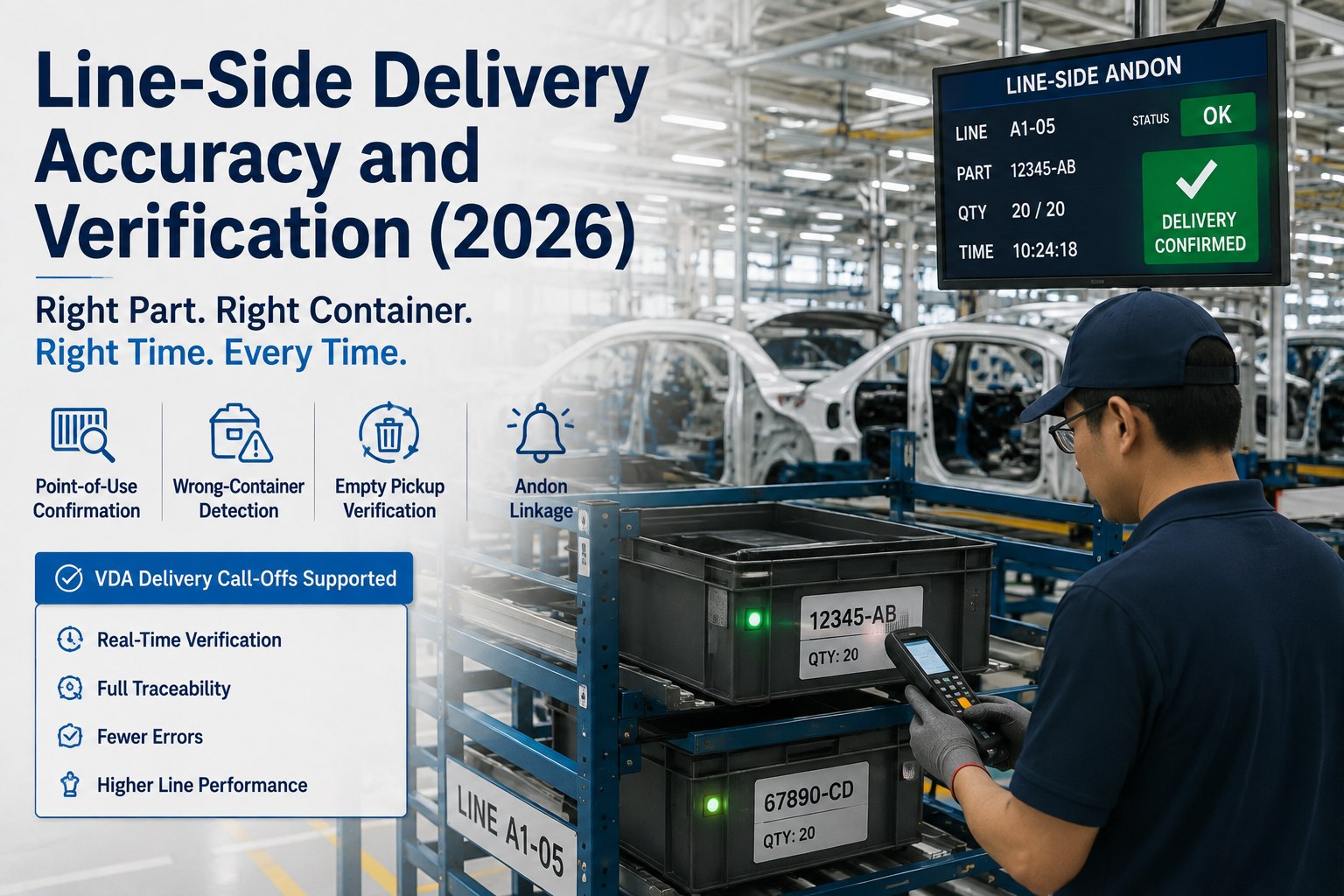
Line-side is where every upstream discipline is finally tested, and it is also where verification is most often skipped — because by the time a container reaches the rack, everyone involved has already confirmed something. The supplier confirmed the despatch, the gate confirmed the arrival, the dock confirmed the unload. The station confirms nothing; it simply consumes what is in front of it. That asymmetry is why line-side errors are expensive out of proportion to their frequency: an operator fitting a part from the wrong container is not making a mistake, they are correctly using material the system placed there, and the error surfaces at final test, in a warranty claim, or in a recall. Accuracy at the point of use is therefore not a checking activity bolted onto delivery. It is a delivery design question — where the confirmation sits, what it physically prevents, and what happens in the four seconds after it fails. See it on your own data against your own routes and racks.
2026 GUIDE · POINT-OF-USE ACCURACY
Line-Side Delivery Accuracy and Verification
Confirmation at the point of use, wrong-container detection that prevents rather than reports, disciplined empty pickup on the return leg, and an andon linkage that turns a deviation into a documented countermeasure instead of a shrug.
1
Deliver full
Right container to the right rack position, in route order
2
Confirm at point of use
Identity verified where consumption happens, not where it was picked
3
Collect empty
Return leg carries the empties and closes the loop
Five Conditions of an Accurate Delivery
All five have to hold. Most measurement programmes track the first two, which is why line-side accuracy figures usually look better than line-side reality.
Right partPart number matches what the station consumes for this buildFails as: a fitted wrong part, discovered at test or later
Right quantityContainer holds the standard pack quantity, not an approximationFails as: an unplanned starve mid-shift with no warning
Right containerCorrect container type for the part and the rack, correctly labelledFails as: rack incompatibility, or a correct part nobody trusts
Right positionDelivered to the specific rack location the operator reaches forFails as: search time, or a pick from an adjacent variant
Right timeWithin the replenishment window the consumption rate requiresFails as: buffer depletion, then an andon, then a stop
All five, togetherAccuracy is the conjunction, never the average of the partsReport it as a single pass rate — partial credit hides the failures
Why the station is the only honest measurement point
Every confirmation upstream measures intent. The pick was confirmed as correct against a list, the route was confirmed as complete against a schedule. Only consumption at the station proves the right part reached the right build — which is also why it is the single event that closes the loop for sequence adherence, kanban replenishment and call-off reconciliation simultaneously.
Where to Put the Confirmation
Four candidate points, each with a different cost and a different blind spot. Most plants use one; the strong ones use two, deliberately chosen so their blind spots do not overlap.
AAt pick, in the supermarket
Directed picking that will not let an operator pull from the wrong location, with a scan confirming the container against the pick instruction.
Blind toEverything that happens after the container leaves — misdelivery to the wrong rack, or a swap on the tugger
BAt drop, on the route
The tugger driver scans container and rack position together, so the pairing is proven rather than assumed at each stop.
Blind toWhether the part in the container is what the label says, and to anything moved afterwards
CAt the point of use
Verification where consumption happens — the operator's scan, a pick-to-light confirmation, or an automated read as the container enters the reach zone.
Blind toVery little. The cost is takt seconds, which is why the design has to make it free rather than fast
DAt the fit, on the unit
The strongest form — the part is verified against the specific build it is going into, not merely against the station.
Blind toNothing, but it is only viable where the part carries individual identity and the operation permits the read
The pairing that works for most plants is A plus C — prevent the error at pick, catch the residue at the station. Choosing A plus B feels thorough and is not: both sit upstream of the rack, so they share a blind spot covering everything that happens once material is line-side.
A confirmation that costs takt seconds will be worked around within a month.
We will look at your rack layouts, route structure and station cycle times and show where verification can sit without spending operator time — and which of your current checks share a blind spot.
Wrong-Container Detection
Ordered from prevention to detection. Prevention is always cheaper, and the mechanisms at the top of this table cost nothing per cycle once installed.
← Swipe to see all columns →
The row worth pausing on is vision on the container opening. A barcode confirms what the label claims; it cannot confirm what is inside. Where a supplier has filled a correctly labelled container with the wrong variant, every scan-based check in your plant will pass it through cleanly — and it will be found at the fit.
The Return Leg
Empty pickup is treated as housekeeping at most plants and is actually half the loop. A tugger pulls a train of carts on a fixed milk-run route, dropping full containers at each stop and collecting empties on the return — and if the second half is unreliable, the first half stops working within days.
1Empty removal is part of the stop, not an afterthoughtA rack position holding an empty is a position not holding a full. Racks silently lose capacity when collection lags.
2Empty count reconciles against full deliveriesFull drops and empty collections should balance across a cycle. A persistent gap means containers are accumulating somewhere you are not looking.
3Empties are scanned, not counted by eyeReturnable pool reconciliation depends on identity. A tally of "twelve empties" tells you nothing about which twelve.
4Flow racks preserve FIFO automaticallyGravity-fed shelves let full containers slide from back to front as operators pull from the front, so rotation happens without discipline. Where flow racks are not used, FIFO has to be enforced some other way.
5Damaged and non-conforming containers exit the loopOtherwise they circulate indefinitely, failing intermittently and blamed on whoever happens to be handling them that day.
6The return leg is timed like the delivery legA route that consistently runs long on the return is a route that will start skipping collections under pressure.
The Andon Linkage
Verification without a response protocol is data collection. The andon is what converts a detected deviation into a documented countermeasure — and the discipline extends beyond the station to the route itself.
Wrong container detected at the station
SignalImmediate, at the position
ResponseQuarantine the container, block the position, dispatch the correct one on priority. The operator does not proceed on judgement.
Replenishment window missed
SignalBefore depletion, not at it
ResponseOff-cycle delivery dispatched, and the route reviewed. An andon at the moment of starvation has already cost the recovery time.
Milk run departs off-schedule
SignalAutomated, at the start point
ResponseA photocell or pressure pad detects the train at its start position; any change from present to absent outside a twenty-second window around the countdown zero triggers the andon. The supervisor documents what led to the deviation and the countermeasure.
Empty collection skipped
SignalOn reconciliation mismatch
ResponseFlag the position and the cycle. Low urgency individually, and the leading indicator of route overload collectively.
Why early departure triggers an andon too
It is counter-intuitive that a driver finishing early is a deviation. Drivers normally have a short wait at the end of each cycle and must not leave before the countdown reaches zero — leaving early risks overproduction, overloading a supplying process, or interfering with another milk run and causing traffic jams. A route that habitually departs early is not efficient; it is desynchronised, and the consequences land somewhere other than on that route.
Closing the Loop Back to the Call-Off
Point-of-use confirmation is the event that makes several upstream systems honest at once. Wire it back rather than treating it as a local quality check. Our integrations overview covers the handoffs.
Delivery call-off reconciliationConsumption confirms what the required cumulative actually consumed, so the open position against a VDA delivery call-off reflects reality rather than goods receipt timing.
JIT call-off precisionWhere the JIT call-off communicates exact shipping times and quantities at time-slot level, consumption is the feedback that shows whether the slot granularity matches real burn rate.
Sequence adherenceThe only unambiguous proof that the right unit reached the right build position. Everything upstream reports intent.
Replenishment triggerConsumption-driven rather than timetable-driven replenishment requires the consumption event to exist. Without it, milk runs necessarily run on a fixed schedule.
Container pool positionFull-in and empty-out at the same position, closing the returnable loop with identity rather than counts.
Supplier attributionA wrong-variant fill inside a correct label is only ever provable at the point of use. That evidence belongs on the supplier scorecard.
What to Measure
Five figures. The first is the headline; the rest explain it. Our analytics and reporting module carries them.
Five-condition pass rateDeliveries meeting all five conditions, as a conjunction. Any partial-credit version of this number is not measuring accuracy.
Errors caught by stagePrevented at pick, caught at drop, caught at use, escaped to fit. The shape of this distribution tells you where to invest next.
Escapes to the fitThe only number that represents real cost. Should be near zero and is worth investigating individually rather than trending.
Route schedule adherenceDepartures inside the window at both ends, since early is a deviation too. A leading indicator for everything above.
Empty-to-full reconciliation gapPer route, per cycle. A widening gap predicts rack capacity loss well before anyone reports a shortage.
Run the Verification Design Against Your Own Lines
Bring your rack layouts, milk-run routes, container standards and station cycle times. We will show where verification can sit without spending takt seconds, which of your existing checks share a blind spot, and how consumption events wire back to call-off reconciliation and sequence adherence.
Point-of-use confirmation
Wrong-container prevention
Empty loop reconciliation
Andon trigger design
Frequently Asked Questions
Where exactly should the confirmation scan sit?
At the point of use, paired with prevention at pick. Confirming at the supermarket proves the pick was right and says nothing about what happened between there and the rack; confirming at the drop proves the pairing and says nothing about the contents. The station is the only place where the part, the position and the build come together. Where a scan action would cost takt seconds, use a passive read — RFID at the rack or vision on the container opening — rather than compromising on the location.
Is a barcode scan enough for wrong-container detection?
For label-to-position errors, yes. For contents-to-label errors, no, and this is the gap worth understanding: a scan confirms what the label claims, so a correctly labelled container filled with the wrong variant passes every scan-based check in the plant and is found at the fit. Vision on the container opening or a weight check on the rack are the practical countermeasures. Which one you need depends on whether your variants differ visually or only dimensionally.
Why does empty pickup matter so much?
Because it is half the loop and the half that quietly fails first. Milk runs drop full containers at each stop and collect empties on the return, so a rack position holding an uncollected empty is a position that cannot hold a full one — the rack loses capacity without anyone reporting a problem. Reconciling empty collections against full deliveries per cycle is the cheapest available early warning, and a widening gap almost always precedes a shortage complaint by a couple of weeks.
Should a driver finishing the route early be flagged?
Yes. Drivers normally have a short waiting time before the countdown reaches zero and must not leave early, because doing so risks overproduction, overloading a supplying process, interfering with another milk run and causing traffic jams, or some combination. The andon can be automated — a photocell or pressure pad detecting the train at its start point, with any state change outside a twenty-second window around the zero mark triggering the signal — and the supervisor then documents what led to the deviation and the countermeasure.
Do flow racks solve FIFO on their own?
Largely, yes. Gravity-fed shelves let full containers slide from back to front as operators pull the front ones off, so first-in-first-out rotation happens automatically without relying on anyone remembering. Where flow racks are not viable — heavy or oversized parts, low-volume positions served by manual carts or forklifts — FIFO has to be enforced by labelling and discipline instead, and those positions are worth identifying explicitly because they are where age-related issues concentrate.
How does this connect to our call-off process?
Consumption is the event that closes it. A VDA delivery call-off carries required and received cumulatives, but goods receipt records arrival rather than use — so the open position reflects what was booked in, not what the line actually burned. Feeding consumption back makes the reconciliation real, shows whether JIT call-off slot granularity matches actual burn rate, and lets replenishment fire on consumption rather than on a timetable that was set months ago and never revisited.
What is the realistic first step?
Audit which of the five conditions you currently verify at all, and where. Most plants find they verify part number and quantity somewhere upstream and nothing at the station, which means their accuracy figure describes the supermarket rather than the line. From there, prevention at pick is usually cheaper and faster to install than detection at use, and it removes a whole class of error rather than reporting it. Add the point-of-use confirmation second, once you know what is still escaping.
Verify Where It Is Consumed
Five conditions treated as one pass rate, prevention at pick paired with confirmation at the point of use, a return leg measured as carefully as the delivery leg, and an andon that produces a documented countermeasure rather than a shrug.
Works alongside existing WMS and EWM · No line changes required · Site-level configuration