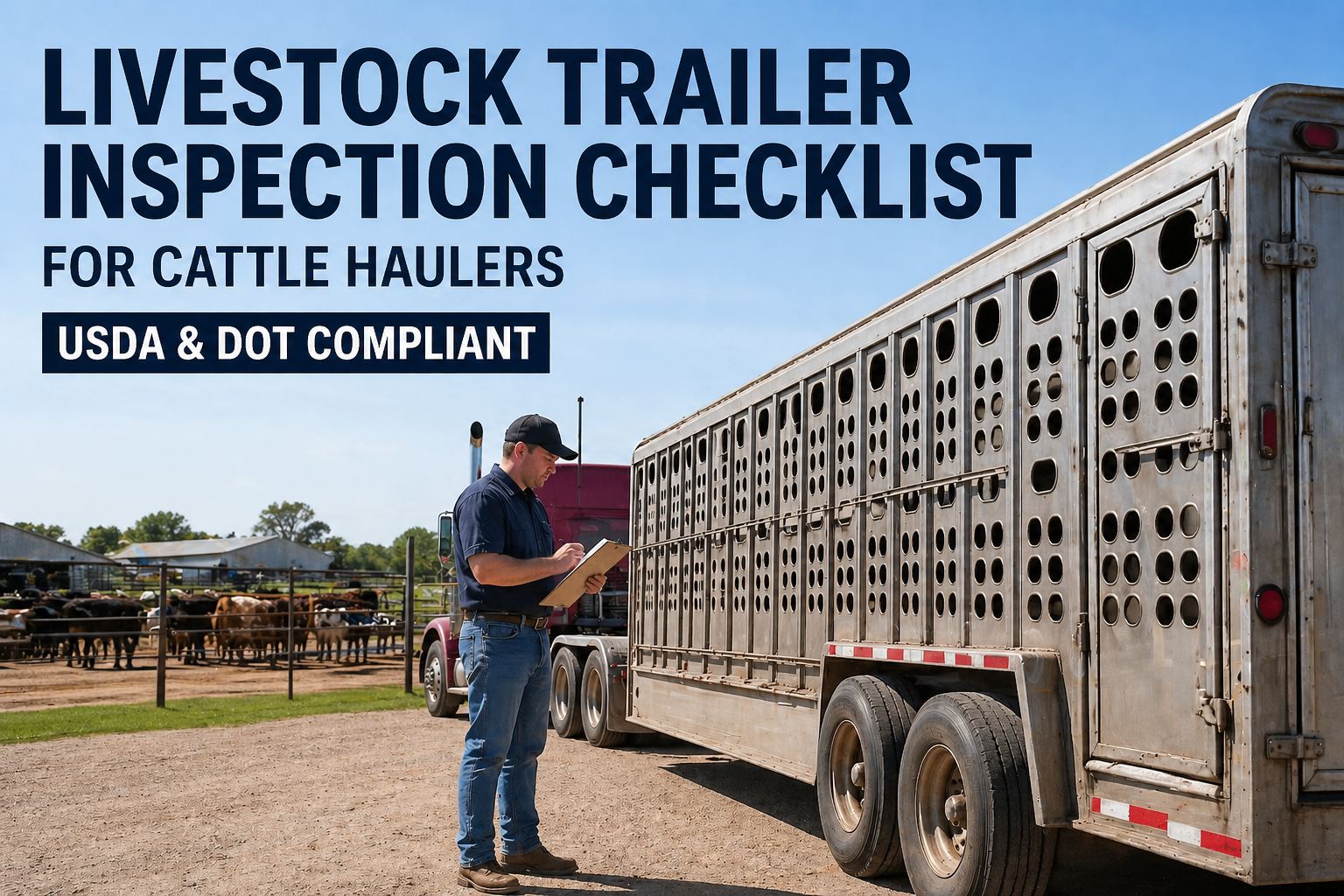
A livestock trailer is unlike any other piece of fleet equipment. The cargo is alive, it shifts under braking, it kicks, it stresses, and federal animal welfare law treats it as something more than freight. The USDA Transport Guidelines mandate 12-15 sq ft of floor space per animal, 20% spacing between animals, and proper ventilation; violations carry penalties up to $2,500 per infraction under federal animal welfare regulations. Any livestock trailer over 10,000 lb GVWR also falls under FMCSA 49 CFR Part 390 — driver logs, annual inspections, daily DVIR, the full DOT regulatory load. The 40-point inspection on this page covers every component a hauler must verify before loading cattle, hogs, sheep, or goats: floor integrity (the single most-used and most-abused part), dividers, ramps, ventilation, lights, brakes, tires, and the livestock-specific hazard checks that USDA, BQA, and the Colorado Livestock Association reference in their best-practice guidelines. Pure pre-trip discipline, organized into 8 stations, with clickable checkboxes for every item printable, audit-defensible, and aligned with both DOT inspection criteria and animal welfare obligations.
40 Points. 8 Stations. Animal Welfare and DOT Compliance Combined.
From floor integrity to divider locks, ventilation to ramp angle — this is the pre-trip checklist used by cattle haulers, livestock auctions, and dairy transport operations to keep animals safe and DOT-ready.
Why Livestock Trailer Inspections Matter More Than Most
Livestock haulers carry liability across two regulatory frameworks at once. DOT cares about CSA scores, Vehicle Maintenance violations, and safety. USDA and state animal welfare programs care about overcrowding, ventilation, ramp angle, and floor integrity. A failed inspection on either side is expensive — and the animals being hauled don't get a do-over.
The Complete 40-Point Livestock Trailer Pre-Trip Checklist
Work through the stations in order. Tap each checkbox as you verify the item. Any defect flagged in a CRITICAL section means the trailer stays at the yard until repaired and re-inspected — animal safety is non-negotiable.
The Next 3 Stations Are Where Animal Welfare Becomes Cargo Safety
Floor, dividers, ventilation, ramp — every defect found here is a potential animal injury. Fleet Rabbit digitizes the inspection that matters most for cattle haulers.
All 40 boxes checked, all defects flagged, every work order open or closed — the driver signs off, dispatch approves, and the load is defensibly documented. See How Digital Livestock Inspections Block Dispatch on Critical Flags →
The 5 Most Costly Livestock Trailer Failures — and How This Checklist Catches Them
Every point on this list traces back to a specific failure mode that has put livestock haulers off the road, off the haul, or in front of a USDA inspector. Here are the five that show up most often — and the exact checklist points that prevent each one.
Rotted wood or corroded aluminum gives way under cattle weight; animal injury or fatality, full load disruption, immediate USDA citation. Caught by points 23, 25.
Unlocked or broken divider swings under braking; animals crushed against trailer wall. USDA data: locked dividers cut crush injuries by 22%. Caught by points 28, 30.
Compartments loaded above 12-15 ft² per head; injury rate spikes 60%; federal animal welfare penalty up to $2,500 per infraction. Caught by point 33.
Blocked slats or stuck roof vents in summer heat; animal mortality possible on long hauls. Temperature-controlled trailers reduce heat stress 40% per Iowa State 2024. Caught by points 34, 35.
Broken hinge, missing non-slip surface, or excessive angle causes animal to fall during loading; injury, refusal-to-load, schedule disruption. Caught by points 36, 37.
Fleet Rabbit's Digital Inspection Platform — Built for Livestock Haulers
Every line above every floor check, every divider lock, every vent — digitizes cleanly into Fleet Rabbit's mobile-first inspection app. Built for cattle haulers operating in remote areas, dawn loadings at sale barns, and DOT scale houses on the way to the slaughter plant.
All 40 points configured out-of-the-box. Floor, dividers, ramps, ventilation, USDA-aligned welfare items — every livestock-specific item already scoped with reg references built in.
Flagged floor rot? Broken divider latch? Mandatory photo before submission. GPS + timestamp locked. Defensible evidence for USDA reviews, insurance disputes, and DOT audits.
Sale barns, ranches, and remote loading docks lose signal. The app completes inspections fully offline and syncs when LTE returns — no data loss, no re-entry.
Any point in Stations 6, 7, or 8 marked defective? Dispatch blocks the trailer from leaving the yard until the work order closes. No driver override, no "we'll fix it after."
Flagged defect instantly generates a prioritized work order in the shop queue. Critical = immediate, standard = end-of-shift. Floor and divider issues escalate automatically.
90 days of logged inspections available as a PDF export — formatted for both DOT/FMCSA and USDA animal welfare review. One workflow, two regulatory frameworks satisfied.
Switch from paper to digital and a 15-trailer livestock fleet typically saves 12+ hours per week in administrative time while catching 30% more defects before they become breakdowns or welfare violations. Book a Demo to See the Livestock Template Live →
Frequently Asked Questions
A trained driver completes the full sequence in approximately 12 minutes following the station order above. First-time inspectors may take 20-25 minutes; efficiency builds quickly with daily repetition. The animal-welfare stations (06-08) take the longest because they are the most consequential — and the most likely to catch a problem before loading.
Yes. All 40 points align with FMCSA 49 CFR Part 390 inspection requirements (for livestock trailers over 10,000 lb GVWR) and USDA Transport Guidelines on animal welfare. Digital execution via Fleet Rabbit satisfies the eDVIR final rule effective March 23, 2026, and produces dual-format exports for both regulatory frameworks. See DOT + USDA Ready Digital DVIR for Livestock →
A regular DVIR covers DOT-mandated mechanical items (brakes, lights, tires, frame). A livestock trailer DVIR adds animal-welfare items: floor integrity, divider locks, ventilation, ramp condition, and biosecurity wash-down. Both are required when hauling livestock — the welfare items aren't optional under USDA regulations even when the DOT framework doesn't explicitly mandate them.
USDA Transport Guidelines mandate 12-15 sq ft per cattle animal, with at least 20% spacing between animals. Industry audits show this rule is violated in roughly 1 of every 3 hauls. Overcrowding increases injury rates by ~60% and exposes haulers to penalties up to $2,500 per infraction under federal animal welfare regulations.
Floor surface and underside inspection every pre-trip — it's point 23 on this list. Wood floors are particularly susceptible to moisture rot and should be lifted (mats removed) for full underside inspection at minimum monthly, with annual structural inspection by a qualified mechanic. The floor carries 100% of animal weight; failure is catastrophic for both the animal and the audit trail.
Yes. The 40-point framework is the baseline; Fleet Rabbit lets you add species-specific items (cattle vs hogs vs sheep vs goats), trailer-specific items (gooseneck vs bumper-pull vs double-deck), and route-specific items (interstate vs short-haul). Every checklist is editable by fleet role. Request a Custom Livestock Template Demo →
Every Animal. Every Floor Board. Every Divider. Documented.
Turn a 40-point paper checklist into a mobile-first, photo-verified, GPS-locked inspection workflow that keeps every livestock trailer in your fleet compliant with both DOT and USDA. Used by cattle haulers, dairy fleets, and livestock auction operations across the US to cut pre-trip errors by 80% and audit prep from days to minutes.