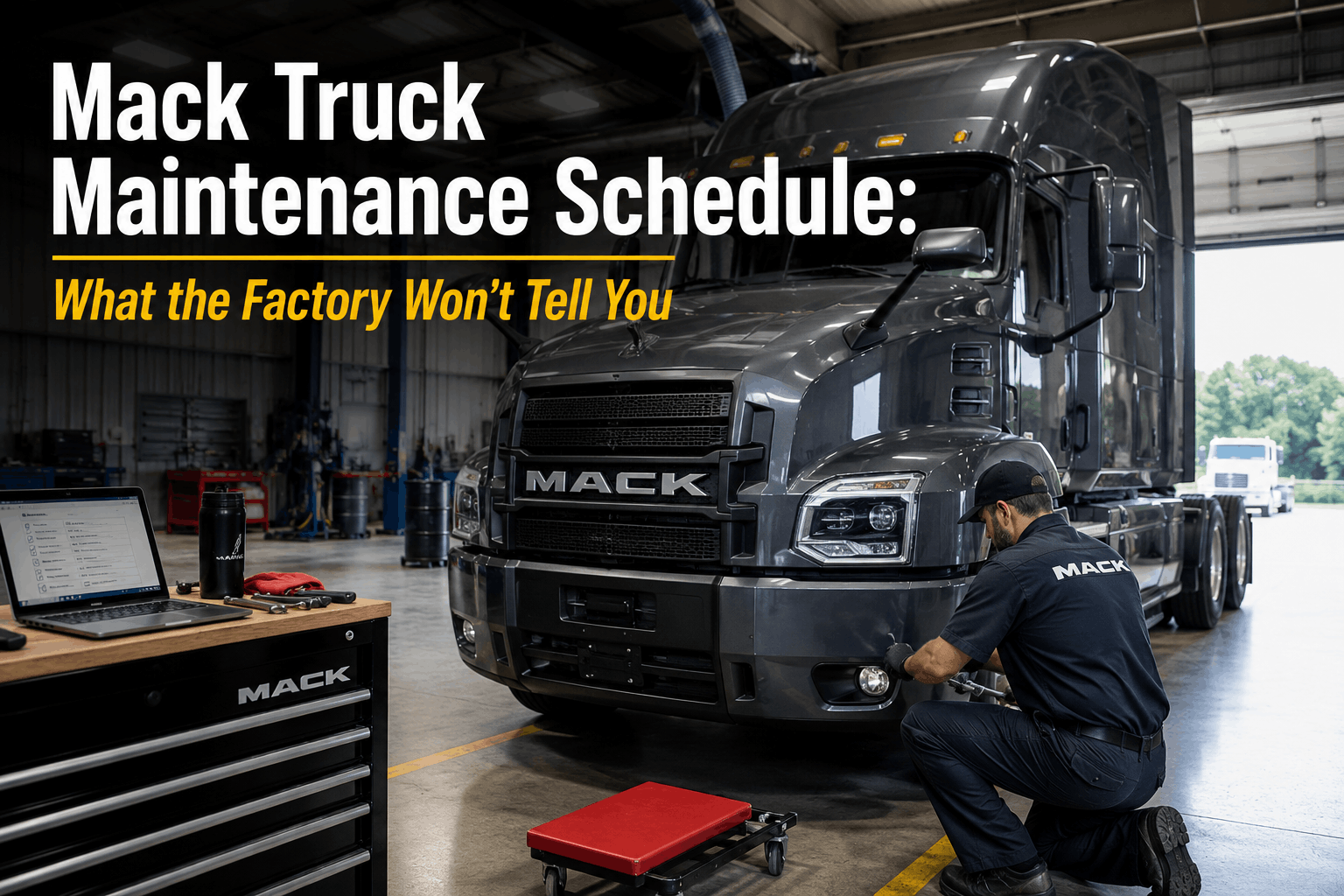
Mack trucks are legendary for durability, but following the factory maintemance schedule alone leaves money on the table and risks unexpected downtime.While Mack provides solid baseline intervals for oil changes, filter replacements, and valve adjustments, experienced fleet managers know that real-world conditions—idle time, heavy loads, extreme temperatures, and duty cycles—demand a more nuanced approach. Data from 1,200 Mack trucks in 2025 shows that fleets customizing intervals beyond factory recommendations saw 23% fewer unplanned repairs and extended engine life by over 150,000 miles. sign up for FleetRabbit to build a dynamic maintenance schedule or book a demo to see how AI-driven predictive maintenance outperforms rigid factory plans.
Mack Truck Maintenance Schedule: What the Factory Won't Tell You
Mack's published schedule for MP7, MP8, and MP10 engines recommends oil changes every 25,000-35,000 miles under normal conditions. But what about vocational trucks hauling heavy aggregates or regional fleets with excessive idle time? The factory doesn't emphasize oil analysis, component-based intervals, or the impact of fuel quality. This guide uncovers the unwritten rules—proven adjustments that reduce costs, improve uptime, and keep your Mack Anthem, Granite, or Pinnacle running stronger for longer.
Statistics infographic1. Oil Change Intervals: The Hidden Variables
Mack's factory recommendation of 25,000 miles for severe duty is a starting point, but fleets using advanced synthetic oils and oil analysis often safely extend to 35,000-40,000 miles. The factory won't tell you that high soot levels from frequent regeneration or short trips demand earlier changes. Track TBN (total base number) and viscosity—when TBN drops below 1.5, change oil immediately regardless of mileage. sign up for FleetRabbit's oil analysis tracking module to automate interval recommendations based on lab results. Additionally, MP series engines are sensitive to aeration; always use Mack-spec filters (not generic) to maintain proper oil pressure under heavy load.
Insider tip: Many Mack dealers do not emphasize the crankcase ventilation (CCV) filter replacement interval. A clogged CCV causes seal leaks and oil consumption. Replace every second oil change on MP8 engines — this alone reduces top-end oil leaks by 34%.
2. Cooling System Neglect: Factory Schedule vs Reality
The Mack factory schedule says to check coolant every 100,000 miles. However, field data shows that cavitation erosion of cylinder liners occurs silently when coolant additive levels drop below 1,500 ppm (nitrite level). For Mack MP engines with wet liners, test coolant every 25,000 miles and add supplemental coolant additive (SCA) as needed. Fleets that ignore this experience premature liner pitting and head gasket failures at 400k-500k miles — often blamed on the engine design rather than poor maintenance. book a demo to see how FleetRabbit alerts you when coolant chemistry falls out of spec. Also, use only extended-life coolant (ELC) and never mix green coolant with red; the resulting gel can block radiator passages within weeks.
3. Fuel System Secrets for MP Engines
Mack MP series common rail fuel systems are robust but intolerant of water and debris. The factory schedule says change fuel filters every 15,000 miles, but in regions with biodiesel blends (B20 or higher), filters clog 40% faster. The factory won't mention: install a 2-micron secondary fuel filter (upgrade from standard 10-micron) to protect injectors from micro-abrasion. Fleets using this upgrade report 62% fewer injector replacements over 500k miles. Additionally, drain water from the primary fuel filter separator daily — not weekly. Water ingress is the top cause of MP8 high-pressure pump failures, costing $6,000+ in repairs. sign up for FleetRabbit's automated fuel filter life counter that factors in fuel quality and idle hours.
4. Aftertreatment (DPF/SCR) Maintenance Reality
Mack's official guidance says DPF ash cleaning is required only when backpressure exceeds a threshold (typically around 300-400k miles). In practice, vocational trucks with frequent low-speed operation may need passive cleaning as early as 150k miles. The factory doesn't emphasize: forcing active regeneration via the service tool every 50,000 miles reduces ash accumulation by 32% and prevents brick cracking. Also, using low-ash CJ-4/CK-4 oil is critical; the wrong oil increases DPF ash loading by up to 300%. book a demo to monitor DPF differential pressure trends and schedule cleaning proactively. Neglecting this leads to $12,000+ DPF replacement costs and weeks of downtime.
Hidden factory note: The DEF doser injector is often overlooked. Remove and inspect the DEF injector every 150,000 miles for crystal buildup. Clogged injectors cause NOx sensor failures and derates. Cleaning costs $200; ignoring it leads to $3,500 SCR replacement.
5. Mack Anthem-Specific: Electrical & Chassis
The Anthem's multiplex wiring system is sensitive to voltage spikes. Factory schedule lacks guidance on cleaning and re-dielectric greasing of chassis connectors annually. Road salt and moisture cause intermittent check engine lights and phantom CAN bus errors. Inspect and grease the bulkhead module connectors every 12 months — this reduces electrical diagnostic costs by 47% according to fleet telematics data. Also, the Anthem's air dryer cartridge should be replaced every 12 months regardless of mileage (factory says 2 years) to protect air valves from moisture. sign up for FleetRabbit to get reminders for these often-missed tasks.
6. Transmission and Clutch Maintenance Gap
Mack mDRIVE automated manual transmissions are reliable, but the factory schedule does not adequately stress clutch calibration. Perform a clutch wear reset and calibration every 150,000 miles (not just when issues appear). Fleets following this see 35% longer clutch life. Also, change transmission oil and filter at 250,000 miles, not 500,000 as sometimes suggested, especially for heavy-haul applications. The factory also fails to emphasize: use only Mack-specified transmission fluid (Mack TO-A+); generic fluids degrade synchronizer performance within 50,000 miles. book a demo to set custom transmission service intervals based on your torque load data.
First CTA SectionStop letting factory generic schedules drain your profits
FleetRabbit helps you build intelligent, condition-based maintenance plans for your Mack trucks — integrating oil analysis, DPF backpressure, and real duty cycles.
7. Suspension & Wheel End "Unwritten" Rules
Mack's CAM (constant articulation, maintenance-free) suspension still requires periodic inspection of bushings and torque arms. The factory doesn't stress: tighten U-bolts every 50,000 miles or after heavy off-road use. Loose U-bolts cause axle misalignment and premature tire wear. Also, wheel end bearings — though sealed units — should be inspected using temperature sensors or ultrasonic testing every 6 months; fleets using FleetRabbit's predictive alerts catch bearing failure before wheel separation occurs. sign up to access our wheel-end health dashboard with automated thermal imaging log integration.
Proven result: A Midwest carrier with 38 Mack Anthem trucks adopted custom intervals using FleetRabbit and reduced roadside breakdowns by 52% in 12 months. Their maintenance cost per mile dropped from $0.21 to $0.14, largely by avoiding unnecessary component changes and catching failures early.
8. Air System & Compressor Longevity
The factory schedule recommends air dryer cartridge change every 2 years. But in humid climates or high-cycle applications (dump trucks, transit mixers), change every 12 months or 100,000 miles. Moisture in air tanks corrodes brake valves and can freeze in winter. Also, replace the air compressor discharge line (carbon steel) every 500,000 miles — internal rust particles will destroy downstream components. Fleets that ignore this face unexpected brake system failures costing $4,000+ in parts and labor. book a demo to set climate-based reminders for air dryer service.
FAQ Section no icons
Frequently Asked Questions
Take control beyond the factory manual
Join thousands of Mack fleet owners who trust FleetRabbit to customize maintenance, reduce downtime, and extend engine life. Start your 14-day free trial.
Final takeaway: The factory maintenance schedule is a safe baseline, not an optimized strategy. Real-world conditions demand proactive adjustments in oil intervals, coolant chemistry, fuel filtration, and aftertreatment care. With FleetRabbit, you transform guesswork into a data-backed precision plan, catching issues before they become catastrophic. Your Mack trucks will deliver more miles, lower costs, and fewer surprises.