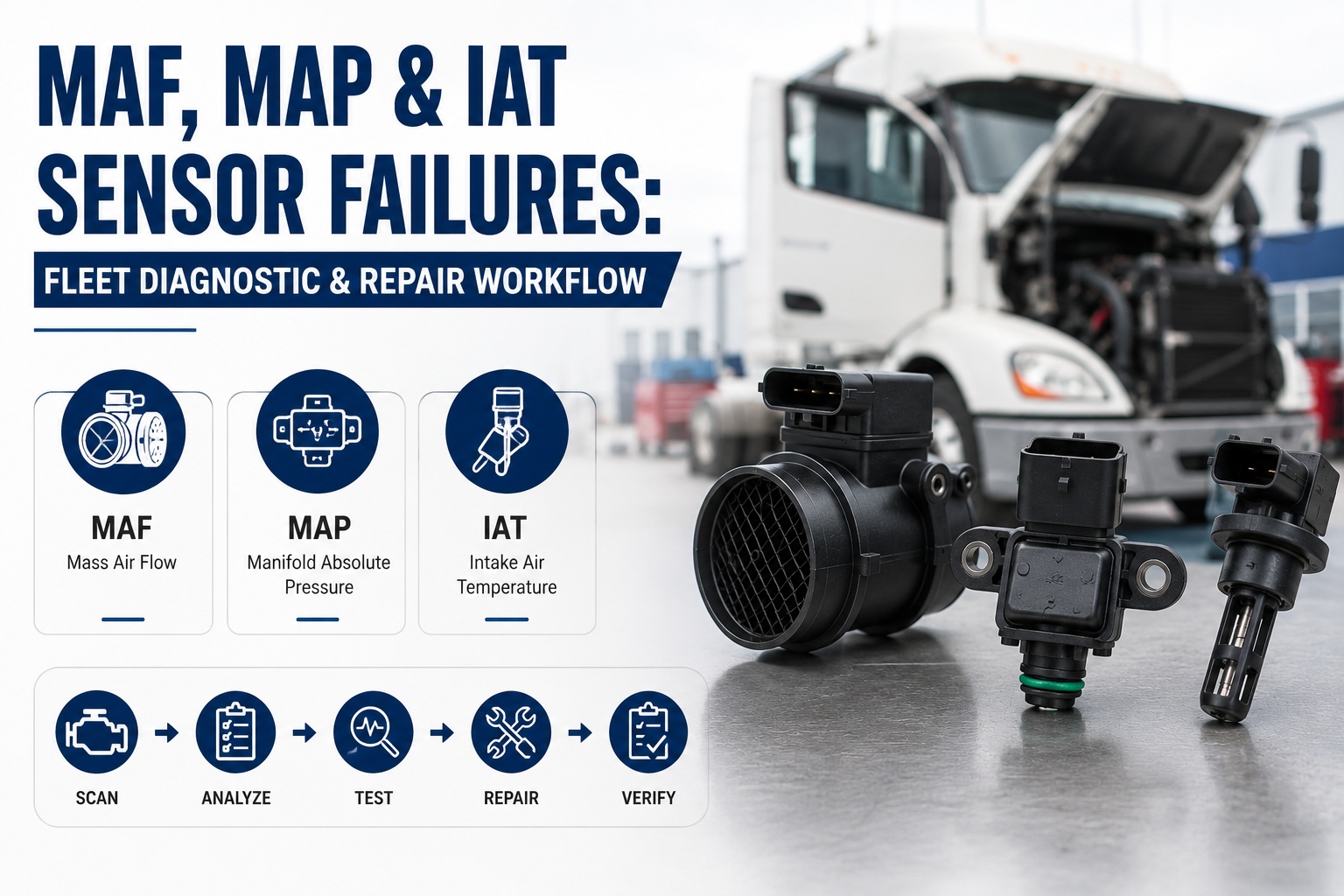
The three sensors watching your intake air — mass airflow, manifold absolute pressure, and intake air temperature — fail more often than almost anything else on a fleet truck, and they generate more unnecessary parts replacement than any other group. The reason is simple: they sit directly in the path of dirty, oily, dusty air, and when one throws a code the temptation is to swap it. But a sensor code does not always mean the sensor is bad. A clogged air filter sets a MAF code. A boost leak sets a MAP code. A corroded connector sets an IAT code. Replace the sensor in any of those cases and the code comes right back, minus the cost of the part. This guide gives fleet maintenance teams an ordered diagnostic workflow for MAF, MAP, and IAT faults — what each sensor does, the codes it throws, the checks to run in sequence before condemning anything, and how to capture the results in maintenance software so a repeat failure tells you where the real fault lives. Start free trial or book a demo to stop paying twice for the same intake fault.
DIAGNOSTICS & REPAIR · INTAKE AIR SENSORS
A Sensor Code Doesn't Mean the Sensor Is Bad
MAF, MAP, and IAT codes overlap constantly — a clogged filter, a boost leak, or a corroded connector all set sensor faults. Which is why the diagnostic order matters more than the code itself, and why swapping the part first is the most expensive habit in the shop.
THE RULE
Do not replace the MAF, MAP, throttle body, or intake manifold just because one code appears
↓
Work the order first
MAF
Mass Air Flow
Measures the actual mass of air entering the engine so the ECM can match fueling and EGR flow to real airflow. Sits just after the air filter box.
P0100P0101P0102P0103
MAP
Manifold Absolute Pressure
Measures pressure inside the intake manifold so the ECM can calculate air density and control boost. On a turbo diesel this is the boost-monitoring sensor.
P0106P0107P0108
IAT
Intake Air Temperature
Reports the temperature of incoming air so the ECM can correct fueling for air density. Often lives inside the MAF housing rather than as a separate unit.
P0112P0113P0114P0118
16 sec
Out-of-range airflow before the ECM sets P0101
Type A
P0101 severity — the ECM commands reduced engine power
4.91 V
IAT circuit voltage above this for half a second sets P0113
–40°F
What the PCM thinks intake temp is when the IAT circuit opens
Why These Three Fail So Often in Fleet Service
Intake sensors live in the dirtiest part of the engine, and fleet duty cycles make it worse. Understanding the failure environment tells you what to look for before you look at the sensor itself.
Contamination on the Sensing Element
Oil vapor, dust, and debris coat the MAF's sensing element and the probe. This is the single most common failure mode — and often the sensor recovers with a proper cleaning rather than replacement.
Clogged or Neglected Air Filter
A restricted filter obstructs airflow to the MAF and makes the intake work harder, raising air temperature. It's a leading cause of both P0101 and P0113 — and it's a maintenance item, not a sensor fault.
Boost and Charge-Pipe Leaks
On turbo diesels, pressure escaping under load causes low boost, smoke, high EGT, and poor response — and sets MAP codes. Oily intercooler boots and cracked charge pipes are the usual culprits.
Carbon & EGR Soot Buildup
Intake carbon restriction and EGR soot accumulation change actual airflow and manifold pressure, so the sensors report values the ECM reads as faults. Common on high-idle and heavy CCV-restriction trucks.
Wiring, Connectors & Corrosion
Corroded terminals, broken wires, and shorts produce codes identical to a dead sensor. Connectors often fail before the component does, and this is the cheapest check available.
Water, Snow & Ice Intrusion
Water in the induction system, or snow and ice building up at the air cleaner or sensor probe, blocks the inlet and sets airflow codes — a seasonal fleet problem that mimics sensor failure exactly.
Half these causes are maintenance items, not sensor faults.
Fleet Rabbit ties air filter intervals, intake service history, and every fault code to the truck — so when a MAF code appears, you can see instantly whether the filter is overdue before anyone orders a sensor.
The Diagnostic Workflow — In Order
Intake fault codes overlap, so the sequence matters. Work these steps in order and you'll resolve most MAF, MAP, and IAT faults without replacing a single sensor — and when you do replace one, you'll know it was actually bad.
1
Pull All Codes, Not Just the First One
Intake codes travel in groups. A P0101 alongside P0113 tells a different story than P0101 alone. Note every stored code before touching anything — the combination often identifies the real fault.
Takes: minutes
2
Inspect Wiring, Connectors & Seals
Check the harness connectors at each sensor for corrosion, damage, and loose pins. Look for a missing or damaged MAP sensor seal and a cracked or broken sensor housing. Connectors fail before components do.
Cheapest possible fix
3
Check the Air Filter and Inlet Path
Inspect for a clogged filter, objects blocking the sensor's air inlet probe, contamination or debris on the sensing element, water intrusion, and snow or ice buildup at the air cleaner. Any of these sets airflow codes on a healthy sensor.
Maintenance item, not a part
4
Run a Boost Leak Test
On turbo diesels this is the high-value check. Pressure escaping under load causes low boost, smoke, high EGT, and sluggish response — and sets MAP faults. Inspect charge pipes, intercooler boots, and clamps.
Diesel-specific priority
5
Compare Live MAP and MAF Data
With the scan tool running, readings should change smoothly and sensibly with engine load and throttle input. A value that's frozen, pegged, or moving in a way that contradicts the other sensors is the real evidence you need.
The decisive test
6
Inspect for Carbon and EGR Soot Buildup
Intake carbon restriction changes real airflow, especially on trucks with heavy CCV filter restriction or oil vapor contamination. Cleaning the intake resolves what looks like a chronic sensor problem.
Common on high-idle units
7
Clean the MAF Before Replacing It
Since contamination is the most common MAF failure mode, a careful cleaning with proper sensor cleaner often restores it. If the fault persists after cleaning, you've earned the replacement — and you know why.
Try before you buy
8
Replace — and Only Then
Replace the sensor when wiring is sound, the intake path is clear, there's no boost leak, and live data confirms the reading is irrational. Replace an intake manifold only after confirming mechanical failure such as cracks or warped sealing surfaces.
Last, not first
i
A useful field shortcut on diesels: unplugging the MAF sensor puts most diesel engines into a default fueling strategy that runs at roughly 90% performance — which is often better than running on erratic readings from a failing sensor. If the truck drives noticeably better unplugged, the MAF is lying. Note that this does not apply to MAP and IAT: unplugging those drops the engine into a low-power default just to keep it moving, so the test tells you much less. Log the result either way — that observation is diagnostic evidence worth keeping with the truck's record.
See how test results stay attached to the truck.
Code Index: What Each Fault Actually Means
Use this as the shop's quick reference. Note how many of these codes point at something other than the sensor named in the description. Swipe the table horizontally on mobile.
← Swipe to see all columns →
Watch for the "code but the truck runs fine" trap. P0113 in particular often appears with no obvious drivability complaint, because the PCM has switched to a failsafe default that masks the problem. Drivers won't report it, so it sits until it compounds — and meanwhile the engine is fueling on a substituted air-temperature value instead of a real one. On turbo diesels, intake faults should always be checked against platform-specific weak points rather than treated as generic sensor problems, because the same code means different things on different engines.
Book a demo to catch silent codes before they compound.
Capture the Diagnostic Work, Not Just the Part Number
Fleet Rabbit records every code, every check performed, and every part replaced against the specific truck — so when the same intake fault returns, the next technician sees the filter was already changed, the boost test already passed, and the sensor was already swapped. That's how a repeat code becomes a root cause instead of another parts order. Deploy at $5/vehicle/month, no hardware, live within 72 hours.
Code-to-repair pairing
Air filter interval tracking
Repeat-failure flags
Diagnostic step logging
What to Capture in Maintenance Software
The value of a diagnostic workflow multiplies when the results are recorded. These are the specific data points that make the next repair on the same truck faster and cheaper. Swipe the table horizontally on mobile.
← Swipe to see all columns →
How Fleet Software Supports the Workflow
A workflow only pays off if it's followed consistently and recorded. Here's how Fleet Rabbit makes that automatic rather than dependent on which technician happens to pick up the job.
01
Diagnostic Step Checklists
Attach the intake-fault workflow to the work order so every technician runs the same ordered checks and records the result of each one — no steps skipped, no findings lost.
02
Code-to-Repair Pairing
Each fault code is stored against the VIN alongside the repair that followed, so the history answers the crucial question: did the last fix actually work, or did it just clear the code?
03
Air Filter Interval Tracking
Filter service is tracked by mileage and hours, so when a MAF or IAT code appears the first question — is the filter overdue? — is answered before anyone opens a parts catalog.
04
Repeat-Failure Flags
When the same intake code returns after a sensor was already replaced, the system flags it — the clearest evidence that the sensor was never the problem and the search should move upstream.
05
Fleet-Wide Pattern Detection
The same intake code across several trucks points to a shared cause — a dusty route, a seasonal ice problem, or a filter supplier issue — rather than a run of coincidental sensor failures.
06
Parts Spend Visibility
See how much the fleet spends on intake sensors and which trucks consume a disproportionate share — the numbers that prove a disciplined workflow pays for itself.
Frequently Asked Questions
Should I clean or replace a MAF sensor?
Clean first. Contamination from oil and dirt on the sensing element is the most common MAF failure mode, and a careful cleaning with proper sensor cleaner often restores normal operation at a fraction of replacement cost. Verify the wiring and check for a clogged air filter or intake leaks at the same time. If the fault persists after cleaning and the rest of the intake path is sound, then the replacement is justified — and you'll know it was actually the sensor.
Book a demo.
What causes a P0101 code besides a bad MAF sensor?
Quite a lot. A clogged air filter obstructing airflow, objects blocking the sensor's inlet probe, contamination or debris on the sensing element, a cracked sensor housing, water intrusion in the induction system, snow or ice buildup at the air cleaner, an intake manifold leak, a missing or damaged MAP sensor seal, and a leaking or cracked intake resonator can all set P0101. The ECM sets it when the measured airflow ratio stays outside the calculated range for more than 16 seconds — and it's a Type A code, so the ECM commands reduced engine power.
Book a demo.
Why does my truck throw a P0113 but run fine?
Because the PCM has switched to a failsafe default. P0113 means the IAT circuit voltage went too high — typically above 4.91 volts for more than half a second — indicating an open or high-resistance circuit. The computer interprets that as an absurdly cold intake temperature, around minus 40 degrees, and rather than fuel on that value it substitutes a default. The engine runs acceptably, so nobody reports it, but you're fueling on a guess instead of a measurement. Common causes are a failed IAT element, a dirty air filter, a faulty MAF, or wiring problems.
Book a demo.
Where is the IAT sensor on most diesel engines?
On many modern engines the IAT sensor lives inside the MAF sensor housing rather than as a standalone unit, though it can also be a separate sensor in the air intake tube. That shared packaging is why MAF and IAT codes so often appear together, and why a single component replacement sometimes resolves both. It also means cleaning can rescue the MAF side while the IAT element may still require replacement — worth knowing before you order parts.
Book a demo.
Why is a boost leak test so important on diesel intake codes?
Because on turbocharged diesels a boost leak is the failure mode that matters most. Pressure escaping under load causes low boost, smoke, high EGT, and poor throttle response — and it sets MAP codes that look exactly like a failed sensor. Where a gas engine's intake trouble usually traces to a vacuum leak affecting fuel trims, a diesel's traces to boost escaping. Charge-pipe cracks, oily intercooler boots, and loose clamps are the usual sources, and none of them are fixed by a new sensor.
Book a demo.
How does recording the diagnostic steps save money?
Because the second visit is where fleets lose money. If a truck comes back with the same intake code and the record shows the filter was changed, the boost test passed, and the MAF was already replaced, the technician immediately knows to look at wiring, carbon buildup, or a manifold issue instead of repeating the same parts swap. Without that record, every visit restarts from zero. Recording live-data observations — "reading frozen at idle" — turns a purchase history into an actual diagnostic trail.
Book a demo.
Run the Workflow. Record the Findings. Stop Buying the Same Sensor Twice.
Fleet Rabbit attaches the diagnostic workflow to the work order, records every code and check against the truck, tracks air filter intervals, and flags repeat failures — so intake faults get solved at the root instead of restarting from zero on every visit. Integrated with your existing systems in 5–7 working days, at $5/vehicle/month, with no new hardware required.
Free tier for up to 3 vehicles · No credit card required · No hardware installation
July 22, 2026By Emily Davis
All Blogs