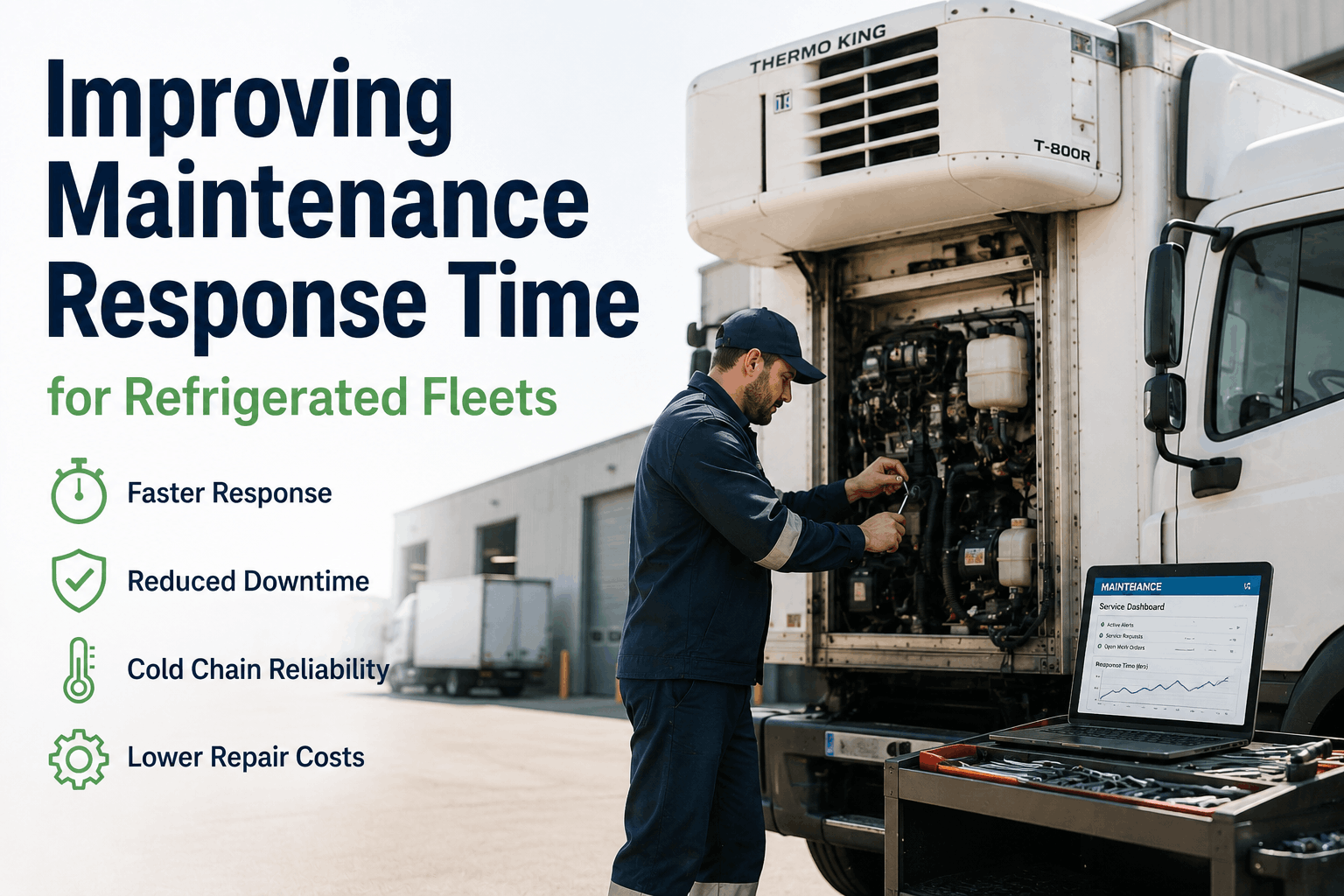
In refrigerated logistics, maintenance response time is not just a metric — it is a lifeline. Every minute a reefer trailer is offline represents potential product loss, customer dissatisfaction, and regulatory exposure. A refrigeration unit failure can render an entire shipment worthless within hours, particularly for sensitive products like pharmaceuticals, fresh produce, or dairy. Improving maintenance response time requires a combination of real-time diagnostics, predictive analytics, integrated work order management, and a skilled technician network. This guide explores the strategies and technologies that enable refrigerated fleets to minimize downtime and protect cargo integrity through faster, more effective maintenance responses.
The Cost of Slow Maintenance Response
When a refrigeration unit fails, the clock starts ticking. The cost of a slow response extends beyond the immediate repair expense to include spoiled cargo, missed delivery windows, customer penalties, and potential regulatory fines. For temperature-sensitive shipments, even a few hours of downtime can result in total loss. The average cost of a refrigeration unit breakdown can range from $2,000 to $10,000 per incident, depending on the cargo value and the duration of the outage. For fleets with multiple assets, the cumulative impact of slow maintenance response can be devastating to profitability and reputation.
Beyond the direct financial impact, slow response times erode customer trust. Food and pharmaceutical distributors rely on their carriers to maintain cold chain integrity. Repeated failures or delayed responses can lead to lost contracts and damaged relationships. Sign up to learn how FleetRabbit helps refrigerated fleets improve maintenance response times and protect customer relationships.
Real-Time Diagnostics and Remote Monitoring
Real-time diagnostics are the foundation of rapid maintenance response. Modern refrigerated fleets are equipped with telematics systems that continuously monitor refrigeration unit performance, including temperature, pressure, fuel levels, and fault codes. When a unit begins to deviate from normal operating parameters, the system triggers an alert that can be sent to maintenance teams, dispatchers, and fleet managers instantly. This early warning enables proactive intervention before a complete failure occurs.
Remote monitoring takes this capability a step further by allowing technicians to access unit data from anywhere. When a fault code is detected, the technician can review the diagnostic data remotely, identify the likely cause, and arrive at the vehicle with the correct tools and parts. This reduces the time spent on diagnosis and eliminates multiple trips to the vehicle. Remote diagnostics can reduce response time by up to 60%, significantly improving the chances of saving the cargo. Book a demo to see how FleetRabbit's real-time diagnostics can improve your maintenance response.
Maintenance Response Workflow for Refrigerated Fleets
Predictive Maintenance and Fault Prediction
While real-time diagnostics help respond to issues as they arise, predictive maintenance prevents issues from occurring in the first place. By analyzing historical data from refrigeration units — including temperature patterns, compressor cycles, pressure readings, and fault code histories — machine learning models can predict when a component is likely to fail. This enables maintenance to be scheduled during planned downtime, before the failure occurs on the road.
Predictive maintenance is particularly valuable for refrigerated fleets because many failures follow predictable patterns. For example, compressor failures often occur after a specific number of operating hours or after repeated pressure fluctuations. By identifying these patterns, fleets can replace components proactively, avoiding breakdowns that would result in cargo loss. Predictive maintenance typically reduces unplanned downtime by 30-50%, making it one of the most effective strategies for improving maintenance response time. Sign up to discover how FleetRabbit's predictive analytics can help you prevent reefer failures.
Integrated Work Order and Parts Management
Once an alert is triggered, the speed of response depends largely on how quickly the repair can be organized. Integrated work order and parts management systems eliminate the administrative delays that often slow down maintenance response. When a fault is detected, the system automatically generates a work order, assigns it to the appropriate technician based on location and expertise, and checks parts availability. If parts are not in stock, the system can automatically reorder them or identify the nearest supplier.
This integration reduces the time between fault detection and repair significantly. Manual processes that might take hours can be reduced to minutes, enabling technicians to reach the vehicle faster and complete the repair more efficiently. For refrigerated fleets, where every minute matters, this can be the difference between saving the cargo and writing it off. Book a demo to see how FleetRabbit's integrated work order and parts management can streamline your maintenance response.
Building a Network of Skilled Technicians
Even the best technology is only as effective as the technicians who use it. Building a network of skilled, well-trained technicians is essential for rapid maintenance response in refrigerated fleets. This network should include both in-house maintenance teams and external service providers who can be called upon when needed. Technicians should be trained not only in refrigeration system repair but also in using diagnostic tools and interpreting fault code data.
Regular training and certification programs help ensure that technicians stay current with the latest technologies and repair techniques. For fleets that operate across multiple regions, establishing relationships with local service providers ensures that coverage is available wherever vehicles operate. Technology platforms like FleetRabbit can help manage this network by providing technician assignment, scheduling, and performance tracking. Sign up to learn how FleetRabbit helps you manage your maintenance network effectively.
Ready to Improve Your Reefer Maintenance Response?
Real-time diagnostics, predictive analytics, and integrated work order management — all in one platform to protect your cold chain.
Frequently Asked Questions
Real-time detection and remote diagnostics are the most critical factors. When a fault is detected immediately and technicians can diagnose the issue remotely, response time can be reduced by up to 60%, significantly improving the chances of saving the cargo.
Predictive maintenance prevents failures from occurring in the first place, eliminating the need for emergency response. When failures do occur, predictive systems provide earlier warning, giving more time to prepare and respond before cargo integrity is compromised.
Parts availability is often the bottleneck in maintenance response. Integrated parts management ensures that parts are available when needed, either through inventory or rapid reordering, so technicians can complete repairs without delays.
FleetRabbit integrates real-time diagnostics, predictive analytics, automated work order creation, and parts management into a single platform. This enables rapid detection, diagnosis, and dispatch, reducing overall response time and protecting cargo integrity.
ROI is realized through reduced cargo spoilage, lower repair costs, fewer customer penalties, and improved asset utilization. Many fleets see payback within 6-12 months through decreased claims and improved operational efficiency.
Join 2,500+ Fleets Using FleetRabbit
From real-time diagnostics to predictive maintenance and integrated work order management — FleetRabbit helps you protect your refrigerated cargo.