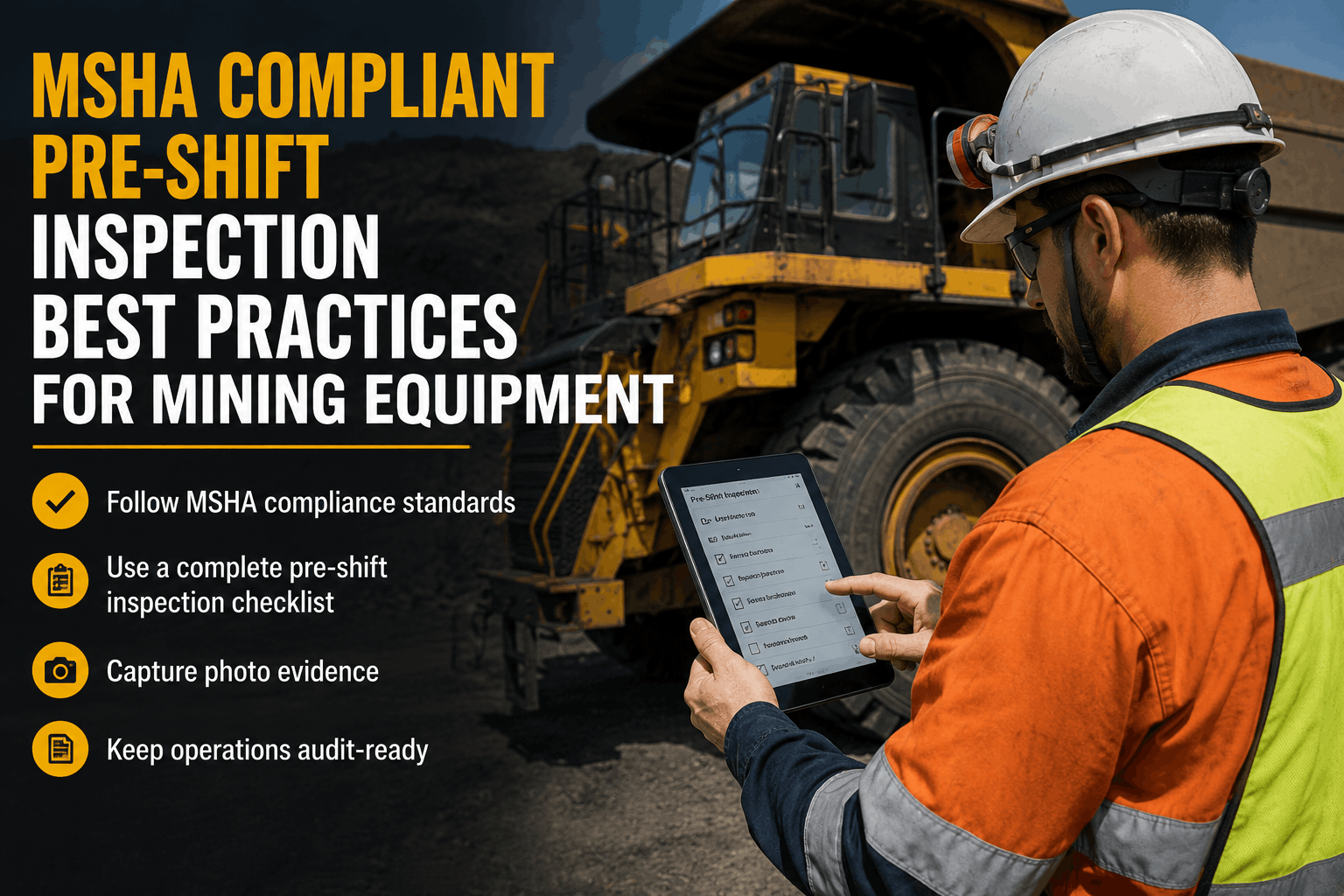
A missed defect in the pit doesn't just mean a breakdown—it means a stranded multi-million-dollar machine, a lost production shift, and potentially a citation from the Mine Safety and Health Administration (MSHA) that can run into thousands of dollars per violation. Under Title 30 CFR, every piece of equipment must be inspected before use, every shift, by the operator who will run it. This isn't a suggestion—it's a legal obligation. And in remote mining sites where paper forms get lost in the dust and a found defect can die on a clipboard before reaching a mechanic, executing a compliant inspection is a challenge. This guide breaks down the MSHA pre-shift inspection framework and shows you how to implement a digital workflow that ensures compliance, improves safety, and drives efficiency, even when you're offline in the pit.
MSHA Pre-Shift Inspections for Mining Equipment: A Digital-First Compliance Guide
The Legal Framework: What MSHA Requires
MSHA's pre-shift inspection requirements are found in 30 CFR Parts 56 and 57 for surface and underground metal/non-metal mines, and Parts 75 and 77 for coal operations. The key requirements are:
All machinery must be inspected before use, each shift, without exception. Multi-shift operations require multiple inspections per vehicle per day.
MSHA explicitly requires the equipment operator to perform the inspection—not a mechanic or supervisor. Delegating to maintenance staff does not satisfy the requirement.
Any safety or health defects identified must be reported immediately. Unsafe equipment must be tagged and removed from service until repaired.
All findings must be documented and retained. Incomplete or missing documentation is treated as non-compliance during inspections.
The 14-Section Pre-Shift Inspection Template
Every MSHA-compliant pre-shift inspection should cover these critical systems. While the depth varies by vehicle type, the categories remain consistent across haul trucks, dozers, excavators, and service vehicles.
Engine oil, coolant, hydraulic fluid, fuel, brake fluid — check levels and visible leaks.
Service brakes, parking brake holding, brake lights, and air system integrity.
Smooth function, no excessive play, power steering fluid, and visible leaks.
Air pressure, tread depth, sidewall condition, wheel lugs, and rim integrity.
Headlights, taillights, hazard flashers, turn signals, and mining strobe lights.
Mirrors clean and adjusted, windshield clear, wipers functional, and side windows operable.
Seat belt present and functional, latch mechanism, webbing integrity, and seat secure.
Audible alarm activates with reverse gear, volume meets MSHA distance standards.
Fire extinguisher pressure gauge, inspection tag, cylinder condition, and mounting.
First aid kit, emergency contact info, reflective triangles, and wheel chocks.
Horn loud and clearly audible, air horn function, engine warning alarms.
Rollover and falling object protective structures intact, mounting bolts tight, certification tags legible.
Radio functional, channels verified, battery adequate, mine-specific programming.
Water tanks, fuel pumps, lube systems, hoists, and cargo securement where applicable.
The Digital Advantage: From Paper to Predictive
Traditional paper-based inspections are fundamentally flawed for mining operations. Forms get lost, defects die on clipboards, and maintenance teams never see the findings until it's too late. The shift to digital inspection platforms delivers measurable improvements in compliance, safety, and maintenance efficiency.
Mobile apps work anywhere in the pit. Inspections sync automatically when connectivity returns.
Defect photos captured on the spot provide irrefutable documentation for MSHA audits.
Defects automatically create work orders routed to the right mechanic, ensuring repairs are completed.
AI-powered platforms predict equipment failures 2-4 weeks early with 85-90% accuracy, reducing maintenance costs by 36-42%.
Digital inspection platforms also integrate with CMMS systems, creating a seamless workflow from inspection to repair completion. This closed-loop process is exactly what MSHA investigators look for after an incident—evidence that defects are not just identified, but actually addressed. To see how this works in practice, book a demo with FleetRabbit and explore our mining inspection solutions.
Take Control of Your Mine Site Compliance
FleetRabbit's digital inspection platform works offline in the pit, captures photo evidence, and automatically routes defects to maintenance teams. Be audit-ready every day.
Common MSHA Citations and How to Avoid Them
Understanding what MSHA inspectors look for helps focus inspection discipline on the highest-risk items. These are the most frequently cited violations related to pre-shift inspections.
S&S indicates a "Significant and Substantial" finding under MSHA Section 104(d), carrying enhanced penalty exposure and contributing to Pattern of Violations (POV) screening. Operations with disciplined digital inspection workflows rarely face citations in these categories. To build a citation-proof inspection process, sign up with FleetRabbit and access our mining inspection templates.
The ROI of Digital Inspections in Mining
The economic case for digital inspection platforms is compelling. Large mining operations with digital integration levels of 70-80% report:
15-25% operational efficiency improvements, 40%+ safety incident reductions, 20-35% equipment downtime decreases, and 10-18% energy cost savings. Autonomous haul trucks with optimized routing deliver 25% efficiency increases and 12-15% fuel consumption reductions.
AI-driven predictive maintenance alone delivers significant ROI. Machine learning algorithms predict equipment failures 2-4 weeks early with 85-90% accuracy, reducing maintenance costs by 36-42% across major equipment categories. The investment case is strong—ROI typically materializes within 18-24 months for digital inspection and autonomous systems, with comprehensive safety cost reductions of 30-45% annually.
To calculate the ROI of digital inspections for your mining operation, book a demo with FleetRabbit and access our compliance ROI calculator.
Frequently Asked Questions
Be Audit-Ready Every Day. Start Your Free Trial.
FleetRabbit's mining inspection platform helps you capture defects in the pit, route them to maintenance, and build the MSHA compliance record you need. Sign up with FleetRabbit and get started today.