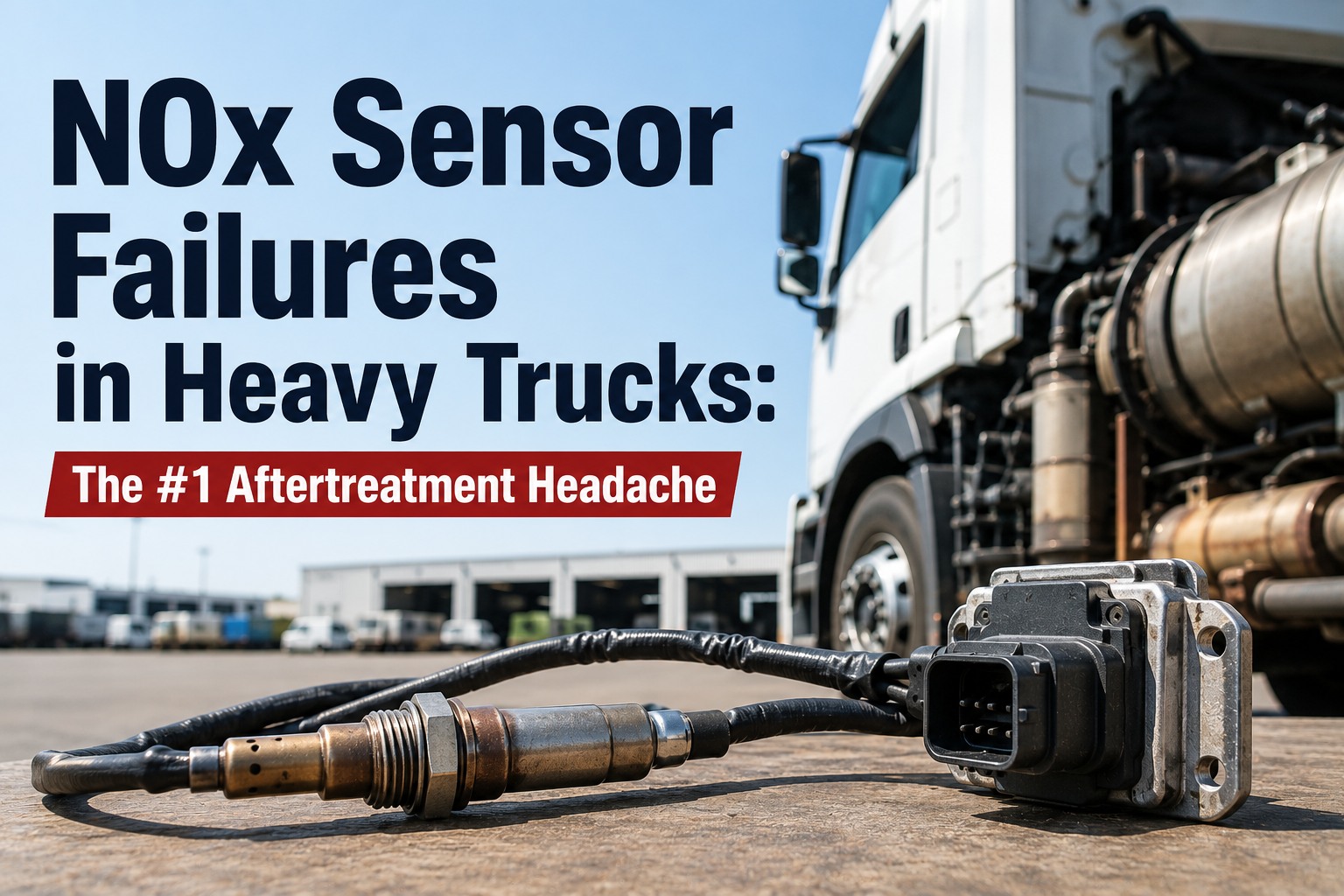
No component in a modern aftertreatment system generates more replaced parts, more repeat visits, and more wasted money than the NOx sensor. Part of that is legitimate — these sensors live in hot exhaust, get poisoned by contaminated DEF, and crack from thermal shock. But a large share of NOx sensor replacements are unnecessary. Aftertreatment suppliers report selling several thousand a year to fleets that swapped the sensor without finding the real fault, and the pattern is predictable: a code appears, the ECM starts a derate countdown, someone panics and orders a $700 part. The discipline that saves fleets money comes down to three things — knowing whether the fault is upstream or downstream, always fixing the upstream sensor first because it generates false downstream and catalyst codes, and verifying the sensor is actually lying before you buy anything. This guide covers upstream versus downstream diagnosis, the live-data test that gives a definitive verdict, repair costs, and how tracking NOx patterns across the fleet reveals whether you have a sensor problem or a DEF problem. Start free trial or book a demo to track aftertreatment faults across every truck you run.
DIAGNOSTICS & REPAIR · AFTERTREATMENT
Fix the Upstream Sensor First — It's Generating the Other Codes
A failing upstream NOx sensor feeds the ECM bad data, which then falsely flags the downstream sensor and calculates that the SCR catalyst is failing. Chase those codes and you'll replace a catalyst that was never bad. The upstream sensor is where the diagnosis starts, every time.
DERATE COUNTDOWN
100–200
miles from first persistent code
Then limp-home speed
Some platforms crawl as low as 5 mph
Engine Out
Exhaust leaves the engine carrying NOx
→
UPSTREAM
NOx Sensor 1
Measures NOx entering the system so the ECM can calculate exactly how much DEF to inject
→
SCR + DEF
DEF converts NOx into nitrogen and water
→
DOWNSTREAM
NOx Sensor 2
The report card — confirms the conversion actually worked, closing the loop
90%
NOx reduction the ECM expects between the two sensors
38%
Of upstream circuit faults trace to a dead heater element
~15%
Of these faults resolve with an ECM calibration update alone
$400–$1,100
Per OEM sensor, before labor
The Live-Data Test That Gives You a Verdict
This is the most reliable diagnostic available and it requires nothing but a scan tool and a warm engine. Bring the truck to operating temperature, display live NOx data, and watch both readings while working the throttle. The pattern tells you exactly where the fault is.
Upstream reads zero, sits pegged at maximum, or doesn't change with throttle
↓
The upstream sensor is bad
Downstream reads higher than upstream — physically impossible with a working SCR
↓
One or both sensors are bad
Both sensors read normally and respond to load, but SCR efficiency or DEF quality codes persist
↓
The catalyst is the issue, not the sensors
i
The rule that prevents the most expensive mistake: always diagnose and fix an upstream fault first. A faulty upstream sensor feeds the ECM incorrect data, which causes it to miscalculate the SCR catalyst's performance and wrongly flag it as failing — that's a P20EE, "SCR NOx Catalyst Efficiency Below Threshold," on a perfectly healthy catalyst. Because the system compares the two sensors against each other, an upstream failure can also make the ECM flag the downstream sensor. Resolve the upstream fault, clear the codes, and run a full drive cycle before you believe anything the downstream or catalyst codes are telling you.
See how code sequencing shows up in per-truck history.
Decoding the Code Family
NOx codes are unusually specific about what kind of failure occurred — electrical, plausibility, heater, or communication — and that distinction changes the repair entirely. Swipe the table horizontally on mobile.
← Swipe to see all columns →
Three trucks, same NOx code, same month. That's not three sensors.
Fleet Rabbit surfaces the same aftertreatment code appearing across multiple units — the pattern that points at contaminated DEF from a shared source rather than coincidental sensor failures.
Why These Sensors Actually Fail
When a NOx sensor genuinely fails, there's usually a reason — and most of those reasons are fleet-controllable. Attack these and sensor life extends across the whole fleet.
Contaminated DEF
Poor-quality or contaminated diesel exhaust fluid accelerates poisoning of the sensor's ceramic element and shortens its life dramatically. This is the single most controllable cause — and the one that hits multiple trucks at once.
Thermal Shock
Driving through icy puddles hits a red-hot sensor with cold water, fracturing the internal ceramic element. Repeated freeze-thaw cycles also promote DEF crystallization — a seasonal failure pattern most fleets never connect.
Heater Element Failure
The sensor's heater brings the element to operating temperature. Roughly 38% of upstream circuit faults trace to a dead heater — and because the heater is integral, the whole assembly gets replaced.
Wiring & Connector Damage
A severed wire or damaged connector produces communication codes that look exactly like a dead sensor. Lost-communication faults point at wiring or the module, not at sensor wear.
Outdated ECM Calibration
Roughly 15% of these faults are resolved by an ECM calibration update alone. Checking for an OEM reflash bulletin before condemning a $700 part is a free step that works often enough to be mandatory.
Low-Quality Aftermarket Parts
Cheap aftermarket sensors frequently fail to meet PCM parameters, failing immediately or throwing intermittent codes. On several platforms, using non-OEM sensors is specifically discouraged for exactly this reason.
Don't shoot the messenger. When NOx data comes back out of tolerance the ECM throws a code and may derate the truck — but the root cause could be any number of upstream problems in the aftertreatment system. Industry experts agree that unnecessary NOx sensor replacement is a systemic problem, often done in haste, leaving the real fault unresolved and the truck back in the bay weeks later. Before ordering a sensor: pull every stored, pending, and history code; check for an OEM reflash bulletin; and run the live-data test. The sensor is frequently reporting a problem, not causing one.
Book a demo to keep the full code history with the truck.
Stop Paying Twice for the Same Aftertreatment Fault
Fleet Rabbit logs every NOx and SCR code against the specific truck with the repair that followed, flags sensors replaced more than once, and surfaces the same code appearing fleet-wide — so you find the contaminated DEF source or the calibration bulletin instead of buying a fourth $700 sensor. Deploy at $5/vehicle/month, no hardware, live within 72 hours.
Per-truck aftertreatment history
Repeat-replacement flags
DEF consumption trends
Derate-risk prioritization
What a NOx Repair Actually Costs
The parts are expensive, but the derate is what really costs money — a truck at limp-home speed isn't delivering a load. Here's the full picture. Swipe the table horizontally on mobile.
← Swipe to see all columns →
How Fleet Tracking Changes the Outcome
NOx failures are pattern problems disguised as component problems. Here's how Fleet Rabbit surfaces the pattern before you spend on another sensor.
01
Per-Truck Aftertreatment History
Every NOx, SCR, and DEF code is stored against the VIN alongside the repair that followed — so a technician immediately sees whether this sensor was already replaced last quarter.
02
Repeat-Replacement Flags
A sensor replaced twice on the same truck triggers a flag — the strongest possible evidence the fault is a wiring, calibration, or DEF-quality problem rather than the sensor itself.
03
Fleet-Wide Code Patterns
The same NOx code across several trucks in a short window points at contaminated DEF from a shared tank or supplier — a fleet-level fix that no amount of sensor replacement will achieve.
04
DEF Consumption Trends
Rising DEF use is an early NOx-system signal that shows up before the MIL does, giving you a chance to investigate while the truck is still in normal service.
05
Derate-Risk Prioritization
NOx faults start a countdown measured in a couple hundred miles. Flagging them as urgent gets the truck scheduled before it drops to limp-home speed with freight aboard.
06
Diagnostic Step Records
Log whether the live-data test was run, whether a reflash bulletin was checked, and what the readings showed — turning a parts receipt into an actual diagnostic trail.
Frequently Asked Questions
Should I replace the upstream or downstream NOx sensor first?
Always resolve the upstream fault first. The upstream sensor measures NOx entering the SCR so the ECM can calculate DEF dosing, and when it reports incorrect data the ECM miscalculates catalyst performance — falsely flagging both the downstream sensor and the catalyst itself. Fix upstream, clear the codes, run a full drive cycle, and then see what remains. Many fleets replace a downstream sensor or even a catalyst that was never bad because they chased the codes in the wrong order —
book a demo to see how per-truck code sequencing keeps that from happening on your fleet.
How do I know if the sensor is bad or the catalyst is?
Run the live-data test. Bring the engine to operating temperature and watch both NOx readings on a scan tool while varying throttle. If the upstream reads zero, sits pegged at maximum, or doesn't respond to throttle, the upstream sensor is bad. If the downstream reads higher than the upstream — impossible when both are working — one or both sensors are bad. If both respond sensibly to load but SCR efficiency or DEF quality codes persist, the catalyst is the problem. That's a definitive verdict in a few minutes, and logging the live-data result against the truck is where
book a demo shows its value on the next visit.
How long can I drive with a NOx sensor code?
Short term, a few hundred miles. Long term, no. The ECM enforces a derate countdown that reduces engine power within roughly 100 to 200 miles of the first persistent code, ultimately dropping the truck to limp-home speed — as low as a 5 mph crawl on some platforms. Beyond the lost productivity, running with a faulty sensor risks damage to the SCR catalyst and guarantees an emissions inspection failure. Scheduling it before the countdown finishes — the kind of derate-risk flag you can
book a demo to see — beats reacting after the truck is already crawling.
Why do NOx sensors fail so often on my fleet?
The most controllable cause is DEF quality — contaminated or poor-quality fluid accelerates poisoning of the sensor's ceramic element and shortens life dramatically. Thermal shock is next: driving through icy puddles hits a red-hot sensor with cold water and fractures the ceramic, and freeze-thaw cycles promote DEF crystallization. Heater element failure accounts for roughly 38% of upstream circuit faults. And cheap aftermarket sensors frequently fail to meet PCM parameters, so they fail again quickly. If several trucks fail together the answer is usually your DEF source, and spotting that shared pattern is exactly what you can
book a demo to see in action.
What should I check before ordering a NOx sensor?
Three things. First, pull every stored, pending, and history code with a capable bi-directional tool, since the combination identifies the real fault. Second, check for an OEM reflash bulletin — roughly 15% of these faults are resolved by an ECM calibration update alone, which costs nothing in parts. Third, run the live-data test to confirm the sensor is genuinely reporting implausible values. Skipping these three steps is exactly how fleets end up with a shelf of removed sensors that turned out to be fine, which is why recording each check against the truck — something you can
book a demo to walk through — pays for itself fast.
How does fleet software reduce NOx sensor spend?
By exposing the patterns a single work order can't show. Every code is logged against the truck with the repair that followed, so a repeat failure flags immediately and redirects the technician to wiring, calibration, or DEF quality instead of another identical part. Fleet-wide pattern detection catches the case where several trucks throw the same code at once — almost always a shared DEF source rather than coincidence. And DEF consumption trends give early warning before the MIL and the derate countdown ever start, so you can
book a demo to see how those trends surface per truck well ahead of a code.
Diagnose Upstream First. Track the Pattern. Buy the Sensor Last.
Fleet Rabbit records every NOx and SCR code against the truck with its repair, flags repeat replacements, surfaces fleet-wide code patterns pointing at DEF quality, and prioritizes derate-risk faults — so aftertreatment spend goes toward fixing root causes instead of replacing messengers. Integrated with your existing systems in 5–7 working days, at $5/vehicle/month, with no new hardware required.
Free tier for up to 3 vehicles · No credit card required · No hardware installation
July 27, 2026By Derek Goes
All Blogs