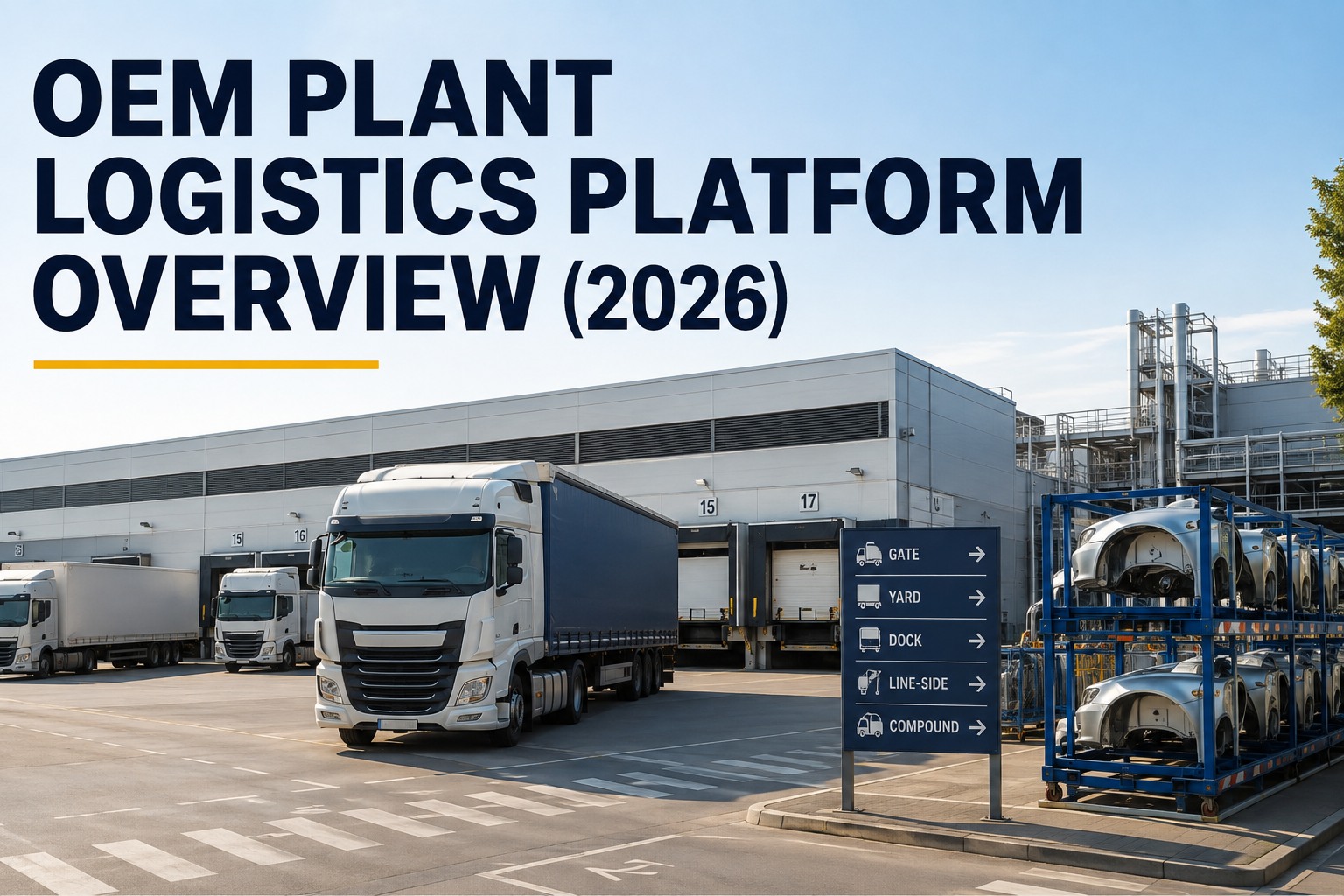
An OEM plant does not have a logistics problem. It has five of them, running at once, on five different clocks — the gate deciding who enters, the yard deciding where they wait, the dock deciding what gets unloaded next, line-side deciding what the station consumes in the next four minutes, and the compound deciding which finished units leave tonight. Most plants run each of those on a different system, or on no system at all: a clipboard at the gate, a spreadsheet in the yard office, a radio call to the dock, a paper kanban at the line. That works until it doesn't — and in automotive, the cost of it not working is measured in the $2.3 million per hour a stopped assembly line burns, a figure that has roughly doubled since 2019. This is an architecture overview of what a single plant logistics operating layer actually covers, what deliberately stays inside SAP, and why the correct deployment unit is one plant rather than one enterprise. Book an architecture review to map it against your own site.
ARCHITECTURE OVERVIEW · 2026
One Operating Layer From Gate to Compound
Gate, yard, dock, line-side and compound are one continuous flow of physical assets — but they are almost never one system. This is what a plant logistics platform owns, what it hands back to SAP, and how a site goes live without touching the ERP core.
The five zones, one asset chain
01GateArrival, identity, check-in
02YardParking, shunting, dwell
03DockDoor assignment, unload
04Line-sideMilk run, kit, sequence
05CompoundFinished units, VIN, release
Every handover between two of these zones is a place where a physical asset changes custody and the data does not follow it. That gap — not the zones themselves — is what a plant logistics platform exists to close.
$2.3MPer hour of automotive assembly downtime
39.3%Of truckload stops involve detention
135MHours lost to detention annually, US
24%Idle-time cut at sites running AI yard optimisation
Zone by Zone: What Actually Breaks
Each of the five zones fails in a characteristic way, and each failure has a different downstream victim. Reading them in order is the fastest way to work out where your own site is losing hours — and which zone to instrument first.
01Gate
Where it breaksManual check-in, paper gate passes, no advance shipping notice matched to the truck at the barrier. Security knows a truck arrived; logistics finds out twenty minutes later. Carriers with no appointment get processed in arrival order rather than production priority.
What the layer ownsAppointment-linked check-in, driver and carrier identity capture, trailer and container ID, automatic notification to the receiving dock the moment the barrier lifts. The gate event becomes the timestamp everything downstream is measured against.
02Yard
Where it breaksTrailers parked wherever there was room. Shunter drivers working from radio calls and memory. Nobody can answer "which bay is the seat trailer in" without walking the yard. Detention meters run at $50–$100 per hour past the two-hour free window, and the invoices arrive a month later with no evidence attached.
What the layer ownsYard bins and parking assignment, shunt task dispatch to the driver's handset, live trailer position, and a dwell clock per transportation unit with a timestamped audit trail that settles detention disputes instead of conceding them.
03Dock
Where it breaksDoor assignment made by whoever is standing on the dock. Unload sequence driven by arrival order rather than line demand. A trailer holding a part the line needs in ninety minutes sits behind three trailers of stock that will not be touched this shift.
What the layer ownsDoor-to-trailer assignment scored against production demand, unload sequencing, live door occupancy, and turn time per carrier. The dock stops being first-in-first-out and starts being demand-out.
04Line-side
Where it breaksMilk-run tuggers on a fixed timetable that no longer matches consumption. Kitting cells building to yesterday's plan. Just-in-sequence mis-picks discovered at the station, where the only options are a sort or a stop — and a stopped station backs up welding, paint and final assembly behind it.
What the layer ownsRoute-level milk-run execution, replenishment triggered by real consumption rather than a timetable, scan gates at pick, pack and line-side issue, and a hard stop on mis-sequence before the container leaves the kitting cell rather than after it reaches the station.
05Compound
Where it breaksFinished units tracked on a whiteboard by row and bay. Damage attributed to nobody because no handover was recorded. Car-carrier drivers — a role running vacancy rates near 15% — burning an hour locating four specific VINs across a compound holding several thousand.
What the layer ownsVIN-level location by zone and bay, movement and custody logging at every handover, damage capture with photo evidence at the point it is found, and release-to-transporter sequencing driven by the outbound plan.
The zones are not the problem. The five handovers between them are.
An architecture review walks your actual site layout, names every custody handover, and shows which ones currently lose their data. It takes thirty minutes and produces a map you keep whether or not you buy anything.
What Stays in SAP — and Why That Matters
This is the question that decides whether a plant logistics project is a six-week deployment or a two-year programme. SAP EWM is SAP's only actively developed warehouse management product as of 2026, and for new builds the embedded variant inside S/4HANA is the recommended path — which means the ERP core is getting more capable, not less. The point of a plant logistics layer is not to replace any of that. It is to sit in front of it and handle the physical execution that the system of record was never built to run in real time.
System of record — stays in SAP
- Inbound and outbound delivery documents
- Stock, batch, valuation and goods movement postings
- Production orders, BOM and the levelled build plan
- Supplier EDI, ASN receipt and settlement
- Transportation planning and freight cost in SAP TM
- Warehouse task and bin master in EWM
- Quality inspection lots and blocked stock
- Financial close and audit reporting
Execution layer — runs on the platform
- Gate check-in, driver identity, barrier events
- Yard bin assignment and shunt task dispatch
- Live dwell clocks and detention evidence
- Dock door assignment scored on line demand
- Milk-run route execution and tugger dispatch
- Scan gates and mis-sequence hard stops
- Compound VIN location and custody handover
- Damage capture, photo evidence, exception alerts
Read the two columns as a contract. Anything that must survive a financial audit or a seven-year retention rule belongs on the left. Anything that has to be decided in under sixty seconds by someone holding a handset in the rain belongs on the right. Problems start when a plant tries to run the right-hand column out of the left-hand system — or when a bolt-on execution tool starts holding its own version of stock.
The Integration Surface
A plant layer that cannot hand its events back cleanly is just another silo with a nicer interface. These are the handoffs that have to exist before anything goes live, and the direction each one runs. Compare this against your own landscape — the same principles apply whether you are on embedded EWM, decentralised EWM, or an ERP that is not SAP at all. Our integrations overview covers the telematics and accounting side of the same surface.
← Swipe to see all columns →
Why the Deployment Unit Is One Plant
The instinct on a programme this size is to design once for the enterprise and roll out globally. That instinct is wrong here, and it is the single most common reason plant logistics projects stall in year two. Physical logistics is site-specific in a way that finance and procurement are not: gate geometry, yard capacity, door count, whether the compound is on-site or twelve kilometres away, whether line-side is fed by tugger or AMR. None of that generalises. A design agreed at head office survives contact with the second plant roughly never.
1The constraint is physical, not organisational. Two plants building the same vehicle can have completely different yard topologies. The rules that work at one are actively harmful at the other. Configuration has to live at site level.
2Value is measurable per site, immediately. Dwell hours, dock turn time and sequence-related stops are all site-level metrics. A single plant produces a defensible business case in one quarter, which is what funds plant two.
3Failure is contained. A misconfigured rule at one plant costs one plant a shift. The same rule pushed globally on day one costs a network.
4The ERP core is untouched. Because the platform integrates rather than replaces, plant two does not wait on an S/4HANA release window. Sites can run different versions of the execution layer against the same system of record.
Single-plant rollout, phased
Phase 1Map and instrumentWalk the site, name every custody handover, baseline current dwell and turn times. No system change yet — this is the evidence layer.
Phase 2Gate and yard liveCheck-in, parking assignment, shunt dispatch and dwell clocks. Highest ratio of value to integration effort, so it goes first.
Phase 3Dock and line-sideDoor scoring against production demand, milk-run execution, scan gates and mis-sequence stops. This is where the SAP handoffs get real.
Phase 4Compound and close the loopVIN-level location, custody and damage capture, release sequencing. Site now has one continuous chain from barrier to transporter.
Map Your Plant Before You Scope Anything
An architecture review is a working session, not a pitch. We take your site layout, the five zones, and your existing SAP landscape, and produce the handover map and the integration surface you would need regardless of vendor. Most plants find at least two handovers they did not know were losing data.
Gate to compound coverage
ERP core untouched
Plant-level deployment
Runs on existing devices
What Good Looks Like
Targets worth holding a programme to. These are the numbers a plant logistics layer should move, and the ones to baseline in Phase 1 so the improvement is arguable rather than asserted. Sites running AI-assisted yard optimisation have reported average truck idle-time reductions around 24%, which is a reasonable anchor for the yard column.
← Swipe to see all columns →
The Architecture Review Checklist
Take these to any vendor conversation, including ours. A platform that cannot answer all eight without a follow-up call is not a plant logistics layer — it is a point tool with ambitions. If you want to run the same exercise against your maintenance and asset stack, our manufacturing fleet solution covers that adjacent surface.
1Does it cover all five zones, or does it stop at the dock door?
2Which of our SAP objects does it read, and which does it write?
3Does it hold its own stock balance? If yes, walk away.
4Can rules be configured per site without a code change?
5What happens to gate and yard operations when the network drops?
6Does it produce timestamped detention evidence we can invoice against?
7Can it enforce a mis-sequence stop before the kit leaves the cell?
8Does plant two require an ERP release window, or not?
Frequently Asked Questions
Does this replace SAP EWM?
No, and any vendor telling you otherwise is proposing a much larger programme than they are admitting. EWM stays the system of record for stock, bins, warehouse tasks and everything that has to survive an audit. The plant layer handles the physical execution in front of it — gate, yard, dock assignment, line-side routes and the compound — and hands the resulting events back so the delivery and goods-receipt picture in SAP reflects what physically happened rather than what someone typed in later.
We already have yard management inside EWM. Is that not enough?
It is a real capability and for some sites it is sufficient — checkpoints, parking spaces, yard bins and transportation units all exist natively. Where plants outgrow it is at the edges: shunt dispatch to a driver's handset, live door scoring against production demand, milk-run execution on the shop floor, and VIN-level compound tracking. Those are execution problems with sub-minute decision cycles, and they sit awkwardly inside a system designed around documents. The honest test is whether your yard office is still running a spreadsheet alongside EWM.
Why not deploy across all plants at once?
Because the configuration that makes plant one work is mostly wrong for plant two. Gate geometry, yard capacity, door count, compound distance and line-feed method differ site to site even within the same OEM building the same vehicle. A single-plant deployment produces a defensible business case in one quarter and contains any misconfiguration to one site. Enterprise-first designs tend to stall when the second plant refuses to fit the template.
What does the line-side piece actually enforce?
Three things. Replenishment fires on real consumption rather than a fixed tugger timetable, so routes match what the line is actually burning. Scan gates at pick, pack and line-side issue create a traceable chain per kit or sequenced unit. And a mis-sequence triggers a hard stop at the kitting cell rather than being discovered at the station, where the only remaining options are a manual sort or a line stop — the second of which is the most expensive event in the building.
How does this help with carrier detention charges?
Detention accounts for close to 40% of truckload stops and roughly 135 million lost hours a year in the US alone, and while almost every carrier bills for it, fewer than half of those invoices are ever paid — which tells you the dispute is about evidence, not principle. A gate-to-gate timestamped record of arrival, parking, door assignment, unload start and departure turns a monthly argument into a settled number, and more usefully, shows you which of your own docks are generating the charges.
Do we need new hardware in the yard?
Generally no for the first two phases. Gate check-in, shunt dispatch and dwell tracking run on handsets and tablets your team already carries, and existing trailer telematics or yard-tractor GPS can feed position data straight in. Fixed infrastructure — gate cameras, RFID portals, automated barriers — becomes worth discussing once the process is proven and you know which specific handover is worth automating. Instrumenting first and buying hardware second is the cheaper order of operations.
What is the realistic first milestone?
A baselined map of your five zones with every custody handover named, and gate plus yard running live. That combination is deliberately chosen: it has the smallest integration footprint, it touches no financial posting, and it moves dwell time — the metric most likely to fund the next phase. Everything after that is a decision made with your own data rather than a vendor's benchmark. An
architecture review is where that map gets built.
Start With One Plant and One Map
Gate, yard, dock, line-side and compound on one operating layer — with SAP left as the system of record and the ERP core untouched. Bring your site layout and your current landscape to a thirty-minute architecture review, and leave with the handover map and integration surface for your plant.
No ERP replacement · Runs on existing devices · Site-level configuration
August 11, 2026By Emily Parker
All Blogs