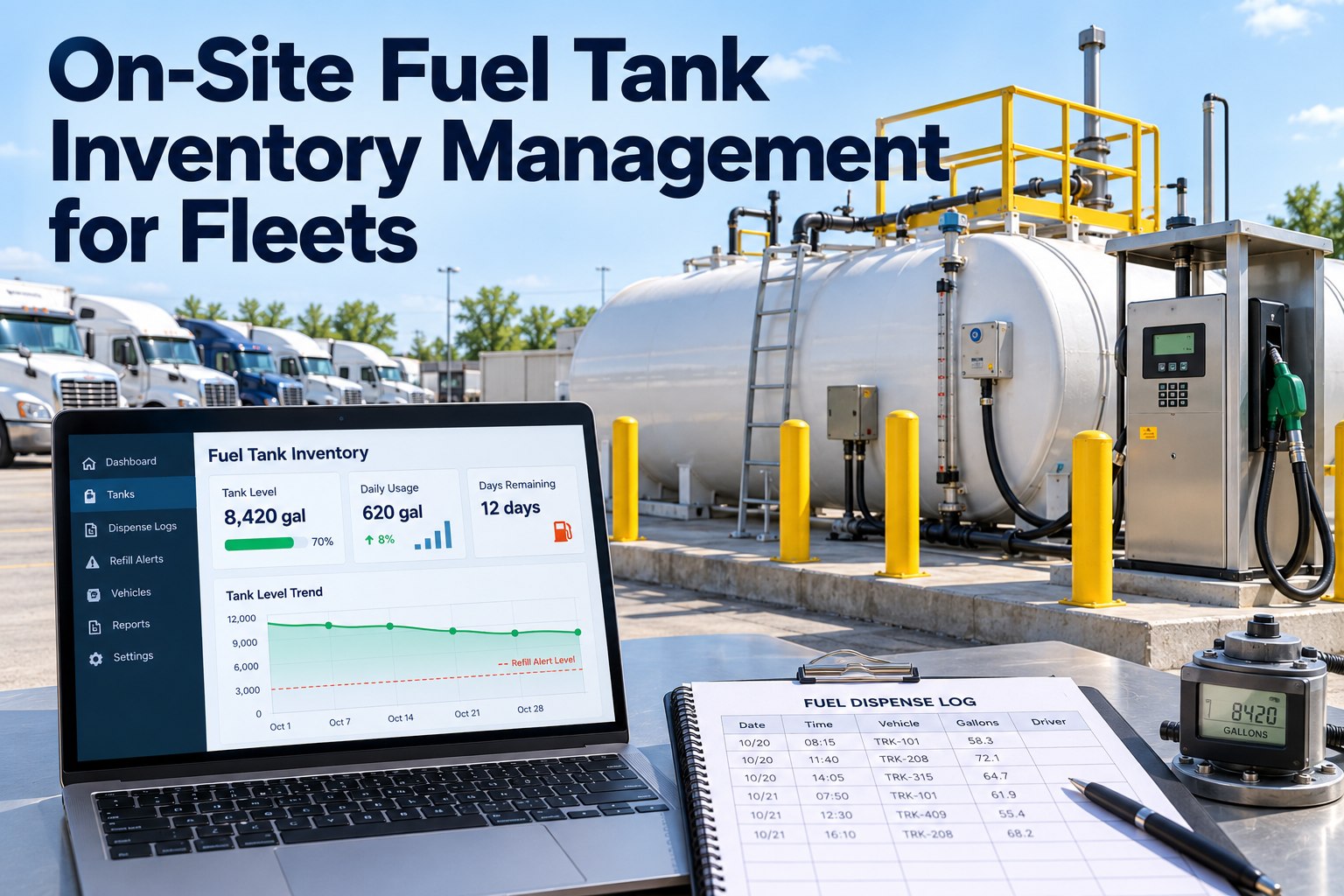
On-site fuel tank inventory management is a checkbook for your yard tank: what was in it, what came in, what went out and what is left. When the stick reading and the books disagree, you have shrinkage, a meter problem or a leak, and the earlier you see it the less it costs. This page covers the daily routine, dip readings, dispense logs, refill alerts and what to look for in bulk diesel tanks. Schedule a call to set up yard fuel tank tracking.
The Daily On-Site Fuel Tank Inventory Routine: Measure, Record Deliveries, Subtract Dispensed and Reconcile
Book inventory is opening stock plus deliveries minus gallons pumped, and the gap to the closing dip is over or short
The method below comes from the US EPA's inventory control guidance for underground petroleum tanks, which many fleets use as a model for yard tanks. It says to measure each tank every day fuel is added or removed with a stick marked to 1/8 inch or a level monitor, never to add or remove fuel while measuring, and to total each dispenser's pump totals to get the day's pumped volume. The numbers in the example are ours and illustrative.
| Daily log line | Example (illustrative) |
|---|---|
| Opening stick | 4,800 gallons |
| Delivery, by stick | 3,000 gallons |
| Dispensed, from pump totals | 2,150 gallons |
| Book inventory | 4,800 + 3,000 - 2,150 = 5,650 |
| Closing stick | 5,640 gallons |
| Over or short | -10 gallons |
Texas TCEQ describes the same idea as balancing a checkbook and asks for at least a 30-day reconciliation of the total overage or shortage, even with an automated system. Whether those rules apply to your tank depends on tank type and state, so check with your regulator.
How to Take Dip Readings and Check Deliveries So the Tank Numbers Hold Up
Consistent method, time and person matter more than equipment, and every delivery gets a stick check against the receipt
EPA's guidance says to lower the stick slowly, touch the bottom gently, pull it out quickly and convert inches to gallons with a tank chart that has a value for every 1/8 inch. For a delivery, measure before, wait at least 5 minutes after, measure again and compare the stick-based volume with the gross gallons on the receipt. A FleetRabbit template page adds that temperature should be recorded with every reading and readings taken at the same time of day. Its claim that mechanical gauges carry 3 to 8 percent error is unsourced, so test your own gauge against a known volume.
Building a Fuel Dispense Log That Links Every Gallon Drawn From the Tank to a Vehicle
Six fields turn pump totals into proof of where the fuel went, including non-road equipment
A dispense log is what lets you explain the pumped total. The fields below are our recommendation, based on what auditors and the IFTA guidance on bulk fuel expect: every withdrawal recorded, with the vehicle or equipment that received it.
| Dispense log field | Why it matters |
|---|---|
| Date and time | Ties each draw to a shift and to the dip readings |
| Vehicle or equipment ID | Links every gallon to a unit, including non-road equipment |
| Odometer or engine hours | Lets you compare gallons with miles or hours |
| Gallons dispensed | Adds up to the daily pumped volume |
| Driver or fueler | Shows who drew the fuel |
| Tank or pump ID | Keeps multi-tank sites separate |
What Causes Fuel Tank Shrinkage, and How to Tell Meter Drift, Leaks and Theft Apart
A persistent gap can come from the meter, the stick, the paperwork or the tank, so rule out the cheap causes first
Cleverence lists meter drift, slow leaks and pilferage as the causes of persistent variances, along with missed dip checks, miskeyed deliveries and skipped temperature corrections that create false variances. The table pairs each cause with a first check.
| Cause of shrinkage | How to separate it from a real loss |
|---|---|
| Meter drift | Compare pump totals with the drop in stick level over several days |
| Slow leak | Look for a steady loss on idle days and water in the tank |
| Pilferage | Draws with no vehicle ID, or at odd hours |
| Missed or inconsistent dips | Check the log for gaps and changes of method or person |
| Miskeyed deliveries | Compare stick-based delivery volume with the receipt |
| Skipped temperature correction | Recompute volumes at a standard temperature before judging the gap |
| Mismatched product codes | Check each system uses the same tank and product names |
How Much Variance Is Acceptable in a Bulk Fuel Tank: Monthly Limits From the EPA Method
The EPA leak check allows 1 percent of pumped gallons plus 130 gallons per month before two failed months trigger action
EPA's inventory control method totals the month's pumped gallons and over-or-short figures, and flags the tank if the absolute total exceeds 1 percent of pumped gallons plus 130 gallons. Two consecutive failed months call for prompt notification of the regulator. A FleetRabbit page suggests 2 to 3 percent for metered tanks and about 5 percent for gauge-only tanks, but it gives no source, so use it as a starting screen only.
The chart applies the stated formula to three example volumes and is our arithmetic. It is a leak-detection limit for regulated underground tanks, not a shrinkage target for your yard.
Refill Alerts That Prevent Fuel Run-Outs: Setting a Reorder Level From Usage and Delivery Lead Time
Order when the dip reaches daily usage times lead time plus a buffer, and check the delivery when it arrives
None of the sources we read gives a reorder formula, so this is our own simple logic: if the yard pumps 400 gallons a day and the supplier needs 3 days, the reorder level is 1,200 gallons plus a safety buffer you choose. Compare each day's dip with that level. Check water at least monthly with water-finding paste, and remove it and tell the supplier if it exceeds 1 inch, per EPA. Keep inventory records at least one year, and confirm your state's period.
How FleetRabbit Handles Bulk Tank Inventory, Dispense Records and Reconciliation Across Sources
Tank, card and telematics data are compared in one place, and you confirm refill alerts on a call
FleetRabbit's oilfield reconciliation template says it ingests bulk tank, fuel card and telematics data, applies temperature-adjusted calculations, accepts manual and electronic gauge inputs, runs reconciliation daily and flags discrepancies by type and priority. These are vendor statements we have not tested, and the page does not mention refill alerts, so confirm those on a call. Free for up to 3 vehicles, then $5 per vehicle per month.