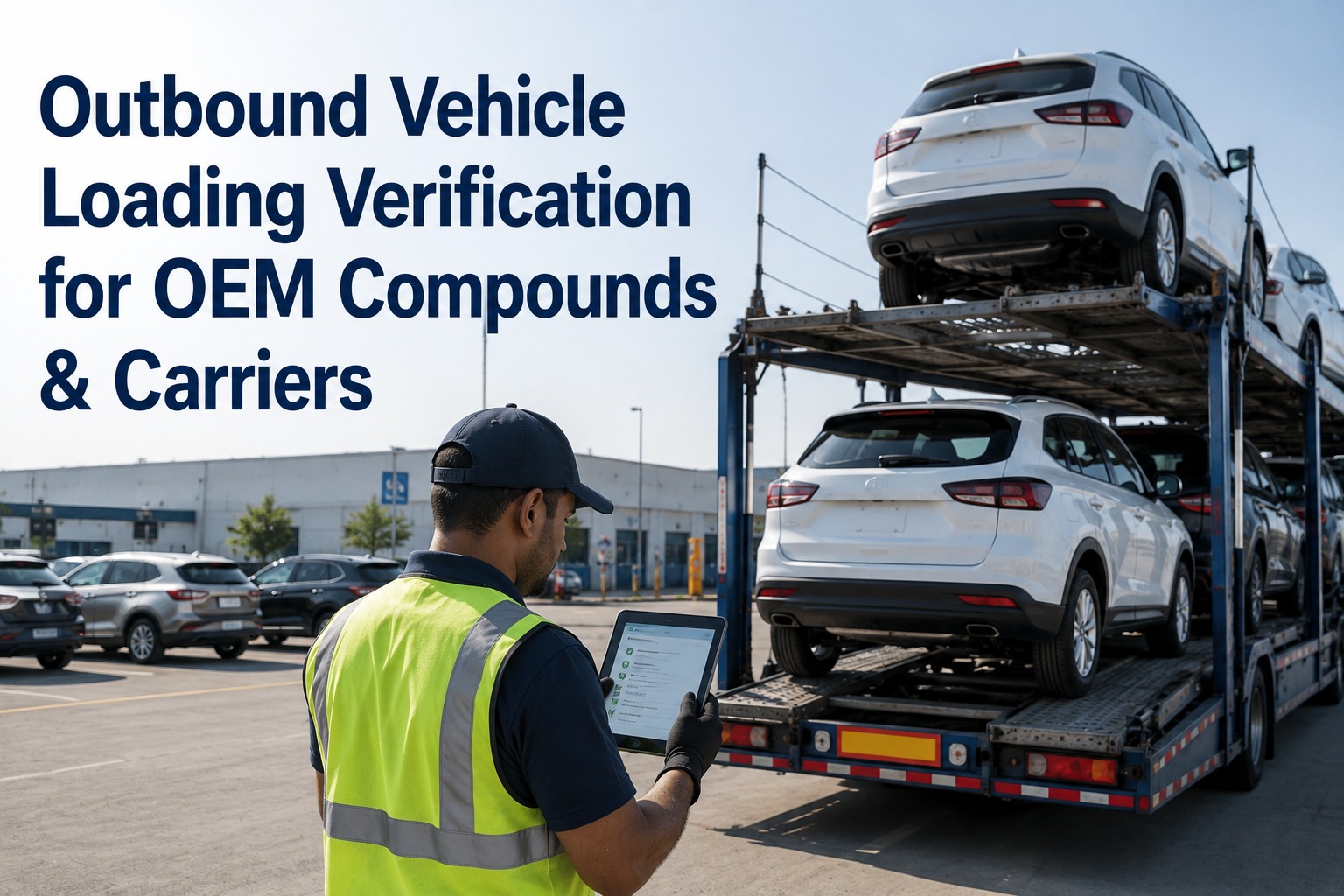
There is a scenario every car-haul driver knows. You arrive to collect a white Camry and there are three of them on the lot. Colour, year and model tell you nothing — the VIN is the only thing that confirms you are loading the right car. Multiply that by ten positions on a deck, a driver working to a departure slot, and a compound where several units of the same specification are parked in the same zone, and mis-loading stops being a remote possibility. What makes it expensive is not the mistake itself but the recovery: a vehicle arriving at the wrong dealer, a unit reported missing that was never missing, and a condition record now attached to the wrong VIN. And the second failure compounds the first, because most disputes do not begin with major damage — they begin with weak documentation. Book a 30-minute session and bring one week of loading records — we'll run them through Fleet Rabbit against the manifest and show you where your departure evidence would hold and where it would not.
FVL · OUTBOUND LOADING VERIFICATION
Outbound Vehicle Loading Verification
Load confirmation by VIN at the point of loading, carrier and driver identity checked before the gate, and departure evidence that survives a claim months later.
Upper deck
U1U2U3U4U5
Lower deck
L1L2L3L4—
VIN matched to manifest
Loaded, not on this manifest
On manifest, not loaded
Two errors on one load, and both are invisible until the far end. The unit in U4 arrives somewhere it was never meant to go; the unit for L5 is reported missing while sitting in your compound.
Why Visual Identification Fails
Not through carelessness. The conditions in a compound actively work against identifying a vehicle by sight, and four of them stack at exactly the moment a driver is loading.
Identical specifications, adjacentSlotting by destination or brand deliberately groups similar units together. The zone that makes retrieval efficient is the zone where three identical cars sit side by side.
Time pressure at the deckLoading happens against a departure slot. Any verification step slower than the shortcut will be skipped by someone running late, every time.
Position sequence mattersA carrier is unloaded in reverse order, so the right vehicles in the wrong positions is its own failure — one that only surfaces at the first drop.
The record follows the assumptionOnce the wrong VIN is written on the manifest, every downstream system inherits it. The error propagates faster than anyone finds it.
The rule, stated plainly
Verify the VIN against the order before loading — not after, and not from the paperwork the driver was handed. The VIN on the vehicle must match the VIN on the transport document and on the order, checked as three separate things rather than assumed to be one. That single discipline eliminates the entire category of error above, and it takes seconds per unit when the capture method is built for the deck rather than for a desk.
Load Confirmation by VIN: The Sequence
Six steps at the point of loading. The order matters, because each one closes a specific failure the next step would otherwise inherit.
1
Scan the VIN on the vehicleFrom the vehicle itself — the label or the plate — rather than from the paperwork. Reading the number off a document only confirms the document is internally consistent.
2
Match against the load manifestConfirm the unit belongs on this load, on this carrier, to this destination. A scan that records without validating is a log, not a check.
3
Confirm release statusThe unit must be clear of quality and campaign holds. A held vehicle physically loaded is a recall of the load, not a paperwork correction.
4
Record the deck positionWhich unit went where, since unloading runs in reverse and drop sequence depends on it. This is also what makes a later condition claim locatable.
5
Capture condition against that VINPhotographic evidence and damage marks tied to the scanned identity, not to a position or a description. A condition report on the wrong VIN is worse than none, because it looks authoritative.
6
Close the manifest before departureEvery position either matched or explicitly exceptioned. An open manifest at gate-out is how a unit gets reported missing while parked forty metres away.
Loading check
VIN scanned from the vehicle
Matched to manifest and destination
Release status confirmed clear
Deck position recorded
Condition captured against that VIN
Five checks, under a minute per unit, and most compounds run two of them.
Bring one week of loading records and a recent claim to a short call. We'll rebuild the loads in Fleet Rabbit, show which of the five checks your data supports today, and identify where a claim would currently fail on evidence rather than on merit.
Carrier Assignment Checks
A separate verification from the vehicle, and increasingly the one that matters. The question is not only whether the right cars are loaded but whether the right carrier is loading them.
← Swipe to see all columns →
The principle behind all five: driver, truck and carrier identity should all align before the freight leaves the yard. A mismatch flagged at the gate is an inconvenience; the same mismatch discovered after departure is a load of vehicles in the custody of a party you did not contract with, and a claim position that is considerably harder to argue.
Departure Evidence That Holds
The transport document is the baseline record of condition and custody — it establishes exactly when and where the carrier assumed responsibility. Eight elements make it defensible.
1VIN, year, make, model and colour, with the VIN captured rather than transcribed
2Origin and destination, plus the carrier's identity and operating authority details
3A joint walkaround completed with both parties present, not one signed afterwards
4Existing damage marked on the condition diagram with specific descriptions
5Mileage recorded, and operational status noted — operable, inoperable, dead battery, missing keys
6Special instructions documented, including gate codes, contacts and handling requirements
7Both parties signed, and the origin party holding its own copy
8Independent timestamped photographs as backup, taken by your side as well
Vague language loses claims
Most disputes do not start with major damage — they start with weak documentation, and the most common weakness is imprecise wording. "Minor scratch" or "small dent" mean entirely different things to different readers: one person pictures a light surface mark, another a deep gouge several inches long. Ambiguity favours whoever is defending, and claims are routinely denied on incomplete or improper documentation regardless of what actually happened. Describe location, length and depth, and photograph it.
What Weak Verification Actually Costs
Five consequences, and only the first is obvious. The others arrive weeks later and are far harder to unwind.
The mis-delivered unit
A vehicle at the wrong dealer, requiring recovery transport and an apology. Direct cost, immediate, and the easiest one to quantify.
The phantom missing vehicle
A unit reported lost that never left the compound, triggering a search across a site where it was sitting in its slot the whole time.
Condition attached to the wrong VIN
A damage record filed against a vehicle that was never on the load. It corrupts two claims at once — the real one and the fictional one.
The unwinnable claim
An incorrect VIN can delay claim processing and missing damage notes can invalidate a dispute entirely. Incomplete documentation is grounds for denial regardless of the underlying facts.
Payment and deduction exposure
Missing signatures, incomplete fields and delayed document capture create exposure to invoice deductions, shortage claims and payment delays — administrative cost with no upside.
Why Digital Capture Changes the Position
Not because paper is inherently worse, but because three specific weaknesses of paper are exactly the weaknesses that lose disputes.
Timestamps and location, automatically
Electronic documents can carry geocoordinate stamps and authenticated timestamps, so when and where custody transferred is recorded rather than asserted. On paper both are handwritten and both are contestable.
Tamper-evident by construction
An audit trail that cannot be quietly amended after the fact, connecting the loading document directly to gate, dock and payment workflows rather than living as a separate artefact.
Capture at the moment, not afterwards
Delayed document capture is itself a source of exposure. A record completed at the deck is a different quality of evidence from one assembled at the end of a shift from memory.
Verification of the evidence itself
Automated checks can flag photo anomalies and condition report discrepancies — a layer that simply does not exist on a paper diagram marked with a biro.
One distinction worth making internally, because it is frequently confused: signing an invoice confirms payment terms; signing the transport document confirms condition and custody. They are separate legal acknowledgements, and treating the second as an administrative formality is how origin sites end up carrying liability they never intended to accept.
What to Measure
Six figures. The first two tell you whether verification is happening; the rest tell you whether it is working.
Scan-verified load rateShare of loaded units with a VIN scanned from the vehicle and matched to the manifest. The foundational compliance number.
Manifest closure rate at gate-outLoads departing with every position matched or explicitly exceptioned. Open manifests are where phantom-missing units originate.
Mis-load rateWrong unit loaded, or right unit in the wrong position. Counted per thousand units so it is comparable across sites and volumes.
Condition capture completenessShare of departures with photographs, damage marks and both signatures present. Predicts your claim outcomes better than anything else here.
Carrier check pass rateLoads where carrier, equipment and driver identity all aligned at first check, and how the exceptions resolved.
Claims lost on documentationDisputes conceded because of evidence quality rather than fault. The number that converts this into a budget conversation.
Twenty minutes on one week of loads and one contested claim
We'll rebuild the departures in Fleet Rabbit — VIN matches, deck positions, condition capture, carrier checks — and show exactly where the evidence chain breaks for the claim you brought. You keep the gap analysis either way, and most teams find the break is in one specific step rather than across the process.
Frequently Asked Questions
Why scan the VIN if the paperwork already lists it?
Because the paperwork confirms only that the paperwork is internally consistent. Where three identical vehicles sit in the same zone, the VIN on the vehicle is the only thing that confirms the right car is being loaded — colour, year and model do not distinguish them. Verify the VIN against the order before loading, treating the vehicle, the transport document and the order as three separate sources that must agree rather than one.
What should a departure record contain?
VIN, year, make, model and colour; origin, destination and the carrier's identity and authority; a joint walkaround completed with both parties present; existing damage marked on the condition diagram with specific descriptions; mileage and operational status including issues like a dead battery or missing keys; special instructions; both signatures with your side holding a copy; and your own timestamped photographs as backup. The goal is a condition report both sides agree is accurate before wheels turn.
Why do documentation disputes go against the origin site?
Because ambiguity favours whoever is defending, and most disputes begin with weak documentation rather than major damage. Vague phrasing is the usual culprit — "minor scratch" means a light surface mark to one reader and a deep gouge to another. Claims are routinely denied on improper or incomplete documentation regardless of the actual damage evidence, and an incorrect VIN alone can delay processing while missing damage notes can invalidate a dispute outright.
How do we verify the carrier as well as the load?
Cross-check that the collecting carrier matches the dispatch, that the equipment presenting is registered to that carrier, and that the driver's identity and credentials align — with any mismatch flagging the load for review before dispatch rather than after. The principle is that driver, truck and carrier identity should all match before the freight leaves the yard, which is what catches unauthorised subcontracting and identity misuse at the point where it is still cheap to resolve.
Does deck position really need recording?
Yes, for two reasons. A carrier is unloaded in reverse order, so the right vehicles in the wrong positions creates a drop-sequence problem that only appears at the first delivery. And when a condition claim arrives weeks later, position is what lets you locate the unit in the load, correlate it with adjacent vehicles and establish whether the damage pattern is plausible. Without it you have a claim against a VIN with no context around it.
Is electronic documentation genuinely better?
For this specific purpose, yes — because it addresses the three weaknesses that lose disputes. Electronic records carry authenticated timestamps and geocoordinate stamps so custody transfer is recorded rather than asserted; they create tamper-evident audit trails connecting the document to gate, dock and payment workflows; and they capture at the moment rather than at the end of a shift, since delayed document capture is itself a source of exposure. Automated checks can also flag photo anomalies and condition discrepancies.
Where should we start?
With scan-verified load rate and manifest closure at gate-out, because those two are measurable from what you already do and they close the largest failure category. Add condition capture completeness next, since it is the strongest predictor of how your claims resolve. Carrier identity checks follow naturally once the loading process is instrumented.
Book a working session with one week of loads and we'll baseline all three before you change anything.
Match the Metal, Not the Manifest
VIN captured from the vehicle and validated against the order, release status confirmed before the ramp, deck position recorded, condition tied to the scanned identity, carrier and driver aligned before the gate, and every manifest closed at departure.
Bring one week of loads and a contested claim to the call · Works with existing handhelds · Free tier available