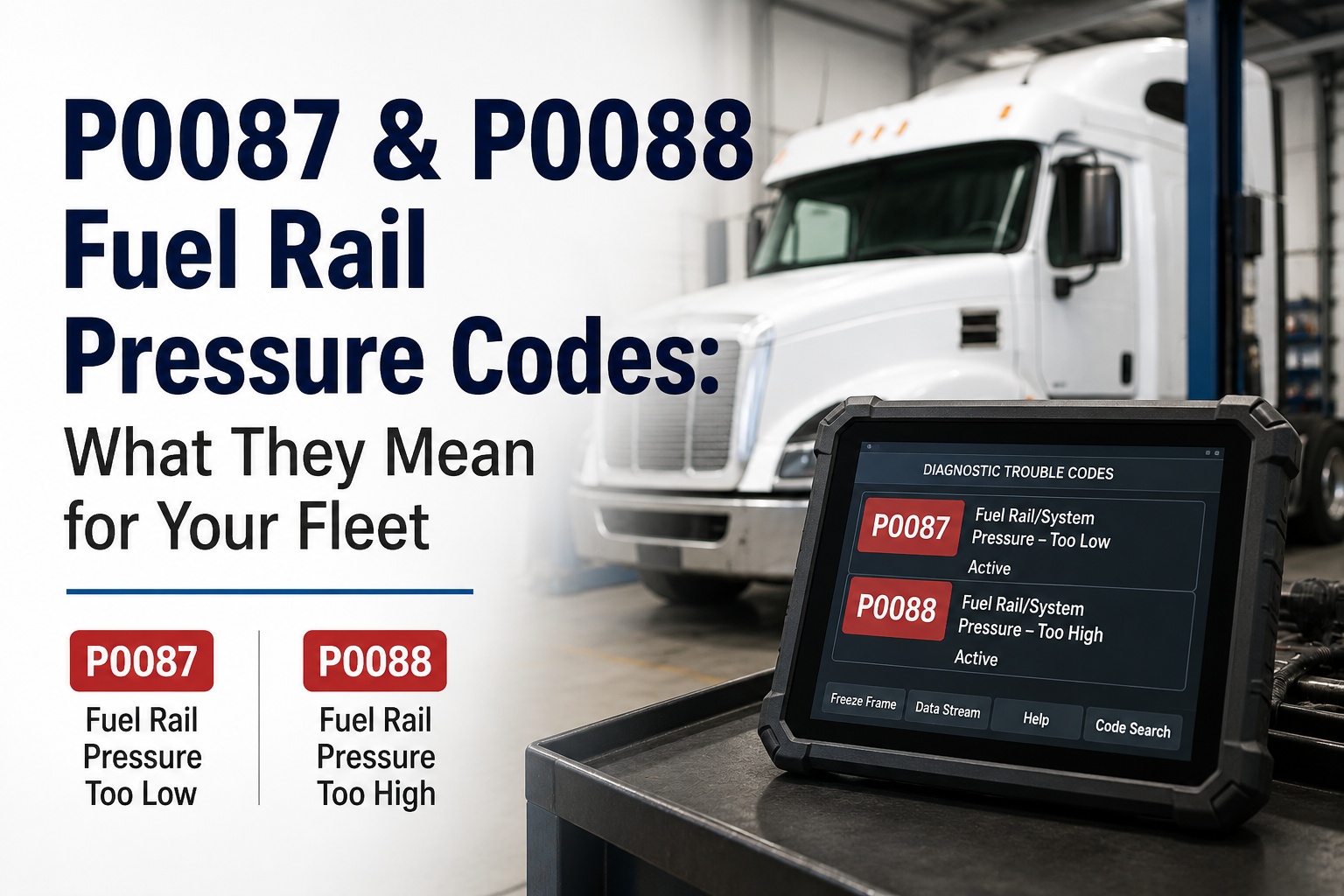
When a fuel rail pressure code lands on your scan tool, the first question a fleet manager should ask is not "how do I clear it" but "which direction did the pressure go?" P0087 means rail pressure is too low; P0088 means it is too high — opposite ends of the same common-rail system, with opposite causes and very different repair paths. Get the direction wrong and you can spend thousands replacing a high-pressure pump when the real problem was a clogged fuel filter, or vice versa. Worse, when both codes appear on the same truck, it is often the signature of an imminent high-pressure pump failure that can send metal shavings through the entire fuel system — a stop-driving-now situation. This guide explains what each code means, the causes behind them, the repair costs (anywhere from a $15 filter to an $8,000 pump job), and how tracking recurring codes across your fleet turns a mystery breakdown into a predictable, scheduled repair. Start free trial or book a demo to track fuel-system codes across every truck you run.
DIAGNOSTICS & REPAIR · COMMON-RAIL FUEL SYSTEM
Same Fuel System, Opposite Problems — and a $7,000 Difference in the Repair
P0087 and P0088 point to the two ends of your common-rail pressure system. Reading which direction the pressure moved — and whether both codes appear together — is the difference between a cheap filter swap and a catastrophic pump failure.
P0087
Fuel Rail Pressure Too Low
▼
Actual pressure falls below what the ECM commands — usually a supply-side shortage or restriction.
P0088
Fuel Rail Pressure Too High
▲
System holds more pressure than commanded — usually a regulation or pressure-control fault.
10–15%
Below target for 2–3 seconds is enough to trigger P0087
35%
Of P0087 cases resolve with a fuel filter — the cheapest fix
$15–$8K
Repair range, from a DIY filter to a full high-pressure pump job
Both
Codes together can signal imminent CP4 pump failure — stop driving
If P0087 and P0088 Appear Together: Stop Driving
On Duramax L5P/LML engines especially, the CP4 high-pressure pump is a known weak point. When it starts to fail, it sends metal shavings through the entire fuel system — and P0087 alongside P0088 is a classic warning sign of imminent CP4 failure. Continuing to drive risks contaminating every injector and the rail itself, turning a pump replacement into a complete fuel-system teardown. This is the one fuel-pressure scenario where the right move is to shut down and diagnose, not finish the route.
P0087: Fuel Rail Pressure Too Low
P0087 is one of the most common diesel fault codes, and on trucks it almost always points to a supply-side problem. The ECM constantly compares commanded rail pressure to what the pressure sensor actually reports; when the real number drops more than 10–15% below target for more than a couple of seconds, it sets the code and usually drops the engine into reduced power to protect the system. The classic fleet complaint is a truck that "falls on its face" when pulling a loaded trailer uphill.
Most Common
Clogged Fuel Filter
A restricted filter starves the injection pump so it can't maintain commanded pressure. It's the first thing to check — and the fix for roughly a third of all cases.
Common
Weak Lift / Supply Pump
If the low-pressure lift pump can't keep up, the high-pressure pump has nothing to work with. On Power Stroke 6.7L, the frame-mounted pump should hold 45–65 PSI at the secondary filter.
Common
Air in the Fuel System
Air intrusion from a loose fitting or failing seal means the pump moves air instead of fuel, and pressure never builds to the commanded level.
High-Mileage
Injector Return Flow
If injectors return too much fuel to the tank, the system may never build enough pressure. Especially common on higher-mileage common-rail Cummins trucks.
Serious
Failing CP3 / CP4 Pump
A worn high-pressure pump can't generate commanded pressure. This is the expensive end — and on CP4 pumps, a failure can contaminate the whole system.
Sensor
Bad FCA or Rail Sensor
A sticking fuel control actuator or an inaccurate rail pressure sensor can report low pressure that isn't real — verify the sensor against a gauge before condemning a pump.
P0088: Fuel Rail Pressure Too High
P0088 is the mirror image: the system is building or holding more pressure than the ECM commanded. Excess rail pressure disrupts the injector spray pattern, causes over-fueling, and stresses fuel-system components. The failures here are on the regulation and control side rather than the supply side — and a surprising number of P0088 codes turn out to be a sensor over-reporting rather than a genuine over-pressure condition.
Most Common
Stuck Pressure Regulator
A pressure regulator or control valve stuck closed commands too much pressure into the rail. On diesels, the volume/pressure control valve is a frequent culprit.
Common
Pump-Control Fault
A fault in the pump's metering or control circuit can over-pressurize the system, holding rail pressure above the commanded target under conditions where it should relieve.
Common
Restricted Return Line
If fuel can't return to the tank freely, pressure has nowhere to bleed off and climbs above target. A pinched or blocked return line is an easy-to-miss cause.
Verify First
Over-Reporting Sensor
A common false alarm: a mechanical gauge shows normal pressure but the code still sets, because the rail pressure sensor is over-reporting. Always verify the sensor against a gauge first.
Wiring
Pressure-Control Circuit Fault
A wiring fault in the pressure-control circuit can cause the system to over-pressurize. Inspect the control wiring and connectors before replacing components.
Serious
Pump Regulation Failure
Internal pump regulation failure holds excessive pressure and, combined with a P0087, can indicate the pump is on its way out entirely.
The same code on three trucks isn't a coincidence — it's a pattern.
Fleet Rabbit logs every fault code against the vehicle and surfaces recurring P0087/P0088 patterns across your fleet, so you catch a bad fuel batch or a failing pump model before it takes down the next truck.
P0087 vs. P0088 Side by Side
The two codes share a system but diverge on almost everything else — direction, cause, symptom, and fix. Here is the direct comparison every technician works from. Swipe the table horizontally on mobile.
← Swipe to see all columns →
Symptoms Your Drivers Will Actually Notice
Long before you plug in a scan tool, a fuel-pressure problem shows up in how the truck drives. These are the complaints that should prompt an immediate code pull — and the ones worth training drivers to report the same day.
Power Loss Under Load
The signature P0087 complaint — the truck "falls on its face" pulling a grade or accelerating with a trailer, often dropping into limp mode.
Hard Starting & Long Cranking
Extended cranking before the engine fires, especially after sitting — the pump can't build pressure fast enough at startup.
Stalling & Rough Running
Stalling at idle or coming to a stop, plus shaking, hesitation, or surging as the ECU struggles to hold fuel delivery steady.
Check Engine Light & Limp Mode
The MIL comes on and the ECM cuts power to protect the fuel system — a clear sign the pressure fault is real and active.
Poor Fuel Economy
Irregular combustion from inconsistent rail pressure shows up as rising fuel-per-mile — a metric fleet software tracks automatically.
Whining Fuel Pump
A loud whine from the fuel pump can point to internal pump failure — an audible clue worth logging alongside the code.
Track Every Fuel-Pressure Code Across Every Truck You Run
Fleet Rabbit logs P0087, P0088, and every other fault code against the specific vehicle, ties it to an open work order, and flags recurring patterns — so a bad fuel batch, a weak pump model, or a maintenance gap gets caught fleet-wide before it strands the next truck. Deploy at $5/vehicle/month, no hardware, live within 72 hours.
Per-vehicle fault-code history
Code-to-work-order linking
Recurring-pattern flags
Fuel-trend anomaly alerts
Repair Cost & Diagnostic Path
The cost of fixing a fuel rail pressure code spans two orders of magnitude, and the only thing standing between the cheap end and the expensive end is a disciplined diagnostic sequence. Verify the sensor against a real gauge, work the supply side before the pump, and you avoid the single most expensive mistake: replacing a pump when a filter or sensor was the culprit. Swipe the table horizontally on mobile.
← Swipe to see all columns →
i
The mistake that costs the most: replacing a high-pressure pump when a $15 filter or a $200 sensor was the real problem. Because P0087 and P0088 both have a common false-alarm cause — a lying pressure sensor — the disciplined move is always to verify actual pressure with a mechanical gauge before condemning any expensive component. A fleet that captures the full code history and diagnostic notes per truck builds exactly the pattern data that stops these misdiagnoses from repeating.
See how per-vehicle code history sharpens diagnosis.
Why Recurring Codes Matter More Than One-Off Codes
A single P0087 on one truck is a repair. The same code showing up across several trucks, or returning on the same truck every few weeks, is intelligence — and it is exactly what a fleet loses when codes live on individual scan tools instead of a shared system. Here is how Fleet Rabbit turns scattered codes into fleet-level insight.
01
Per-Vehicle Fault-Code History
Every P0087, P0088, and related code is logged against the specific VIN with a timestamp, so you see the full pressure-fault history of each truck at a glance instead of relying on a mechanic's memory.
02
Code-to-Work-Order Linking
Each code ties directly to the work order and the parts and labor that resolved it — so when it comes back, the tech sees what was already tried and skips straight to the next step.
03
Recurring-Pattern Flags
When the same fuel-pressure code hits multiple trucks in a short window, the dashboard flags it — surfacing a bad fuel batch, a contaminated tank, or a weak pump model before it spreads across the fleet.
04
Fuel-Trend Anomaly Alerts
Rising fuel-per-mile on one truck often precedes a fuel-pressure code. Trend alerts catch the gradual decline early, giving you a chance to inspect before the code and the limp mode ever arrive.
05
Usage-Based Fuel-System PM
Fuel filter and water separator services scheduled by mileage and engine hours prevent the restriction and contamination behind most P0087 codes — attacking the cheapest, most common cause before it triggers.
06
Platform-Aware Alerting
Tag trucks by engine platform so a P0087+P0088 combination on a known CP4-equipped unit raises the stop-driving flag immediately — turning a catastrophic pump failure into a caught-in-time repair.
Frequently Asked Questions
What is the difference between P0087 and P0088?
They are opposite ends of the same common-rail fuel-pressure system. P0087 means fuel rail pressure is too low — actual pressure has fallen below what the ECM commanded, usually a supply-side shortage or restriction like a clogged filter or weak pump. P0088 means pressure is too high — the system is holding more than commanded, usually a regulation or pressure-control fault like a stuck regulator or blocked return line. Both can also be triggered by a faulty pressure sensor reporting inaccurately.
Book a demo.
Can I keep driving with a P0087 or P0088 code?
Not safely. When P0087 sets, the engine is not getting adequate fuel pressure and may stall unexpectedly; the ECM reduces power to protect the system, but continued driving risks damaging the high-pressure pump and injectors — repairs that can exceed $5,000. If both P0087 and P0088 appear together, especially on a CP4-equipped engine, treat it as an imminent pump failure and stop driving immediately to avoid contaminating the entire fuel system. Pull over safely and diagnose.
Book a demo.
How much does it cost to fix a fuel rail pressure code?
The range is wide because the causes are. Roughly 35% of P0087 cases resolve with a fuel filter — as little as $15 for a DIY replacement. A pressure sensor runs a few hundred dollars, a lift pump several hundred, and a full high-pressure fuel system replacement can run $3,000 to $8,000 if the pump has failed. The single most expensive mistake is replacing the pump when a filter or sensor was the real cause, which is why verifying the sensor against a gauge first is essential.
Book a demo.
Why do P0087 codes happen so often on diesel trucks?
Diesel common-rail systems run at extremely high pressure and demand consistent fuel supply, so any restriction or supply-side weakness shows up quickly as a low-pressure code. It is especially common on trucks that tow — a diesel pickup pulling a trailer uphill that "falls on its face" with poor acceleration is the textbook P0087 case. Contaminated or low-quality fuel, extended filter intervals, and high-mileage injector return flow all make it more likely, which is why disciplined fuel-system maintenance matters so much.
Book a demo.
How do I know if it's the sensor or a real pressure problem?
Verify actual pressure with a mechanical gauge and compare it to what the scan tool reports as commanded and actual. If the mechanical gauge shows normal pressure but the code still sets, the rail pressure sensor is likely reporting inaccurately — a common false alarm for both P0087 and P0088. If the pressure drop or spike is real and tracks with engine load, the problem is mechanical: the pump, filter, regulator, or return line. Always confirm the sensor before replacing an expensive component.
Book a demo.
How does fleet software help with recurring fuel-pressure codes?
It turns isolated codes into fleet-level intelligence. Every P0087 and P0088 is logged against the specific truck with a timestamp and linked to the repair that resolved it, so a returning code shows the tech what was already tried. When the same code hits several trucks at once, a pattern flag surfaces a bad fuel batch or a weak pump model before it spreads. Combined with fuel-trend alerts and usage-based filter scheduling, it catches the cheap, common causes before they escalate into pump failures.
Book a demo.
Stop Guessing at Fuel-Pressure Codes. Start Tracking Them.
Fleet Rabbit logs every P0087, P0088, and fuel-system fault against the vehicle, links it to the work order that fixed it, and flags recurring patterns across your fleet — so a $15 filter never becomes an $8,000 pump job, and a CP4 warning never becomes a teardown. Integrated with your existing systems in 5–7 working days, at $5/vehicle/month, with no new hardware required.
Free tier for up to 3 vehicles · No credit card required · No hardware installation
July 21, 2026By Emily Davis
All Blogs