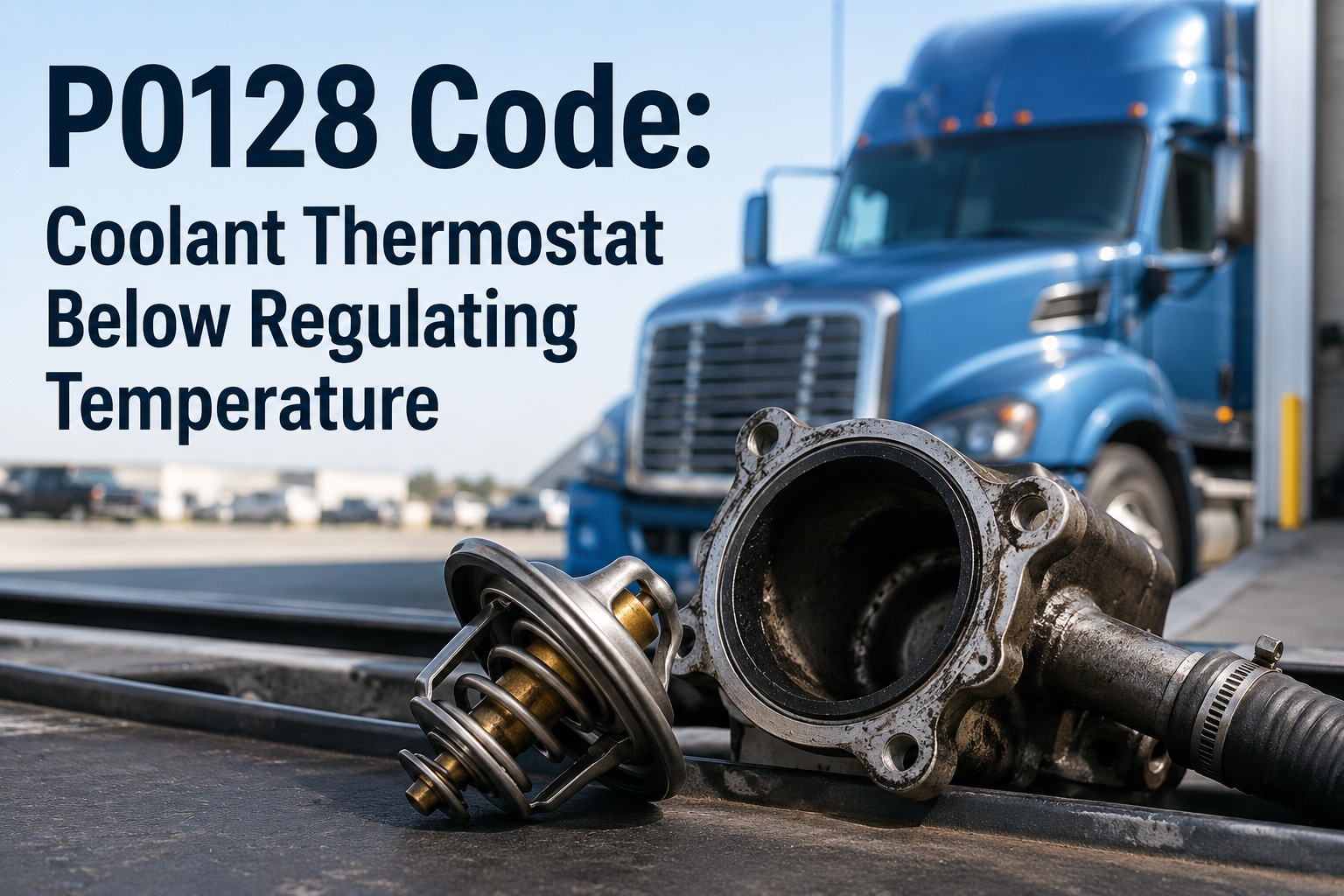
P0128 is the fault code fleets are most likely to leave sitting. Nothing breaks, the truck drives normally, and the only obvious symptom is a heater that takes too long — which in July nobody notices at all. The code means the engine control module watched the coolant temperature from a cold start, expected the engine to reach normal operating temperature within a set time, and it did not. Engines are designed to run best somewhere around 200°F, and one running persistently below that burns more fuel on every mile it covers, because a cooler engine runs a richer mixture and loses more energy to thicker oil and larger clearances between pistons and cylinder walls. Left long enough it also builds sludge. It is a low-severity code with a running cost attached to every trip. Book a demo and see how logging every code and repair against the unit turns a recurring P0128 into a pattern instead of a note.
DIAGNOSTIC GUIDE · OBD-II CODE
P0128
Coolant Temperature Below Thermostat Regulating Temperature
Also logged as thermostat rationality. What sets it, what causes it, how a technician isolates it, and what it costs to leave alone.
Expected
Reaches operating temperature in the expected time
Actual
Plateaus below
The module is not measuring a temperature — it is measuring a rate. Too slow, or never arriving, and the code sets.
What Sets the Code
The logic is a timed expectation rather than a threshold, which is why the same truck can set it on one cold morning and not the next.
1
Cold start baseline
At start-up the module reads coolant temperature and intake air temperature. On a genuinely cold engine both should sit close to ambient — a mismatch here is itself diagnostic.
2
A warm-up window opens
The module expects the engine to reach its normal operating temperature within a specific timeframe, adjusted for conditions. The thermostat's job during this period is to stay shut so coolant does not circulate early and slow the warm-up.
3
The window closes without the temperature arriving
If the engine warms too slowly or never reaches the regulating temperature at all, the module stores P0128 and illuminates the lamp. Nothing has failed catastrophically — the engine is simply running colder than designed.
Why cold running costs money
Below its designed operating temperature an engine runs a richer air-fuel mixture and suffers greater energy losses from thicker oil and larger clearances between the cylinder walls and pistons. The fuel penalty applies to every mile until it is fixed. Over a longer period, a persistently cold-running engine also builds sludge, and thicker oil lubricates less effectively — which increases friction on internal components in a way that eventually costs considerably more than a thermostat.
Symptoms Drivers Actually Report
Five, and only the first two tend to get mentioned unprompted.
Check engine lamp illuminatedOften the only reason the code surfaces at all, since the truck otherwise drives normally.
Weak or slow heater outputA cooler engine cannot generate the heat the cab needs. The complaint appears in winter and vanishes as a reported issue in summer, though the underlying fault does not.
Temperature gauge sitting lowNever reaching the normal operating band, or reaching it only after an unusually long run.
Slow warm-up from coldNoticeable to a driver who runs the same unit daily, and easy to dismiss as seasonal.
Fuel economy downThe symptom nobody attributes to this code, because it does not present as a fault. It presents as a truck that has quietly got worse — visible in fuel data long before anyone connects it to a cooling issue.
Causes, in the Order Worth Checking
There is no single fix, so the order matters more than the list. Start cheap and easy — where the thermostat is straightforward and inexpensive to change on that engine, it is a reasonable first move.
01
Thermostat stuck open or opening early
The primary culprit by a wide margin. Coolant circulates before the engine has warmed, so it never gets there. Replacing the thermostat usually resolves it — though on some engines the thermostat and housing are an integrated assembly replaced as one unit.
02
Low coolant level
Cheap to check and frequently the answer. Worth doing before anything is removed, and it also raises the separate question of where the coolant went.
03
Faulty coolant temperature sensor
The engine may be reaching temperature perfectly well while reporting that it is not. A sensor or wiring fault produces the same code with an entirely healthy cooling system underneath.
04
Cooling fan stuck on
A fan running constantly pulls heat away faster than the engine can produce it during warm-up. Easy to observe and easy to overlook.
05
Poor circulation — air pockets or a weak pump
Trapped air after a previous cooling system service, or a water pump no longer moving coolant properly. Both disrupt the warm-up behaviour the module expects.
06
Intake air temperature sensor
Checked last, once the others come back clean. It contributes to the module's warm-up expectation, so a bad reading can produce the code without any cooling fault at all.
Same unit
Same code
Third time
A repeat P0128 is a diagnosis, not a repeat repair.
Where the same unit sets this code after a thermostat replacement, the thermostat was not the cause — it is usually a sensor, a fan running constantly, or air still trapped in the system. Bring a unit with a repeat history to a 30-minute call and we'll lay its code and repair timeline out in Fleet Rabbit so the pattern is visible rather than remembered.
How a Technician Isolates It
Five steps, in sequence. Each one eliminates a cause, which is what stops the job becoming a parts-swapping exercise.
Step 1
Scan live data on a cold engineReview coolant temperature and intake air temperature together. On a genuinely cold engine both should read close to the outside air temperature — if they do not, you have found something before touching a tool.
Step 2
Warm up at idle and watchLet the engine idle to normal operating temperature. If the gauge only rises when the engine is revved or the heater is switched on, that points squarely at a thermostat stuck open.
Step 3
Compare the sensor against realityCheck live sensor data against the dashboard gauge, and against a reliable thermometer near the engine. Where the actual and reported temperatures disagree, the sensor or its wiring is the likely cause — and no amount of thermostat replacement will fix it.
Step 4
Confirm the fan is not running constantlyA fan stuck on will keep pulling heat away during the warm-up window. Quick to verify and it explains an otherwise baffling case.
Step 5
Check the intake air temperature sensorLast, once everything else is clean. Also worth scanning for a related cooling system performance code, which covers similar ground and may explain what P0128 alone does not.
The fleet trap worth knowing
This code can set with nothing mechanically wrong. A vehicle used for repeated short trips in cold weather may simply never reach operating temperature within the expected window — and several longer runs can clear the condition without any repair. Before ordering parts, check the duty cycle: a unit doing short urban stops in winter is a different diagnosis from the same truck on a highway route, and the difference is visible in your own trip data rather than in the scan tool.
Cost and Repair Time
Figures vary considerably by engine and by how the thermostat is packaged, so treat these as a planning range rather than a quote.
← Swipe to see all columns →
Weigh that against what leaving it costs. The fuel penalty applies to every mile the unit covers, and it compounds silently — a truck running two or three percent worse on fuel for a year will have spent considerably more than the highest figure in this table. Severity is low; running cost is not.
Preventing the Next One
Four measures. None require anything you are not already capable of doing.
Put cooling on a real interval
Inspect coolant condition and level, and check thermostat behaviour, on a defined schedule rather than when a code appears — commonly suggested at around every six months or fifteen thousand miles, adjusted to your own duty cycle.
Bleed the system properly after any cooling work
Air trapped after a service produces exactly this code weeks later, at which point nobody connects the two. Record the bleed as a step on the work order so it is visible if the code returns.
Log the code against the unit every time
Not just the repair. A second occurrence after a thermostat replacement is the most useful diagnostic information available, and it only exists if the first one was recorded somewhere permanent.
Watch fuel economy per unit
A cold-running engine shows up as a gradual fuel decline before anyone reports a symptom. Where fuel data and fault codes sit on the same asset record, the correlation is obvious — and where they sit in different systems, it is invisible.
Codes are cheap to read and expensive to forget
Fleet Rabbit records every fault code against the unit with the repair that followed, flags repeat occurrences of the same code after a completed repair, and keeps fuel data on the same asset record — so a cold-running engine shows up as a trend rather than as a heater complaint next winter.
Frequently Asked Questions
Can we keep driving with P0128?
Briefly, yes — the code is low severity on its own and the vehicle drives normally. But it should not be deferred indefinitely. The engine is burning more fuel on every mile it covers because a cold engine runs a richer mixture with greater energy losses, and over time a persistently cold-running engine builds sludge while thicker oil lubricates less effectively, increasing friction on internal components. It is a small repair that gets expensive by being ignored.
What causes P0128 most often?
A thermostat stuck open or opening too early, by a wide margin — coolant circulates before the engine has warmed, so it never reaches temperature. After that: low coolant, a faulty coolant temperature sensor, a cooling fan running constantly, poor circulation from air pockets or a weak water pump, and an intake air temperature sensor fault. There is no single magic fix, which is why the diagnostic sequence matters more than the list.
How do we tell a thermostat from a sensor?
Let the engine idle to operating temperature and watch. If the gauge only rises when you rev the engine or switch on the heater, that points to a thermostat stuck open. If it climbs normally but the scan tool disagrees with the dashboard gauge or with a thermometer near the engine, the sensor or its wiring is the likely cause. That single comparison prevents most of the unnecessary thermostat replacements in this category.
Can this code set with nothing actually broken?
Yes, and it catches fleets out. A vehicle used for repeated short trips in cold weather may never reach operating temperature within the expected window, setting the code without any mechanical fault — and several longer runs can clear the condition on their own. Check the duty cycle before ordering parts. A unit doing short urban stops in winter is a different situation from the same truck on a highway route.
What does it cost to fix?
The range runs from roughly $20 for a standalone thermostat up to around $300 for a water pump, with an integrated thermostat and housing assembly landing around $70 to $150 for an original part on some engines. Labour for a thermostat replacement is commonly one to two hours on an accessible design. Costs vary considerably by engine, so treat those as planning figures rather than a quote.
The code came back after we replaced the thermostat. Why?
Because the thermostat was not the cause. The usual explanations are a coolant temperature sensor reading incorrectly, a cooling fan running constantly, or air trapped in the system from the replacement itself if it was not properly bled. A repeat occurrence after a completed repair is genuinely useful information — it eliminates the most common cause and points you at the remaining three.
Book a demo to see repeat-fault tracking against the unit.
How do we stop this recurring across the fleet?
Put cooling system inspection on a defined interval rather than waiting for codes — around every six months or fifteen thousand miles is a commonly suggested starting point, adjusted to your duty cycle. Record the bleed step on any cooling work order, since trapped air produces this code weeks later. And watch fuel economy per unit, because a cold-running engine shows as a gradual fuel decline well before anyone reports a symptom.
Low Severity, Permanent Running Cost
Diagnose in sequence rather than replacing the obvious part, check the duty cycle before ordering anything, record the code against the unit every time it appears, and watch fuel economy — because that is where a cold-running engine shows up first.
General guidance — always follow the manufacturer's diagnostic procedure for your specific engine · Costs vary by make, model and labour rate
August 27, 2026By Sam Parker
All Blogs