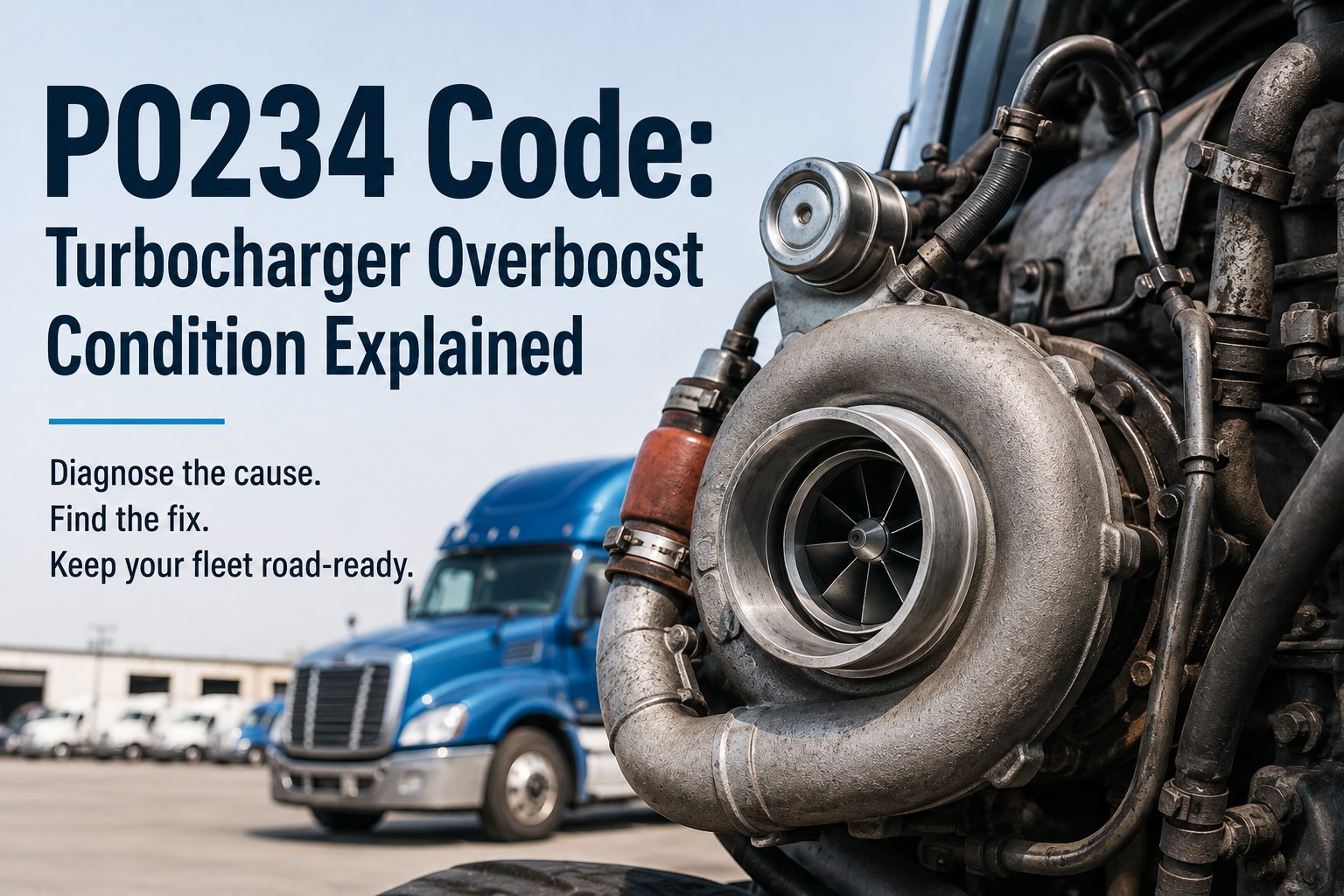
P0234 is not a code to schedule. The engine control module has detected boost pressure above the maximum it will allow and has cut power to protect the engine — which is the module doing its job, because uncontrolled boost can produce a blown head gasket, cracked pistons or a destroyed turbocharger. The symptom drivers describe is distinctive: the truck pulls hard up a grade in a high gear, then abruptly loses power and jerks, sometimes needing an ignition cycle to recover. Often there is a whistling or siren note under load that stops the instant the module intervenes. The good news is that the expensive cause is not the likely one. Around half of these cases come down to a wastegate actuator or its control solenoid, and a proper diagnosis before parts are ordered is what separates a few hundred dollars from a few thousand. Start free with three vehicles and keep the code, the test results and the repair on one record.
DIAGNOSTIC GUIDE · OBD-II CODE
P0234
Turbocharger / Supercharger "A" Overboost Condition
Boost pressure above the allowed maximum, with the module cutting power to protect the engine. What causes it, how to test before you buy parts, and what each repair actually costs.
Normal boost range
Limit
Overboost — module cuts power
Severity: high · Do not continue driving under load
Unlike a slow-warm-up code, this one is the module protecting the engine from itself. Treat a P0234 as an immediate assessment, not a next-service item.
Triage First: Drive It or Stop It?
Two situations, and the distinction matters within the first few minutes rather than at the shop.
Gentle recovery may be acceptable
Where the code is stored, power is reduced, and there are no other symptoms, driving gently at low engine speed to a workshop is generally considered acceptable. Do not load it, do not climb grades under power, and do not treat restored power after an ignition cycle as the fault having cleared.
ConditionsNo unusual noises, no burning smell, no flashing lamp, no significant additional symptoms
Stop driving now
Any of these means the risk of engine damage outweighs getting the truck home. Excessive boost pressure can cause serious engine damage, and the failure modes at this end are not repairs you want on a unit's history.
Any of theseFlashing check engine lamp · loud engine noises · significant power loss · any burning smell
What the module is preventing
As boost pressure rises, so does the mechanical stress on the engine. Left uncontrolled, overboost can produce blown head gaskets, cracked or melted pistons, and turbocharger failure. The power reduction that frustrates the driver is the cheapest part of this event — it is the thing standing between a wastegate repair and an engine rebuild.
Symptoms Worth Recording
Seven, and several are specific enough to point at the cause before anyone opens the bonnet.
Power cut under hard accelerationCharacteristically when climbing a grade in a high gear. The engine pulls, then abruptly drops or jerks — sometimes requiring the ignition to be cycled before normal power returns.
Limp modePower limited deliberately by the module. Makes merging, overtaking and towing genuinely unsafe rather than merely inconvenient.
Whistling or siren noise under loadRising with boost and stopping abruptly at the moment the module intervenes. One of the more useful driver reports available.
Knocking or pre-ignitionA sign the engine is being pushed past its designed cylinder pressure. Do not continue running it in this state.
Signs of overheatingEngine, and sometimes transmission — with harsh shifting reported alongside. On diesels, exhaust gas temperatures running higher than normal.
MisfiringWhere combustion conditions have been pushed outside their normal envelope.
Additional stored codesWorth pulling deliberately. Codes exist for every electrical component the module uses to control boost, so a companion code usually identifies the cause. Their absence is itself informative — with no related electrical codes, the problem is most likely mechanical.
Causes, Weighted by How Often They Are the Answer
Published diagnostic data puts the distribution roughly as follows. The point is not the precision of the percentages — it is that the cheap end of the list is where most cases end.
~50%
Wastegate actuator or boost control solenoid
The single largest category. A solenoid that fails to modulate, or an actuator rod stuck, seized or bent, prevents the wastegate opening — so exhaust keeps driving the turbo and boost keeps climbing.
~30%
Turbocharger itself
Internal failure — a stuck wastegate flapper, or sticky variable-geometry vanes carboned into a high-boost position. On variable-geometry units, carbon buildup is a very common mechanism.
Smaller share
Boost or manifold pressure sensor
Reading higher than actual, out of range, or shorted. The engine may be behaving perfectly while reporting that it is not — which is why the sensor must be verified before anything is replaced.
Smaller share
Hoses and control lines
A hose off the wastegate or boost controller, or a supply line to or from the controller clogged, cracked or misrouted. Cheap to find and cheap to fix if anyone looks.
Occasional
Aftermarket tuning
Tunes raising boost targets beyond factory limits set this code readily, particularly on marginal hardware. Worth establishing early whether the unit has been modified.
~5%
Control module
Rare. Commanding excessive boost or misinterpreting sensor data. Reached only by elimination, never as a starting hypothesis.
One clarification that saves confusion: a boost leak generally causes underboost rather than overboost, and would normally set a different code. The exception is a leak specifically in the wastegate control line, which can prevent the wastegate opening and cause overboost indirectly. Same symptom family, opposite mechanism.
Actual boost
vs
Target boost
One scan-tool comparison decides whether this is real.
If actual pressure consistently exceeds target by more than roughly 0.2 to 0.3 bar, the overboost is genuine and mechanical. If it does not, you are chasing a sensor. Bring a unit with a live P0234 to a 30-minute call and we'll walk the test order with you and show how the results, the code and the eventual repair sit on one asset record in Fleet Rabbit.
The Diagnostic Order
Seven steps, sequenced so that each one either finds the fault or eliminates a cause. Working out of order is how a turbocharger gets replaced for a cracked hose.
01
Confirm the code and pull companions
Scan for stored codes alongside P0234. Codes exist for every electrical component involved in boost control, so a companion often names the part. No related electrical codes points toward a mechanical cause.
02
Compare actual boost against target
The decisive test. Monitor both on the scan tool — where actual consistently exceeds target by more than around 0.2 to 0.3 bar, the overboost is real. Where it does not, suspect the sensor and stop before ordering anything mechanical.
03
Verify the sensor against a mechanical gauge
Compare the scan tool's boost reading with an independent gauge, or substitute a known-good sensor. This rules out a false overboost reading and is far cheaper than the alternative.
04
Inspect hoses, piping and vacuum lines
Boost hoses, intercooler piping, clamps and every small line between solenoid, actuator and intake — checking for cracks, kinks, disconnection or misrouting. Listen for hissing or whistling in the engine bay.
05
Test the wastegate actuator with a hand pump
Disconnect the line and apply vacuum. The actuator should sweep smoothly through its full range — commonly checked from zero to around twenty inches of mercury. Stiff, sticking or unresponsive movement means cleaning or replacement, and it is the test that most often changes the verdict.
06
Command an electronic actuator open and closed
Where the actuator is electronic rather than vacuum-operated, drive it from the scan tool. No response indicates the actuator motor or its position sensor. Also check the solenoid connector and harness for damage and proper seating.
07
Inspect linkage travel, then look at the turbo
Wastegate and bypass linkage checked for free movement and correct travel. Only once everything upstream is clean does the turbocharger itself become the leading candidate.
Before you accept "it needs a new turbo"
Ask whether a vacuum sweep test was performed on the actuator. Where the actuator does not move smoothly through its range on a hand pump, the usual cause is carbon clogging rather than a failed turbocharger — and on variable-geometry units an intake cleaning service can often free sticking vanes without removing anything. That is a modest service against a four-figure replacement, and it is worth insisting on the test before authorising the part.
Repair Cost, Cheapest Cause First
The spread on this code is unusually wide because a cracked hose and a destroyed turbocharger produce the same fault. That is precisely why diagnosis before purchase saves the most money here.
Vacuum or boost hose
Roughly $20–$100
Boost control solenoid
Around $150–$350 parts and labour
Wastegate actuator, or cleaning a variable-geometry mechanism
Around $200–$600 depending on access
Turbocharger replacement
$900–$2,500 and upward
Overall, professional repairs commonly land somewhere between roughly $250 and $1,500, with labour rates, make, and original versus aftermarket parts all moving the final figure. Costs vary considerably by engine and region — treat these as planning ranges, not quotes.
Two Patterns Worth Knowing
Both are documented, both are easily misdiagnosed, and both save a great deal of time when recognised early.
The code that sets at idle and clears at speed
A documented pattern on some diesel pickups: the engine runs fine, the lamp comes on at idle setting P0234, and the light goes out several minutes later at cruise. The cause has been traced to an intermittent manifold pressure sensor fault occurring at idle that does not itself set a code — with sensor replacement resolving it.
TellThe code appears at idle rather than under load, which is the opposite of the usual presentation
The one that only appears when overtaking
Where the cut-out happens specifically under sustained high load — climbing a grade in a high gear, or overtaking at speed — sticking variable-geometry vanes under load are the likely mechanism. Limp mode is common in this presentation.
TellNormal driving is fine; the fault appears only when the turbo is asked to work hardest
If your scan tool supports it, review the deeper monitor data to see how often the overboost test is failing rather than only whether a hard code is stored. That reveals marginal cases before they become limp-mode events on a loaded truck — which is the difference between a planned repair and a roadside one.
Start free · 3 vehicles
The same code twice on the same unit means the first repair missed something
Fleet Rabbit records every fault code against the vehicle alongside the repair that followed, flags a recurrence of the same code after a completed job, and keeps test results and part replacements on one asset timeline — so the second P0234 arrives with the first one's history attached rather than as a fresh diagnosis.
Frequently Asked Questions
Can we keep driving with P0234?
Not under load. Excessive boost pressure can cause serious engine damage including blown head gaskets, cracked pistons and turbocharger failure, so this should be addressed immediately rather than scheduled. Gentle driving to a workshop at low engine speed may be acceptable where no other symptoms are present — but stop driving straight away if there is a flashing check engine lamp, loud engine noises, significant power loss or any burning smell.
What causes P0234 most often?
A wastegate actuator or its boost control solenoid, which published data places at roughly half of all cases — either the solenoid failing to modulate or the actuator rod stuck, seized or bent so the wastegate cannot open. Turbocharger issues account for around a further thirty percent, typically a stuck wastegate flapper or variable-geometry vanes carboned into a high-boost position. Sensors, hoses, aftermarket tuning and, rarely, the control module make up the rest.
How do we tell a real overboost from a sensor fault?
Monitor actual boost pressure against target boost on a scan tool. Where actual consistently exceeds target by more than roughly 0.2 to 0.3 bar, the overboost is real and mechanical. Where it does not, the sensor is the likely culprit and no mechanical part should be ordered yet. Confirm by comparing the scan tool reading against an independent mechanical gauge or substituting a known-good sensor — a cheap test that regularly prevents an expensive repair.
The shop says we need a new turbo. Should we accept that?
Ask whether a vacuum sweep test was performed on the actuator first. If it does not move smoothly through its full range on a hand pump — commonly checked from zero to around twenty inches of mercury — the likely cause is carbon clogging rather than turbocharger failure. On variable-geometry units an intake cleaning service can often free sticking vanes without removing the unit, at a small fraction of a replacement. Insist on the test before authorising a four-figure part.
Could a boost leak cause this?
Generally no — a boost leak causes underboost and would normally set a different code. There is one important exception: a leak specifically in the wastegate control line can prevent the wastegate from opening, which causes overboost indirectly. So leaks are worth inspecting, but you are looking at the control circuit rather than the charge pipe when this code is stored.
Why does the code only appear when climbing or overtaking?
Because that is when the turbo is working hardest and the boost control has the least margin. A cut-out specifically under sustained high load — a grade in a high gear, or an overtake at speed, followed by a jerk or a power drop that may need an ignition cycle to clear — points strongly at variable-geometry vanes sticking under load. If your scan tool exposes the deeper monitor data, check how often the overboost test is failing to catch this before it becomes a limp-mode event on a loaded truck.
What will the repair cost?
It depends entirely on which cause it turns out to be, and the range is wide: roughly $20 to $100 for a hose, $150 to $350 for a boost control solenoid, $200 to $600 for a wastegate actuator or cleaning a variable-geometry mechanism, and $900 to $2,500 or more for a turbocharger. Professional repairs commonly land between about $250 and $1,500 overall. That spread is exactly why the diagnostic order matters more than the parts list.
Start free with three vehicles and keep the test results with the repair.
Test Before You Buy the Turbo
Stop the truck if the serious symptoms are present, compare actual boost against target before anything else, sweep the actuator with a hand pump, work upstream to downstream — and record the result against the unit so a second occurrence starts from what you already learned.
General guidance — follow the manufacturer's diagnostic procedure for your specific engine · Cost ranges vary by make, model, region and labour rate
August 27, 2026By Alex Rowan
All Blogs