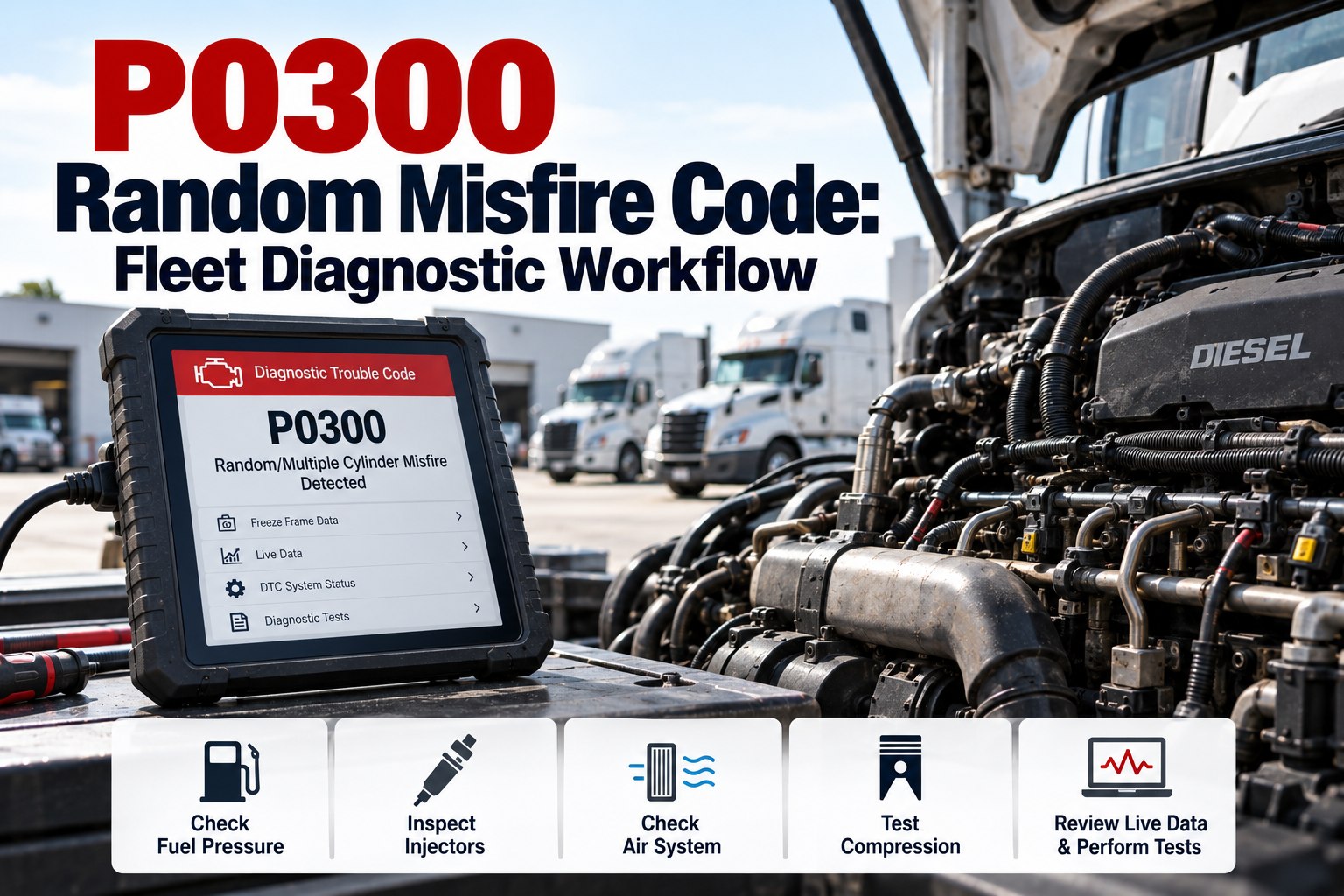
P0300 means the engine computer detected random or multiple-cylinder misfires — it saw the crankshaft slow at combustion events it expected to be even. On a diesel there is no spark to blame, so the causes sit in three places: fuel delivery, air and compression, or the electrical and data side. Manufacturer bulletins show how often the cheap end wins: a General Motors bulletin covering 2017–2023 Duramax HD trucks traces P0300 and injector circuit codes to wear between the injector connector terminal and the injector itself, and a Volkswagen misfire diagnostic aid warns that multiple components should not be replaced for one misfiring cylinder, listing loose or damaged electrical connections, circuit grounds and poor fuel quality as common causes. This guide gives you a staged workflow that starts with data and ends at the head. Book a demo to see misfire codes tracked to the repair, or create a free account to start with your own trucks.
Fault code workflow · Diesel misfire
P0300 Isn't a Part Number. It's a Question: Fuel, Air or Electrical?
For fleet mechanics, shop leads and maintenance managers: a staged diagnostic workflow for random and multiple-cylinder misfires on diesel trucks, from freeze-frame data to compression.
What a P0300 Random Misfire Code Actually Measures on a Diesel Engine
The engine controller watches crankshaft acceleration between firing events. When a cylinder contributes less than expected, the crank slows slightly, and enough of those events set a misfire code. P0300 means the misfires were random or spread across cylinders rather than isolated to one, which is why it so often points at something shared — fuel supply, air, grounds or data — rather than one component. You can keep every misfire code and its repair on the truck's record with a free account.
P0300 on its own
Usually a shared cause: fuel supply or quality, air in the fuel, intake restriction, grounds or a data fault.
P0300 with cylinder codes such as P0301 to P0306
Points at those cylinders: injector, its connector, or compression on that hole — while the shared causes can still be behind it.
One misfiring cylinder does not justify replacing several parts
A Volkswagen misfire diagnostic aid states it plainly: multiple components should not be replaced for one misfiring cylinder, and it lists loose or damaged electrical connections, circuit grounds and poor fuel quality as common misfire causes. It also tells technicians to review applicable bulletins and controller software updates before diagnosing.
Five Quick Checks to Run Before You Suspect an Injector
Each of these takes minutes and each has resolved P0300 in manufacturer bulletins. Run them in order and record the results, because they also narrow everything that follows. We can add these checks to your misfire work orders in a demo.
Low fuel and poor-quality or contaminated fuel set misfire codes without a failed part; one bulletin notes misfire codes alongside a low fuel level are usually the fuel, not a component.
Cold start, load, engine speed and fuel temperature at the moment the code set tell you where to test.
A GM bulletin for Duramax HD trucks traces misfire and injector circuit codes to wear between the injector connector terminal and the injector, caused by engine vibration.
Misfire behavior is often addressed by a controller calibration; check before condemning hardware.
A restricted filter or a leaking charge-air connection changes combustion on every cylinder at once.
A Four-Stage Diagnostic Workflow for Diesel Misfires, From Data to Compression
Work in stages, and stop as soon as a stage explains what the data showed. Recording each stage on the work order is what stops the next technician repeating it. Add this workflow to your templates free.
Read the data before touching anything
- All codes, active and inactive, with freeze-frame values
- Desired versus actual fuel rail pressure at idle and under load
- Cylinder contribution or balance rates
- Fuel temperature and fuel level
Prove the fuel supply is clean, full and air-free
- Filters and water separator; prime fully after any filter work
- Inspect for air in the supply and for suction-side leaks
- Check supply pressure to the high-pressure pump
- Sample the fuel if quality is in doubt
Test the injectors and their circuits, in that order
- Cylinder contribution test to rank the cylinders
- Injector return flow test to find leaking injectors
- Inspect connectors and pins for wear or corrosion
- Look for external leaks around injectors with a borescope, as one bulletin specifies
Confirm the mechanical side only if stages one to three pass
- Compression test across all cylinders
- Valve lash and valve train inspection
- Timing components where applicable
- Cylinder leak-down if compression is uneven
Keep every misfire test result on the truck's record
In 30 minutes we'll show how FleetRabbit holds the contribution results, pressure readings and parts fitted from the last misfire job, so a repeat P0300 starts at stage three instead of stage one.
What the Misfire Pattern Tells You Before You Open the Engine
When the misfire happens matters as much as which cylinder. Match the pattern your driver describes, or the freeze-frame data, to the most likely area. We can map your own misfire history to these patterns in a demo. Swipe the table on mobile.
| Pattern | Usually points to | Best test |
|---|---|---|
| Misfire only on a cold start | Fuel quality, low compression on one or two cylinders, or glow system on smaller diesels | Freeze-frame data at the moment it set |
| Misfire under load, smooth at idle | Fuel supply or rail pressure falling short when demand rises | Desired versus actual rail pressure under load |
| Rough idle, clears as it warms | Injector return flow or a sticking injector | Injector return flow test |
| Started right after a filter change or running out of fuel | Air in the fuel system, incomplete priming | Prime fully, then recheck |
| One cylinder clearly worst, P0300 plus a cylinder code | That injector, its connector or that cylinder's compression | Cylinder contribution test, then the connector |
| Random across cylinders, no pattern | Fuel supply, air intake restriction, or a data or grounding fault | Fuel pressure, intake restriction, grounds |
Manufacturer-Documented Causes Worth Checking on Diesel Trucks
These aren't theories — each comes from a service bulletin filed with NHTSA, and each is cheaper than the repair most shops reach for first. Record which of these you ruled out, free.
On 2017–2023 Chevrolet and GMC HD trucks with the Duramax, engine vibration can wear the injector connector terminal against the injector, setting injector circuit and misfire codes. The bulletin has technicians verify the connector before replacing an injector.
A 2025 bulletin covering a small diesel engine pairs a fuel pressure code with multiple-cylinder and single-cylinder misfires, unstable idle and abnormal engine noise, and has technicians verify an injector leak with an endoscope before replacing injectors and the high-pressure pipe.
One manufacturer campaign resolved P0300 by adding fuel and running the engine through drive and start-stop cycles, because the factory fill exceeded allowable driveability limits.
A misfire diagnostic aid lists loose or damaged electrical connections and circuit grounds as common causes, and tells technicians to use freeze-frame data to reproduce the conditions.
Sources: General Motors bulletin 23-NA-027; an FCA fuel injector leak bulletin (TSB 14-009-25); a Chrysler fuel driveability campaign; and a Volkswagen engine misfire diagnostic aid — all filed with NHTSA. Confirm applicability to your engine before using any procedure.
What a P0300 Misfire Costs a Fleet, Depending on Where It Ends
The gap between the cheapest and most expensive outcome here is larger than on almost any other code, which is exactly why the stages matter. Downtime sits on top: benchmarking by FleetNet America and ATA's Technology & Maintenance Council puts unplanned downtime at roughly $448 to $760 per truck per day before towing and repair. Estimate your downtime exposure with our team.
Relative cost by outcome, illustrative — not prices. Downtime benchmark: FleetNet America and TMC via industry reporting.
Maintenance Habits That Keep Misfire Codes Off Your Fleet's Dashboard
Most of the documented causes above are preventable with fuel discipline and a few inspections. Build them into preventive maintenance and have drivers report rough running or smoke on the DVIR before a code sets. Schedule these checks free on 3 vehicles.
P0300 Diesel Misfire Questions Fleet Mechanics Ask Most
What does P0300 mean on a diesel truck?
Random or multiple-cylinder misfire: the controller saw uneven crankshaft acceleration across more than one cylinder. On a diesel it points at fuel delivery, air and compression, or electrical and data faults rather than ignition. See your own misfire history.
What are the most common causes of P0300 on diesels?
Fuel supply and quality problems, air in the fuel after filter work, injector or injector-connector faults, intake restriction or charge-air leaks, grounds and wiring, and uneven compression. Track confirmed causes per truck free.
Can I drive a truck with a P0300 code?
Short distances at light load, perhaps, but misfires can dump unburned fuel into the exhaust, overheat aftertreatment components and worsen quickly. Diagnose promptly rather than clearing and going. Set severity rules with our team.
Should I replace injectors for P0300?
Not before testing. Run a cylinder contribution test and an injector return flow test, and inspect connectors — one manufacturer bulletin traces misfire codes to connector wear rather than a failed injector. Log test results before parts free.
Why did P0300 appear right after a fuel filter change?
Air left in the system after filter service or after running out of fuel is a common cause. Prime the system fully, clear the code and retest before diagnosing further. Review your post-service codes with us.
How much does fixing a diesel P0300 cost?
It ranges from fuel and filter work to injectors, a high-pressure pump or head repair. Downtime adds roughly $448 to $760 per truck per day by industry benchmarks, which is why staged diagnosis pays. Track repair costs per truck free.
Keep Every Misfire Test, Reading and Repair on One Truck Record
FleetRabbit logs each misfire code with the contribution results, rail pressure readings, connector checks and parts fitted — so a repeat P0300 picks up where the last diagnosis stopped.