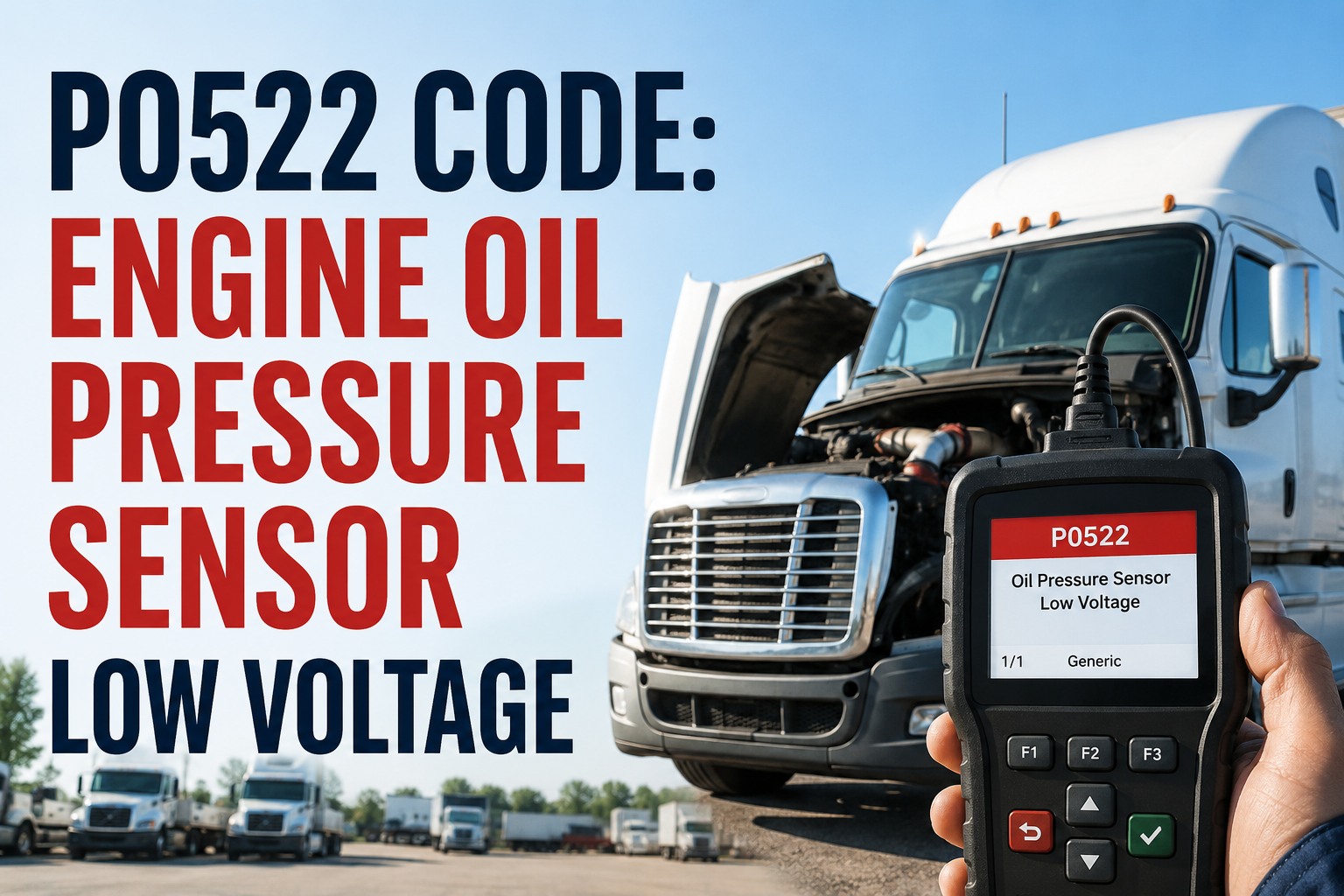
P0522 is two completely different problems wearing the same code. The module has seen a signal from the oil pressure sensor below its specified value for long enough to log a fault and light the oil warning — but that signal being low can mean the sensor is reporting a pressure that is not real, or it can mean the pressure genuinely is that low. The first is an inconvenience and usually an electrical repair. The second means the engine is running without adequate lubrication and every minute of it is doing damage. The good news is that resolving the ambiguity does not require judgement or experience. It requires a mechanical gauge and ten minutes: measure the actual pressure and compare it to what the sensor is telling the module. Everything else on this page follows from that one comparison. Start free with three vehicles and keep the reading with the repair.
P0522
Engine Oil Pressure Sensor / Switch Low Voltage
One test decides which problem you have
Gauge reads normal
Sensor or wiring. Annoying, affordable.
Gauge reads low too
Stop the engine. This is lubrication.
The Test That Settles It
Fit a mechanical gauge, read the actual pressure, and compare it against what the scan tool says the sensor is reporting. Three outcomes, and each one ends the argument.
Actual normal, sensor low
The engine is fine and the sensor is lying. Focus entirely on the sensor, its connector and its circuits — nothing internal is involved.
Electrical repair
Actual low, sensor low
The sensor is reporting correctly and the pressure really is down. Shut the engine off and investigate lubrication — oil level, viscosity, pump, bearings.
Stop driving
Actual only just acceptable
The reading passes, barely. This is the outcome most people misread, and it has its own section below because a marginal pass is not the same as a pass.
Read on
For orientation while you have the gauge on: published reference figures put normal readings at roughly 10 to 15 psi at idle and 30 to 40 psi at driving speeds. Those are general figures rather than a specification — always compare against the manufacturer's values for that engine, because acceptable limits vary considerably and the manufacturer's minimum is the number that matters.
A safety instruction, not a suggestion
If measured oil pressure drops below the minimum value specified for the engine, do not continue running it to complete the test — engine failure can result. Shut it down and diagnose from there. No diagnostic step is worth a bearing.
Causes, Ordered by How Often They Turn Up
Five, ranked. The first is free to check and the last is why the mechanical gauge matters.
01
Oil level too low
From leaks or consumption. The most frequently encountered cause and the one that costs nothing to rule out. Check the level and the condition before anything else happens.
02
A faulty sensor or sending unit
The component itself, reporting a value the engine is not producing. Common, and the reason many technicians reach for it first — which is defensible only after the gauge test, not before.
03
Damaged or corroded wiring and connectors
Shorts, corrosion and poor connections at the sensor. A low signal caused by a bad ground or a chafed wire looks identical to a failed sensor and is considerably cheaper to fix.
04
Incorrect or degraded oil viscosity
The wrong grade, or oil that has broken down in service. On a fleet drawing from bulk stock this is worth taking seriously — a viscosity error affects every unit filled from that drum, and it produces genuinely low pressure rather than a false reading.
05
Mechanical failure
Worn bearings or a failing oil pump. Least common, most expensive, and the reason a sensor should never be fitted without confirming actual pressure first.
Sensor lying
or
Engine starving
Whichever it was, write it down.
A unit that has set this code twice with a normal gauge reading has a wiring problem, not a sensor problem. Fleet Rabbit records fault codes, test findings and repairs on one vehicle timeline — with telematics codes arriving as work orders that already carry the history, so the second occurrence starts from what the first one measured.
The Marginal Pass Is the Trap
The most valuable thing on this page, and the outcome that gets misfiled most often.
What it looks like
Repairs to wiring or a replaced switch produce scan readings within acceptable limits, confirmed by a mechanical gauge. The job appears complete and the code stays away. Technically, that is a successful repair.
What it actually means
Pressure readings that only just comply with the lower acceptable limit indicate excessive wear or other internal problems. In that situation, replacing the switch will not correct the underlying issue — and the honest long-term answer is engine work rather than another sensor.
Why it matters commercially
Because a unit that keeps returning with this code and keeps passing marginally is telling you about its remaining life. Recording the actual measured figure — not just "within limits" — is what makes that trend visible across a year rather than a shift.
This is the single strongest argument for writing the number down. "Within limits" and "32 psi at speed against a 30 psi minimum" are the same verdict and completely different information, and only the second one tells you anything when the same truck comes back in four months.
When It Arrives With a Crowd
A pattern worth recognising, because it points somewhere other than the oil system entirely.
Several unrelated sensor codes together
Reported cases show this code appearing alongside a cluster of other sensor and reference-voltage faults, with the vehicle dropping into limp mode and losing throttle response intermittently — running normally for a while, then failing again.
Suspect what they share
When several sensors on different systems all report implausible values at once, the common factor is usually a shared supply or ground rather than five simultaneous component failures. Chase the reference voltage and the ground, not the oil pressure sensor.
The tell is the company it keeps
This code alone points at the oil system. This code among a crowd of unrelated sensor faults points at the electrical supply feeding them. Reading the full code list before acting takes seconds and redirects the whole job.
Diagnostic Order
Seven steps, arranged so that nothing expensive is ordered before actual pressure is known.
01Scan, capture freeze frame, read the full listConfirm the code and note everything else stored. Freeze frame shows the conditions when it set, and companions tell you whether this is an oil problem or an electrical one.
02Check oil level, condition and gradeLevel first, then whether the oil is clean and free of contamination, then whether the correct viscosity was used. Also look at the filter for damage or blockage and the pan for leaks.
03Inspect the sensor connector and wiringCorrosion, damage and poor connections at the sensor. A visual inspection here resolves a meaningful share of cases before a meter comes out.
04Test signal and ground circuits with a meterAgainst the manufacturer's specified values rather than against expectation. This separates a failed sensor from a circuit that is not delivering to it.
05Verify actual pressure with a mechanical gaugeCompare it against the sensor reading on the scan tool and against the manufacturer's specification. This is the step that rules internal engine and pump problems in or out, and everything after it depends on the answer.
06Repair or replace, then clear and road testFit a quality part matching the original specification if the sensor is the fault. Clear the code and drive it — a code that stays away after a road test is resolved; one cleared without testing is merely quiet.
07Only then consider the moduleModule failure is possible and rare. It is reached by elimination, with manufacturer guidance, after everything above has been ruled out — never as a starting hypothesis.
The tempting shortcut, and its condition
Where the sending unit is inexpensive and easy to reach, fitting one to see what happens is a recognised approach — but the published advice attaches a condition: a proper diagnosis is strongly recommended so you do not replace perfectly good parts. On a fleet the calculation is worse than on one vehicle, because a wrong guess repeated across several trucks is a parts budget with nothing to show for it.
Cost, Cheapest Cause First
The repair list runs from a can of oil to an engine, which is exactly why the gauge test comes before the parts order.
Top up or change oil to the correct viscosity
Consumables — and the most common fix on the list
Repair wiring or connectors at the sensor
Labour, and permanent if done properly
Replace the oil pressure sensor or switch
Modest — use a part matching the original specification
Diagnostic time
Around an hour, and cheaper than any wrong guess below this line
Oil pump or bearing replacement
Major work, and only after low pressure is confirmed mechanically
Ranges vary widely by engine and region, so treat the ordering rather than any figure as the useful part. The gap between the top and the bottom of this list is the entire argument for a mechanical gauge, and it is why the cheapest possible outcome and the most expensive one share a code.
Should the Truck Move?
Not until the cause is confirmed, and the reasoning is specific rather than cautious boilerplate.
If unconfirmed
Do not drive itDriving is not recommended until the cause is established, because you cannot tell from the dashboard which of the two problems you have. The code alone does not distinguish an electrical fault from an engine starving of oil.
If pressure is genuinely low
Pull over and shut it offContinuing to run an engine with insufficient lubrication causes serious and permanent damage. Where actual low pressure is confirmed or suspected, stop as soon as it is safe to do so rather than completing the route.
If it is the sensor
Still fix it promptlyA sensor fault poses no immediate threat, but it also means the warning system protecting a very expensive component is now unreliable. A truck running with a known-faulty oil pressure sensor has no working alarm for the fault that actually matters.
Do not dispatch until the cause is confirmed
The code that means either nothing or everything
Fleet Rabbit brings telematics fault codes in as work orders with severity and the vehicle's full history attached, alongside driver inspection defects and preventive schedules in the same queue — so an oil pressure code lands as a hold on that unit rather than as a note somebody intended to pass on. Free for three vehicles, no credit card.
Frequently Asked Questions
What does P0522 mean?
The module detected a signal from the oil pressure sensor below its specified value for a defined period, and set the code along with the low oil warning light. The sensor sits in contact with the oil gallery and changes resistance as pressure changes, which the module reads as a real-time pressure input. Related codes cover the circuit generally, range and performance, and a high-voltage version of the same fault.
Is it serious?
It is either trivial or extremely serious, and the code alone does not tell you which. In most cases the fault turns out to be electrical — a short, a damaged harness or a failed sending unit — which poses no immediate threat to the engine. But if the pressure genuinely is low, continuing to drive causes serious damage through insufficient lubrication. That ambiguity is why driving is not recommended until the cause is confirmed.
How do we tell the difference?
Fit a mechanical gauge and compare actual pressure against what the sensor is reporting on the scan tool, both against the manufacturer's specification. If actual pressure is normal while the sensor reads low, the fault is the sensor or its circuit. If both read low, the pressure really is down and the investigation moves to oil level, viscosity, the pump and the bearings. General reference figures put normal readings around 10 to 15 psi at idle and 30 to 40 psi at driving speeds.
The pressure passed, but only just. Is that fine?
No, and this is the outcome most often misread. Readings that only just comply with the lower acceptable limit indicate excessive wear or other internal problems — and in that situation replacing the switch will not correct the underlying issue, with engine work being the more effective long-term answer. Record the actual measured figure rather than "within limits", because the trend across several months is the information that matters.
What causes it most often?
Ranked by frequency: oil level too low from leaks or consumption, a faulty sensor or sending unit, damaged or corroded wiring and connectors, incorrect or degraded oil viscosity, and mechanical failure such as worn bearings or a failing pump. The viscosity item deserves attention on a fleet — the wrong grade from bulk stock affects every unit filled from it, and it produces genuinely low pressure rather than a false reading.
It appeared with several other unrelated codes. Does that change things?
Substantially. Reported cases show this code arriving alongside a cluster of other sensor and reference-voltage faults with intermittent limp mode and lost throttle response. When several sensors across different systems all report implausible values at once, the common factor is normally a shared supply or ground rather than several simultaneous failures. Chase the reference voltage and grounds rather than the oil pressure sensor.
Can we just fit a sensor and see?
Where the part is inexpensive and accessible it is a recognised approach, but the published advice attaches a clear condition — proper diagnosis is strongly recommended so you do not replace perfectly good parts. The risk is asymmetric here: a wrong guess on an electrical fault wastes a part, while a wrong guess that masks genuinely low pressure costs an engine.
Start free with three vehicles and record the gauge reading with the repair.
Measure Before You Replace
A mechanical gauge and ten minutes separate a cheap electrical repair from an engine running without lubrication — then write down the number rather than the verdict, because a marginal pass today is a rebuild conversation next quarter.
Reference pressures and acceptable limits vary by engine — always compare against the manufacturer's specification for your vehicle
September 3, 2026By Alex Rowan
All Blogs