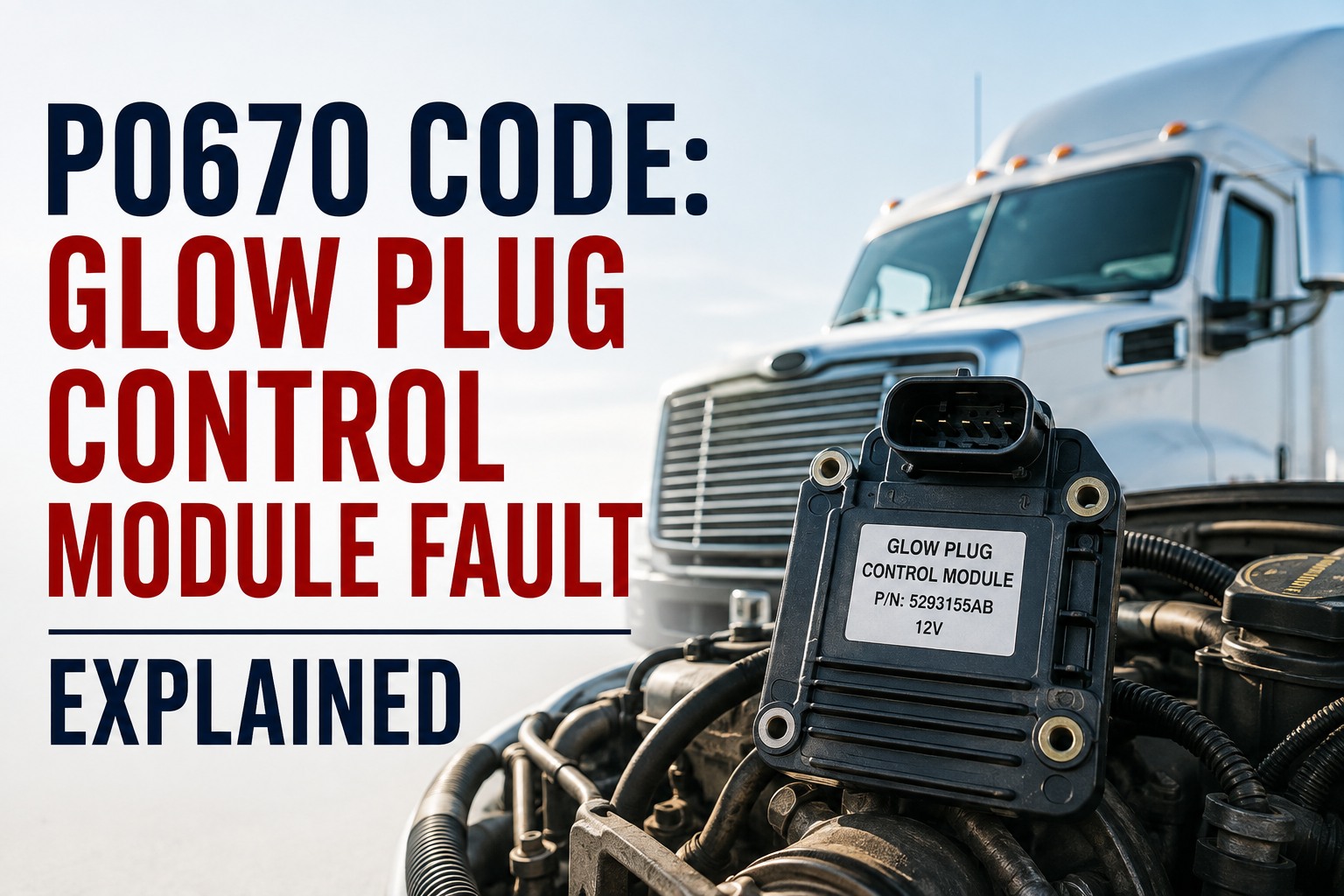
P0670 is a code with a season. The engine control module has detected a fault in the glow plug control module circuit — the module that powers the plugs preheating the combustion chambers — and in mild weather a truck with this fault often starts perfectly well. It cranks a little longer, idles roughly for a minute, and nobody escalates it. Then the first genuinely cold morning arrives and the same truck does not start at all. That alone would make it worth fixing early. What makes it urgent is what happens in between: a glow system that is not doing its job disrupts combustion, and disrupted combustion progressively clogs the particulate filter. A repair costing a couple of hundred dollars in autumn has been documented turning into a filter replacement running into thousands within six months. Start free with three vehicles and get it onto a schedule instead.
P0670
Glow Plug Control Module Circuit Fault
Mild weather
Starts. Cranks longer, idles rough for a minute. Easy to ignore.
First hard frost
Does not start. Same fault, different morning.
What the Plugs Are Fighting
Brief, because the physics explains both the symptoms and the seasonality.
A diesel needs superheated air
Ignition comes from the heat of compression rather than a spark. The air has to reach temperature on the compression stroke alone, with nothing else assisting it.
A cold cylinder head steals that heat
On a cold engine the compressed air loses its heat into the surrounding metal faster than compression can build it. That is precisely why a diesel that starts instantly in summer becomes reluctant in winter.
The plug closes the gap
A pencil-shaped element in the cylinder head glows for up to ten seconds, raising the surrounding wall temperature enough that the heat of compression becomes sufficient for ignition. Lose that and you have not lost a convenience — you have lost the margin the engine relies on when cold.
What Deferring It Actually Costs
The reason this code deserves a work order rather than a note. Published escalation figures for a neglected glow system, with the added cost at each stage.
0–1 month
Hard cold starting, strain on starter and battery, worse fuel economy
Extended cranking every cold morning wears the starter and drains the battery it depends on. Fuel economy falls because combustion is poor until the engine warms.
+$50–$200
1–6 months
Failed regeneration cycles progressively clog the particulate filter
Poor combustion loads the filter faster than it can clear, regenerations fail to complete, and the engine eventually enters limp mode. The glow fault is now an emissions problem.
+$300–$800
6+ months
Filter failure, and back pressure that reaches the turbocharger
Catastrophic filter failure requiring replacement, with excess back pressure causing turbocharger damage alongside it. Two major components, both downstream of a plug.
+$2,000–$8,000
Published guidance puts it bluntly: neglect can turn a repair of roughly $150 into a filter replacement of $3,000 or more within six months. That is the single most useful number on this page, because it converts a starting complaint into a capital risk — and it is the argument that gets the work order approved.
Do Not Replace All the Plugs
The most common expensive mistake on this code, and the reasoning against it is straightforward.
Simultaneous failure is rare
Individual plugs fail one at a time, and each has its own cylinder-specific code. Several failing together is unusual enough that it should not be your first hypothesis.
So look for what they share
When the whole system is affected, suspect a common failure point: the control module, the main relay, a blown high-amperage fuse, or a bad ground. This code names the module circuit specifically, which makes a module or supply fault more likely than a plug failure from the outset.
Test power and ground first
Before replacing the module itself. A module with no supply behaves exactly like a failed one, and the difference is a fuse and a ground check rather than a part.
Reading the code combination
Where a general glow circuit code appears alongside a specific cylinder code, the general one usually points at the primary system fault causing the specific symptom — a relay or supply problem making one cylinder report. Fix the system-level fault first and re-scan before deciding any individual plug needs replacing.
Does Your Truck Even Have a Module?
A worthwhile thirty-second check, because not every diesel has a separate one.
Two architectures
The glow circuit is common across diesels, with one exception: what times the glow operation. Some vehicles have a dedicated glow plug control module; on others the engine control module handles the timing itself.
The quick way to find out
Without a service manual to hand, call a parts supplier and ask whether they sell a glow plug control module for that vehicle. If no such part exists for it, the engine control module is doing the timing — which changes where you look and what you can replace.
Fix in October
↓
Or tow in January
The whole point of this code is that it warns you months early.
And the warning gets ignored because the truck still starts. Fleet Rabbit takes fault codes from your telematics and raises a work order with severity and the unit's history attached — so a glow circuit fault logged in autumn becomes a scheduled job rather than a note that resurfaces on the first frost.
The Order: Fuse, Ground, Module, Wiring, Plugs
Published guidance describes the approach as universal across platforms, and it works from cheapest to dearest by design.
01Confirm the code and check the batteriesScan and note anything else stored, then check the batteries are at full charge. A glow system draws heavily, and inadequate supply produces faults across the circuit that no component replacement will fix.
02Fuse and groundThe high-amperage supply fuse and the circuit grounds. This is the cheapest possible outcome and a genuinely common cause — corrosion at a ground disrupts the circuit exactly as a failed module does.
03Power and ground at the moduleBefore condemning it. A module without supply cannot respond, and testing here separates a failed part from a supply problem feeding it.
04Module outputWhether it is actually delivering to the plugs when commanded. A scan tool reading the circuit and its feedback is the fastest route here.
05Wiring and connectorsDamage, corrosion and water intrusion along the harness. These components live in heat and vibration and the circuit is unforgiving of a poor connection.
06The plugs themselves, lastTested individually by resistance, not replaced as a set on suspicion. An open circuit or an out-of-specification reading confirms a plug; anything else sends you back up this list.
One cause that is not electrical
An engine temperature sensor malfunction appears among the documented causes, and it makes sense: the module decides when and for how long to glow based on engine temperature. A sensor reporting a warm engine on a cold morning produces a glow system that behaves correctly and helps nobody — worth checking before replacing anything in the glow circuit itself.
Symptoms, and What They Sound Like
Six, and the third is distinctive enough to identify from across a yard.
The glow plug lamp, plus the check engine lightThe dedicated warning is the giveaway that this is a glow circuit fault rather than a general starting complaint.
Extended cranking, worsening with temperatureSlow to start in warm weather, failing to start in cold. The seasonal gradient is the signature of this fault more than any single symptom.
A pronounced knock when it does fireWhere the engine starts without adequate preheat, combustion is poor and the noise is obvious. A cold diesel knocking noticeably harder than its stablemates is worth a scan before it is worth a conversation.
Rough idle for the first few minutesThen clearing as the engine warms, which is exactly why it gets dismissed as normal cold behaviour.
Hesitation and reduced power while coldSluggish acceleration until fully warm, as fuelling is adjusted to compensate for the affected cylinders.
Fuel economy down, emissions upQuietly, on every cold start. This is the cost that accumulates while the fault is being tolerated.
Making It a Schedule Item
Six preventive measures, and this is a system that genuinely rewards planned attention rather than reactive repair.
Check the module during diesel serviceIt is a documented common failure point, and inspecting it while the truck is already in the shop costs almost nothing.
Replace ageing plugs proactivelyA failing plug can stress the module that drives it, so worn plugs are not only a starting issue — they shorten the life of the more expensive component.
Protect the wiring from heat and vibrationHeat-resistant loom on module and plug wiring. The circuit runs through the worst environment on the engine and the harness is a recurring cause.
Keep grounds and connectors cleanCorrosion disrupts the circuit directly, and this is the cheapest item on any glow system list.
Address cold-start issues before deep winterThe explicit advice, and the one with a date attached. A glow fault carried into January is a recovery; the same fault handled in October is an hour in the shop.
Use parts to the original specificationCheap modules and plugs are documented as failing early, which on a component this awkward to reach means paying the labour twice.
Every one of those sits naturally on a preventive schedule rather than in a fault queue. A glow system inspection added to the autumn service across the diesel fleet costs a few minutes per unit and removes the failure mode that produces the most winter recoveries — which is a maintenance decision rather than a diagnostic one.
Can It Keep Working?
In mild conditions, generally yes — with two conditions attached that make deferral a poor bargain.
In mild weather
The truck will usually still start and run, with hard cold starts as the visible cost. It is not a safety fault and it will not strand a unit in warm conditions.
But the meter is running
Starter and battery wear, worse fuel economy, and a particulate filter loading faster than it can clear — all accumulating quietly while the truck appears to be coping.
And the deadline is the weather
This is the unusual case where the repair has a genuine calendar date rather than a judgement call. The first cold snap decides when the deferral ends, and it will not consult your schedule.
Put the glow system on the autumn service, not the winter breakdown list
Fleet Rabbit runs preventive schedules on time, mileage or engine hours and brings telematics fault codes into the same queue as inspection defects — so a seasonal check reaches every diesel in the fleet on a date you chose rather than one the weather chose. Free for three vehicles, no credit card.
Frequently Asked Questions
What does P0670 mean?
The engine control module has detected a fault in the glow plug control module circuit — the module that powers the glow plugs preheating the combustion chambers on a diesel. It indicates the powering module is not responding as expected. Usual causes are a failed control module, wiring or connector faults, a blown fuse or bad ground, faulty plugs, or in some cases an engine temperature sensor giving the module wrong information.
Can we keep running the truck?
In mild weather, generally yes, but expect hard cold starts — and that tolerance is exactly what makes this code expensive. Meanwhile extended cranking wears the starter and battery, fuel economy falls, and poor combustion progressively loads the particulate filter. Published escalation figures put the added cost at roughly $50 to $200 in the first month, $300 to $800 over one to six months as regenerations fail, and $2,000 to $8,000 beyond six months once the filter fails and back pressure reaches the turbocharger.
Should we replace all the glow plugs?
Not on this code, and not first. Simultaneous failure of multiple plugs is rare, so when the whole system is affected the sensible suspicion is a common failure point — the control module, the main relay, a blown high-amperage fuse, or a bad ground. This code names the module circuit specifically, which makes a module or supply fault more likely than a plug failure. Test power and ground at the module before replacing it, and test individual plugs by resistance rather than replacing them as a set.
How should we work through it?
The approach described as universal across platforms runs fuse and ground, then module output, then wiring, then the plugs — cheapest to dearest by design. Check the batteries are at full charge before any of it, since the glow system draws heavily and inadequate supply produces circuit faults no part replacement will resolve. A scan tool that reads glow circuit data and module feedback shortens the whole job considerably.
Does every diesel have a control module?
No. The glow circuit itself is common across diesels, but what times the glow operation varies — some vehicles have a dedicated glow plug control module while on others the engine control module handles it. A quick way to establish which you have, without a service manual, is to ask a parts supplier whether they sell a glow plug control module for that vehicle. If no such part exists, the engine control module is doing the timing.
What does it cost to fix?
Published ranges land broadly between $50 and $700 depending on cause, with module replacement including parts and labour commonly quoted around $200 to $500 and some estimates reaching $600 or more where diagnosis is involved. The relevant comparison is not that range but the deferral figures above — a repair in the low hundreds against a filter replacement in the thousands is the calculation that should decide the timing.
How do we stop it recurring?
Treat it as a scheduled item. Check the control module during diesel servicing since it is a known failure point, replace ageing plugs proactively because a failing plug stresses the module, protect module and plug wiring with heat-resistant loom, keep grounds and connectors clean, use parts to the original specification since cheap ones fail early, and address cold-start issues before deep winter rather than during it.
Start free with three vehicles and put the check on a schedule.
A Warning With Months of Notice
Work fuse and ground before the module and the module before the plugs, check the temperature sensor feeding it, and schedule the whole system before the weather turns — because this is the rare fault that tells you months in advance and gets ignored precisely because the truck still starts.
Cost figures are published ranges and vary by platform and region · Follow the manufacturer's procedure for your specific engine