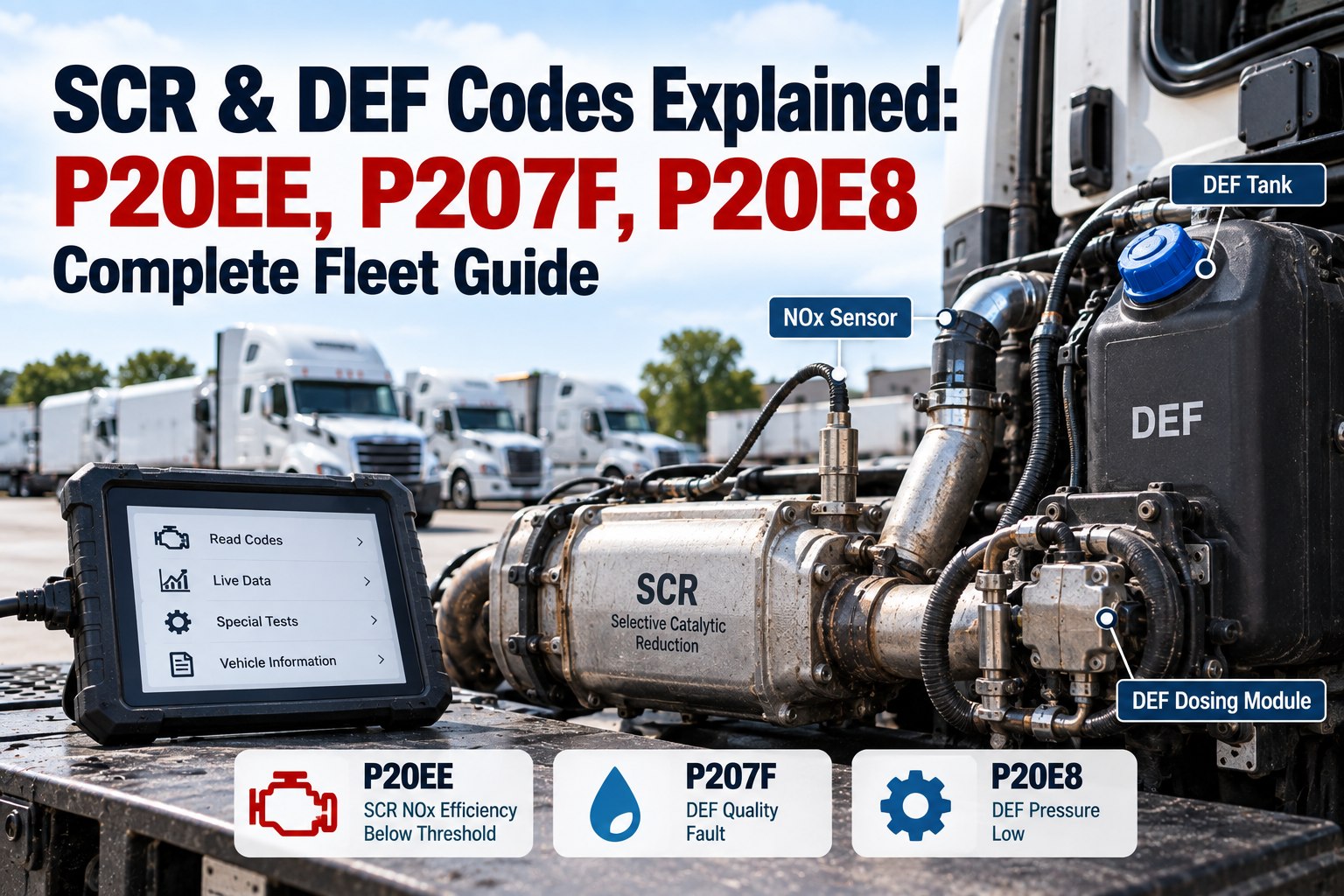
P20EE, P207F and P20E8 are the three diesel exhaust fluid and selective catalytic reduction codes that put trucks on a derate clock. P20EE means SCR NOx catalyst efficiency is below threshold — the system isn't converting enough NOx. P207F means reductant quality performance — the fluid or the dosing behind it is wrong. P20E8 means reductant pressure is too low — the DEF isn't reaching the injector at the pressure the system expects. They overlap constantly, and manufacturer bulletins show why: a Volvo repair instruction lists DEF dosing, DEF concentration, the SCR catalyst, the DPF catalyst and excessive hydrocarbon dosing as causes of P20EE, with an engine derate as the observable symptom, and it lists dosing too low, the wrong liquid in the tank, a restricted filter and a faulty DEF dosage valve behind P207F, with vehicle speed limited to 5 mph. This guide explains each code, which one to fix first, the two bench tests that settle most arguments, and how to avoid the derate. Book a demo to see SCR faults tracked to the repair, or create a free account to start with your own trucks.
Fault code guide · SCR and DEF system
Three Codes, One System: Fix Them in the Wrong Order and You'll Buy a Catalyst You Didn't Need.
For fleet mechanics, shop leads and maintenance managers: what P20EE, P207F and P20E8 each test, how they interact, and the checks that come before any expensive part.
Not enough NOx is being converted across the catalyst.
Engine derateThe fluid, its concentration or the dosing behind it is wrong.
Speed limited to 5 mphDEF isn't reaching the injector at the required pressure.
Dosing stops, derate followsDerate behaviors as listed in a Volvo Trucks repair instruction for P207F-00 and P20EE-00 filed with NHTSA. Inducement timing varies by engine calibration.
What the SCR and DEF System Is Doing When These Codes Set
Selective catalytic reduction (SCR) injects diesel exhaust fluid (DEF) into hot exhaust, where it becomes ammonia and converts nitrogen oxides into nitrogen and water across the catalyst. A NOx sensor before the catalyst and another after it tell the engine computer how well that conversion is going — Volvo notes that engines built to 2017 emissions standards carry both a pre-catalyst and a post-catalyst NOx sensor. Every one of these three codes comes from that loop failing somewhere. You can keep each truck's SCR codes and repairs in one record on a free account.
P20EE, P207F and P20E8 Explained, With the Causes Manufacturers List
Each code has its own suspect list, and the overlap between them is the reason shops replace catalysts that were never bad. These causes come from a Volvo repair instruction covering P20EE-00 and P207F-00, and from general SCR service practice for pressure faults. We can match your own SCR codes to these lists in a demo.
SCR NOx catalyst efficiency below threshold, bank 1
The post-catalyst NOx reading says conversion is too low. The catalyst is the last suspect, not the first.
- DEF dosing too low or interrupted
- DEF concentration out of specification
- SCR catalyst degraded or damaged
- DPF catalyst condition
- Hydrocarbon dosing amount too high
Reductant quality performance
The system judges the fluid itself, or the amount delivered, to be wrong.
- Dosing too low
- Wrong liquid in the DEF tank
- SCR catalyst condition
- DEF dosage valve fault
- Restricted DEF filter
- Hydrocarbon doser over-fueling
Reductant pressure too low
The pump can't build or hold dosing pressure, so dosing falls short before anything reaches the catalyst.
- Clogged DEF filter or supply line
- Weak or failing DEF pump
- Blocked or crystallized dosing valve
- Leaking lines, fittings or a loose tank pickup
- Frozen DEF or a failed heater in cold weather
Causes for P20EE-00 and P207F-00: Volvo Trucks repair instruction RD18-002, filed with NHTSA. P20E8 causes reflect general SCR service practice; confirm against your engine maker's procedure.
Which SCR Code to Fix First When Several Set at Once
When P20EE, P207F, P20E8 and NOx sensor codes all appear together, the cheapest path runs from the fluid to the catalyst. Fix supply and quality problems first, because both can produce a catalyst efficiency code on a perfectly good catalyst. Keep the order of checks on the unit's work order so the next technician sees what was ruled out, and start free with 3 vehicles.
Filter, pump, lines, dosing valve and DEF concentration. Nothing downstream works without these.
Dosing quantity test, dosing valve condition, hydrocarbon doser over-fueling.
Sensor drift and leaks near the sensors distort the conversion reading.
Only after fluid, dosing and sensing check out — and after confirming a software update isn't the fix.
| Related code | What it means | Where it usually points |
|---|---|---|
| P202E | Reductant injector performance | Dosing valve restricted, crystallized or electrically faulty |
| P218F | Reductant no flow detected | Pump, filter, lines or a blocked injector |
| P249E | Closed-loop reductant injection at limit, flow too high | System is dosing at maximum and still not converting NOx |
| P2201 / P229F | NOx sensor performance, sensor 1 or 2 | Sensor drift, wiring, or exhaust leaks near the sensor |
| P1C54 | SCR catalyst missing | System sees no catalyst response at all |
| P205B | Reductant tank temperature sensor range | Heater circuit or sensor fault, common in winter |
Related codes as named in manufacturer bulletins covering SCR and DEF faults, filed with NHTSA. Swipe the table on mobile.
The Two Bench Tests That Settle Most SCR Arguments
Before anyone opens a parts catalogue, two measurements decide whether the fluid and the dosing are doing their job. Both are quick, and both belong on the work order with their results. See test results captured on work orders in a demo.
DEF concentration check
DEF is 32.5% urea in purified water. A refractometer reading well off that figure means the tank has been diluted, contaminated or filled with the wrong fluid — which is exactly what P207F suspects.
DEF dosing quantity test
The engine maker's dosing test measures how much fluid the injector actually delivers in a set time. A low or erratic result points at the filter, pump, lines or a crystallized dosing valve rather than the catalyst.
Check for a calibration update before condemning the catalyst
Manufacturer bulletins for these codes include software updates as the repair. One FCA bulletin reprograms the engine controller for a list of faults that includes P20EE, P207F, P229F, P2201, P202E and P249E, and field cases show codes clearing after the reflash. Confirm the truck is on current software before ordering an SCR catalyst.
How Long You Have Before an SCR Code Turns Into a Derate
These codes are the ones that reduce power. Older calibrations act quickly — Volvo's bulletin lists a 5 mph speed limit as the observable symptom of P207F. Under EPA's August 2025 guidance, heavy-duty trucks with updated engine software get a warning for the first 650 miles or 10 hours, then a 15% power derate, reaching a 25 mph limit only after about 8,400 miles or 160 hours. Which applies depends on the truck's calibration. Track which trucks have the updated calibration free.
Sources: Volvo Trucks repair instruction RD18-002 (NHTSA) for the 5 mph limit on P207F; EPA diesel exhaust fluid guidance, August 2025, as reported by Waste Advantage and DieselNet.
Catch SCR codes while they are still a warning
In 30 minutes we'll show how FleetRabbit takes DEF and SCR codes from your telematics, opens a work order with the code history attached and flags the trucks that keep setting them.
What These SCR and DEF Codes Cost a Fleet to Put Right
The spread between the cheapest and most expensive outcome on these three codes is wider than almost any other fault, which is why the order of work matters so much. Downtime sits on top of all of them: benchmarking by FleetNet America and ATA's Technology & Maintenance Council puts unplanned downtime at about $448 to $760 per truck per day before towing and repair. Estimate your SCR downtime exposure with our team.
Relative cost by repair type, illustrative — not prices. Volvo's repair instruction for these codes replaces both the pre-catalyst and post-catalyst NOx sensors together.
How Fleets Keep P20EE, P207F and P20E8 Off the Dashboard
Almost every cause on these lists is a handling or maintenance item rather than a failed part. Build them into your preventive maintenance program and have drivers report DEF warnings on the DVIR. Set these checks up free on 3 vehicles.
P20EE, P207F and P20E8 Questions Fleet Mechanics Ask Most
What does code P20EE mean on a diesel truck?
SCR NOx catalyst efficiency below threshold: the system isn't converting enough NOx across the catalyst. Manufacturer causes include low DEF dosing, wrong DEF concentration, catalyst condition, DPF condition and excessive hydrocarbon dosing, with an engine derate as the observable symptom. See your own SCR fault history.
What causes a P207F reductant quality code?
Dosing that's too low, the wrong liquid in the tank, a restricted DEF filter, a faulty dosing valve, catalyst condition or hydrocarbon doser over-fueling. On the Volvo procedure, the observable symptom is vehicle speed limited to 5 mph. Log DEF quality test results free.
What does P20E8 mean and how do I fix it?
Reductant pressure too low. Check the DEF filter, pump, supply lines and dosing valve for restriction or crystallization, and rule out frozen DEF or a failed heater in cold weather before replacing the pump. Walk through the checks with us.
Can I just clear these codes and keep driving?
They will return once the monitor runs, and on many trucks the derate continues until the underlying fault is repaired and confirmed. Record the codes, repair the cause, then clear and verify. Track code history per truck free.
Do I need a new SCR catalyst for P20EE?
Not usually as the first step. Check DEF concentration and dosing, sensors and exhaust leaks, and confirm the truck is on current software — several manufacturer bulletins resolve these codes with a reflash. Review your catalyst replacements with us.
Why do NOx sensors get replaced in pairs?
Engines built to 2017 emissions standards use a pre-catalyst and a post-catalyst NOx sensor, and the conversion calculation depends on both. Volvo's repair instruction for these codes lists both sensors as required parts. Record parts used per repair free.
Keep Every DEF Test, Dosing Result and SCR Repair on One Truck Record
FleetRabbit logs each SCR and DEF code, the concentration and dosing results, the software level and the parts fitted — so the next P20EE starts from evidence instead of a parts order.