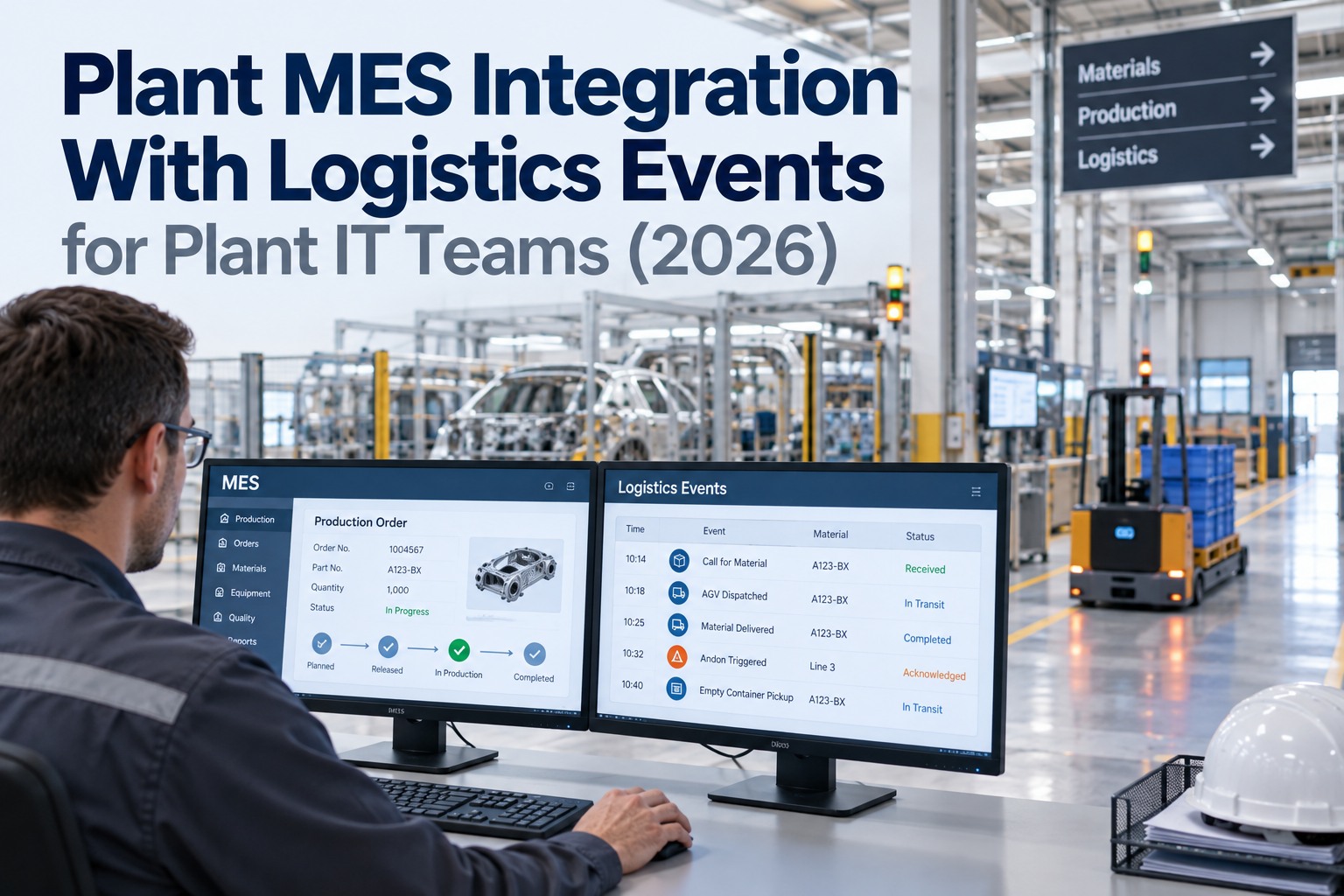
Modern discrete manufacturing plants run on disciplined line takt times where an uncoordinated delay between an execution state change and a line-side parts delivery causes immediate station starvation. Unifying a Manufacturing Execution System (MES) with plant logistics requires deep operational context: linking production order milestones directly to material pull signals, integrating line-side andon cord events into automated tugger dispatches, and enforcing strict partition-key FIFO ordering over industrial telemetry fabrics. When plant IT teams rely on traditional batch polling or disconnected manual radio calls, the result is chronic line-side buffer bloat, phantom stockouts, and compromised Overall Equipment Effectiveness (OEE). FleetRabbit provides a dedicated industrial logistics event fabric engineered for plant IT teams, combining native OPC UA and MQTT broker ingestion with resilient edge-buffering failover to synchronize material flows with actual shop-floor consumption. Book a technical demo to request the deployment brief or explore our live platform trial.
Plant MES Integration With Logistics Events
A purpose-engineered industrial middleware pattern for plant IT systems engineers—translating production order lifecycles, automated station calls, and andon signals into direct intralogistics dispatch.
Industrial Telemetry Ingestion vs Execution SLAs
Evaluating telemetry performance requires measuring propagation speed, network overhead, and payload determinism across the manufacturing perimeter. Review the performance benchmarks below.
B2MML & ISA-95 Event Schema Specification
Production order transitions require structured JSON payloads to pass equipment context, material lots, and workstation identifiers without serialization loss.
{
  "eventId": "evt_7f8a92c4e01b",
  "timestamp": "2026-09-12T14:21:30.045Z",
  "equipmentId": "LINE_04_STATION_12",
  "partitionKey": "PK_BAY_4_CELL_12",
  "eventContext": {
    "workOrderId": "WO-98442-BATCH-08",
    "productionOrderStep": "SUB_ASSY_PRESS",
    "triggerType": "OPTICAL_BIN_EMPTY",
    "andonSeverity": "CRITICAL_STARVATION_RISK"
  },
  "materialPayload": {
    "materialLot": "LOT-2026-ENG-8812",
    "partNumber": "PN-44021-HEAVY",
    "quantityRequired": 48,
    "destinationPointOfUse": "BAY4_RACK_A"
  }
}Deterministic Field Execution Rules
Routes all station messages to an isolated partition broker thread, enforcing strict FIFO arrival and zero race conditions with adjacent assembly bays.
Automatically triggers queue preemption, dynamically reallocating the closest available tugger or AMR from low-priority empty-bin return loops.
Locks component genealogy in the plant MES layer prior to physical replenishment drop, ensuring complete serial-level traceability without manual scanning.
Directly resolves coordinate geometry on the plant-floor AGV navigation map, guiding transport units straight to the line-side staging zone.
How FleetRabbit Software Executes Plant Logistics Integration
FleetRabbit acts as the industrial middleware engine that converts high-frequency machine states into physical transportation tasks without overloading your enterprise MES core.
Native OPC UA & MQTT Edge Gateway
Deploys on industrial IPCs inside the plant subnet. Connects directly to PLC NodeIDs and photoelectric sensors, converting raw binary signals into structured B2MML events in under 50 milliseconds.
Dynamic Tugger & AMR Mission Dispatch
Evaluates station urgency, buffer runout times, and vehicle locations in real time. Automatically generates turn-by-turn pick-and-drop tasks on driver mobile screens or directly interfaces with robotic fleet managers.
Autonomous Store-and-Forward Replay
Maintains an on-disk write-ahead buffer at the plant edge. If the central MES server or plant-wide network goes down, logistics dispatches continue executing locally and reconcile chronologically upon reconnection.
Closed-Loop Geofence Reconciliation
Uses barcode validation and point-of-use geofencing to confirm deliveries at the exact station rack. Automatically notifies the MES to clear andon starvation flags and logs lot genealogy without operator delays.
Plant Network Subnet Isolation & Perimeter Architecture
Preserving operational integrity demands physical and logical segmentation between high-speed machine control loops and supervisory enterprise IT layers.
Beckhoff, Siemens S7-1500, Allen-Bradley ControlLogix emitting binary register shifts over PROFINET and Modbus TCP.
Photoelectric bin-level sensors, barcode scanners, and torque tool controllers running static local IP addresses.
Performs millisecond event correlation, partition ordering, and dynamic tugger fleet assignment over local edge runtimes.
Asynchronous outbound webhooks delivering confirmed inventory movements to SAP S/4HANA, EWM, and central MES databases.
Step-by-Step Production Cutover & Verification Protocol
Transitioning from manual call systems to automated event fabrics requires a phased validation methodology to eliminate downtime during operational shifts.
OPC UA Node Namespace Discovery
Industrial edge connectors map active station PLCs, identifying machine register addresses, bin-trip bits, and manual andon inputs without halting ongoing station production.
Shadow Execution & Telemetry Auditing
The event fabric runs parallel to legacy radio calls for 7 business days, capturing call-offs and testing automated route planning against actual operator response times.
Edge Partitioning & High-Availability Stress Test
Network isolation drills simulate plant subnet disconnections, proving that edge write-ahead buffers record line-side events locally and replay them in strict chronological sequence upon link restoral.
Full Cutover to Event-Driven Pull Logistics
Physical material handling teams transition to automated mobile notifications; material replenishment missions fire dynamically based on actual line-side consumption.
Frequently Addressed Engineering Questions
How does the platform prevent duplicate material dispatches if a sensor triggers repeatedly?
The ingestion fabric uses cryptographic deduplication based on transaction nonces and a configurable sliding time window. Once an optical sensor trips for a specific station bin, subsequent triggers for the same point-of-use are ignored until the current delivery lifecycle completes and an operator or barcode confirms receipt.
What happens if the plant's central MES server experiences a restart or update?
FleetRabbit maintains an autonomous edge-buffering architecture on localized industrial IPCs. If the centralized MES or cloud network becomes unreachable, local edge brokers continue to accept station call signals, schedule tugger assignments, and record transactions in local persistent storage, re-synchronizing with the central MES upon recovery.
Can legacy machinery without OPC UA servers interface with this pattern?
Yes. Legacy workcells can be integrated using lightweight industrial protocol bridges that convert binary 24V PLC outputs, Modbus TCP registers, or digital I/O signals directly into modern MQTT or OPC UA event packets without modifying the underlying machine safety software.
How are multiple high-priority andon calls handled simultaneously?
The routing engine evaluates line takt risk, real-time safety stock buffers, and asset proximity. If multiple andon alerts occur at once, the system calculates which workstation has the shortest remaining run time before full line stoppage, preempting routine empty-tote returns and routing the nearest transport asset to the critical cell.