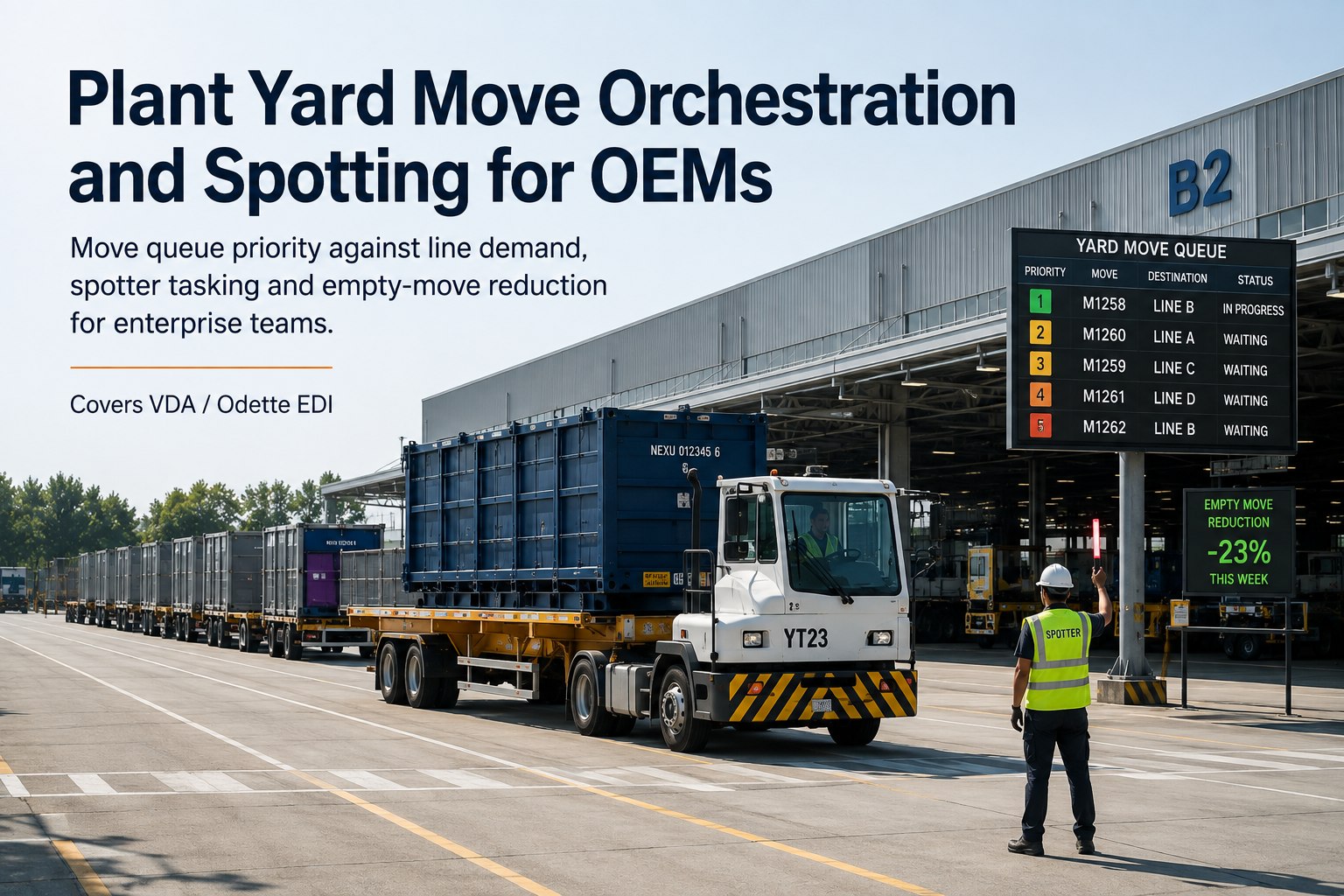
Ask a plant how it decides which trailer moves next and the honest answer, at most sites, is whoever asked loudest. Radio dispatch reacts to volume — of voice, not of freight — so a shunt driver spends the shift chasing urgent requests, arriving at a door to find the trailer already pulled, and driving back across the yard empty because nobody linked the outbound leg to the inbound one. The result is a team that logs a respectable move count and still cannot get the right trailer to the right door at the right minute. Move orchestration is the fix, and it is not fundamentally a visibility problem: automating the gate or adding location tracking without redesigning the dispatch logic changes nothing, because better visibility alone does not improve throughput unless the system also changes move decisions in real time. What follows is how a move queue is prioritised against line demand, how spotter tasking should actually work, and where empty legs hide. Request an enterprise demo to run the queue logic against your own yard.
2026 GUIDE · ENTERPRISE YARD OPS
Yard Move Orchestration and Spotter Tasking
A move queue scored against line demand instead of radio volume, tasking that reaches the driver's handset with context attached, and linked moves that stop half of every shift being driven empty.
Every Move Is One of Seven Types
Orchestration starts with naming the work. Most yards track a single undifferentiated count called "moves," which makes it impossible to tell a productive shift from a busy one. These seven cover essentially all shunt activity in a plant yard.
AGate to stageNewly admitted trailer to its assigned lane position
BStage to doorThe spot. The move that actually feeds the dock
CDoor to empty poolPulling the unloaded trailer clear so the door can work again
DEmpty pool to gateRelease to a collecting carrier
ERehandleMoving a trailer only to reach another one. Pure waste
FRepositioningLane rebalancing ahead of a known demand peak
GNon-move taskInspection, securement, equipment checks. Real work, not a move
The measurement trap
A spotter logging twelve moves while spending three hours on inspections is performing very differently from one logging twelve moves in six hours of pure move time — and a single "moves per shift" figure rates them identically. Split type G out before you judge anybody's productivity, and count type E separately, because rehandles are the one category you want to drive toward zero rather than optimise.
The Move Queue, Scored
This is what a dispatch board looks like when priority comes from line demand rather than from who called in. Every ticket carries its own score, its own reason, and a clock — so the driver knows not just what to do next but why it outranks the thing they were about to do.
Rank
Move
Driver
Score
1
TR-4471 · Stage L2 → Door 3Sequence window opens in 38 min · seat sets
Sequence
96
2
TR-2208 · Door 3 → Empty poolUnload complete · door blocked, linked to rank 1
Door release
91
3
TR-3915 · Stage L1 → Door 7Booked slot in 12 min · general inbound
Slot due
74
4
TR-5560 · Gate → Stage L1Checked in 6 min ago · validated despatch advice
Intake
58
5
TR-1104 · Empty pool → GateCarrier collecting · detention clock at 94 min
Detention
51
6
TR-8832 · Stage L4 → Stage L2Rebalance ahead of 14:00 peak · no deadline
Reposition
22
Note ranks 1 and 2 — the door release is deliberately scored just below the spot it enables, so the pair executes as one linked instruction rather than as two independent tickets that might land with two different drivers. That single design choice removes more empty running than any routing algorithm.
What Feeds the Score
Six inputs, with indicative weights. Publish yours — a driver who understands the ranking will accept being reordered mid-shift, and a supervisor who does not will simply override it back to whoever shouted.
← Swipe to see all columns →
Visibility alone will not fix this. The dispatch logic has to change.
An enterprise demo runs your yard geometry, door list and sequence windows through the scoring model and shows the queue your shift would have had this morning.
Where the Empty Legs Are
The difference between an unlinked and a linked move chain is not subtle. Same six productive moves, same yard, same driver — the only change is that each move's destination is chosen with the next move already known.
Unlinked — dispatched one ticket at a time
Stage→D3
empty
Gate→L1
empty
D3→Pool
empty
Stage→D7
empty
Every productive leg is followed by a return leg carrying nothing. The driver is busy all shift and half the running is waste.
Linked — paired on the next known task
Stage→D3
D3→Pool
short
Pool→Gate
Gate→L1
short
Stage→D7
Each arrival is already at the origin of the next task. Empty running collapses to short repositioning hops, and moves per hour rises without anyone driving faster.
Productive move
Short reposition
Empty leg
Six Sources of Wasted Running
Each has a different fix, and only one of them is about the driver. Work down the list in order — the first three are dispatch design and cost nothing but configuration.
Unpaired return legsCause: tickets issued individually with no lookahead into the queue.Fix: linked-move sequencing — pair each task with the nearest logical next one at the point of dispatch.
Search timeCause: trailer position held in memory or on a whiteboard rather than in a system.Fix: live position per trailer, pushed to the handset with the task, not looked up on arrival.
RehandlesCause: staging assignment ignored extraction order, so reaching one trailer requires shifting others.Fix: single-move extraction as a mandatory rule in sequence lanes, measured as moves per extraction.
Chasing urgent callsCause: radio dispatch that reorders around whoever escalates most effectively.Fix: a scored queue with a published weighting, and a named approver for any manual override.
Empties left on live doorsCause: door release treated as low priority because nothing is visibly waiting.Fix: score the pull just below the spot it enables — every minute an empty holds a working door delays the next inbound.
Idle waiting for instructionsCause: dispatcher is a person with a radio and a finite attention span.Fix: the next task is already queued on the handset before the current one completes.
Where an Eight-Hour Shift Actually Goes
Before and after orchestration, illustrative but representative. The productive move count barely moves at first — what changes is the ratio, and the ratio is what determines whether you need another spotter or another shift.
Productive
Empty
Search
Idle
Non-move
Radio dispatch
Productive
Empty
Search
Idle
Non-move
Orchestrated queue
Non-move time is unchanged deliberately — inspections and securement do not disappear, and any vendor claiming otherwise is describing a different job. The recoverable time sits in empty running, search and idle waiting, which together can account for more of a shift than the productive moves do.
Tasking Rules That Hold Up Under Pressure
Encode these as rules with owners. Every one will be argued against at the exact moment it matters. Our analytics and reporting module tracks the thresholds.
1Tasks reach the handset with position, contents and reason attached — never as a location alone.
2The next task is queued before the current one is confirmed complete. Idle waiting is a dispatch failure.
3Door releases score immediately below the spot they enable, so the pair dispatches as one instruction.
4Manual override requires a named approver and is logged. Overrides are data, not exceptions.
5Queue age escalates score, so nothing starves behind a permanent stream of urgent work.
6Move completion is confirmed by the driver, not assumed by the system. Assumed completions poison every metric downstream.
7Non-move tasks are dispatched and timed like moves, or they will be blamed for a productivity gap they did not cause.
8Call-to-door time is the service level. Strong spotter teams hold it inside fifteen minutes.
Messages That Trigger Moves
In European automotive the demand signals a move queue needs mostly arrive as EDI. This is the mapping worth building — each message either creates a move, changes a move's priority, or cancels one, and a queue wired to them stops depending on a human noticing.
VDA 4987 despatch adviceCreates the intake move and binds contents, so the stage lane is chosen automatically. Replaced legacy VDA 4913, derives from EDIFACT DESADV.
VDA 4937 APERAKValidation acknowledgement. Until it lands, the trailer routes to the exception lane rather than into normal staging flow.
VDA 4915 JIT call-offSets the sequence window that dominates queue scoring. This is the message that makes rank 1 rank 1.
VDA 4945 transport statusIn-transit events that pre-create or cancel an intake move before the vehicle reaches the barrier.
VDA 4902 Odette labelScanned at the barrier, confirming the move ticket matches the physical trailer in seconds.
VDA 4905 delivery scheduleForecast volume, which is what spotter headcount and shift pattern should be sized against.
See the Queue Running on Your Yard
An enterprise demo takes your yard geometry, door list, staging lanes and sequence windows, and replays a real shift through the scoring model — showing the queue order, the linked pairs, and where this morning's empty running actually went. Runs on handsets your team already carries.
Demand-scored move queue
Linked-move sequencing
Handset tasking
VDA / Odette triggers
Frequently Asked Questions
What is a realistic spotter productivity figure?
Fifteen to twenty-five moves per spotter per eight-hour shift is the typical published range, varying with yard size and move distance. But treat the raw number carefully: low productivity usually reflects idle time waiting for instructions, equipment problems, or a heavy load of non-move tasks rather than driver pace. Labour hours per move is the more diagnostic figure, because a rising value points directly at too many handoffs, unclear prioritisation or over-reliance on manual coordination.
We added yard tracking and nothing improved. Why?
Because visibility and orchestration are different things. Automating gate entry or adding location tracking without redesigning the dispatch logic is a well-documented failure mode — better data does not improve throughput unless the system also changes move decisions in real time. If drivers still receive tasks by radio in the order people ask, knowing exactly where every trailer sits simply makes the same bad queue better informed. The economic sweet spot is usually a yard management layer combined with automated gate processing, position visibility and dynamic move assignment together.
How much empty running is normal?
More than most sites believe, because it is rarely measured. Deadhead percentage should be a standing metric alongside moves per driver and queue times. The structural cause is dispatching tickets individually rather than pairing each with the nearest logical next task — linked-move sequencing optimises distance, cuts empty runs and lifts moves per hour without anyone driving faster. Start by measuring it for two weeks; the figure itself usually makes the case.
Why prioritise pulling empties off doors so highly?
Because a finished trailer sitting at a working door blocks the entire downstream chain, and nothing visible is queueing for it, so it loses every informal priority contest. Strong spotter teams clear empties off live doors aggressively for exactly this reason — every minute an empty holds a door is a minute the next inbound waits somewhere it should not be. Scoring the release just below the spot it enables makes the pair execute together instead of the release drifting to the bottom of the list.
What service level should we hold move times to?
Call to door inside fifteen minutes is the benchmark strong dedicated spotter operations maintain, alongside staging the next several loads before anyone asks. Measure it as a distribution rather than a mean — the outliers are where the sequence exposure lives, and an average of eleven minutes can comfortably conceal a handful of forty-minute moves that each cost a dock hour. Consistency matters more than the headline figure.
Do we need new hardware for handset tasking?
Not usually. Task dispatch, position display, completion confirmation and linked-move pairing all run on ruggedised phones or tablets the operation already has, and existing yard tractor GPS or trailer telematics can feed position automatically where present. Fixed infrastructure becomes worth costing once the dispatch logic is proven and the remaining waste is identified. Our
integrations overview covers the telematics surface.
How do we stop supervisors overriding the queue?
Make overrides legitimate but visible. Blocking them entirely fails on the first genuine emergency and destroys trust in the system; allowing them silently means the queue is decorative within a month. Require a named approver, log the reason, and review override frequency weekly. High override rates are usually not indiscipline — they are a signal that the scoring weights are wrong for your site, and reviewing them is how the model gets calibrated rather than abandoned.
Dispatch on Demand, Not on Volume of Voice
A move queue scored against the sequence window, tasks that arrive on the handset with context and a reason, linked pairs that eliminate the return leg, and a productivity picture that separates real moves from search, idle and inspection time.
Runs on existing handsets · Works alongside existing EDI · Site-level configuration