Power steering fluid service on a commercial truck is almost never a fluid problem on its own. It is an air problem, a filter problem or a wrong-product problem that shows up in the fluid, and the reservoir tells you which one before anybody quotes a pump. Pink-coloured frothing or foam in the reservoir, or tiny air bubbles in the fluid, is entrained air — and the driver reports it as a lumpy feel to the steering, or a chatter, like the steering wheel is vibrating. Air matters more than most shops treat it: it can cause catastrophic damage to the pump due to cavitation, and the way it gets in is simple enough to be uncomfortable — if steering fluid is leaking out, air could be leaking in. Meanwhile 49 CFR 393.209 sets hard limits on steering wheel lash by wheel diameter, requires that belts not be frayed, cracked or slipping, and requires that the system not leak at all. This guide covers the lash limits, the five places air gets in, how to read the fluid by colour, the symptoms and their real causes, and what the service costs. Book a 30-minute demo to see steering checks held on record, or start free with 3 vehicles.
If Steering Fluid Is Leaking Out, Air Is Leaking In. That's the Whole Diagnosis.
For diesel technicians, shop leads and fleet maintenance managers: the 393.209 lash table, the five air ingress points, what the fluid colour is telling you, and how to make a steering check that survives an inspection.
No credit card required. Drops into the PM sheet you already run.
The Lash Limit Is a Number, Not a Feel
Steering wheel lash is the first thing an inspector measures and the last thing most shops write down. 49 CFR 393.209 sets the maximum by steering wheel diameter, and a power system is allowed roughly twice what a manual system is. Measure it at the rim and record the figure. Log measured lash per unit, free on 3 vehicles.
Limits per 49 CFR 393.209(b). For steering wheel diameters not listed in the rule, the limit is expressed as angular rotation instead: 14 degrees for manual steering systems and 30 degrees for power steering systems. Measure at the wheel rim with the wheels straight ahead and the engine running.
| What 393.209 requires | The condition as written |
|---|---|
| Steering wheel | Secured, with no spokes cracked through or missing |
| Steering column | Securely fastened |
| Joints and gear box | No worn, faulty or welded universal or ball-and-socket joints; no loose or missing bolts and no cracks in the gear box |
| Pitman arm | Not loose on the steering gear output shaft |
| Wheel travel | Wheels must turn freely through full travel |
| Power steering belts | Not frayed, cracked or slipping |
| Power steering system | Must not leak, and the reservoir fluid level must be sufficient |
Requirements above are per 49 CFR 393.209, steering wheel systems, as published in the current eCFR.
Five Places Air Gets Into a Steering System
Air is the failure mode that looks like every other failure mode. It makes a good pump moan, makes steering feel lumpy, and if it is left alone it can cause catastrophic damage to the pump due to cavitation. Work the ingress points in order rather than replacing parts and hoping. We'll walk your own steering complaints through this in a demo.
The low-pressure side between reservoir and pump. A joint here can be dry on the outside and still pull air in, because the pressure inside is below atmospheric.
A worn shaft seal draws atmospheric air, and it does it most readily on a cold start before the seal has swelled to temperature.
A weeping fitting is a two-way fault. If steering fluid is leaking out, air could be leaking in.
A gear seal that leaks under reversal pulls air in as the gear changes direction, which is why the symptom often appears only in turns.
A return line dumping above the fluid level, or a level low enough to uncover the pickup, aerates the fluid on every stroke.
Schematic is simplified and not to scale; hose routing, reservoir position and gear type vary by chassis. Working pressure range and the air-source list are drawn from published power steering diagnostic guidance — confirm the pressure specification for your gear and pump before testing.
Was the Lash Measured, or Did It Just "Feel Fine"?
A steering line on a PM sheet that carries no number cannot show a trend and cannot answer an inspector. In 30 minutes we'll set up steering as a measured check — lash figure, fluid condition, belt state, leak found or not — so the next PM compares against the last one instead of starting over.
Reading the Fluid by Colour Before You Quote a Pump
Four appearances cover almost everything that walks into a shop as a steering complaint. This is a thirty-second check with the cap off, and it changes what you quote. Photograph the reservoir onto the work order, free.
Correct fluid, no entrained air, no water. This is what the reservoir should look like with the engine running and the fluid warm.
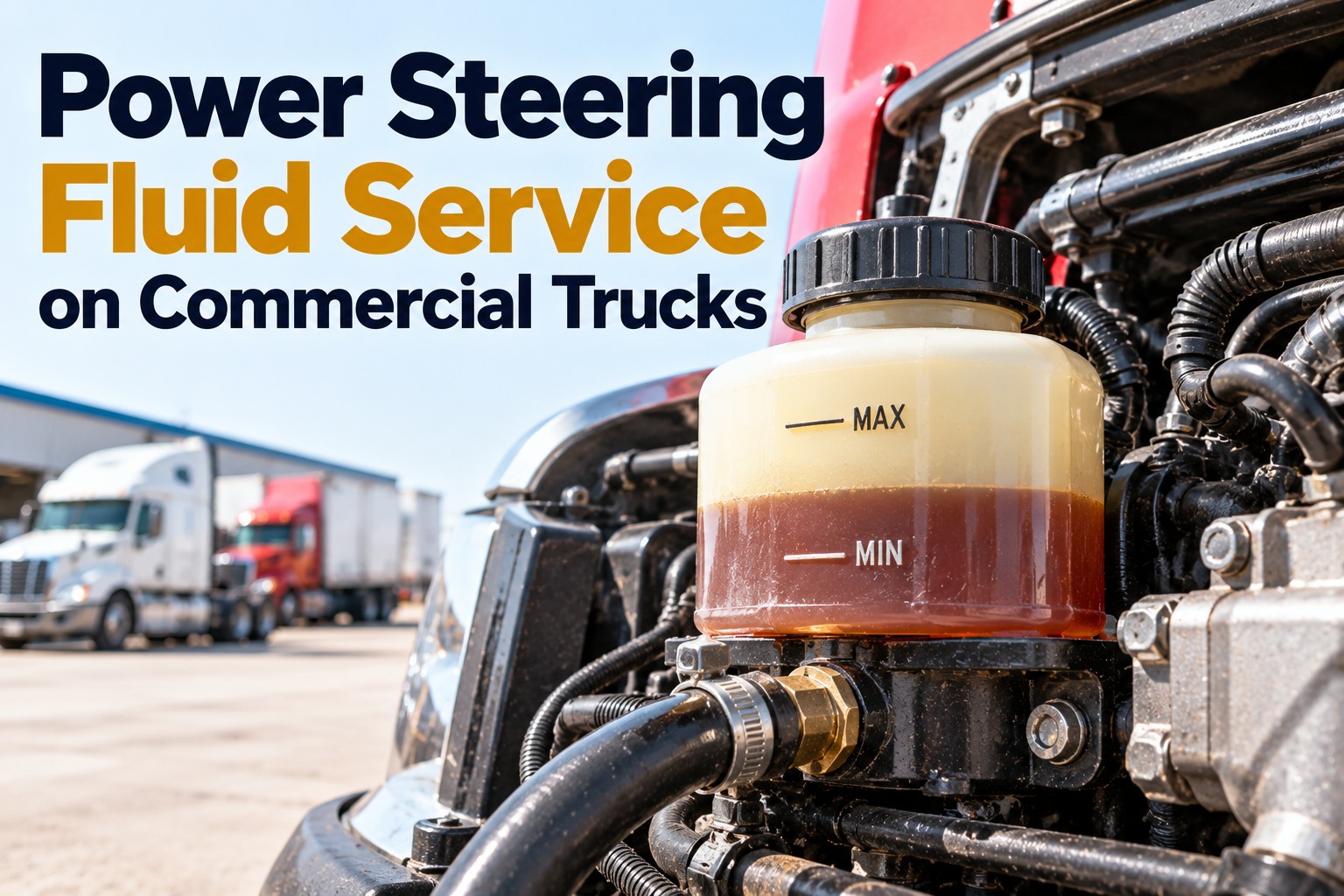
Entrained air. Pink-coloured frothing or foam in the reservoir, or tiny air bubbles in the fluid, is the signature — and the driver usually reports it as a lumpy feel to the steering, or a chatter, like the steering wheel is vibrating.
Metallic particles from mechanical pump failure. The fluid is now an abrasive slurry, so replacing the pump without flushing the system buys you a second pump failure.
Water ingress, usually through the reservoir cap or a breather during washdown. Water destroys the fluid's ability to carry load and corrodes the gear from the inside.
Fluid appearance indicators are drawn from published heavy-duty steering maintenance guidance, including ZF and Bendix steering specialists quoted in Heavy Duty Trucking, and from power steering pump diagnostic guidance in Tomorrow's Technician.
Never fit a replacement pump into unflushed fluid
Mechanical pump failure contaminates the fluid with metallic particles, and those particles are still in the gear, the hoses and the reservoir when the new pump goes on. Flush the circuit and change the reservoir filter as part of the pump job, not as an upsell — otherwise the second failure is on the shop, and it usually arrives inside a year.
Symptoms, and What They Actually Mean
Steering complaints are reported as noise and effort, and the part the driver blames is rarely the part at fault. Read the symptom to the cause. Map your own driver reports with our team. Swipe the table on mobile.
| What gets reported | What it usually is | What to check first |
|---|---|---|
| Whine or growl that rises with engine speed | Pump struggling to draw fluid — clogged reservoir filter or a pinched return hose | Look in the reservoir before touching the pump; a growl from a starved pump is not a worn pump |
| Moan or groan, worst on lock | Aerated fluid, or level low enough to uncover the pickup | Fill to level, then find the air. Topping it up without finding the leak just resets the clock |
| Lumpy or chattering steering feel | Entrained air in the system | Check the reservoir for pink froth and tiny bubbles, then work the ingress points in order |
| Heavy steering at low speed, normal at road speed | Low pressure or flow — slipping belt, weak pump or restriction | Check belt condition and tension first; 393.209 puts frayed, cracked or slipping belts out of spec on their own |
| Steering effort that changes turn to turn | Gear seal drawing air as the gear reverses | The intermittent symptom is the clue; a seal that only leaks under reversal only aerates under reversal |
| Fluid dark or gritty, pump recently replaced | Metallic debris left in the system from the first failure | Flush the circuit and change the filter, or the replacement pump goes the same way |
| Excessive play at the wheel before the tyres move | Lash beyond the 393.209 limit for the wheel diameter | Measure it against the table rather than judging it by feel, and record the measurement |
Doing the Service So It Holds Up
Eight steps, and the two that get skipped most are the filter and the measurement. Put them on the inspection report and into preventive maintenance so the steering check carries a number every time.
A cold reading and a hot reading are different, and the regulation asks for sufficient fluid in the reservoir — which means at the level the gauge or dipstick actually calls for, not merely above empty.
Colour and clarity answer most of the diagnosis. Pink froth means air, grey and gritty means the pump is already making debris, milky means water got in.
Improper fluids cause foaming and can adversely affect steering rack seals, hoses and other soft components. Brake fluid and engine oil do not belong in a steering system at any point.
Hoses fail from the outside in. Check for weathering or cracks, and treat a weeping fitting as an air path as well as a leak.
A clogged filter makes a healthy pump growl. It is the cheapest part in the circuit and the one most often left in place.
Not "steering feels fine". A measured figure against the limit for that wheel diameter is what survives an inspection and what shows a trend at the next PM.
Ensure that bolts are securely torqued across the system — the Pitman arms, drag links, even the tie rods — and confirm the axle stops are properly set.
Mechanical pump failure contaminates the fluid with metallic particles, and those particles stay in the gear and the hoses unless the system is flushed.
What Power Steering Service Costs Against What It Prevents
A filter, a few litres of the right fluid and a measured lash reading against a pump, a gear, or a truck put out of service at the roadside. Industry benchmarking puts unplanned downtime at roughly $448 to $760 per truck per day before the repair, and ATRI puts 2025 repair and maintenance cost at $0.215 per mile, up 8.6%. Work out your own exposure with our team.
Relative cost by where the problem is caught, illustrative — not prices. Downtime benchmark: FleetNet America and ATA's Technology & Maintenance Council via industry reporting; per-mile cost: ATRI.
Power Steering Fluid Questions Fleets Ask
What fluid goes in a commercial truck power steering system?
Whatever the steering gear and pump maker specifies for that unit — which on many heavy trucks is a transmission fluid rather than something sold as "power steering fluid". The specification matters because improper fluids cause foaming and can adversely affect steering rack seals, hoses and other soft components. Brake fluid and engine oil never belong in the system. Check your spec with our team.
Why is my power steering fluid foamy or pink?
That is entrained air. Pink-coloured frothing or foam in the reservoir, or tiny air bubbles in the fluid, is the signature, and it usually comes with a lumpy feel to the steering or a chatter at the wheel. Find the ingress point rather than topping it up, because air can cause catastrophic damage to the pump due to cavitation. Record the finding on the work order, free.
How much steering wheel play is legal on a truck?
It depends on the wheel diameter. Under 49 CFR 393.209 a power steering system with a 20-inch wheel is allowed 5¼ inches of lash at the rim, and a 22-inch wheel 5¾ inches; manual systems are held to roughly half that. Diameters not listed in the rule are limited to 30 degrees of angular rotation for power systems and 14 degrees for manual. See lash logged per unit in a demo.
Why does my power steering whine or growl?
Most often the pump is struggling to draw fluid — a clogged reservoir filter or a pinched return hose will produce a growling noise from a pump that is otherwise healthy. Check the reservoir and the filter before condemning the pump. Track filter changes per unit free.
Do I need to flush the system when replacing the pump?
Yes. Mechanical pump failure contaminates the fluid with metallic particles, and those particles remain in the gear, hoses and reservoir after the pump comes off. Fitting a new pump into contaminated fluid is the most reliable way to buy a second pump. Put the flush on the job template.
Can a slipping belt fail an inspection on its own?
Yes. 49 CFR 393.209(e) states that belts shall not be frayed, cracked or slipping, and that the system shall not leak. Neither condition needs to have caused a steering complaint to be a defect. Add belt condition to the checklist free.
How often should power steering fluid be changed?
On the interval the chassis and steering gear maker give, shortened where the duty cycle is hard on the fluid — high ambient temperature, constant low-speed manoeuvring, refuse and yard work. Condition, not mileage, is the better trigger: fluid that has gone dark, milky or gritty is due regardless of when it was last done. Set the interval per unit in a demo.
Make the Steering Line Carry a Number
FleetRabbit holds measured lash, fluid condition, belt state and the leak found or not against each unit, so a steering complaint arrives as a work order with the last three readings already attached — and an inspector gets a figure instead of an opinion.
No credit card required. Start with your next PM.