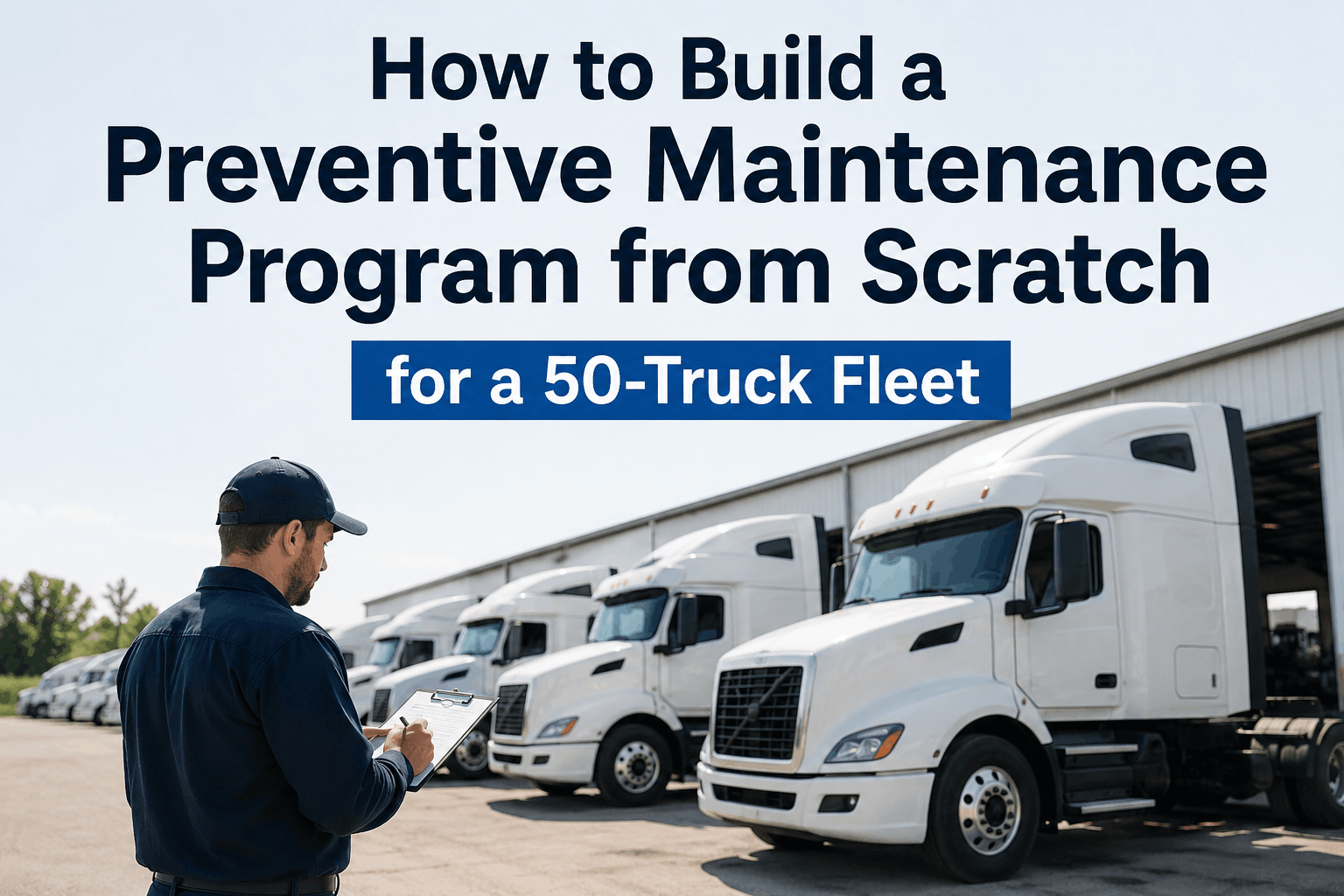
Building a preventive maintenance program from scratch for a 50-truck fleet isn't just about scheduling oil changes — it's a strategic overhaul that can save your operation over $150,000 annually in avoided breakdowns, extended asset life, and reduced emergency repairs. Most fleet managers inherit chaotic maintenance logs, missed service windows, and unexpected roadside failures. But when you design a data-driven PM program tailored to your 50 trucks, you transform maintenance from a cost center into a reliability engine. Ready to blueprint your system? sign up for FleetRabbit's guided setup or book demo to see live automation.
Why a Preventive Maintenance Program Is Non‑Negotiable for 50 Trucks
With 50 Class 8 trucks logging an average of 120,000 miles each per year, even a 5% increase in unexpected downtime equals hundreds of lost revenue hours. A structured preventive maintenance program fleet reduces roadside events by up to 47%, according to industry benchmarks. More importantly, it lowers your cost per mile by catching small issues — worn brake pads, minor coolant leaks, early tire wear — before they become catastrophic failures. Fleet managers who implement rigorous PM schedules see ROI within the first six months, often exceeding 300%. The formula is simple: consistent inspections + digital tracking + proactive parts management = maximum uptime. For a 50-truck fleet, that translates to 8–12 fewer breakdowns per month. Want numbers tailored to your operation? sign up for a free fleet health snapshot.
Daily Inspections
Pre‑trip: tires, lights, fluids, belts, leaks
Every 10K mi
Oil + filter, chassis lube, air filter check
25K - 30K mi
Brake adjustment, wheel bearings, alignment
50K mi
Transmission service, coolant flush, diffs
Annual / 100K
AC recharge, electrical, suspension bushings
Major 200K mi
Injectors, turbo inspection, clutch assessment
Step 1: Foundation — Data Collection & Fleet Segmentation
Before you write a single PM work order, audit every truck's VIN, current mileage, engine hours, and last service date. For a 50‑truck fleet, you'll likely discover that 30% of units are overdue for basic service. Segment your fleet into three duty cycles: long‑haul (highway, 120k+ miles/year), regional (mixed, 60k‑90k/year), and short‑haul/local (stop‑and‑go, under 50k/year). Each segment requires different vehicle service intervals. For example, stop‑and‑go trucks need brake inspections twice as often as highway trucks. Use this data to build a baseline fleet maintenance planning matrix. Without this foundation, your PM program will be guesswork. To automate this entire audit, sign up and connect your fleet data in minutes.
? 30‑Day PM Launch Timeline for 50 Trucks
Full fleet audit: mileage, service gaps, parts inventory
Define A/B/C PM levels & interval rules per truck type
Implement digital PM software, configure automated alerts
Pilot on 10 trucks → refine → full rollout & training
Weekly compliance review & data‑driven interval tuning
Step 2: Assign Clear Ownership & Deploy Digital PM Tools
The best PM schedules fail without role clarity. Assign each truck to a primary driver who performs daily walk‑arounds using a mobile checklist. Designate shop leads to schedule and close PM work orders based on mileage triggers. With 50 trucks, manual tracking via whiteboards or spreadsheets breaks down quickly — you'll miss 20‑30% of PM windows. A digital platform like FleetRabbit eliminates this gap: real‑time dashboards show which trucks are due, overdue, or coming due. It also sends push notifications to drivers and mechanics. One fleet manager reduced overdue PMs from 38% to 6% within 60 days using this approach. See exactly how it works: book demo and watch a live walkthrough of automated PM workflows.
Step 3: Build Your Multi‑Level PM Schedule (A/B/C Framework)
For a 50‑truck fleet, a one‑size‑fits‑all service interval leads to over‑maintaining some trucks and under‑maintaining others. Adopt the A/B/C framework:
? Level A (Light PM) – every 10,000–12,000 miles: engine oil & filter, chassis lube, air filter inspection, fluid top‑offs, tire pressure check, visual brake inspection. Takes 1.5 hours per truck.
?️ Level B (Medium PM) – every 30,000–35,000 miles: all Level A items + brake lining measurement, wheel bearing repack, alignment check, drive belt inspection, coolant specific gravity test. Allow 3–4 hours.
⚙️ Level C (Major PM) – every 60,000–70,000 miles: includes Level A+B + transmission fluid & filter, differential oil change, fuel filter replacement, turbo inspection, valve lash adjustment (if applicable), full electrical diagnostics. Allow full day per truck.
Use telematics data to adjust intervals: dusty environments may require air filter changes twice as often, while heavy hauling shortens brake service life. A digital PM platform automatically adapts these intervals based on real usage. Want to import OEM recommendations instantly? sign up and access FleetRabbit's library of 500+ pre‑built PM checklists.
? Real KPIs to Measure PM Program Health (50‑Truck Benchmark)
Step 4: Smart Parts Inventory & Vendor Partnerships
Nothing kills a PM schedule faster than missing a $12 oil filter. For a 50‑truck fleet, you need a lean but complete stock of fast‑moving parts: oil filters (multiple brands), fuel filters, air filters, brake shoes/pads, belts, coolant, and common sensors. Set reorder points based on PM frequency — for example, if you perform 10 Level A services per week, keep 20 oil filter kits in stock. Partner with two local vendors for competitive pricing and backup availability. Digitize your parts room with barcode scanning to prevent stockouts. FleetRabbit's inventory module sends low‑stock alerts and integrates with your PM work orders so mechanics know parts are ready before the truck arrives. To see inventory automation in action, book demo and we'll show you how to reduce parts downtime by 40%.
Step 5: Driver Engagement & Pre‑Trip Inspection Excellence
Drivers are your first line of defense against major failures. Implement a digital pre‑trip inspection (DTI) process where drivers use a mobile app to check 20+ points: lights, tires, fluids, belts, leaks, brakes, and coupling devices. For a 50‑truck fleet, aim for 98% daily DTI completion. When drivers report issues (e.g., "brake pedal feels spongy"), the system automatically creates a follow‑up work order. This proactive culture reduces surprise roadside events by up to 55%. Offer incentives for drivers who consistently submit high‑quality inspections. Also, train drivers to understand the preventive maintenance program fleet goals: more uptime = more miles = higher bonuses. Provide quarterly refreshers on spotting early warning signs. FleetRabbit's driver app makes checklists visual and simple. Get your team on board: sign up and start a free driver pilot program today.
Advanced Tactics: Condition‑Based Monitoring & Predictive Analytics
Once your basic PM schedules are humming, upgrade to condition‑based maintenance (CBM). Use telematics data like engine oil pressure, coolant temperature, and battery voltage to predict failures before they happen. For example, a gradual drop in oil pressure may indicate a failing pump — catch it during a Level A service instead of on I‑80 at 2 AM. Similarly, track brake stroke frequency; excessive stroke length means adjustment is needed. For a 50‑truck fleet, CBM can reduce unplanned downtime by an additional 25% beyond traditional PM. FleetRabbit integrates with major telematics providers (Geotab, Samsara, etc.) to bring this data into your PM dashboard. You'll see a "health score" for each truck and get predictive recommendations. Want to explore predictive maintenance? book demo and we'll show you live examples from real fleets.
? Cost Impact: Reactive vs. Preventive for 50 Trucks (Annual)
Avg. roadside call: $1,200
25 calls/year → $30,000
Major engine failure: $22,000 (2x/year) → $44,000
Lost revenue due to downtime: $85,000
Total: ~$159,000+
PM labor & parts: $42,000
Reduced roadside calls (70% less): $9,000
Extended engine life: $7,500 saved
Reduced lost revenue: $21,000
Net cost: ~$44,500
? Annual savings ≈ $114,500
*Based on typical 50‑truck mixed fleet. Your numbers may vary, but the ROI direction is clear.
Implementation Checklist: Launch Your PM Program in 30 Days
Week 1 – Audit & Data Cleaning: Collect odometer readings, last service dates, and VINs for all 50 trucks. Enter into a digital fleet system. Identify top 10 overdue vehicles and prioritize immediate service.
Week 2 – Define Intervals & Software Setup: Set A/B/C intervals based on OEM and duty cycle. Configure FleetRabbit with automated mileage triggers, email/SMS alerts, and role assignments (shop lead, drivers, parts manager).
Week 3 – Pilot & Training: Run the PM program on 10 trucks (mix of duty cycles). Train drivers on mobile inspection app. Run a dry week to catch workflow issues.
Week 4 – Full Deployment & Compliance Review: Roll out to all 50 trucks. Hold a weekly review meeting: PM completion rate, parts stock levels, driver feedback. Adjust intervals based on early data.
Need a ready‑to‑use checklist template? sign up and we'll email you a 30‑day implementation guide plus editable Excel templates for PM tracking.
Frequently Asked Questions – Building Your PM Program
FleetRabbit is trusted by fleet managers nationwide to build, execute, and optimize preventive maintenance programs. From 10 trucks to 200+, our platform adapts to your workflow. Start your journey to zero unplanned downtime today.