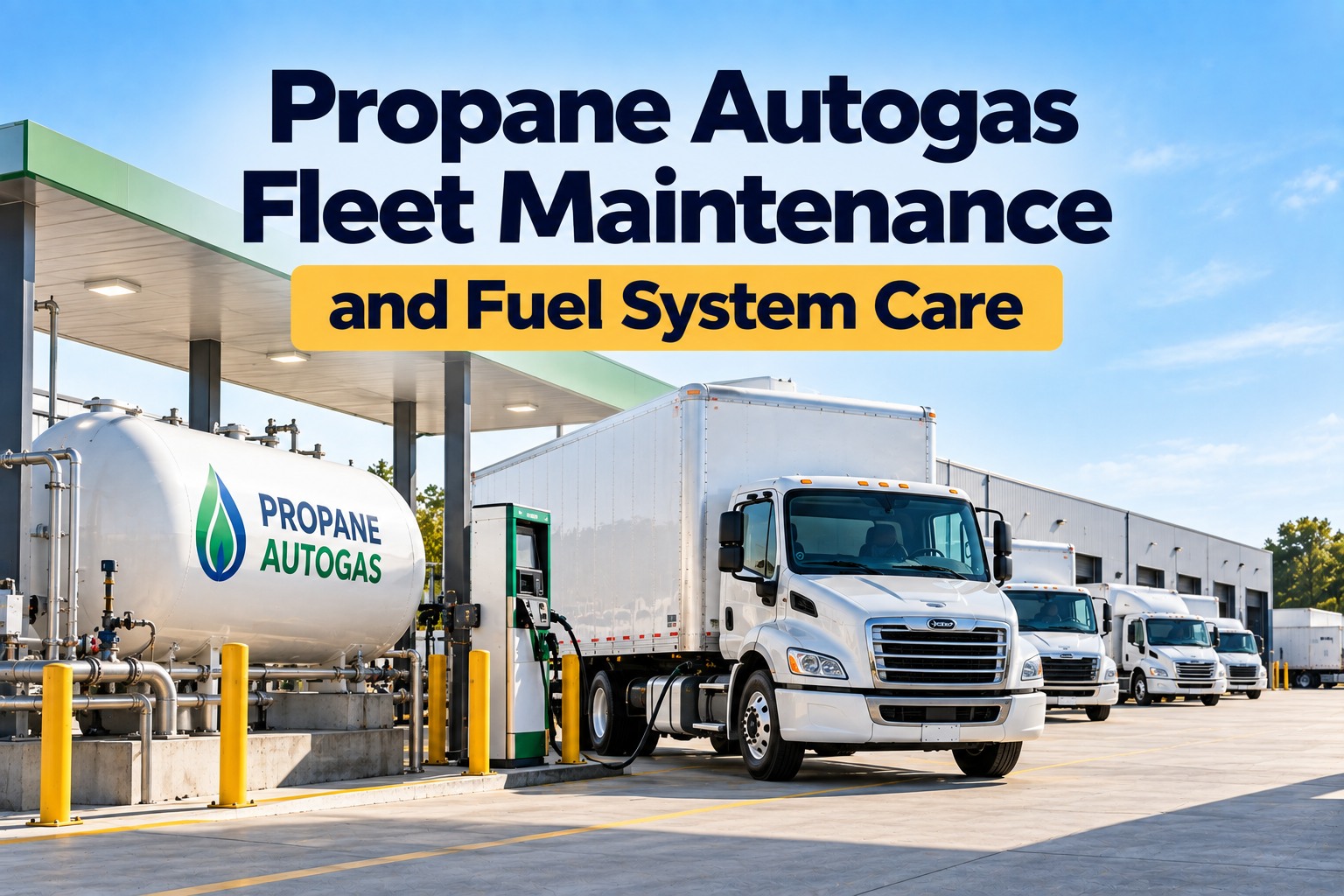
Across the alternative fuels, propane autogas is the one that moves in the opposite direction. Battery electric adds high-voltage qualification and charging infrastructure. CNG adds a 3,600 psi system with a certified inspection regime. Hybrids add an entire electric drivetrain on top of the diesel. Propane adds a tank holding about 150 psi — which the Department of Energy describes as roughly twice the pressure of an inflated truck tire — and DOE attributes to it a "potential for lower maintenance costs" from "low carbon and low oil contamination characteristics" that "may result in longer engine life." The trade-offs are real, but they are not maintenance trade-offs. See your propane PM schedule set up.
The Alternative Fuel That Makes the Workshop Simpler
What propane actually changes on a maintenance schedule, why its pressure regime keeps work in house, the two trade-offs worth planning around, and how it compares with diesel, CNG and electric on the things a workshop has to carry.
Start With the Pressure
Almost everything that makes propane easier to live with in a workshop follows from one number, and it is best understood next to the alternative.
DOE states propane is "stored onboard a vehicle in a tank pressurized to about 150 pounds per square inch — about twice the pressure of an inflated truck tire." A CNG system runs at 3,600 psi service pressure against a 4,500 psi design ceiling. Both are pressurised systems that demand respect, proper components and trained handling, and neither should be improvised on. But a twenty-four-fold difference in pressure is what separates a fuel system a competent diesel workshop can largely maintain from one that requires a certified container inspector on a regulated interval.
Six Things That Genuinely Work in Your Favour
Each of these is drawn from what DOE publishes rather than from vendor material, which matters on a topic where the marketing runs ahead of the evidence.
- Low carbon and low oil contaminationDOE attributes propane's “potential for lower maintenance costs” directly to this, noting it “may result in longer engine life.” Cleaner combustion means less soot loading the oil, which is the mechanism behind most of the claimed benefit.
- A pressure regime a workshop already understandsAbout 150 psi, which DOE compares to roughly twice an inflated truck tire. That is a different world from a 3,600 psi CNG system with its certified inspection regime, and it keeps far more work in house.
- No high-voltage qualificationNothing on a propane vehicle requires insulated tooling, PPE for electrical work or a documented de-energising procedure. The skills your diesel technicians already hold cover the vehicle.
- Genuinely good in the coldDOE states propane performs well in cold climates because the propane and air mixture is completely gaseous entering the combustion chamber, letting these vehicles avoid many cold-start issues associated with diesel.
- Higher octanePropane has a higher octane rating than gasoline, making it more resistant to knocking and compatible with higher compression ratios — which is why purpose-built propane engines exist rather than only conversions.
- Spills are not a contamination eventIf released from a vehicle, DOE notes propane “presents no threat to soil, surface water, or groundwater.” On a yard with drainage concerns that removes a category of problem entirely.
Note the careful wording DOE uses: "potential for lower maintenance costs" and "may result in longer engine life." That is a mechanism with a plausible consequence rather than a measured guarantee, and your own oil analysis results on your own duty cycle are worth more than any published claim — which is an argument for measuring it from the first vehicle rather than assuming it.
Running propane next to diesel on separate spreadsheets?
Most of a propane vehicle's maintenance is identical to the diesel parked beside it. Only the fuel system differs. We will set up one unit so the shared intervals run once and the fuel-specific ones raise on their own — and show you the cost-per-mile comparison corrected for propane carrying less energy per gallon.
What Actually Sits on the Propane PM Sheet
The fuel system is the only part of the vehicle that differs, so it is worth being specific about what it contains rather than leaving it as a category.
On the storage side there is the tank itself with its valves, the fill valve and the service valve, plus the mounting that holds it to the chassis — inspected for corrosion, security and damage the same way any mounted component is, and with whatever periodic requirement applies to your container type and jurisdiction.
Between the tank and the engine sit the components that do the work: the fuel lines and fittings, the lock-off valve that isolates supply when the engine stops, a filter that catches whatever the fuel carried with it, and the regulator or vaporiser that converts liquid propane to vapour and drops it to working pressure. The vaporiser on many systems is heated by engine coolant, which quietly ties the fuel system to the cooling system — a coolant problem can present as a fuel problem, and that connection surprises people the first time.
On the engine side, propane-specific injectors or mixers, and the control electronics managing them. Everything downstream of combustion — exhaust, and whatever aftertreatment the application carries — behaves according to the engine rather than the fuel, though cleaner combustion is the reason the aftertreatment burden tends to be lighter on spark-ignition propane than on an equivalent diesel.
Follow the manufacturer's service information for your specific system rather than a generic list, and confirm which tasks your installer expects to do versus which stay in house. The honest summary is that this is a fuel system with a regulator in it — genuinely familiar territory for a workshop, which is the whole point of the comparison on this page.
Four Fuels, One Comparison
The dimensions a workshop actually has to plan around, across every powertrain a mixed fleet is likely to run. Swipe the table sideways on mobile.
| What the workshop carries | Diesel | Propane autogas | CNG | Battery electric |
|---|---|---|---|---|
| Tank or storage pressure | Atmospheric | About 150 psi | 3,600 psi service, 4,500 psi design | Not applicable |
| Periodic container inspection by a certified inspector | No | Not on the CNG regime | At least every 12 months on a heavy vehicle | No |
| High-voltage qualification for technicians | No | No | No | Yes, for the propulsion system |
| Refuelling or charging infrastructure | Existing | Tank and dispenser, modest footprint | Compressor, storage, dispenser | Chargers, electrical service, possible upgrade |
| Aftertreatment burden | DPF, DEF, SCR | Much reduced on spark ignition | Much reduced | None |
| Cold-weather penalty | Gelling, hard starts | Performs well; fuel is gaseous entering the chamber | Generally good | Range falls 41% at 20°F |
| Energy density per gallon or charge | Baseline | 27% less energy per gallon than gasoline | Lower; more frequent filling | Range-limited by pack |
| Argonne repair cost scaling, MHDV | 100% | Not separately published | Not separately published | 60% for battery electric |
Read down the propane column and the pattern is clear: it is the only alternative fuel in the set that does not add a new qualification requirement, a new inspection regime or a new category of infrastructure. What it adds is a fuel system, and fuel systems are something every workshop already understands. Argonne publishes repair cost scaling for conventional, hybrid, plug-in hybrid and battery electric medium and heavy duty vehicles but not separately for propane, so that row is left honest rather than filled in.
The Two Trade-Offs, and Three Smaller Ones
The case for propane is strong enough that it does not need the costs hidden. Swipe on mobile.
| The trade-off | What it means in practice | Response |
|---|---|---|
| 27% less energy per gallon than gasoline | You carry more fuel to go the same distance, so tank sizing and refuelling frequency both change. On a route-constrained operation this is the first thing to model, not the last. | Plan around it |
| Fuelling infrastructure is thinner than diesel | Better than CNG or public DC charging, but it still needs planning. Most fleets install on site, which is a modest project rather than a major one — but it is a project. | Install on site |
| Fuel system components still need service | Regulators, filters, lock-off valves and injectors are real parts with real intervals. Lower pressure means easier handling, not an absence of maintenance. | Schedule it |
| Tank requirements vary by type and jurisdiction | Vehicle propane containers are built and marked to recognised standards, and what is required of them over their life depends on the container type and where you operate. Confirm with your installer and your own regulator. | Check locally |
| Conversions need the right installer | Propane vehicles come from OEMs or via conversion, and the quality of a conversion determines most of what follows. This is not the place to optimise on price. | Specify carefully |
The energy density point is the one that catches people, because it is easy to compare fuel prices per gallon and reach a conclusion that does not survive contact with a fuel log. A gallon of propane carries 27% less energy than a gallon of gasoline, so any comparison has to be made per mile or per unit of energy rather than per gallon. That is not a reason against propane — it is a reason to build the comparison properly.
How FleetRabbit Handles This
Four things, and the first is what stops a fourth fuel type becoming a fourth system.
Propane units sit on the same vehicle record as diesel, CNG, hybrid and electric, with only the fuel-specific tasks differing. Four fuel types do not need four systems.
Regulator, filter and lock-off service raise on their own schedule while brakes, tires, suspension and inspections run exactly as they do on every other unit.
Propane carries 27% less energy per gallon than gasoline, so a cost-per-mile comparison built on gallons without accounting for that is misleading. Record energy and distance and let the comparison be real.
DVIR, annual inspection, brake stroke and the rest are identical whatever is in the tank — which is most of the compliance burden, and the part that benefits most from not being split.
Questions Fleets Ask
Does propane really reduce maintenance?
DOE states propane offers "potential for lower maintenance costs," attributing it to low carbon and low oil contamination characteristics that "may result in longer engine life." That is a mechanism rather than a guaranteed figure, so treat it as a reason to measure your own oil analysis and intervals from the first vehicle rather than as a number to put in a business case. Start measuring free.
How does the tank pressure compare with CNG?
About 150 psi against 3,600 psi service pressure for CNG — roughly twenty-four times the difference. DOE compares a propane tank to about twice the pressure of an inflated truck tire. Both are pressurised systems needing proper components and training, but the regimes around them are not comparable. Review your fuel mix.
What inspections do propane tanks need?
Requirements depend on the container type and your jurisdiction, and they are not the annual certified-inspector regime that applies to CNG containers on heavy vehicles. Confirm the specifics with your installer and your own regulator rather than assuming either extreme — and record whatever applies so it comes due on its own. Check your tank requirements.
How does it perform in winter?
Well. DOE notes propane performs well in cold climates because the propane and air mixture is completely gaseous entering the combustion chamber, letting these vehicles avoid many cold-start issues associated with diesel. Set against battery electric losing 41% of range at 20°F, cold weather is one of propane's clearer advantages. Compare winter performance.
Is the fuel cheaper?
Often per gallon, but the comparison has to be per mile. A gallon of propane carries 27% less energy than a gallon of gasoline, so a price-per-gallon advantage partly closes once you account for consumption. Run it on your own fuel log over a quarter rather than on a pump price. Log your first fill free.
OEM vehicle or conversion?
Both exist and DOE references both routes. The practical difference is that a conversion's quality depends entirely on the installer, and most of the problems fleets report trace back to that choice rather than to the fuel. Specify carefully and treat installer selection as the decision it is. Talk through the options.
Can we run it alongside diesel, CNG and electric?
Yes, and the shared portion is larger than most fleets expect. Body, brakes, tires, suspension and every inspection obligation are identical across all four; only the fuel or powertrain tasks differ. Keeping them on one maintenance record is what makes a four-fuel fleet manageable rather than four parallel problems. Run all four together.
Add a Fuel Type Without Adding a System
FleetRabbit treats fuel as an attribute of the vehicle rather than a reason for a separate schedule — shared intervals run once, fuel-specific tasks raise on their own, and consumption is recorded so a cost-per-mile comparison across diesel, propane, CNG and electric is actually valid.
Free for 3 vehicles · no credit card required