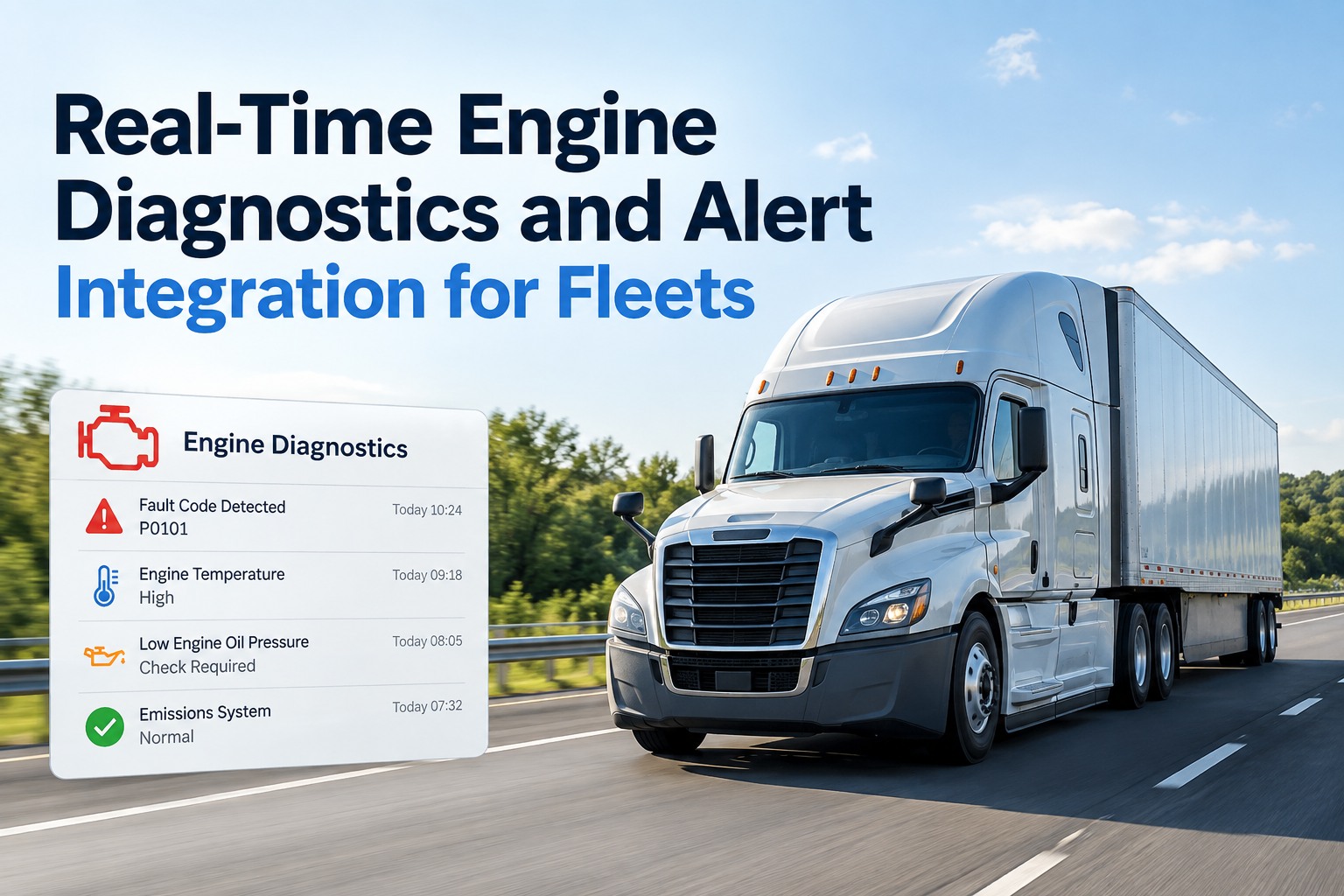
Real-time engine diagnostic alerts only reduce breakdowns when each fault code is read for severity, given to a named owner and closed before the truck's next dispatch. Heavy-duty engines already broadcast every active fault over the J1939 network — the SAE standard data bus used in North American trucks — roughly once a second, so detection is rarely the problem. The gap is what happens after the alert fires. This guide gives you a decoder for the four numbers in every code, a lamp-to-response matrix, the 2025–2026 DEF derate timeline, and the routing rules that turn an engine alert into a closed, audit-ready work order. Book a demo to see engine codes routed into repairs, or start a free account and connect your own units.
ENGINE DIAGNOSTICS · ALERT INTEGRATION GUIDE
Real-Time Engine Diagnostics and Alert Integration for Fleets
For maintenance managers and fleet operations leads who already run telematics: how to triage engine fault codes by severity, route each one to the right person, and prove it was fixed.
ProtectEngine protection on
AmberFix before it escalates
WHY NOW
An Unrouted Engine Alert Costs More Every Year
Repair costs are climbing faster than inflation, and fleets are keeping trucks longer before replacement — so engines are older, fault codes are more frequent, and every code left sitting in an inbox carries more risk. Federal rules add a hard edge: under 49 CFR 396.7, a vehicle may not be operated in a condition likely to cause a breakdown, and an engine that has already reported a severe fault is hard to defend as fit to dispatch.
$0.215/mi
Repair and maintenance cost in 2025, up 8.6% year over year (ATRI, 2026)
633,772 mi
Average truck mileage at replacement, up nearly 50,000 (ATRI, 2026)
18.1%
Vehicles placed out of service at the 2025 International Roadcheck (CVSA)
Every Engine Fault Code Is Four Numbers
A J1939 diagnostic trouble code (DTC) tells you which controller reported the fault, what failed, how it failed and how many times — read all four before you decide anything. Active faults travel in the DM1 message; faults that were active and have since cleared are kept in DM2, which is why codes should be captured on a work order before anyone clears them.
SA 0
Source address
Which controller reported it. 0 is the engine ECM.
SPN 110
Suspect parameter number
What failed. SPN 110 is engine coolant temperature.
FMI 16
Failure mode identifier
How it failed. 16 means above normal, moderately severe.
OC 3
Occurrence count
How often. Three activations is a pattern, not a blip.
The dash lamp is not the severity of each code
J1939 carries one lamp status per controller, and it reflects the worst active fault on that module rather than each code separately. A red stop lamp from the engine ECM can sit on top of two or three amber-level codes, and fixing the red one can leave the others unseen. Triage by SPN and FMI, then use the lamp as the floor for urgency — not the whole answer.
See every active code on your units by SPN and FMI — create a free FleetRabbit account
Match Each Lamp to a Response Window and an Owner
A lamp only becomes useful when it maps to a response time and a person, so write that mapping down once and apply it to every alert. The windows below are a starting policy most fleets can adopt, then tighten by vocation and duty cycle. Swipe the table horizontally on mobile.
← Swipe to see all columns →
A written lamp policy is the difference between an alert and a repair.
Bring your current alert setup to a 30-minute session and we'll map each lamp to a response window and an owner in FleetRabbit, using your own units.
Read the FMI to Decide Where Diagnosis Starts
The failure mode identifier tells a technician whether to suspect the system or the sensor circuit, which decides whether the first hour goes to a wiring check or a teardown. Group the FMIs you see into six families and the first diagnostic step becomes obvious.
Out of range, most severe
FMI 0FMI 1
The reading is valid and dangerously high or low. Trust it and investigate the system itself.
Out of range, moderate
FMI 16FMI 18
A real trend that has crossed a limit. Schedule the repair before it becomes FMI 0 or 1.
Out of range, least severe
FMI 15FMI 17
Early drift. Watch the occurrence count and fold the check into the next PM.
Circuit faults
FMI 3FMI 4FMI 5FMI 6
Voltage high or low, open or grounded circuit. Check connector, harness and sensor before ordering the component.
Mechanical response
FMI 7
The system did not respond as commanded. Suspect the actuator, valve or linkage.
Data and network
FMI 2FMI 9FMI 19
Erratic, late or corrupted data. Check the data link and the reporting module first.
Same parameter, opposite jobs
SPN 100 · FMI 1
Engine oil pressure is genuinely, severely low. This is a stop-the-truck event and a lubrication-system investigation.
SPN 100 · FMI 4
The oil pressure sensor circuit voltage is low. The engine may be healthy, but it has lost the signal that protects it — a same-day sensor or wiring repair, not an overhaul.
Send us your ten most frequent codes and we'll sort them by FMI family with you
DEF Derates Changed in 2025–2026 — Your Fleet May Run Two Schedules
Selective catalytic reduction (SCR) derates — the power and speed limits an engine imposes after a diesel exhaust fluid (DEF) or aftertreatment fault — now depend on which software calibration each truck carries. That makes the MIL the lamp whose urgency varies most from one unit to the next.
Before Aug 2025
Trucks could be limited to 5 mph within about four hours of a DEF-related sensor alert.
Aug 2025
EPA guidance for heavy-duty trucks: warning only for the first 650 miles or 10 hours, then a 15% power derate with no speed limit, and a final 25 mph limit only after roughly four work weeks.
Jan 2026 onward
Engine makers roll out updated ECM calibrations. Cummins covers on-highway engines from model year 2017, with a 25 mph final truck limit — and states the update is not covered under warranty.
Jul 2026
EPA proposed replacing SCR derates with audible and visual warnings for model year 2027+ engines. A proposal, not a final rule.
Two derate clocks in one yard
Until every unit is reflashed, a mixed fleet runs old and new inducement schedules side by side. Record ECM calibration status per truck: an MIL on an unflashed unit is a same-day job, while the same code on an updated unit can go into a planned slot inside its warning window. Engine makers are also clear that inducement is not a maintenance strategy.
Know Which Trucks Are on Which Derate Schedule
Bring your unit list and model years. We'll show you how to record calibration status as a vehicle field in FleetRabbit, next to each truck's fault and repair history, so MIL alerts are prioritized by real exposure instead of dash color.
Calibration status per unit
Fault history in one place
Works with your telematics
How an Engine Alert Becomes a Closed Work Order
Integration earns its keep in five steps, and fleets usually lose the fault between the second and the fourth. FleetRabbit sits downstream of your existing telematics — GPS and telematics platforms such as Geotab, Samsara and Verizon Connect, or OEM telematics — so your hardware and driver apps stay as they are.
1
Receive the active code
The fault arrives tied to the right unit, with SPN, FMI and whatever lamp, location and odometer data your provider sends — nobody retypes a unit number.
2
Collapse the repeats
DM1 repeats roughly every second while a fault is active. Group by unit, SPN and FMI so one fault is one alert, and raise priority when the occurrence count climbs.
3
Classify it
Apply the lamp matrix and the FMI family to set a priority and a due time — the same rule every time, not whoever happens to see it.
4
Assign it to a person
A
maintenance work order with an owner, a due date and the unit's code history. This is the step an alert-only setup skips.
5
Verify and close
Parts and labor are logged against the job, and closure is confirmed when the code moves from active to previously active and stays there. The record sits with the unit's
inspection history, kept for the one-year and six-months-after-disposal periods 49 CFR 396.3 requires.
Put your first units on live fault routing — sign up free
Five Rules That Prevent Alert Fatigue
The fastest way to kill an engine alert program is to send people every message the data bus produces, so filter before you notify. Use these as a checklist when you configure alerts.
✓
Alert on state changes, not broadcasts. A fault becoming active or its count rising is news; the same DM1 frame for the thousandth time is not.
✓
One alert per unit, SPN and FMI. Escalate priority when the occurrence count climbs instead of sending another alert.
✓
Page people only for red and protect. Amber and MIL codes go to the planner's queue with a due time.
✓
Never clear a code before it's on the work order. Clearing first erases the evidence the technician needs.
✓
Review the ten most frequent codes every week. A code that returns after repair points to a root cause, not a part.
Walk through these alert filters on your own fleet in a demo
Frequently Asked Questions
What are real-time engine diagnostic alerts?
They are notifications generated when the engine control module reports an active fault code over the J1939 network, forwarded by your telematics device within moments. Each alert carries the source controller, the SPN, the FMI, the occurrence count and the lamp status.
See real alerts decoded in a demo.
Which engine fault codes should stop a truck immediately?
Any code accompanied by a red stop lamp, and range faults with FMI 0 or 1 on safety-critical parameters such as oil pressure or coolant level. Under 49 CFR 396.7, a vehicle likely to break down should not be operated.
Set up stop-level routing on your units free.
Do we need to replace our telematics or ELD?
No. FleetRabbit takes fault codes from the platform you already run and turns them into maintenance work, so hardware, hours-of-service logging and driver apps stay as they are.
Check your provider's compatibility with us.
How do we avoid alert fatigue?
Alert on state changes rather than every broadcast, merge repeats of the same unit, SPN and FMI into one alert, and only page people for red and protect lamps. Everything else goes to a planner queue with a due time.
Try these filters on your units free.
How did the 2025 EPA DEF guidance change derates?
For heavy-duty trucks, a DEF fault now brings a warning for the first 650 miles or 10 hours, then a 15% power derate, with a 25 mph limit only after roughly four work weeks — but only once the truck's ECM calibration is updated.
Map which of your units are updated.
What records do we need to keep for engine repairs?
49 CFR 396.3 requires inspection, repair and maintenance records to be kept where the vehicle is housed or maintained for one year, and for six months after the vehicle leaves your control. A closed work order with the fault code attached covers the repair side of that record.
Start building that record free.
Turn Every Engine Code Into a Job With a Name On It
Your trucks already report their faults. FleetRabbit brings them into your maintenance workflow, so each one gets a priority, an owner and a closed repair on file for your next audit — without replacing the telematics you already run.
No credit card required · No new hardware · Your telematics stays as it is
September 21, 2026By Alex Rowan
All Blogs