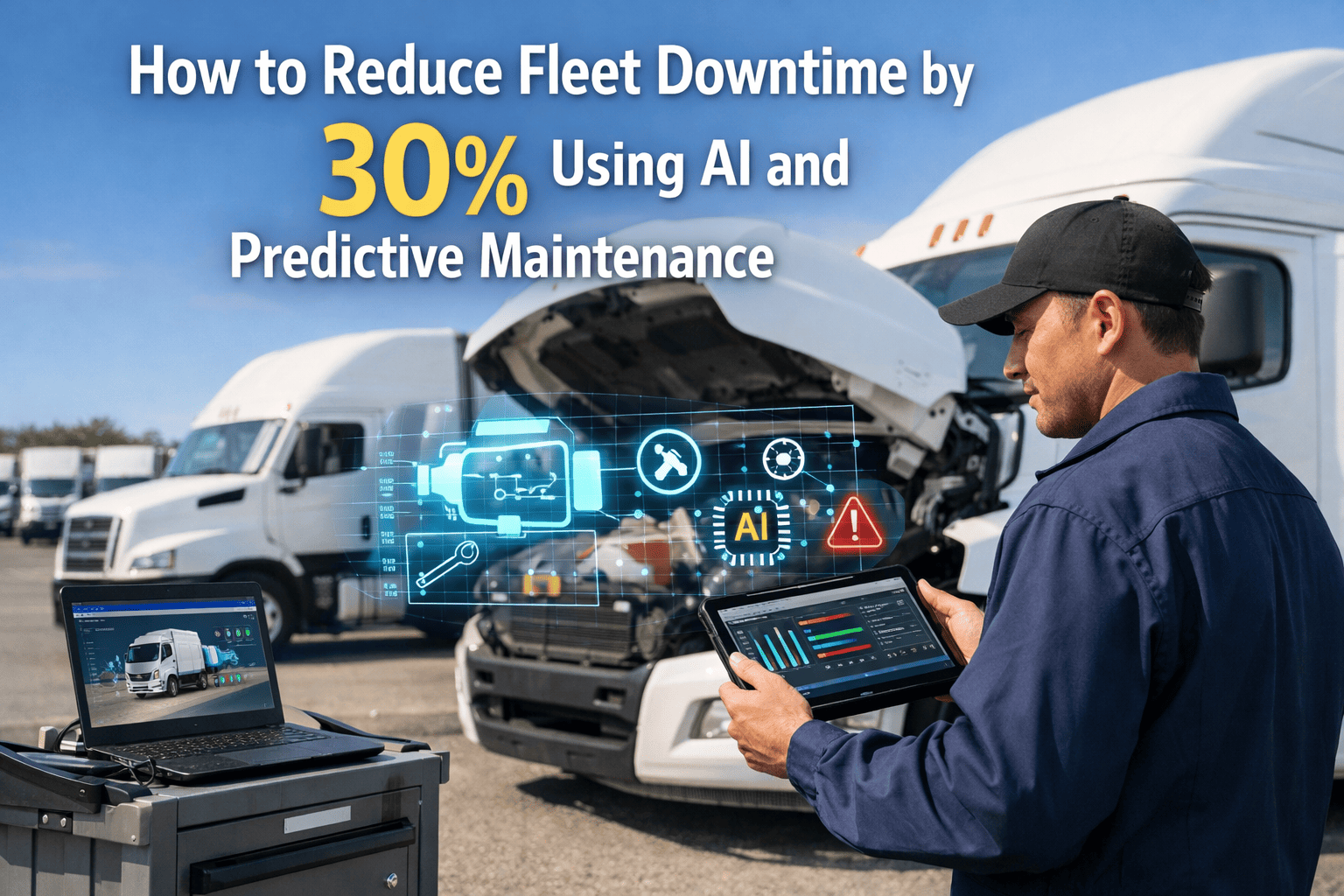
Unplanned breakdowns are silently draining profits from logistics companies every single day. Industry data shows that unplanned vehicle downtime can cost fleet operators between $500 to $1,000 per vehicle per month— and for fleets running 20, 50, or 100+ trucks, that number compounds into a serious operational crisis.
The good news? AI and predictive maintenance have changed the game. Fleet managers using modern AI fleet management software are now reducing downtime by 25–35%, cutting maintenance costs, and keeping vehicles on the road longer — without adding headcount.
Want to Reduce Fleet Downtime by 30%?
See how FleetRabbit's AI-powered platform keeps your trucks moving and your costs down.
What Is Fleet Downtime — And Why It's So Costly
Fleet downtime is any period when a vehicle is out of service and unable to generate revenue. This includes unplanned breakdowns on the road, vehicles sitting in the shop waiting for parts, missed inspections that pull trucks from service, and delays caused by reactive maintenance cycles.
The cost isn't just the repair bill. Every hour a truck sits idle translates into:
- Lost revenue from delayed or missed loads
- Customer dissatisfaction and contract penalties for late deliveries
- Emergency repair premiums — roadside breakdowns cost 3–5x more than scheduled shop repairs
- Driver retention issues — drivers don't stay with fleets that put unreliable equipment on the road
- Higher insurance exposure from vehicles that fail mid-route
For a fleet of 20 trucks, even a conservative estimate of $600/vehicle/month in downtime costs adds up to $144,000 per year in pure losses — before accounting for lost revenue opportunities.
The Top Causes of Fleet Downtime
Most fleet downtime is preventable. These are the root causes that operations managers see again and again:
- No structured maintenance tracking — service intervals are missed because there's no automated reminder system
- Purely reactive repairs — problems are only addressed after a vehicle breaks down, not before
- Skipped or incomplete inspections — DVIRs done on paper get lost, defects go unreported, and small issues become major failures
- Zero real-time visibility — fleet managers don't know vehicle health status until a driver calls in broken down
- Parts stockout delays — when a repair is finally needed, the right parts aren't in inventory
- No performance trend data — without historical data, it's impossible to predict which vehicles are at risk
If any of these sound familiar, your fleet is operating in a mode that guarantees higher downtime than necessary.
Why Traditional Maintenance Methods Are Failing Your Fleet
Most mid-sized fleets are still running on outdated systems: Excel spreadsheets for service tracking, paper-based DVIR logs that nobody reviews, and calendar reminders that get ignored when things get busy. Some fleets use basic software that records maintenance history but offers no forward-looking insights.
The core problem with traditional maintenance is that it's entirely backward-looking. You record what happened, but you can't predict what's about to go wrong. You know a vehicle had its oil changed six weeks ago, but you don't know that the engine temperature sensor has been running 8% above normal for the past three days — a warning sign that a cooling system failure is 72 hours away.
Traditional systems also create information silos. Maintenance data lives in one place inspection data in another, fuel consumption data somewhere else entirely. Without a unified view, patterns go undetected until they become breakdowns.
What Is Predictive Maintenance? (A Simple Explanation)
Predictive maintenance uses real-time sensor data, vehicle telematics, and AI algorithms to detect early warning signs of mechanical failure — before the vehicle breaks down. Instead of waiting for a problem to appear or relying on fixed-interval service schedules, predictive systems continuously monitor vehicle health and alert your team when something needs attention.
Think of it like a health monitoring system for your trucks. Just as a wearable device tracks heart rate variability and flags abnormal patterns before a health event occurs, predictive maintenance monitors engine diagnostics, brake wear, tire pressure, transmission behavior, and dozens of other parameters — flagging anomalies the moment they appear.
The result: your maintenance team works on a vehicle at a convenient, planned time — not at 2am on the side of the highway.
How AI Actually Reduces Fleet Downtime
This is where the technology creates real, measurable business impact. Here's exactly how AI-powered predictive maintenance translates into fleet downtime reduction:
AI systems continuously analyze data from OBD-II ports, telematics devices, and integrated sensors. Engine fault codes, abnormal fuel consumption patterns, and temperature deviations are detected instantly — not at the next scheduled inspection.
Machine learning models trained on fleet failure data identify which warning patterns precede specific component failures. When those patterns emerge on your vehicles, the system sends an alert — with a recommended action and estimated time-to-failure window.
Instead of servicing vehicles on a fixed calendar, AI schedules maintenance based on actual vehicle condition and usage patterns. High-mileage vehicles in demanding duty cycles get serviced more frequently; lightly used assets aren't pulled for unnecessary service.
Digital DVIR processes ensure every pre- and post-trip inspection is completed, documented, and reviewed. Defects trigger immediate alerts to fleet managers, creating an unbroken chain of vehicle health accountability.
AI identifies which vehicles, drivers, and routes generate the most wear — enabling proactive rotation, driver coaching, and route optimization decisions that extend vehicle life and reduce failure rates.
Fleets that implement AI-based predictive maintenance consistently report 25–35% reductions in unplanned downtime within the first 6–12 months — with the largest gains coming from eliminating breakdown events that would have required roadside assistance.
See FleetRabbit's AI Maintenance Platform in Action
Real-time alerts, predictive scheduling, and automated inspections — built for fleets managing 10 to 1,000+ vehicles.
How FleetRabbit Uses AI to Eliminate Preventable Downtime
FleetRabbit is built specifically for fleet operators who are done accepting preventable breakdowns as a cost of doing business. The platform combines AI-powered predictive maintenance, automated digital inspections, and real-time fleet visibility into a single dashboard — replacing the spreadsheets, paper logs, and disconnected tools that create blind spots in your operations.
Here's what fleet managers get when they use FleetRabbit:
- Predictive maintenance alerts that flag vehicles at risk of failure before they break down — with specific component-level guidance so your shop knows exactly what to address
- Automated DVIR and inspection workflows that ensure every driver completes inspections correctly, and every defect is escalated to the right person immediately
- Real-time fleet health dashboard showing the status of every vehicle — what's in service, what's in the shop, and what needs attention — from any device, anywhere
- Smart PM scheduling that builds service reminders based on mileage, engine hours, and vehicle condition — not just calendar dates
- Parts and inventory integration so the right parts are staged before a vehicle comes in for service, eliminating shop delays
- Maintenance cost tracking by vehicle, driver, and route — giving you the data to make better asset management decisions
FleetRabbit is designed to be operational in days, not months — with no complex implementation or IT infrastructure required. Start your free trial here and see how the platform fits your operations.
Real Business Benefits: The Numbers That Matter
A logistics company operating 35 refrigerated trucks was experiencing an average of 4–6 unplanned breakdowns per month — each costing $800–$1,200 in emergency repairs plus missed delivery revenue. After implementing AI-powered predictive maintenance, the fleet reduced breakdowns to 1–2 per month within 8 months. The maintenance team shifted from fighting fires to executing planned service. Annual savings exceeded $85,000 in avoided repair costs alone, not counting the revenue impact of improved on-time delivery rates.
5 Steps to Start Reducing Fleet Downtime Right Now
You don't need to overhaul your entire operation overnight. Here's a practical roadmap for implementing AI-driven downtime reduction:
Replace paper DVIRs with digital inspection workflows. This creates an auditable record of every vehicle's condition and ensures defects are captured, reported, and acted on — not buried in a pile of paper forms.
Integrate your existing GPS and telematics devices with a fleet management platform. This unlocks real-time vehicle health data that becomes the foundation for predictive analytics.
Move away from calendar-based PM schedules. Configure maintenance triggers based on mileage, engine hours, and sensor thresholds — so service happens when the vehicle needs it, not based on an arbitrary date.
Establish a single view of your entire fleet's maintenance status, upcoming service needs, and open defects. This gives operations managers the visibility to make proactive decisions before issues escalate.
Measure downtime by vehicle, driver, and route. Use this data to identify your highest-risk assets, coach drivers on behaviors that cause accelerated wear, and build a continuous improvement cycle that reduces downtime month over month.
Frequently Asked Questions
Most fleets see measurable reductions in breakdown events within 60–90 days of implementing AI-powered predictive maintenance. Full optimization — where the system has enough historical data to make highly accurate predictions — typically takes 6–12 months. Quick wins like digitizing inspections and automating PM reminders often show immediate impact on shop efficiency and missed-service rates.
No. Fleets as small as 10–15 vehicles see meaningful ROI from predictive maintenance tools. The cost of even a single roadside breakdown — emergency towing, repair premium, missed load revenue — typically exceeds a full month of fleet software costs. Smaller fleets actually feel breakdown impacts more acutely since there's less redundancy to absorb the disruption. FleetRabbit is free for up to 3 assets — no credit card required.
Generally no. Most AI fleet management platforms — including FleetRabbit — integrate with existing telematics providers, GPS systems, and OEM diagnostic tools. You can layer predictive maintenance capabilities onto your current hardware investment without starting from scratch.
Preventive maintenance follows a fixed schedule — change oil every 10,000 miles, inspect brakes every 3 months. Predictive maintenance uses real-time data and AI to service vehicles based on actual condition, not a calendar. Predictive catches problems that preventive misses (because they develop between scheduled service dates) and eliminates unnecessary service on vehicles that don't yet need it.
If Your Fleet Is Still Running on Reactive Maintenance, You're Losing Money Every Day
Every unplanned breakdown is a failure that could have been prevented. FleetRabbit's AI-powered platform gives your team the predictive insights, automated inspections, and real-time visibility to keep vehicles on the road and revenue flowing.