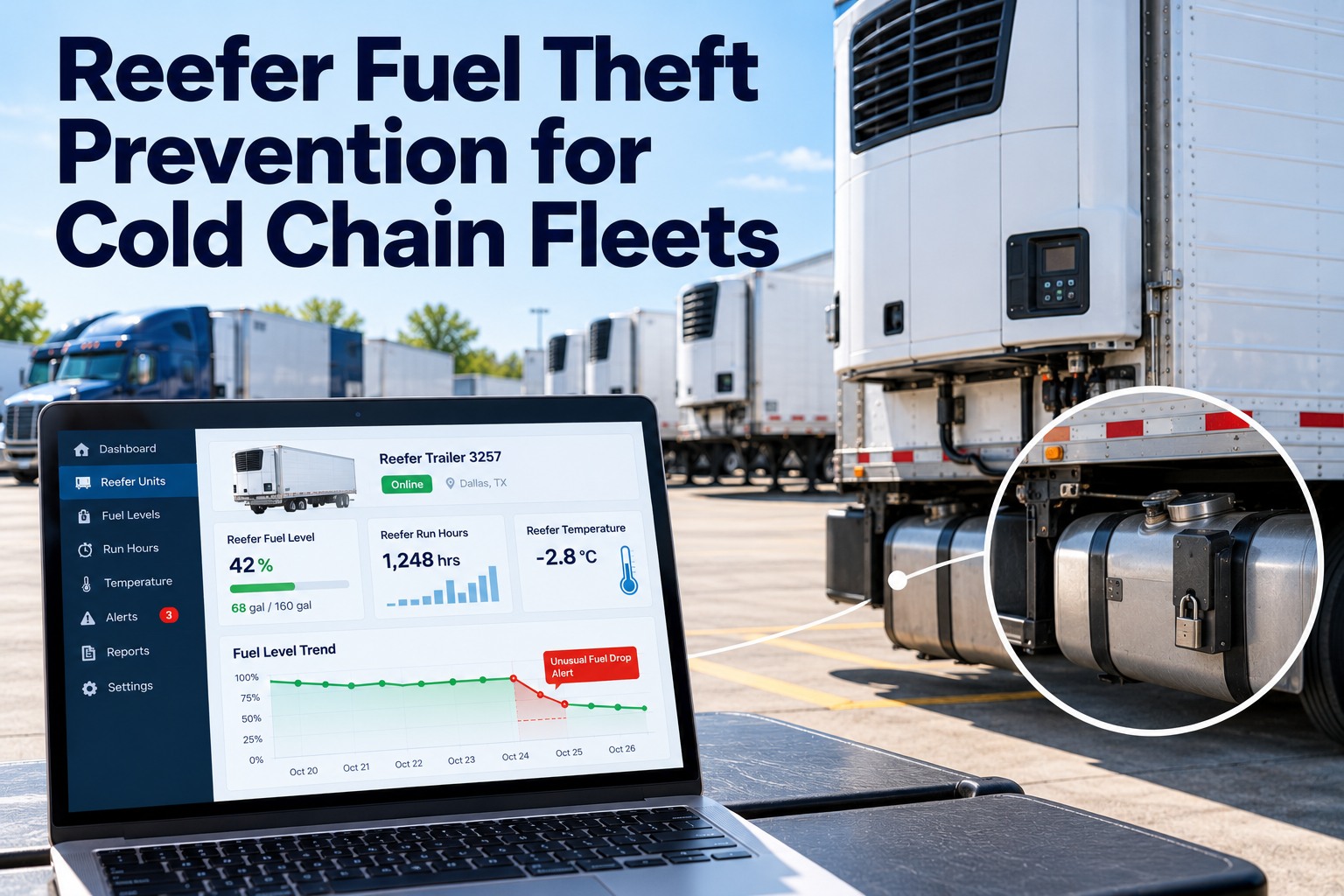
Reefer fuel theft prevention starts with a simple rule: a refrigeration unit that is off should not burn fuel, and one that is running should burn it at a predictable rate. Anything outside those two rules is worth a look. This page explains why reefer tanks are targets, what a unit legitimately burns, how to separate genuine run time from theft and what to put on the tank and in the process. Schedule a call to set up reefer fuel monitoring.
Why Reefer Fuel Tanks Are Easy Targets for Theft on Cold Chain Fleets
A small separate tank, a visible gauge and trailers parked unattended make the unit an opportunity
We found no published reefer theft statistics, so this page makes no claim about how common it is. The reasons below come from a UK anti-siphon maker, Aide Automotive, writing in August 2025, and from tank sizes published by a trailer dealer.
What a Refrigeration Unit Legitimately Burns: Reefer Fuel Rates, Tank Sizes and the Factors That Move Them
Burn rates differ widely by source, so measure your own units before setting any alert level
| Source | Reefer burn rate | Caveat |
|---|---|---|
| Hale Trailer, Dec 2024 | Older trailers about 1 to 3 gallons per hour; newer units about 0.4 to 1.1 | Depends on load and how hard the unit runs |
| Heavy Vehicle Inspection, Aug 2026 | Modern unit 0.4 to 1.5 gallons per hour; older than 5 years up to 2.0 to 3.0 at 100F | Matrix has no stated test conditions or source |
| Tank size | Usually 50 gallons, some up to 100 (Hale Trailer) | Check your own unit |
The sources overlap but do not agree, and neither states test conditions, so treat them as ranges for sanity checks, not alert thresholds.
How to Separate Genuine Reefer Run Time From Fuel Theft Using Unit State and Burn Rate
A drop while the unit is off is a flag, and a drop while it runs is compared with hours times burn rate
This logic is our own simple method, with an illustrative example: a unit ran 10 hours at an expected 0.9 gallons per hour, so about 9 gallons should be gone. If the tank fell 21 gallons, 12 are unexplained. Check mode, door events, ambient temperature and sensor health before concluding anything.
| Situation at the drop | How to read it |
|---|---|
| Unit off, level falls quickly | Possible theft or leak; no burn is expected |
| Unit running, drop close to hours x burn rate | Likely genuine run time |
| Unit running, drop well above hours x burn rate | Check mode, door events, ambient and setpoint, then the tank |
| Drop right after a refuel or at a yard | Compare with the fuel receipt and location |
| Level falls and recovers | Likely sensor or slosh, not theft |
Modes, Setpoints and Pre-Cool Time: Why Your Reefer Fuel Baseline Moves and What It Means for Alerts
Set a baseline per trailer and per mode, or normal variation will look like theft
| Factor that shifts the baseline | Why it matters for theft checks |
|---|---|
| Continuous vs start-stop mode | One analysis by a telematics vendor found about 40 percent less run time in start-stop, while a trailer dealer says neither is simply cheaper, so set a baseline per mode |
| Setpoint and ambient temperature | Colder setpoints and hotter days raise burn |
| Door-open time and pre-cool length | One client averaged 86 minutes of pre-cooling against a 45-minute benchmark before adjustments, per the same vendor |
| Unit age and maintenance | Older or poorly maintained units burn more |
The 40 percent figure and the pre-cool example come from a vendor-promotional FreightWaves article quoting an EROAD engineer, from June 2025, and the article's own fleet-level totals do not add up, so use them as an illustration of how much mode can matter, not as a forecast.
Locks, Anti-Siphon Devices, Level Sensors and Process Controls That Protect Reefer Tanks
Hardware slows the thief, and tracking reefer fuel as its own line shows what hardware misses
Carrier Transicold lists anti-siphon devices, reefer fuel tank locking caps and fuel level sensors, including ultrasonic and resistive kits, as fuel management accessories, but its page gives no descriptions or performance data. A 2025 article and Heavy Vehicle Inspection's 2026 guide add a process side: track reefer fuel separately from tractor fuel with distinct card codes or a log, capture run hours, setpoint and mode per trailer from the unit's telematics and alert when burn drifts above baseline. Heavy Duty Trucking noted in 2010 that careful manual logging of running hours can also reveal misuse.
What to Do When a Reefer Fuel Alert Fires: Confirm the Unit State, Check the Data and Secure the Evidence
Write down the unit state and location first, then inspect the tank, cap and sensor
How FleetRabbit Handles Reefer Fuel Level, Run Hours and Drop Alerts for Cold Chain Trailers
Controller data and tank level sit in one view, and you confirm thresholds and plan details on a call
FleetRabbit's reefer fuel page says it reads reefer controller data remotely, uses ultrasonic sensors for continuous tank level, can detect rapid drop signatures while the unit is off and send security alerts, sends run-dry warnings and separates tractor fuel from reefer fuel. The page does not say how baselines or alert thresholds are set, and it ties ultrasonic monitoring to a higher plan, so confirm what is included on the free tier. We left out its performance statistics because it gives no source. Free for up to 3 vehicles, then $5 per vehicle per month.