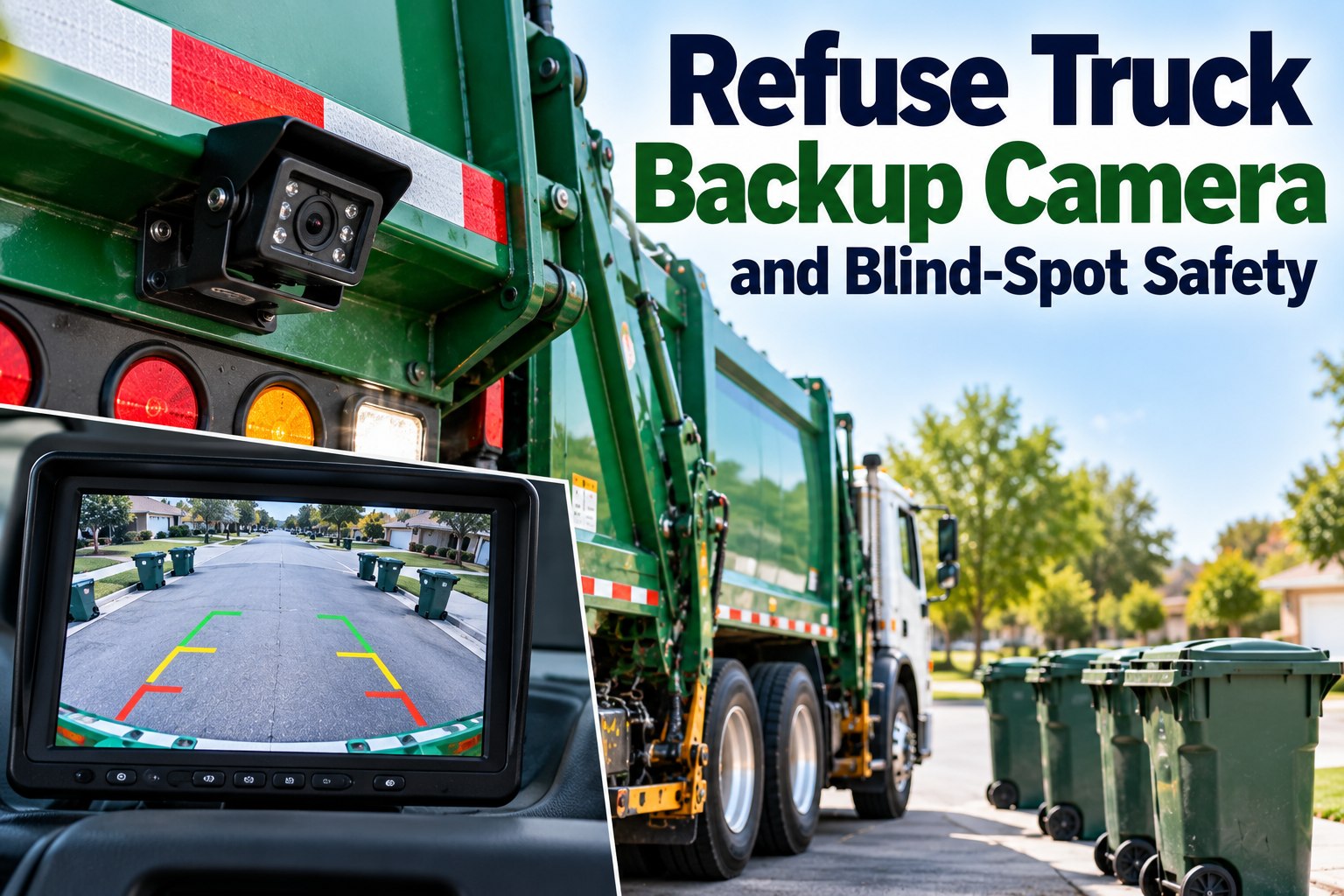
A refuse truck backup camera fails for reasons a car camera never encounters, and the most common failure is one that no diagnostic will ever report. The camera is mounted on the dirtiest vehicle in the fleet, pressure-washed daily, shaken continuously by hydraulic cycling, and routed across a joint that moves every time the body tips. When it dies, nothing warns anybody — there is no code, no derate and no dash light. The first person to discover the problem is a driver already reversing. And unlike almost every other safety system on the vehicle, no federal standard requires it to be there, to cover any particular area, or to work within any particular time. Its specification, and its condition, are entirely yours to prove. Book a demo.
The Most Common Camera Failure Produces No Fault Code at All
Symptoms matched to causes, why refuse cameras fail differently from every other vehicle’s, the federal benchmark your trucks are exempt from, and how to catch a dead camera in the yard instead of at a reversing manoeuvre.
Six Symptoms, and What Each One Usually Means
Start here. Most camera complaints resolve to one of these, and the right first move differs sharply between them. Swipe sideways on mobile.
| What the driver reports | Most likely cause | Where to start |
|---|---|---|
| Black screen the moment reverse is selected | Power or ground at the camera, or a failed monitor | Check the monitor on a known-good feed first — it is the cheaper half of the system and fails more often than crews assume. |
| Image appears, then drops out over bumps | Connector fretting or a chafed cable at a flex point | Trace to the body pivot and the frame-to-body crossing. Vibration failures are almost always at the two ends, not in the middle. |
| Picture is milky or washed out in all conditions | Moisture ingress behind the lens | Seal failure. Replacing the camera without fixing the mounting or the gland gets you the same fault next season. |
| Image is fine at the yard, useless on route | Lens contamination | Not a fault. This is the system working exactly as designed and still showing the driver nothing. |
| Image lags or arrives late after shifting | Slow start-up on a cold or degraded unit | Worth timing against the two-second benchmark the rule sets for light vehicles — if yours is far outside it, that is a specification problem. |
| Intermittent flicker or rolling lines | Supply voltage or a shared circuit with the body electrics | Common on units where the camera was added later and spliced into whatever was nearest. |
The fourth row is the one worth dwelling on, and the rest of this page comes back to it. A contaminated lens is not a malfunction. Every component is powered, the monitor shows a picture, and the system passes any test you can run on it — while presenting the driver with an image that contains no information.
No Federal Rule Requires a Camera on a Vehicle This Size
This surprises people, because the rear visibility rule is well known and widely assumed to be universal.
What the rule covers
The federal rear visibility standard applies to passenger cars, trucks, multipurpose passenger vehicles, buses and low-speed vehicles with a gross vehicle weight rating under 10,000 pounds. Motorcycles and trailers are excluded. The phase-in ran from 10 per cent of vehicles manufactured on or after 1 May 2016, to 40 per cent a year later, reaching 100 per cent for vehicles manufactured on or after 1 May 2018.
A refuse packer is several times the 10,000-pound threshold, so it sits entirely outside the standard. Whether your trucks have cameras, how wide a view they give, and how quickly the image appears are all specification decisions somebody made — or did not make — rather than compliance obligations. One honest caveat: the rule text itself is slightly inconsistent, with the summary saying “10,000 pounds or less” and the regulatory discussion saying “less than 10,000 pounds”. Either way a refuse truck is far above it.
Borrow the 20-by-10-Foot Benchmark Anyway
Being exempt from a standard is not a reason to ignore what it specifies. The rule gives two concrete numbers that make a decent minimum for a fleet that wants to set its own bar.
The required view is of a 20-foot by 10-foot zone directly behind the vehicle, and the image must appear within 2.0 seconds of the driver selecting reverse. Both are modest targets for a light vehicle and worth checking against on a heavy one, where the blind area behind the body is considerably larger and the consequences of missing something in it are correspondingly worse.
Timing the response is a thirty-second test anybody can run with a phone. A unit that takes five or six seconds to produce an image is a unit whose driver has already begun moving, and that is a specification failure rather than a fault to be repaired.
Why Refuse Cameras Fail Differently From Every Other Vehicle’s
Six environmental factors, none of which apply to the vehicles the technology was designed around.
A camera on a delivery van gets road film. A camera on a packer gets the contents of the hopper, airborne on every cycle, all shift.
Daily washdown is necessary and is also a weekly assault on seals and glands. Most water ingress on refuse cameras is introduced by the cleaning, not the weather.
A body that tips and a tailgate that opens mean the cable crosses a joint. Every flex cycle is a fatigue cycle at the connector.
Hydraulic cycling runs through the frame all day. Fasteners back off, connectors fret, and brackets crack at the weld rather than the bolt.
The corrosive environment is underneath the truck as well as inside the body, and it reaches the connector before it reaches the camera.
Unlike an engine fault, a dead camera produces no warning, no code and no reduced power. The first person to find out is a driver reversing.
The failure with no fault code
A dirty lens reports as a working camera
There is no diagnostic for an obscured view. The only thing that catches it is a person looking at the monitor before the shift and having somewhere to record what they saw. That is a process problem, and it is a cheap one to fix.
What to change, in order of payback
Mounting first. A bracket that damps vibration and a cable route that crosses the body joint in a loom with proper strain relief will outlast two or three cameras fitted to a rigid bracket and a cable tie. Sealing second — a gland that survives a pressure lance is cheaper than the camera it protects. Cleaning third, as an agreed habit rather than an instruction: a lens wiped at the start of a shift stays usable for most of it, and nobody needs a tool to do it. Only then is it worth arguing about which camera to buy, which is usually where these conversations start.
What Camera Problems Cost, Early Versus Late
The component is rarely the expensive part, which is why this gets deprioritised and why that is a mistake.
A camera, a monitor and a harness are modest parts that a technician can change in well under a shift. Caught in the yard on a pre-trip check, a dead unit costs a part and an hour. Caught at the end of a route, it costs the remainder of that route run without a working camera, or a truck pulled out of service mid-shift and a collection round that has to be recovered. The cost that dominates everything else, though, is the one that arrives when a reversing incident happens and the camera is found to have been inoperative — at which point the question is not what the part cost but what the records showed, who knew, and how long it had been like that.
Where a unit keeps consuming cameras, the economics change again. Three replacements on one truck is not three parts; it is a mounting or routing defect being paid for repeatedly, and the only way anybody notices is if the repairs are attached to the vehicle rather than to a parts order. That is the same logic that makes a maintenance record worth keeping for anything else on the truck.
That last point is why the repair log matters more than the repair. A fleet that can show a camera was checked daily, that a fault was raised the morning it appeared and a work order opened the same day, is in a completely different position from one that can show nothing at all. The parts are identical; the exposure is not.
Catch a Dead Camera in the Yard With FleetRabbit
Every failure on this page is found by one of two things: a driver looking at the monitor, or a technician on a scheduled preventive maintenance check. The software’s job is to make sure both happen and both leave a record.
What FleetRabbit tracks on camera systems
A driver confirms the image is present and clear before the shift, so a dead unit is found in the yard rather than at a reversing manoeuvre.
No image, dirty lens, intermittent drop-out — each is a defect attached to the vehicle, not a remark at shift change.
The same camera replaced three times on one truck is a mounting problem. The system surfaces that instead of quietly reordering parts.
A failed camera check becomes a job with an owner and a date rather than a note somebody intended to pass on.
Every camera fault and every repair on one vehicle timeline, which is what turns a vague supplier complaint into an evidenced one.
Camera spend rolled up per truck, so the units consuming the budget are obvious before the next order.
Product walkthrough · 20 minutes · no obligation
See a Camera Check Become a Work Order in One Pass
- We add the camera check to your daily inspectionOne line for image present, one for image clear. It takes a couple of minutes to set up across the fleet.
- We show what a failed check doesIt opens a work order, assigns it, and stays on the vehicle record. You see the whole path from driver to shop.
- We look at your repeat faultsKey in a few past camera repairs and the per-unit pattern is visible immediately.
- You decide whether to carry onTwenty minutes, no obligation. If your current process already catches these, we will tell you.
Or set it up yourself — the first three vehicles are free, and the daily inspection items can be live this afternoon.
Refuse Truck Backup Camera Questions Fleet Managers Ask
Are backup cameras required on refuse trucks?
Not by the federal rear visibility standard, which applies to vehicles under 10,000 pounds GVWR. A refuse packer is far above that, so cameras on your fleet are a specification choice rather than a compliance requirement.
What is the most common camera failure on a packer?
A contaminated lens, by a wide margin — and it is the one that never produces a fault. The system is powered, the monitor shows a picture, and the driver sees nothing useful. Log Every Camera Fault.
How fast should the image appear after selecting reverse?
The federal rule sets 2.0 seconds for light vehicles. Your trucks are exempt, but it is a sensible minimum and takes about thirty seconds to test. A unit taking five or six seconds has a specification problem, not a repair.
How much area should the camera cover?
The rule specifies a 20-foot by 10-foot zone behind the vehicle. That is written for a light vehicle, so treat it as a floor rather than a target on something with a much larger blind area. Spec Your Camera Checks.
Why do our cameras keep failing in the same place?
Almost always the connector or a chafe point at a flex joint rather than the camera itself. If the same unit has consumed three cameras, the problem is the mounting or the cable route, and replacing the camera a fourth time will not change it.
Is pressure washing damaging the cameras?
Frequently, yes. Most moisture ingress on refuse cameras is introduced during cleaning rather than by weather. It is worth agreeing where the lance may and may not be pointed, and at what distance.
How do we prove a camera was working?
With a daily check that leaves a record on the vehicle and a work order trail when something is found. The parts are cheap; the documentation is what matters after an incident. Track Every Repair.
Should drivers be allowed to run without a working camera?
That is a policy call for your operation, but it should be an explicit one rather than a default that emerges because nobody recorded the fault. Decide it in advance and write it down. Book a Demo.
Found in the yard, not in the mirror
Make the Camera Check Something That Leaves a Record
A two-line daily check, faults reported from the cab, failed checks that open a work order automatically, and a full fault history per vehicle so repeat offenders stop hiding. First three vehicles free.