Modern automotive manufacturing logistics operate on millisecond-level precision where traditional batch-based ERP sync causes assembly line starvations, misallocated container loops, and inventory ghost records. Integrating shop-floor logistics with SAP S/4HANA requires navigating automotive-specific objects, high-frequency Just-in-Time (JIT) and Just-in-Sequence (JIS) call-offs, clean-core extensibility rules, and industrial shop-floor OT connectivity via OPC UA. Without event-driven architecture, mission-critical delivery split notifications and packaging handling unit (HU) state changes bottleneck at the warehouse perimeter. FleetRabbit provides a resilient, SAP-certified integration layer that bridges plant-level execution with enterprise planning while isolating the ERP core from custom code debt. Book a live technical demo to see SAP automotive integration patterns on your own plant data or start a technical evaluation today.
S/4HANA 2026 CLEAN-CORE READY
OPC UA & MQTT NATIVE
EVENT-DRIVEN ARCHITECTURE
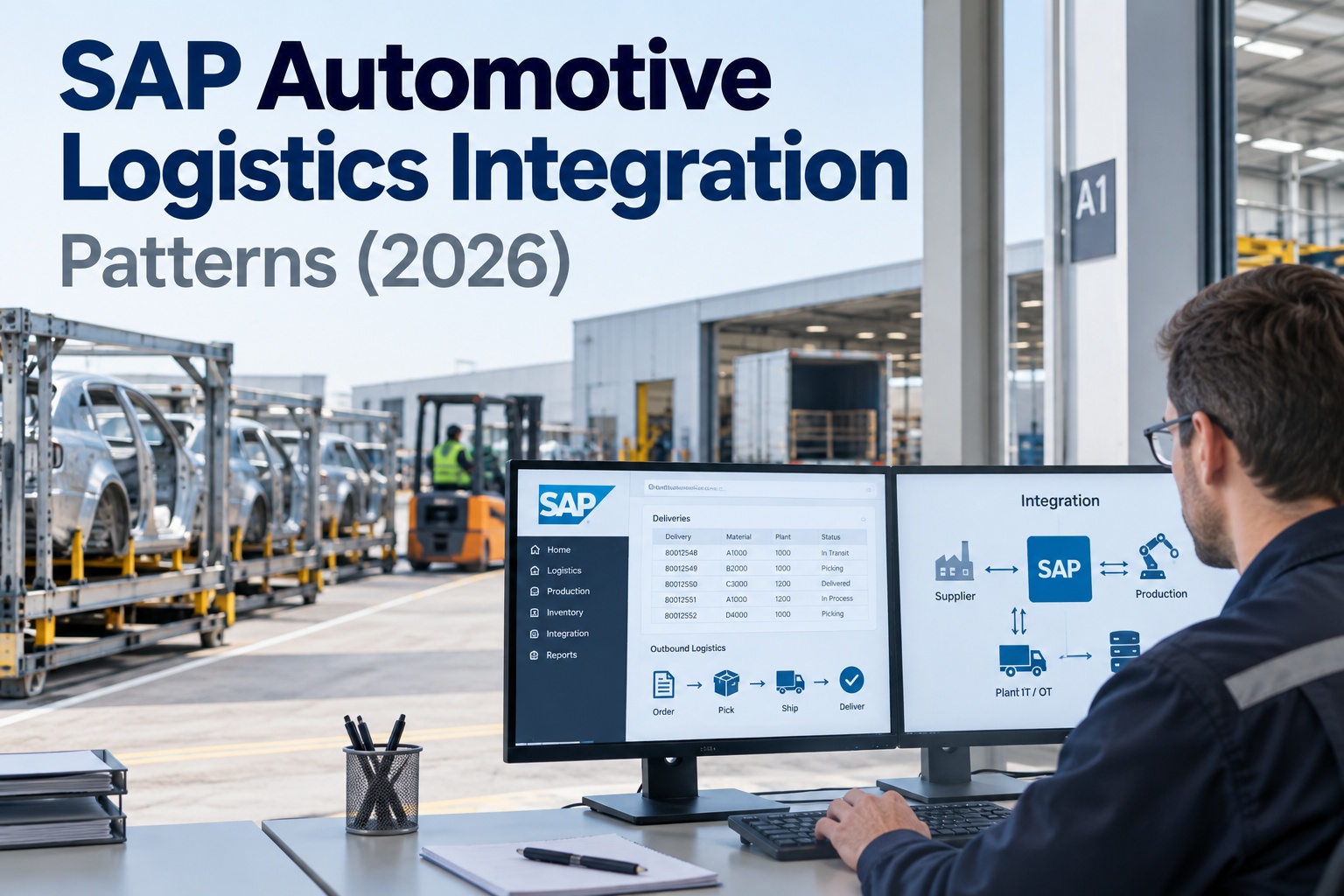
SAP Automotive Logistics Integration Patterns
The plant IT/OT engineer's blueprint for synchronizing sequenced deliveries, production call-offs, handling units, and industrial edge telemetry with SAP S/4HANA without modifying the enterprise core.
< 80ms
Event Sync Latency
100%
Clean-Core Compliance
OPC UA
Direct OT Sensor Fabric
Zero
ERP Downtime Upgrades
Core Automotive Logistics Business Objects in SAP S/4HANA
Automotive supply chains depend on specialized business documents that bridge long-term OEM contracts with dynamic plant call-offs. Understanding their technical mapping is the foundation of high-performance architecture.
DELFOR / DELJIT
Scheduling Agreements & JIT Calls
Synchronizes delivery schedule lines with real-time EDI 830/862 transmissions. Translates cumulative received quantities into dynamic line-side replenishments without manual intervention.
LE-SHP / LIKP
Outbound Delivery Split & PGI
Tracks dynamic delivery splits caused by carrier shortages or damaged racks. Emits Post Goods Issue (PGI) triggers immediately upon RFID/barcode scan at the plant dispatch gate.
LE-TRA / VT01N
Shipment & Transportation Orders
Manages multi-stop milk runs and dedicated yard shuttles. Maps carrier status events, geofence arrivals, and seal verifications directly to SAP Transportation Management (SAP TM).
HUM / VEKP
Nested Handling Units (HUs)
Maintains multi-level packaging hierarchies (KLT bins, master pallets, custom stillages) ensuring digital twins match physical serial numbers across all cross-dock movements.
Plant IT/OT Integration Architecture: Edge to ERP
Modern automotive assembly lines cannot wait for synchronous cloud API handshakes. Industrial edge gateways running industrial protocols must decouple plant shop-floor hardware from enterprise business logic.
LEVEL 0 / 1: SHOP FLOOR (OT)
Industrial Sensors, AGVs, Automated Racks & PLC Controllers
Generates high-frequency telemetry via OPC UA server profiles, industrial fieldbuses, and MQTT brokers monitoring packaging weights, bin presence, and AGV transit states.
▼ Encrypted Industrial Gateway Bridge (OPC UA to Event Stream)
LEVEL 2 / 3: EDGE ORCHESTRATION
FleetRabbit Automotive Event Broker & Local Buffer
Performs real-time event filtering, packaging hierarchy assembly, offline queueing, and deduplication. Prevents plant stoppages during network degradation or ERP release cycles.
▼ S/4HANA Clean-Core Integration (OData v4 / Event Mesh Webhooks)
LEVEL 4: ENTERPRISE (IT)
SAP S/4HANA Enterprise Cloud (EWM, TM, JIT/JIS)
Receives validated delivery confirmations, cumulative quantity updates, and handling unit states via standard, upgrade-safe BTP microservices and public API interfaces.
Evaluate the SAP Automotive Architecture Blueprint
See how FleetRabbit eliminates point-to-point custom ABAP code with zero-latency OPC UA bridging and clean-core S/4HANA event streaming.
Clean-Core Extension Rules for Automotive Supply Chains
Legacy SAP automotive implementations suffered from deep ERP modifications in standard user exits (e.g., MV45AFZZ) that broke during system upgrades. Clean-core patterns ensure perpetual upgrade safety.
01
Zero Modifications to Standard SAP Automotive Code
Eliminate custom Z-tables and modifications within core delivery creation transactions. All logistics event processing must occur side-by-side on decoupled event fabrics.
02
Standard Released APIs & Developer Extensibility
Interface solely through SAP-released OData v4 endpoints and Tier-1 public interfaces (such as API_OUTBOUND_DELIVERY_SRV_0002) to guarantee backward and forward compatibility.
03
Asynchronous Event Meshing Over Synchronous RFCs
Replace legacy tRFC/qRFC calls with asynchronous event triggers. Plant-floor logistics events emit notifications through event brokers, preventing database locking during peak volume.
04
Side-by-Side Edge Processing for High-Frequency Telematics
High-frequency data such as forklift positioning, container temperature, and door switch states must remain at the industrial edge, only passing state anomalies up to SAP.
Technical Integration Comparison: Modern Patterns vs. Legacy IDocs
Automotive suppliers transitioning from legacy ECC systems to S/4HANA must weigh traditional batch integration against event-driven industrial architectures.
| Evaluation Criteria |
Modern Event-Driven + OPC UA |
Direct OData Sync APIs |
Legacy IDoc / RFC Integration |
| Clean-Core Upgrade Safety |
✓ 100% Isolated / Zero ERP Debt |
○ Moderate (API Version Locks) |
✕ Low (Custom ABAP Dependencies) |
| End-to-End Latency |
< 80 milliseconds |
500ms – 2.5 seconds |
Batch queued (1 – 15 minutes) |
| Offline Plant Survivability |
✓ Local Edge Buffer & Replay |
✕ Line stops on network drop |
○ Local queue (manual clearing) |
| Handling Unit (HU) Nesting |
✓ Dynamic Multi-Level Serialization |
○ Complex Payload Overhead |
○ Rigid Fixed Segment Formats |
| Industrial Sensor Support |
✓ Native OPC UA / MQTT Parsing |
✕ Requires Middle Middleware |
✕ Incompatible with Raw Sensors |
| Release-Cycle Impact |
Zero downtime during S/4 updates |
Requires sandbox testing cycles |
High regression testing effort |
Production Call-Off Lifecycle: JIT / JIS Flow Diagram
The sequence below illustrates how an automated line-side call-off executes between plant shop-floor hardware, FleetRabbit, and the SAP S/4HANA system without human intervention.
Step 1
Line-Side Consumption
Automated bin scale or vision sensor detects empty container at assembly station and publishes an OPC UA state event.
Step 2
Edge Ingestion & Validation
FleetRabbit validates bin ID, verifies component serialization, checks buffer thresholds, and formats an asynchronous call-off request.
Step 3
SAP Event Orchestration
SAP S/4HANA receives clean-core event, automatically adjusts production schedule lines, and generates an internal EWM transfer order.
Step 4
AGV Dispatch & Replenishment
FleetRabbit issues pick-and-carry tasks to autonomous transport systems, confirms receipt, and signals SAP Goods Movement (Mvt 261).
Common Plant IT / OT Integration Pitfalls and Solutions
Resolving integration friction early preserves plant operational uptime and eliminates catastrophic production line stoppages.
Problem: Assembly Line Stoppages During Cloud Latency
When public cloud ERP links experience jitter, synchronous API calls stall line-side barcode scanners, causing direct physical station backups.
FleetRabbit Solution: Industrial Edge Buffering
Edge nodes cache scan verifications locally at the sub-millisecond level, queueing confirmed transactions and reconciling them asynchronously once connectivity stabilizes.
Problem: Incomplete Packaging Data on ASN Transmissions
Nested packaging layers (pallets holding boxes with internal trays) fail to map correctly in standard IDocs, causing OEM receiving dock rejects.
FleetRabbit Solution: Automated HU Digital Twins
Pre-configured packaging profiles validate multi-tier handling units against OEM-specific packaging instructions before emitting final Advanced Shipping Notices.
Problem: Massive Custom Code Debt Blocking ERP Upgrades
Decades of customized ABAP scripts in plant shipping routines prevent enterprises from adopting annual S/4HANA feature pack releases.
FleetRabbit Solution: Clean-Core Side-by-Side Extensibility
Shifts custom validation logic, sensor transformations, and carrier integrations entirely into FleetRabbit, leaving the SAP system completely vanilla and upgrade-ready.
Problem: Disconnected Shop-Floor Sensor Networks
PLCs, optical readers, and automated tuggers broadcast legacy industrial protocols that cannot communicate natively with modern enterprise cloud APIs.
FleetRabbit Solution: Native OPC UA / Industrial Fieldbus Ingestion
Provides protocol conversion directly at the shop-floor perimeter, converting binary PLC register updates into clean, structured JSON business events.
Frequently Asked Questions
How does clean-core compliance apply to automotive logistics integrations?
Clean-core principles mandate that no custom business logic or modifications exist inside standard SAP delivery, shipment, or material management source code. Integrations must use standard, public APIs and asynchronous event streaming through external platforms like FleetRabbit, ensuring that enterprise SAP upgrades occur without code regressions or plant testing downtime.
Book a demo to review our clean-core architecture guide.
Can FleetRabbit operate during an active SAP maintenance window or upgrade?
Yes. FleetRabbit features an autonomous edge store-and-forward architecture. If SAP S/4HANA becomes temporarily unavailable during a release upgrade or system patch, plant-floor logistics operations—such as dock-door scanning, cross-dock transfers, and AGV dispatches—continue executing locally. Transactions are queued and automatically reconciled once the ERP connection restores.
What industrial shop-floor protocols are supported for plant IT/OT convergence?
FleetRabbit natively interfaces with industrial edge protocols including OPC UA, MQTT, Modbus TCP, PROFINET, and standard REST/WebSocket endpoints. This allows automotive plants to bridge physical PLCs, barcode scanning stations, weight scales, and smart racks directly into digital event streams without intermediate legacy middleware.
How are complex multi-level Handling Units (HUs) mapped to SAP EWM?
FleetRabbit maintains serialized digital twins of all packaging hierarchies (such as inner trays nested inside small load carriers on master stillages). The platform validates packing rules against OEM specifications and pushes structured packaging records through standard SAP EWM APIs, generating fully formed packaging structures without manual entry.
Start an evaluation to test handling unit mapping workflows.
How long does a typical SAP automotive logistics integration implementation take?
Because FleetRabbit leverages pre-built automotive business object mappings and clean-core connectors, integration pilots typically go live in 2 to 4 weeks. Enterprise-wide rollouts across multiple manufacturing plants avoid multi-month custom development cycles by standardizing integration endpoints across all facilities.
Modernize Your SAP Automotive Logistics Architecture
Connect shop-floor automation, handling units, and JIT/JIS call-offs to SAP S/4HANA with sub-second event streaming, OPC UA connectivity, and zero clean-core violations. Schedule a tailored technical session with our enterprise integration engineers.
September 12, 2026By Alex Rowan
All Blogs