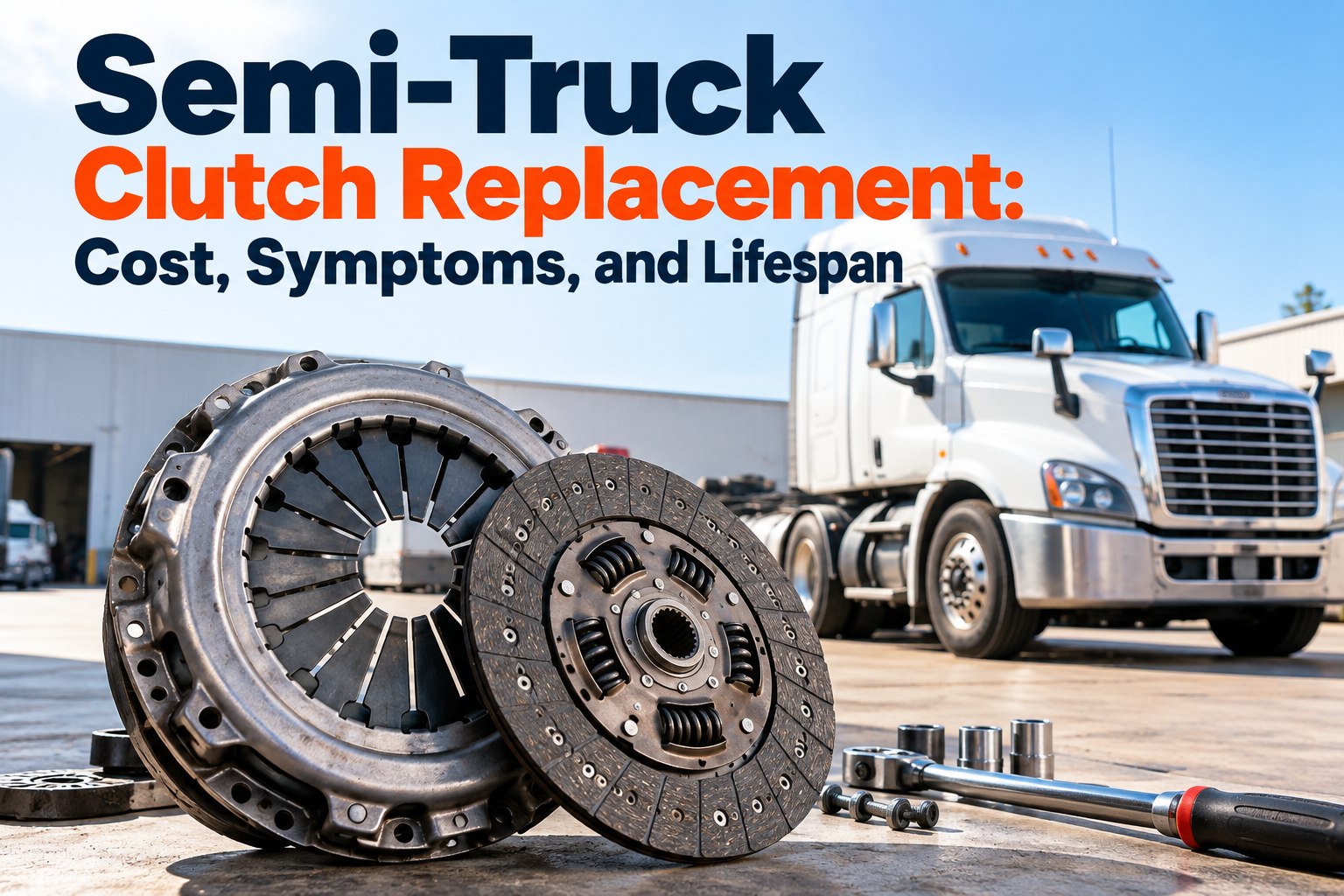
A clutch job on a Class 8 truck is expensive for one structural reason: you cannot reach the clutch without pulling the transmission. The part is rarely the biggest line on the invoice, which is why any single figure quoted for semi-truck clutch replacement cost is guesswork about somebody else's truck, somebody else's chassis and somebody else's shop rate. What is worth knowing instead is that the clutch will tell you how much life it has left before it fails. Eaton publishes the conversion from wear-tab movement to miles, and it gives the adjustment threshold as a measurement rather than a feel. Together those turn replacement from an emergency into something you put on a schedule. See how a clutch job gets tracked per unit.
Semi-Truck Clutch Replacement: What It Costs and How Long It Should Last
For fleet maintenance managers, owner-operators and shop supervisors: the symptoms that tell you which failure you have, how to read remaining clutch life off the wear tab instead of guessing, verified part pricing, and the five lines that actually make up the bill.
Which Failure You Actually Have
These point at different jobs with very different costs. A hard pedal is linkage and grease; slipping under load is a clutch out. Getting this wrong is how a lubrication task turns into a quoted replacement. Swipe on mobile.
| What you notice | How it presents | Usual cause |
|---|---|---|
| Slipping under load | Engine revs climb, road speed does not, worst on a grade or pulling away loaded | Worn friction material, or a clutch never adjusted as it wore |
| Dragging, will not go into gear | Gears grind or refuse at a standstill even with the pedal on the floor | Too much free pedal, a failed clutch brake, or a warped disc |
| Chatter on take-up | Shudder through the cab as the clutch engages, often worse cold | Oil on the friction surface, a glazed flywheel, or worn dampers |
| Hard pedal, heavy effort | The pedal takes noticeably more force than it used to | Dry or seized linkage and cross-shaft bushings, not the disc |
| Noise with the pedal down | Rumble or squeal that appears only when the pedal is depressed | Release bearing, which is a cheap part inside an expensive job |
Worth separating the last two from the first three before anyone quotes a clutch. A release bearing is inexpensive but sits inside the same teardown, which is exactly why it gets replaced whenever the transmission is out regardless of how it sounded going in.
The Clutch Will Tell You What Is Left
This is the part most cost articles skip, and it is the part that decides whether you pay for a planned job or a roadside one. Eaton's self-adjust clutches carry a wear tab whose travel converts directly to mileage.
From Eaton's heavy-duty clutch service manual: mark the wear tab, and "3.5″ remaining tab movement X 104,000 miles per inch" estimates total clutch life. The manual also gives the adjustment trigger for manual-adjust clutches — act "when clutch free pedal is one-half of OEM specifications, not less than one-half inch" — and the setup target, a release bearing sitting 0.490″ to 0.560″ from the clutch brake with the pedal up, with a 0.010″ feeler gauge just clamped when the pedal is on the floor. These are measurements, which means they can be recorded, trended and scheduled against.
Take two readings six months apart and you have a wear rate for that truck on that work. That is a replacement window you can plan a spare unit around, rather than a number you find out on a Tuesday morning on the side of a highway.
Getting the Replacement Right
Most of a clutch specification is dictated rather than chosen, and the two places people actually go wrong are torque rating and release type. Swipe on mobile.
| Specification | Typical values | What decides it |
|---|---|---|
| Diameter | 14″ or 15.5″ | Set by the bellhousing and flywheel, not by preference. Measure or look it up by VIN — this is not a spec you upgrade. |
| Torque rating | e.g. 1860 or 2050 lb-ft | Must meet or exceed the engine's rating as installed. Fitting under-rated is how you buy this job twice; note that a higher rating did not cost more in the listings above. |
| Spring vs damper design | 7-spring, 9-spring, ceramic | Driven by duty cycle. Heavier or rougher work changes what survives; the parts catalogue application guide is the authority for your unit, not a generic chart. |
| Manual or self-adjust | Adjust by hand, or not | Self-adjust removes a recurring task. Given that lack of adjustment is on Eaton's own list of failure causes, that matters most in shops where the task gets skipped. |
| Pull type vs push type | Release mechanism | Determined by the transmission and linkage. Getting it wrong is not a performance question; the part will not work. |
| Clutch brake | Included or separate | Cheap, inside the same teardown, and the cause of grinding-into-gear complaints that get misread as a failing clutch. |
Confirm every line against the manufacturer's application guide for your exact unit before ordering. A clutch that physically fits and is under-rated for the engine will work for a while, which is the worst possible failure mode — it puts the transmission back on the floor months later with nothing obviously wrong to point at.
The Five Lines on the Bill
Rather than a total that will be wrong for your truck, here is the structure so you can price your own. Shop rates, chassis layout and what the teardown reveals move the answer too far for a single range to be honest.
A genuine Eaton 15.5″ Easy Pedal Advantage manual-adjust kit listed at $1,039.69 for the 2050 lb-ft part and $1,312.65 for the 1860 lb-ft part at one US retailer in September 2026. Note the direction: the lower-rated part costs more. Price tracks the part number and its availability, not the torque rating.
There is no way to reach a clutch without separating the transmission from the engine. Access is the job; the clutch is the easy part once you are there. A day cab with clear frame rails is a different proposition from a tight sleeper chassis with an APU and cross-members in the way.
Flywheel condition, pilot bearing, release bearing, clutch brake, cross-shaft bushings, and the rear main seal are all sitting right there. Replacing them now costs parts; replacing them later costs this entire job again. This is where two quotes for the same truck diverge.
Heat checking and scoring may resurface out, or may not. Resurfacing changes stack height, which affects release-bearing position, which is why the adjustment specification matters after the work rather than before.
Whatever your cost per truck per day is, multiplied by however long the unit sits. On most fleets this exceeds parts and labour combined, and it is the only line that shrinks if you catch wear before it becomes a failure.
The two verified prices above are real listings at one retailer on one day, quoted so you have a floor for the part rather than a guess. They are not a national average, they exclude labour entirely, and the fact that the lower-torque kit was dearer is the useful lesson: get a quote against your actual part number, because the spec does not predict the price.
Put the wear reading on the PM before the clutch decides for you
Thirty minutes, one truck. We will set up the free-pedal check and the wear-tab reading as recorded tasks, and show you what the trend looks like after a few intervals — the difference between a clutch you replace on a Saturday and one that strands a load.
How FleetRabbit Handles This
Four things, and none of them are about the repair itself — they are about never being surprised by it.
The adjustment point Eaton gives is a measurement, so it belongs on a scheduled task with a recorded result rather than a technician's recollection.
Log the tab movement each time and the trend becomes a forecast. One reading is a number; four readings are a replacement date you can plan a truck around.
A slipping complaint on a DVIR becomes the work order, so the symptom the driver felt stays attached to what the shop found.
Pilot bearing, release bearing, clutch brake and seal logged with the clutch, so the next comeback shows what was already done and what was not.
What Actually Kills a Clutch Early
Eaton names excessive heat as the major cause of clutch failure, and almost everything below is a way of making heat. None of it is a parts problem.
- Riding the clutchEaton is direct about it: partial engagement permits slippage, and slippage makes heat. A clutch held partly engaged is a brake made of friction material.
- Slipping to hold on a gradeNamed explicitly in Eaton's service literature — a slipping clutch accumulates heat faster than it can dissipate it. Use the brakes; they are designed for it.
- Skip-shifting too earlySelecting a gear before road speed matches forces the clutch to make up the difference, which it does with heat.
- Never adjusting itAn improperly adjusted or slipping clutch will produce enough heat to burn up quickly. Free pedal is not a comfort setting; it is what keeps the disc fully clamped.
- OverloadingExceeding the vehicle's load recommendation is on Eaton's own list of causes. A clutch rated for 1860 lb-ft does not become a 2050 lb-ft clutch on a good day.
- Dry linkageFailure to lubricate the bearing and bushings results in bearing failures — a grease point skipped becomes a transmission out of the truck.
Questions Fleets and Owner-Operators Ask
How long should a semi-truck clutch last?
Eaton's own estimate for its Solo self-adjust clutch works out at roughly 364,000 miles from 3.5″ of tab travel at 104,000 miles per inch — but that is an estimate against a duty cycle, and yours will differ. Linehaul running loaded at highway speed is a completely different clutch life from urban stop-start or heavy-haul on grades. The point of the wear tab is that you do not have to rely on the average. Start logging readings free.
What does a clutch replacement cost?
The part has a verifiable floor — genuine Eaton 15.5″ kits were listed at $1,039.69 and $1,312.65 at one US retailer in September 2026 — and everything above that depends on your shop rate, your chassis and what the teardown finds. Anyone quoting a single national figure is guessing; ask instead for a quote itemised across the five lines above so you can see where the variance sits. Talk through a real quote.
Can a slipping clutch be adjusted instead of replaced?
Sometimes, and it is always worth checking first on a manual-adjust clutch, because a clutch that slips from lack of adjustment is not worn out yet — it is on its way to being worn out by the heat the slipping makes. Eaton's trigger is free pedal at half of OEM specification, and no less than half an inch. Once the friction material is actually gone, adjustment cannot recover it. Schedule the check free.
Should we replace the flywheel at the same time?
Inspect it, then decide. Heat checking and scoring sometimes resurface out and sometimes do not. What matters afterwards is that resurfacing changes stack height, which shifts release-bearing position, so the 0.490″ to 0.560″ setup measurement has to be verified after the work rather than assumed from before it. Review your teardown checklist.
What is the clutch brake and why does it matter here?
It squeezes the transmission input shaft when the pedal goes to the floor, and Eaton describes its job as eliminating damaging gear clash while reducing shift effort. A worn or misadjusted one shows up as grinding into gear at a standstill — which feels like a failing clutch and is not. It is also cheap, and inside the same teardown. Add it to your job template.
Is a self-adjusting clutch worth the difference?
It removes a recurring manual task, which matters most if that task is the one your shop skips — and given that lack of adjustment is on Eaton's list of failure causes, skipping it is expensive. It does not remove inspection: you still read the wear tab, which is how you get the mileage forecast in the first place. Compare against your PM load.
Can we fit a higher-torque clutch for longer life?
Only within what the bellhousing, flywheel and release mechanism allow — diameter and release type are dictated by the truck, not chosen. Within those constraints, meeting or exceeding the engine's rating is the requirement, and the pricing above shows a higher rating does not reliably cost more. What extends life is heat management and adjustment, not over-specifying the part. Check your unit's spec with us.
How do we stop this being a surprise next time?
Record the measurement rather than the impression. Free pedal and tab movement both produce numbers, and numbers trend. A unit with four readings has a replacement window; a unit with a note saying "clutch checked, OK" has nothing. That is a maintenance records problem more than a mechanical one. Set up the tasks free.
Schedule the Clutch. Do Not Discover It.
FleetRabbit keeps the free-pedal and wear-tab readings as recorded tasks per unit, trends them into a replacement window, and ties the driver's complaint, the inspection and the job to the same vehicle history.
Free for 3 vehicles. No credit card required.