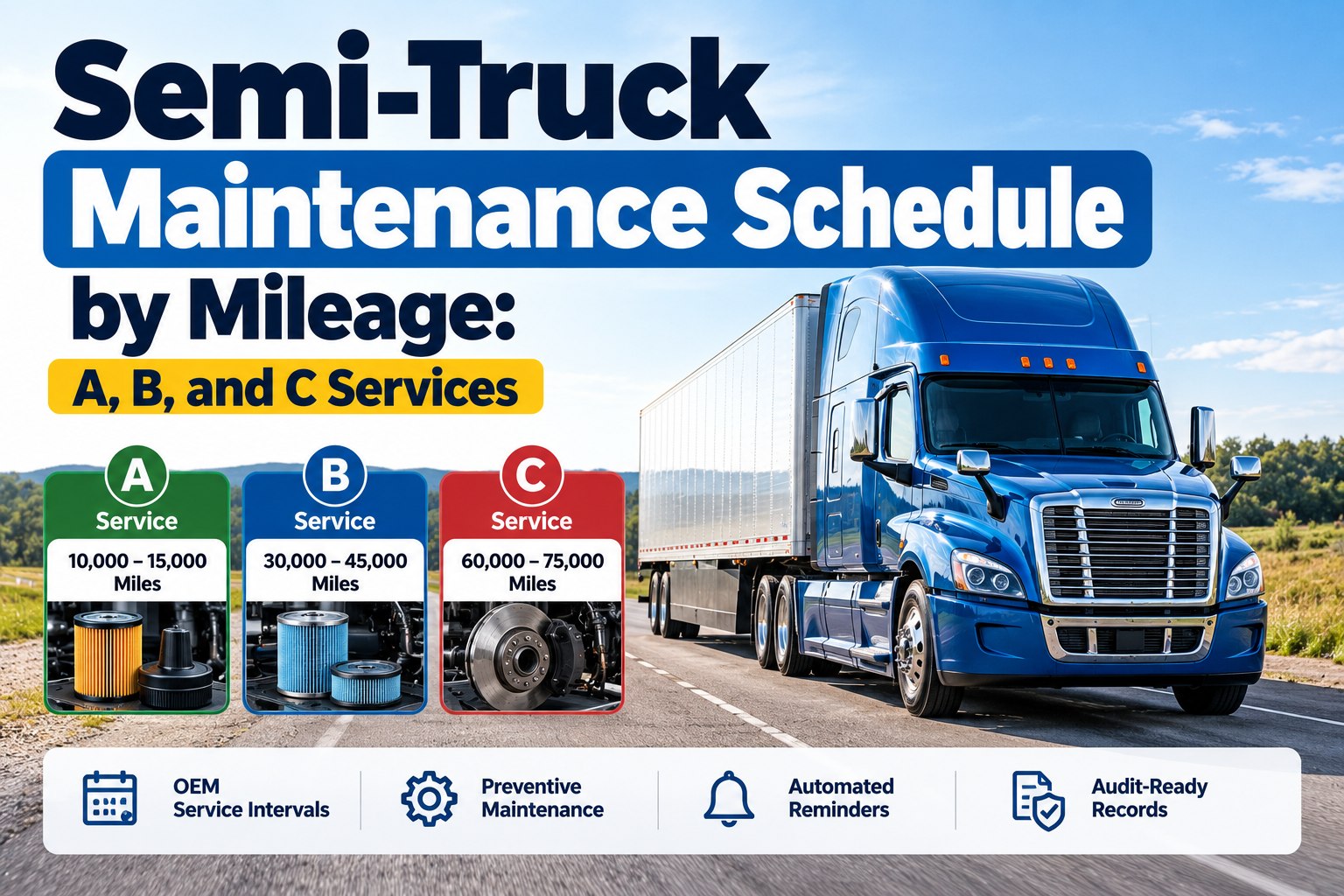
Search for a semi-truck PM schedule and you will find PM-A at five to ten thousand miles, PM-B at ten to twenty, PM-C annually. Those ranges are real in the sense that many fleets use them, and they are not a standard. No regulation defines them, no governing body publishes them, and PM-B at one fleet is not PM-B at another. The federal requirement is a single sentence about systematically inspecting, repairing and maintaining your vehicles — it names no levels at all. Which means the letters are yours to define, the definition matters far more than the mileage, and comparing your PM costs against another fleet’s is comparing two things that only share a name. Book a PM program review.
Nobody Can Tell You What a PM-B Is
There is no standard definition, which is exactly why the one you write down is the one that counts. What the levels are supposed to mean, what the regulation actually asks for, and how to set intervals from your own evidence.
What Levels Are Supposed to Mean
The idea behind A, B and C is containment, and it is worth being explicit about it because this is where most PM structures quietly fall apart.
A PM-C is not a different service from a PM-A. It is a PM-A with more attached to it. The frequent level sits at the centre and happens every time; each larger level carries everything inside it and adds its own. That is what makes the system coherent — a truck arriving for its annual service still gets its brakes looked at, because the brake check belongs to the innermost ring and never stops applying.
The common failure is three services that happen at different intervals and share nothing. When that happens, items from the small service go unperformed for long stretches whenever a larger one displaces it, and the person who wrote the structure usually believed the opposite was happening.
What the Regulation Actually Requires
Worth reading closely, because it asks for less than people assume in one respect and more in another.
Every motor carrier “must systematically inspect, repair, and maintain” all vehicles subject to its control.
No levels. No intervals. A system, and the ability to show it exists.A written driver report at the end of each day covering brakes, steering, lighting, tires, coupling, wheels and emergency equipment, listing any defect affecting safe operation.
Retain for three months from the date the report was prepared.Each component must pass inspection “at least once during the preceding 12 months” with documentation carried on the vehicle.
Retain the inspection report for fourteen months.Three things follow. There is no required interval, so nobody can tell you your PM-A is overdue by reference to a rulebook. There is a required system, which means an undocumented set of habits is a weak position even if the trucks are in good condition. And the two retention periods differ — three months for driver reports, fourteen for the annual inspection — which is a detail that catches out fleets keeping everything in one place with one disposal rule.
If a technician asked what your PM-B includes, where would they look?
On most fleets the answer is a person rather than a document, which works until that person is on leave. In thirty minutes we will turn your levels into written item lists and map your OEM schedules into them.
Mapping Items Into Levels
The real work in a PM program is not choosing intervals. It is deciding what belongs where, and making the nesting hold.
One fleet's mapping, shown as an example rather than a recommendation. Filled markers are items introduced at that level; hollow ones are inherited from the level below and keep happening. Read down a column and you can see how often each item actually occurs. Read across a row and you have the content of that service. Any item with no marker at all is an item nobody is doing.
That last point is the reason to draw it. A mapping exercise reliably surfaces two or three items that everybody assumed belonged to somebody else's level, and it is far easier to find them on a grid than in three separate checklists written at different times.
Setting the Intervals From Your Own Evidence
Since there is no standard to copy, here is the method that replaces one.
What has actually broken on your trucks, and how far in advance an inspection would have caught it. That is the only evidence you have that is about your operation rather than somebody else's.
The frequent level exists to find things while they are cheap. Its interval is a question about how long you are willing to let a developing defect run, not about oil.
The engine, transmission and axle schedules fall where they fall. Your levels should be built so those land inside a planned visit rather than generating unscheduled ones.
Miles, engine hours and the calendar all appear in OEM schedules, and the annual inspection is a date. A level structure that only counts miles will miss the items that do not.
The published ranges are still useful as a starting position — they encode a lot of accumulated practice. Treat them as the first draft rather than the answer, and expect a fleet running urban stop-start work to end up somewhere different from one running steady highway miles, because they are different machines doing different jobs.
Why Benchmarking Against Other Fleets Misleads
A consequence of all this that is worth stating directly, because the comparison gets made constantly.
If PM-B means different things at different fleets, then "we do a PM-B every 15,000 miles and they do one every 25,000" compares nothing. The other fleet's PM-B may contain half of what yours does, or twice as much. The same applies to cost per mile for PM, to labour hours per service, and to any quote from a shop that prices by level rather than by item.
It applies inside a single fleet too, over time. A PM-B defined in 2019 and quietly extended by successive technicians is not the PM-B in the document, and a cost trend measured across that change is measuring the drift rather than the performance.
The comparison that does work is against your own history on the same definition — which is another argument for writing the definition down and dating it, so you know when the thing you are measuring changed.
What to Write Down
Six things that turn a convention into a program. Swipe the table sideways on mobile.
| What to record | Why it matters |
|---|---|
| What each level contains, item by item | Not “PM-B includes filters” but which filters, replaced or inspected, to what specification. |
| The interval and which clock it runs on | Miles, hours, months, or whichever arrives first — stated explicitly rather than assumed. |
| Which OEM item each level is carrying | So that when an engine schedule changes, you can see which of your levels is affected. |
| What a technician signs for | The difference between a level that was performed and a level that was recorded is a signature against a list. |
| Who may perform each level | Particularly where a level includes anything requiring qualification or certification. |
| When the definitions were last reviewed | A PM structure written for a fleet that no longer exists is the most common thing we find. |
The Two Ways a Level Structure Decays
Both are gradual, neither announces itself, and between them they account for most of the PM programs we see that no longer describe what the shop does.
The first is scope creep downward. A technician finds something worth checking and adds it to the frequent level, which is exactly the right instinct. Repeated over a few years with nobody maintaining the document, PM-A grows until it takes nearly as long as PM-B, the two stop being meaningfully different, and the interval that was set for a small service is now carrying a large one. The symptom is PM times rising with no change in the written definition.
The second is silent substitution. A truck is in the shop for a repair, somebody performs part of a PM while it is on the ramp, and the service is recorded as done. The work was real, but it was not the defined level, and the record now says something that is not quite true. Do that often enough and the history stops being a reliable account of what the vehicle has had.
Both are caught by the same thing: recording the items rather than the letter. A service logged as a list shows scope creep as items accumulating, and shows partial work as items missing. A service logged as “PM-A completed” shows neither, which is why a tidy-looking service history is not evidence of a healthy program.
How FleetRabbit Handles This
Four things, built on the assumption that your levels are yours rather than something to be inherited from a template.
Each level is a list of items on the system rather than a letter, so what falls due is what you decided it should be and a technician sees it.
Engine, transmission and axle schedules attached to the level that carries them, so an OEM interval change shows you which of your levels moved.
Miles, hours and the calendar together, because the annual inspection is a date and several OEM items are hours.
Signed item lists, DVIRs and the annual inspection report retained for their own periods, so the systematic part of 396.3 is demonstrable rather than asserted.
Questions Fleets Ask About PM Levels
What mileage should a PM-A be at?
There is no required figure. Commonly quoted ranges put PM-A around 5,000 to 10,000 miles, PM-B around 10,000 to 20,000 and PM-C annually, but those are conventions rather than a standard. Set yours from your failure history and duty cycle. Set Intervals From Your Data.
Does any regulation define PM-A, PM-B and PM-C?
No. 49 CFR 396.3(a) requires carriers to systematically inspect, repair and maintain their vehicles, and names no levels, classes or intervals. The levels are a management convention built on top of that requirement. Write Down Your Definitions.
Should higher levels include the lower ones?
Yes, and if they do not you do not really have levels. The point of the structure is containment — a PM-C carries everything a PM-A carries, plus more — so that frequent checks keep happening when a larger service displaces them. Check your nesting.
How do OEM schedules fit into our levels?
They have to be mapped in, because the engine and driveline schedules fall where they fall regardless of what you call your services. Build the levels so OEM items land inside planned visits rather than generating unplanned ones. Map OEM Items to Levels.
How long do we keep the records?
Driver vehicle inspection reports, repair certifications and the driver's review certification for three months from the date the report was prepared. The periodic inspection report for fourteen months. Two different periods, which is easy to get wrong with a single disposal rule. Set retention properly.
Can we compare our PM costs to other fleets?
Not meaningfully, because the levels are not standardised. Their PM-B may contain half of yours. Compare against your own history on a dated definition instead, so you know when what you were measuring changed. Baseline your own.
What about the annual inspection?
Every component must pass inspection at least once in the preceding 12 months with documentation carried on the vehicle. It is a date-driven obligation, so it belongs on a calendar clock rather than inside a mileage-based level. Put it on its own clock.
We run mixed makes. Does one PM structure still work?
The level structure can be shared; the item content behind each level cannot, because every make publishes its own intervals. One maintenance record with per-unit contents under a common level naming is what makes a mixed fleet manageable. Start Free on Three Trucks.
Make Your Levels Mean Something Written Down
FleetRabbit holds each level as the items it actually contains, maps your OEM schedules into them, runs miles, hours and the calendar together, and keeps the signed record so the systematic part of the regulation is something you can show rather than something you believe.
Free for 3 vehicles · no credit card required