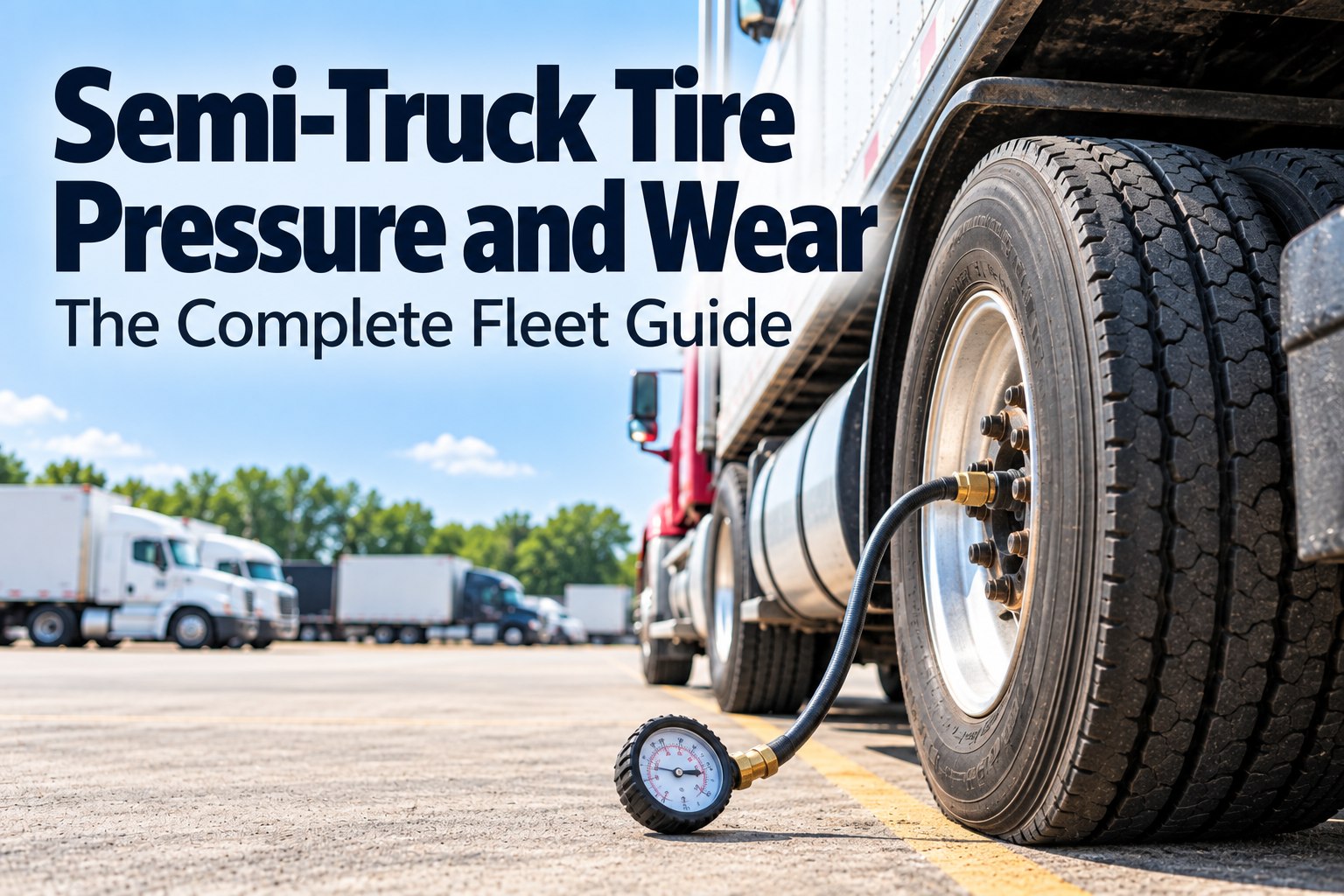
Semi-truck tire pressure is judged cold, against the load being carried — that is the standard in 49 CFR 393.75, which prohibits operating on a tire whose cold inflation pressure is less than that specified for the load, and requires heat-induced pressure increases to be corrected out rather than counted in your favor. The industry's own measurements show how far reality sits from that standard: Commercial Carrier Journal reports that only 44% of all tires are within 5 psi of their target pressure, while 7% are under-inflated by at least 20 psi. A tire 20 psi low is not a tire that needs air next week; it is a casing being destroyed by heat while it still looks fine from the cab. This guide covers why cold pressure is the number that matters, what underinflation actually does, the six ways air escapes, how manual checks, monitoring and automatic inflation compare, and what the whole thing costs. Book a 30-minute demo to see pressure tracked by wheel position, or start free with 3 vehicles.
A Tire 20 PSI Low Looks Exactly Like a Tire That's Fine. That's the Entire Problem.
For fleet managers, shop leads and maintenance supervisors: the cold-pressure rule, what low pressure does to a casing, and how manual checks, monitoring and automatic inflation actually compare.
Figures reported by Commercial Carrier Journal. The middle band is inferred from those two published shares.
Cold pressureWhy the Only Reading That Counts Is Taken Before the Truck Moves
A tire warms as it works and its pressure rises with it, so a warm reading flatters a tire that was low when it left the yard. The federal rule is written around this: the tire must not be operated at a cold inflation pressure below that specified for the load, and the heat-induced increase is corrected out using the factors in the regulation. Practically, that makes the yard the only honest place to check. Record cold readings per position on a free account.
This is the number the specification is written against, and the one that tells you whether the tire is carrying its load correctly.
Set it here, check it hereUseful for spotting a tire running hotter than its neighbours, but never for setting pressure — top up warm and the tire is under-inflated once it cools.
Diagnostic only, never the standardSymptomsWhat Low Pressure Does Long Before It Becomes a Blowout
Underinflation rarely announces itself. It works through heat, and heat is what destroys the casing that a retread depends on — which is why a pressure problem is a casing problem first and a road call second. We'll connect your road calls to pressure history in a demo.
A low tire flexes more in the sidewall, and that flex becomes heat inside the casing where nobody can see it.
Center and intermediate depression, cupping and heel-and-toe all list pressure among their causes in manufacturer wear references.
In a dual, one soft tire hands its share of the load to the other, so a single leak damages two tires.
Rolling resistance climbs as pressure falls, spread across eighteen tires on every mile of the route.
A casing cooked by underinflation cannot be retreaded, turning a recoverable asset into scrap.
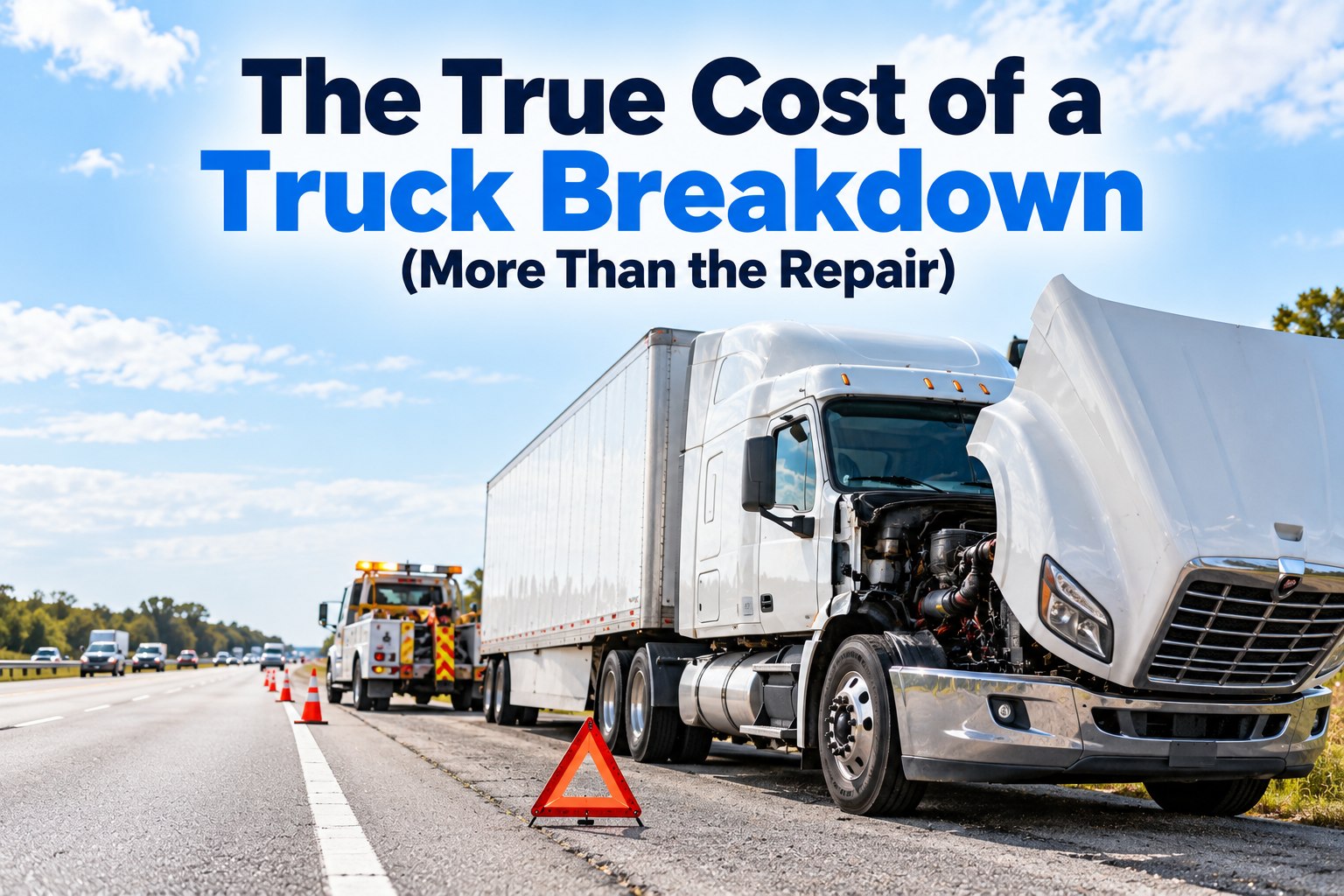
The visible end of the sequence — and by industry benchmarking, tires are the leading system behind unscheduled roadside repairs.
CausesSix Ways Air Leaves a Tire, and Only One of Them Is Dramatic
Most pressure loss is gradual and silent, which is why a fleet that only reacts to visibly flat tires is always late. Each of these needs a different countermeasure. Log the cause with every top-up, free on 3 vehicles.
Air migrates through the rubber over time — every tire loses pressure sitting still
Scheduled checks, not event-driven onesA weeping core or a missing cap is among the cheapest leaks to find and fix
Cap check daily, core check at PMA nail can hold pressure for weeks while the tire runs low the whole time
Gauge readings catch what eyes don'tCorroded, damaged or dirty rims leak slowly at the bead
Inspect at every dismountCold mornings read lower; a tire set warm reads low once it cools
Always set and check coldOne tire in an assembly loses air and its partner silently carries the load
Check both, every time, never by sound"When the warning light is activated, a driver should always stop to inspect and determine the cause … treat it similar to a check engine light."
Jim Sharkey, vice president at Pressure Systems International, quoted in Commercial Carrier JournalThe optionsManual Gauge, Pressure Monitoring, or Automatic Inflation
These three are not competing products so much as three different answers to "who is watching the pressure between checks." A monitoring system tells you about a problem; an inflation system deals with it. We'll map these against your own fleet mix in a demo. Swipe the table on mobile.
| Manual gauge checks | Tire pressure monitoring (TPMS) | Automatic inflation (ATIS) | |
|---|---|---|---|
| What it does | Nothing until someone checks | Warns when pressure falls below a threshold | Adds air continuously to hold target pressure |
| When you learn about a leak | At the next scheduled check | When the alarm triggers | Often not at all — the system compensates |
| Depends on | Discipline and a calibrated gauge | Someone acting on the warning | Working plumbing and a periodic audit |
| Main weakness | Between checks, the fleet is blind | A warning nobody stops for is no warning | Can mask a slow leak until the audit finds it |
| Best suited to | Small fleets with tight yard routine | Tractors and mixed fleets wanting visibility | Trailers, where nobody is watching the gauges |
Sources: Commercial Carrier Journal, "Optimizing commercial truck tire pressure for fuel economy and safety," including comments from Bendix, Pressure Systems International, Dana and Aperia Technologies.
Automation doesn't remove the audit — it changes what you're auditing for
An inflation system holding a tire at target can hide the leak it is compensating for, which is why the industry view is that these systems reduce downtime rather than eliminate inspection. As Aperia's Judith Monte puts it, a monitoring system cannot guarantee tires will not fall below target pressure, which is the case for inflation on trailers — but a fleet running either still needs a periodic manual audit to find the leaks the technology is quietly covering.
Take Cold Pressures on Ten Trucks Tomorrow Morning. Bring Us the Numbers.
It takes twenty minutes and it is the most revealing thing most fleets do all quarter. We'll load the readings by wheel position, show which assemblies are mismatched, and set up the checks and alerts so the same tires don't drift again before the next PM.
The checkHow to Take a Pressure Reading That Is Actually Worth Recording
A pressure check that isn't recorded against a position tells you about today and nothing about the trend. Six steps, and the last one is the one fleets skip. Put it on the daily inspection report where the reading joins a history. Start recording by position, free.
Before the first run, or after the tire has fully cooled — never top up a warm tire to its cold target.
A thumping stick finds a flat, not a tire 15 psi low. Calibrate gauges on a schedule.
The specification is written for the weight carried, so mixed-load fleets need a policy per configuration.
Inner tires are the ones that get skipped and the ones that fail.
They are the last barrier on the valve core, and they cost almost nothing.
A number without a wheel position can't show you a trend, and the trend is the whole point.
CostWhat Pressure Discipline Is Worth Against What It Prevents
The cheapest version of this problem is a few minutes with a gauge; the most expensive is a casing destroyed and a truck stopped with a load on it. Industry benchmarking puts unplanned downtime at roughly $448 to $760 per truck per day before towing and repair, and ATRI puts 2025 repair and maintenance cost at $0.215 per mile, up 8.6%. Tie the pressure routine into preventive maintenance so it is scheduled rather than remembered. Estimate your own exposure with our team.
Relative cost by where the pressure problem is caught, illustrative — not prices. Downtime benchmark: FleetNet America and ATA's Technology & Maintenance Council via industry reporting; per-mile cost: ATRI.
MeasureFour Numbers That Show Your Pressure Program Is Real
Pressure programs fail quietly, because nothing visibly breaks until something does. These four make the drift measurable. Start tracking them free.
QuestionsSemi-Truck Tire Pressure Questions Fleets Ask Most
What tire pressure should a semi-truck run?
Whatever the tire's specification calls for at the load being carried — the rule is written around cold inflation pressure for that load, not a single number for every truck. Fleets running mixed loads need a pressure policy per configuration. Set yours up with our team.
Should I check pressure hot or cold?
Cold, before the truck runs or after it has fully cooled. A warm tire reads high, so topping up warm leaves it under-inflated once it cools — and the regulation corrects heat-induced increases out rather than counting them. Record cold readings free.
How much underinflation is actually a problem?
Enough that industry measurements treat 5 psi as the tolerance band and flag tires 20 psi under as a distinct failure group. Both numbers matter: 44% of tires sit within 5 psi of target, while 7% are at least 20 psi low. Benchmark your own fleet in a demo.
Is a TPMS or an automatic inflation system worth it?
They solve different problems. Monitoring tells you a tire is low; inflation holds the pressure and, per industry reporting, can overcome 97% of leaks. Bendix's TPMS product manager frames the payback simply: avoid one on-road tire failure and the system has paid for itself. Track the outcome either way, free.
If we fit inflation systems, can we stop checking?
No. A system holding pressure can mask the leak it is compensating for, so a periodic manual audit is what finds those. The technology changes what you audit for, it doesn't remove the audit. Build the audit routine with us.
Why does the inner tire always seem to be the one that fails?
Because it is the one that gets skipped. In a dual, a soft inner tire hands its load to its partner and runs hot doing it, so one missed check damages two tires. Check both, every time. Track both positions per assembly free.
Find the Slow Leak While It's Still Just a Slow Leak
FleetRabbit records cold pressures by wheel position, flags the assemblies that keep drifting apart, and turns a driver's tire report into a work order with that position's history attached — so the next low reading is a repair, not a road call.
No credit card required. Works with the gauges and systems you already run.