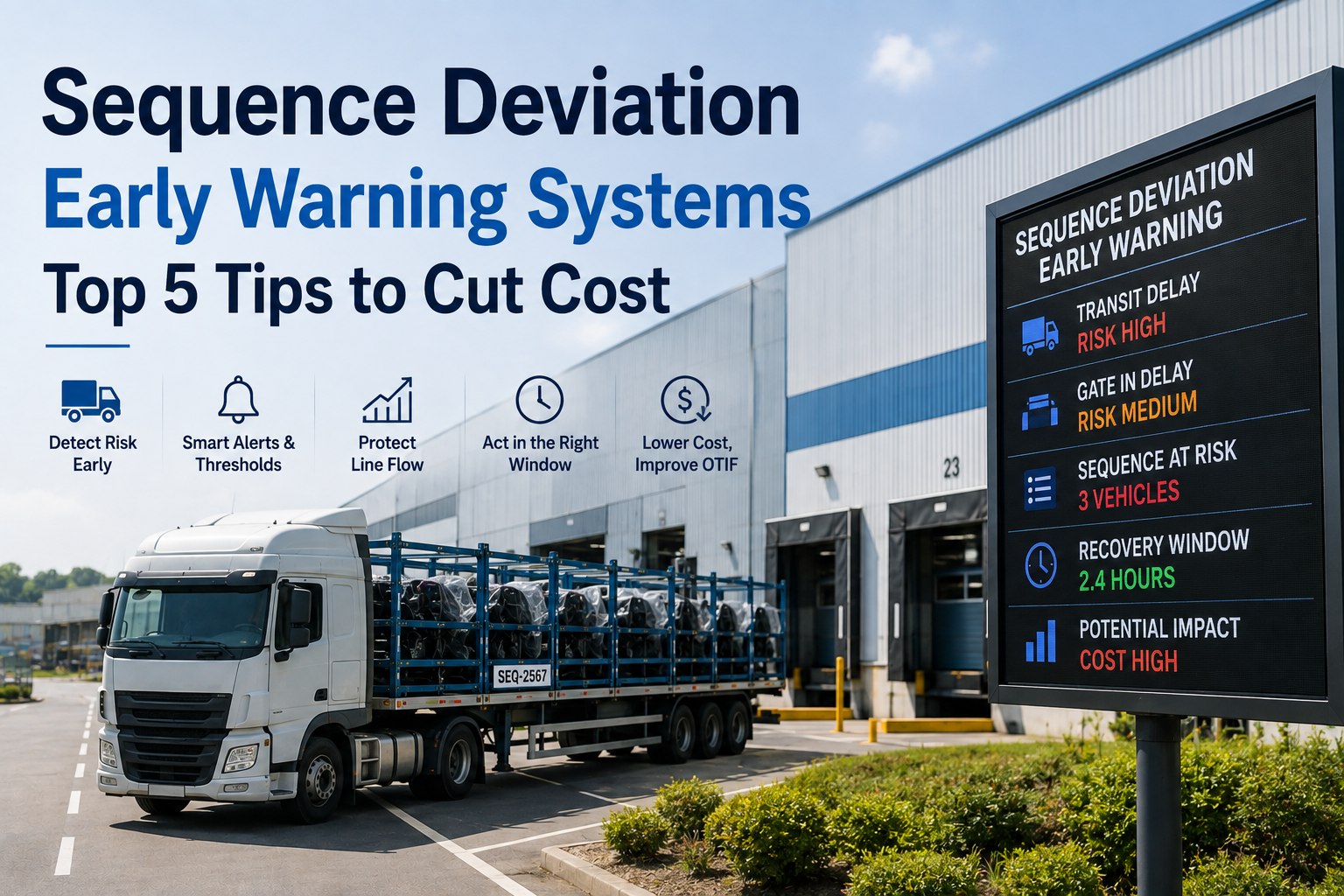
Every sequence break was preceded by something. That is not a comforting observation, it is an operational one — the post-mortem almost always finds that the signs were there, scattered across a telematics feed, a gate log, an acknowledgement queue and a spreadsheet on someone's desktop, with nobody connecting them. The data existed and the signal existed; the organisation could not see it because it was looking in fragments. An early warning system is simply the work of joining those fragments and putting a threshold on the result. Where it goes wrong is threshold design: set them too low and you generate constant noise on minor deviations, set them too high and you find out too late, and both failures look identical on a dashboard that only counts alerts fired. What follows is five ways to build one that pays — lead indicators drawn from transit and gate data, thresholds that survive contact with a real shift, and the escalation window inside which recovery is still cheap. Talk to a solutions engineer to size the thresholds against your own lanes.
TOP 5 · SEQUENCE EARLY WARNING
Sequence Deviation Early Warning Systems
Lead indicators from transit and gate data, thresholds tuned against false positives rather than against optimism, and the escalation window in which a deviation is still a planning event rather than a production one.
T-8hReplan freely
T-4hReslot, re-point
T-90mExpedite or sort
T-30mStop decision
The value of a signal is entirely a function of where on this bar it fires. A perfect prediction at T-20m is worth almost nothing.
Who Owns Which Minute
Escalation fails when the window is defined but ownership is not, because the first thing anyone does with an alert is work out whether it is theirs. Assign the segments in advance and that question disappears.
T-8h to T-4hInbound plannerReissue, reconfirm, reslot. No cost, no visibility outside logistics.
T-4h to T-90mLogistics supervisorPriority call-forward, door reassignment, alternate on-site source.
T-90m to T-30mLine feed leadSort decision, kit re-point, buffer coverage check with a stated deadline.
T-30m to T-0Production managementHold position, resequence, or stop. The only segment where those are the options.
The rule that makes ownership stick
An alert that crosses a segment boundary without being closed escalates automatically to the next owner — it is not re-sent to the same person more loudly. Systems that repeat rather than escalate train people to ignore the repeat, and the second notification is the one that gets dismissed fastest.
Five Ways to Cut the Cost
Ordered by effect on how early you find out. The first two need no new data at all — only joining data you already hold.
01Join transit data to the sequence position it feeds
A late truck is a logistics fact. A late truck carrying positions 340 to 385 of tomorrow's frozen window is a production fact, and only the second one gets acted on with urgency. Most plants hold both pieces and never join them, so ETA variance is reviewed as a carrier performance issue rather than as sequence exposure. The join is the intervention — once an ETA is expressed in sequence positions at risk, the alert routes itself.
Data neededCarrier ETA plus call-off sequence mapping
New captureNone — both already exist
Fires atT-6h and earlier
02Alert on missing signals, not just bad ones
The highest-value alerts fire when nothing arrives — no acknowledgement against a transmitted call-off, no despatch advice against a due window, no gate arrival against a booked slot. Absence is invisible to systems built around processing events, which is exactly why these failures survive so long. Every expected event needs a deadline and an owner, or its non-occurrence is not detectable at all.
Data neededExpected-event register with deadlines
New captureNone — inference from existing flows
Fires atWhenever the deadline passes
03Make thresholds configurable per lane, not per system
A platform without adjustable thresholds either creates constant noise by alerting on minor deviations, or misses real problems by alerting too late. One global tolerance guarantees both outcomes simultaneously across a mixed supply base. Tighter monitoring belongs on sequence-critical lanes and high-variance carriers; looser tolerance on general supply that a buffer will absorb. The configuration surface is the product.
Data neededLane classification and buffer coverage
New captureCoverage per part family
Fires atVaries deliberately by lane
04Push alerts into the workflow, not onto a screen
A standalone dashboard sitting on a separate monitor creates friction, and alerts get missed. Delivery into the tool where the work already happens — the yard handset, the dock terminal, the planner's queue — is the difference between a warning system and a warning archive. Route by consequence with the impact already calculated, so the recipient is deciding rather than investigating.
Data neededOwner mapping per exception type
New captureDelivery integration
Fires atSame time, but reaches someone
05Run a false-positive review as a standing process
Keep alert history and analyse it. False positive analysis identifies the threshold adjustments needed to reduce unnecessary alerts, and feedback from users confirming whether an alert was accurate is what lets the thresholds improve rather than ossify. Without this loop, thresholds are set once by whoever was in the room and then defended indefinitely — and every unnecessary alert erodes the response to the necessary ones.
Data neededAlert history with outcome tagging
New captureOne-tap accuracy feedback
Fires atMonthly review, not runtime
Tips one and two use data you already have. Most plants get a working early warning system before buying anything.
A solutions engineer will map your existing transit, gate and call-off feeds, identify which expected events currently have no deadline, and propose starting thresholds by lane.
Starting Thresholds
Three bands per signal. Start here, then let the false-positive review move them — these are opening positions, not settled values, and they should be tighter on sequence-critical lanes than on general supply.
← Swipe to see all columns →
Note the pattern in the red column: almost every escalation condition is a combination rather than a single breach. Single-variable thresholds are what produce noise, because any one signal crossing a line is usually benign. A late arrival with intact coverage is information; a late arrival with coverage already breached is an event.
Where the Signals Come From
Two families, with very different latency and reliability characteristics. Design around both — transit data tells you what is coming, gate data tells you what is true.
Transit signals — predictive
Carrier ETA feedRecalculates continuously as the load moves rather than holding the static time entered at booking. Earliest usable signal, and the one worth investing in first.
Geofence crossingsDiscrete, high-confidence position events. Less granular than a live ETA but far more reliable as a trigger.
Driver app statusCovers carriers without telematics. Lower fidelity, but it closes the coverage gap that otherwise leaves your least reliable carriers unmonitored.
Supplier despatch confirmationFires before the vehicle moves at all. The only transit-family signal available at full lead time.
Caveat: ETA accuracy varies by provider and lane. Published figures around 91% within a one-hour window and 97% within six hours give a sense of the achievable band — treat the six-hour number as the planning-grade one.
Gate and yard signals — confirmatory
Check-in eventGround truth. Converts every upstream prediction into a settled fact and closes the open alerts against that load.
Advice validation at barrierCatches version mismatch physically — the load arrived, but against a call-off nobody is expecting.
Staging assignment and dwellA sequenced trailer sitting past its call-forward deadline is a deviation regardless of how punctual its arrival was.
Door and unload eventsLast confirmatory point before the kit cell. Late here means the recovery options have narrowed to two.
Caveat: gate signals are reliable and late by definition. They should close alerts, not open them — a warning system that fires first at the barrier is a reporting system.
Keeping the System Trusted
Six rules that determine whether people act on alerts in month six. Every one of them is about restraint rather than capability.
1Track alert-to-action ratio as the system's primary health metric. If it falls, the thresholds are wrong — not the people.
2Every alert carries the calculated impact and at least one option. An alert that only states a fact makes the recipient do the analysis.
3One-tap accuracy feedback on every alert, feeding the monthly threshold review. Without a feedback loop the thresholds never improve.
4Suppress duplicates across signals. One load generating four alerts from four sources is one event, and should read as one.
5Escalate across owners on boundary crossing rather than repeating to the same person. Repetition trains dismissal.
6Close alerts automatically on the confirmatory event. An alert list that only grows is one nobody reads by Thursday.
Size the Thresholds Against Your Own Lanes
Bring your carrier feeds, gate data, call-off flows and a month of actual deviations. A solutions engineer maps which signals you already hold, identifies the expected events currently lacking a deadline, and proposes starting thresholds by lane with the false-positive review process attached.
Transit-to-sequence joining
Missing-signal detection
Per-lane thresholds
Escalation ownership
Frequently Asked Questions
Where should we set the first thresholds?
Deliberately loose, then tighten. Setting them too low produces excessive false positives and operational fatigue; too high and real degradation is missed — and the second failure is easier to correct than the first, because a team that has stopped trusting alerts takes months to win back. Start with combination conditions rather than single breaches, review monthly against tagged outcomes, and tighten per lane where the review shows you are missing events. Thresholds should be per lane and per SLA tier, not global.
Which signal gives the most warning?
Missing acknowledgement against a transmitted call-off, because it fires at full production lead time and costs nothing to detect. After that, live carrier ETA joined to the sequence positions the load feeds. Most disruptions are visible well before they affect production — the gap is not detection capability but whether anyone joined the fragments. Our
analytics and reporting layer is where the joined view lives.
How do we stop alert fatigue?
Measure it, then treat it as a threshold problem. Keep alert history for performance evaluation, run false-positive analysis to identify which thresholds need adjusting, and let users confirm whether an alert was accurate so the system learns rather than repeats. Alongside that, suppress duplicates across signals, close alerts automatically on the confirmatory event, and escalate across owners instead of re-notifying the same person. Fatigue is almost never caused by alert volume alone — it is caused by unactionable volume.
Do we need a dedicated dashboard?
Preferably not as the primary channel. A standalone dashboard on a separate screen creates friction and alerts get missed, which is why delivery into the tools people already have open — the handset, the dock terminal, the planner's work queue — outperforms a well-designed monitoring screen almost every time. Keep a dashboard for review and pattern analysis, but do not make it the route by which anyone first learns something is wrong.
How accurate does an ETA need to be to be useful?
Less accurate than people assume, provided the accuracy is characterised. Published performance in the region of 91% within a one-hour arrival window and 97% within six hours is enough to drive planning-grade decisions at T-6h, which is where the cheap recovery options live. What breaks the system is unstated accuracy — an ETA presented as precise when it is not teaches people to discount it entirely. Publish the confidence band alongside the estimate and it stays usable.
What if some carriers have no telematics?
Cover them with a driver app and accept lower fidelity, because the alternative is that your least instrumented carriers are also your least monitored — and those two attributes correlate uncomfortably often. A coarse position update from a phone is far more useful than nothing, and for these lanes you can lean harder on the non-transit signals: despatch confirmation, acknowledgement age and advice validation all work regardless of what the vehicle is carrying. Our
integrations overview covers the telematics surface.
How long before this pays for itself?
The first two tips typically produce results within a quarter because they use existing data, and the saving shows up as expedites that did not happen rather than as anything visible on a production report. Track avoidable premium freight before and after — it is the cost line finance already watches, and it is the one an earlier warning most directly attacks. Threshold tuning continues indefinitely; the payback does not wait for it to finish.
Fire Early Enough to Matter
Transit data joined to the sequence positions it feeds, missing signals detected as deliberately as bad ones, thresholds set per lane and reviewed against outcomes, and an escalation window where every minute has an owner.
Uses existing transit and gate feeds · Runs on existing handsets · Site-level configuration
August 13, 2026By Alex Rowan
All Blogs