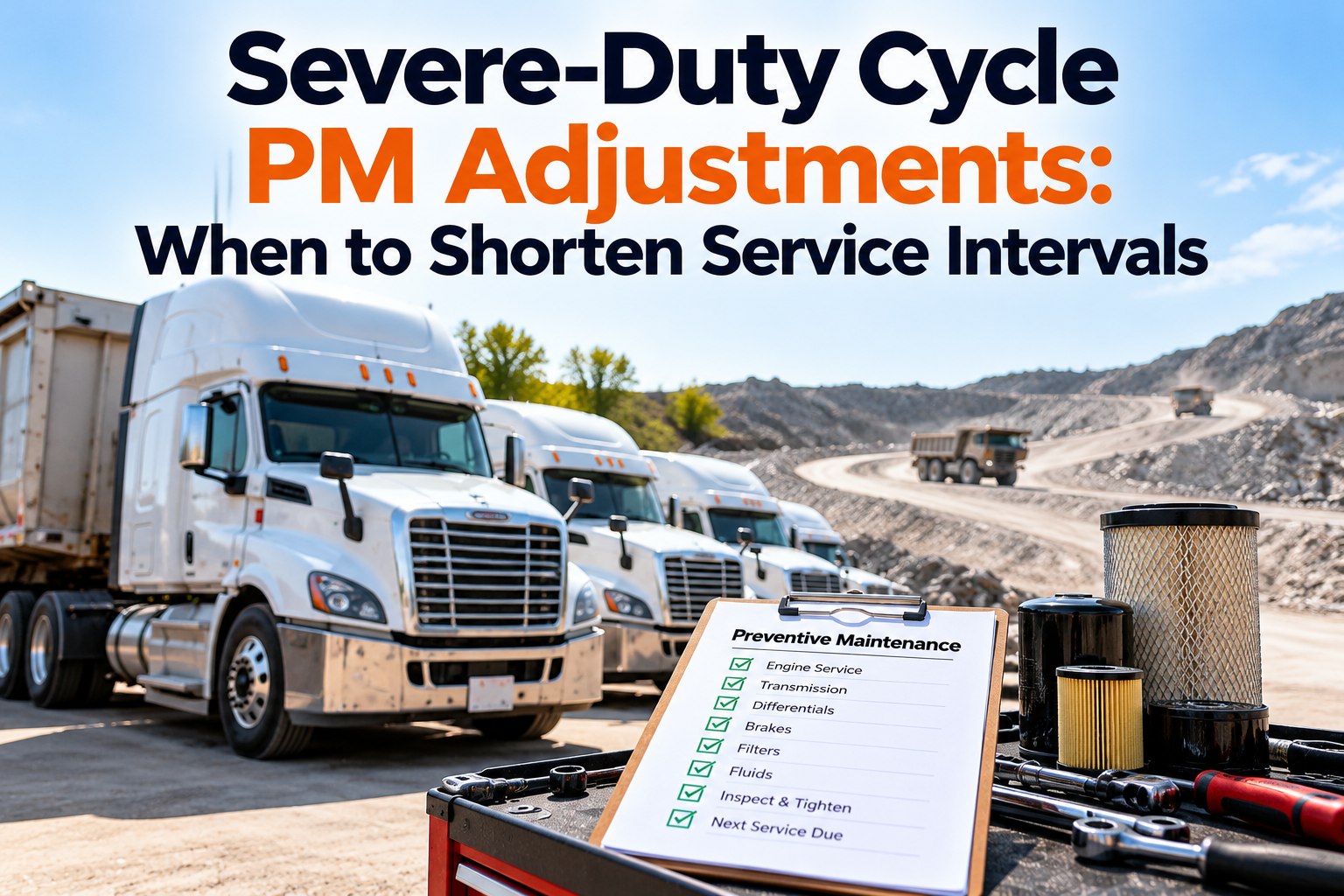
Severe-duty PM adjustment means shortening a truck's standard service intervals because its work wears parts faster than the manual's normal-duty schedule assumes. Stop-and-go routes, heavy loads, long idling, dust and extreme temperatures are the usual triggers. This guide shows how to tell if a unit is severe duty, how much to shorten each interval, where published guidance disagrees, and how to make your PM software carry the adjustment. Schedule a call to set duty-cycle intervals on your units.
DUTY-CYCLE PM · FLEET MANAGERS AND SHOP LEADS
Two Trucks With the Same Odometer Reading Can Be Two Different Distances From a Breakdown
Idling, dust, heat, heavy loads and stop-and-go work age an engine faster than the miles show. Shorten the intervals where the duty cycle earns it, and leave the rest alone.
DUTY CLASS, SET PER UNIT
Normal dutyOEM interval
Mixed dutyShorten some
Severe dutyShorten and trigger on hours
Set it per unit, and review it each season.
What Counts as Severe Duty on a Diesel Truck
Eight conditions put a unit on the severe-duty schedule, and one is often enough
One maintenance guide offers a self-check list with thresholds, which is below. Check your owner's manual too, because manufacturers define severe service in their own terms and their thresholds may differ.
Climate and environment
Temperatures regularly above 100°F or below 0°F
Dust heavy enough that the air filter needs cleaning every day
Idle time above 40 percent of operating time
Operation over 16 hours a day
Use and load
Off-road or construction-site work
Short trips, under about 5 miles per start
Constant heavy loads, above about 80 percent of GVWR
Stop-and-go city delivery or refuse routes
Idling adds engine wear that the odometer never records
One fleet guide converts idle time to miles of wear at roughly 30 to 40 miles per idle hour, or about 60 to 80 miles for two hours. A truck that idles four hours a day for 25 days logs 100 idle hours, which is roughly 3,000 to 4,000 miles of engine wear with no odometer change. That is why high-idle units belong on engine-hour triggers instead of mileage.
Treat the conversion as a rule of thumb. It comes from one vendor guide and is not an OEM figure. Use it to see the direction of the error, and confirm intervals with your engine maker.
How Much to Shorten Service Intervals for Each Duty Condition
Guidance for one condition usually lands between 10 and 30 percent, and 15 to 25 percent is a sensible starting point
The chart below is one published engine-hour matrix. It shows how much the interval shrinks for each condition, with heat the largest at 30 percent and idle the smallest at 10 percent.
ENGINE-HOUR INTERVAL REDUCTION BY CONDITION, PERCENT. ONE PUBLISHED MATRIX
Extreme heat, above 100°F
30% shorter
Heavy dust or sand
25% shorter
Corrosive environments
20% shorter
Extended idle time
10% shorter
Another table from the same source shows much deeper cuts, so published numbers do not agree
The multiplier table below keeps only 25 to 75 percent of the standard interval, which means reductions of 25 to 75 percent. It treats idling as a 60 percent cut where the matrix above treats it as 10 percent. The two use different baselines, so do not blend them. Use them as the top and bottom of a range, then test against your own failure and oil-analysis data.
INTERVAL KEPT AS A SHARE OF THE STANDARD INTERVAL, PERCENT. A SECOND PUBLISHED TABLE
Heavy dust or dirt
25% of standard
Heavy idling or PTO, over 50% idle
40% of standard
Extreme temperature, below -20°F or above 110°F
50% of standard
Stop-and-go, city delivery or refuse
50% of standard
Constant heavy loads, over 80% GVWR
60% of standard
Water or mud exposure
70% of standard
Short trips, under 5 miles per start
75% of standard
When several conditions apply, decide the stacking rule once and write it down
The multiplier table says to use the lowest factor when conditions overlap, so dust at 0.25 times plus idling at 0.40 times gives 0.25 times, not 0.10 times. The engine-hour matrix does not say whether its percentages stack. A written rule keeps every shop applying the same adjustment.
Running severe-duty trucks on normal-duty intervals? Schedule a call and we will set up the adjustments.
Bring one route type, and leave with duty classes and adjusted PM intervals per unit.
Severe-Duty Interval Examples: What Shorter Looks Like on Real Services
Four examples show how a multiplier changes a standard interval
These examples come from the multiplier table above, so they show the deeper end of the range.
AIR FILTER, DUST
30,000 mi
↓
7,500 mi
0.25x
BRAKES, STOP-AND-GO
50,000 mi
↓
25,000 mi
0.50x
TRANSMISSION, HEAVY LOAD
60,000 mi
↓
36,000 mi
0.60x
COOLANT, EXTREME TEMPERATURE
2 years
↓
1 year
0.50x
Engine oil is the clearest case, and drain intervals roughly halve for severe or vocational work
One vendor guide gives 20,000 to 25,000 miles for normal on-highway oil drains and 10,000 to 15,000 for severe or vocational use. It also suggests reducing the interval by 15 to 20 percent below about -10°F, or using a 0W-40 synthetic. On an engine-hour matrix, a 30 percent heat reduction applied to a 250-hour oil change gives about 175 hours, which is my arithmetic, not the source's.
ENGINE OIL DRAIN INTERVAL, MILES. ONE VENDOR GUIDE, CONFIRM WITH YOUR ENGINE OEM
Normal on-highway
20,000 - 25,000 mi
Severe or vocational
10,000 - 15,000 mi
How to Avoid Over-Shortening: Use Oil Analysis and Inspection Findings
Shortening everything is expensive, so let the data tell you which services need it
Duty multipliers are a starting point. Oil analysis, brake-wear trends and inspection findings show whether a unit needs the full reduction, a smaller one or none. One guide cites about $300 per oil sample, so apply sampling where the interval decision is worth it.
Oil analysis habits
Start from the OEM interval, not a guessed extended one
Sample oil at each drain and often mid-interval
Track TBN, viscosity and wear metals as a trend
Leave margin below the longest supported interval
Keep dated results and approvals per truck
What your PM software should reflect
Mark each unit with a duty class, not just a truck class
Apply the right multiplier to each affected service, not to everything
Trigger on engine hours where idle time is high
Show the adjusted due date next to the standard one
Keep a record of why an interval was shortened
Severe-Duty PM Checklist for Fleets
If every box is ticked, your duty-cycle adjustments are ready to run
Classify the units
Each unit has a duty class: normal, mixed or severe
Severe units are flagged for the conditions that apply
Idle-heavy units trigger on engine hours
The stacking rule for several conditions is written down
Apply and review
Shortened intervals are applied to the services they affect
Oil analysis or inspection findings are used to adjust
Cold-weather and hot-weather adjustments are scheduled by season
Intervals are reviewed after each season against failures
Put Severe-Duty PM Adjustments in Your Schedule: Set Duty Classes and Shorter Intervals in FleetRabbit
FleetRabbit lets you set PM intervals per unit, trigger them by miles, engine hours or date, and keep the service history on each truck. Give a severe-duty truck its own shorter schedule, get reminders before it is due, and see every service on that unit's record.
Intervals per unit
Mileage, hour and date triggers
PM reminders before due
Service history per truck
Frequently Asked Questions
Quick answers on severe-duty PM interval adjustments
What is severe duty on a diesel truck?
Operation that wears parts faster than normal highway use, such as heavy idling, stop-and-go routes, dust, extreme temperatures, heavy loads, short trips and off-road work. Check your engine maker's own definition.
How much should I shorten service intervals?
Published guidance ranges widely, from about 10 to 30 percent for a single condition up to much deeper cuts for dust or heavy idling. Start in the 15 to 25 percent range, then adjust with oil analysis and failure history.
Do severe-duty adjustments stack?
One source says to use the lowest single factor when conditions overlap, and another does not say. Choose a rule, write it down and apply it the same way across the fleet.
Should idle-heavy trucks use engine hours?
Yes. Idling adds wear without adding miles, and one guide estimates 30 to 40 miles of wear per idle hour. Engine-hour triggers capture it.
Can oil analysis replace a shorter interval?
It can show whether a longer interval is safe, but it needs a monitoring program, dated records and margin below the maximum interval. Start from the OEM interval.
Can PM software handle different intervals per truck?
It should. Look for per-unit intervals, mileage, hour and date triggers, and history that shows why an interval was changed.
What does FleetRabbit cost?
Match Your PM Intervals to the Work: Put Each Truck's Duty Class on Record
A truck that idles, hauls heavy or runs dusty roads is not on the same clock as the one in the manual. Set its duty class once, let reminders follow the shorter interval and keep the record of why.
Free tier for up to 3 vehicles · No credit card required · Intervals and history stored per unit
October 12, 2026By Derek Goes
All Blogs