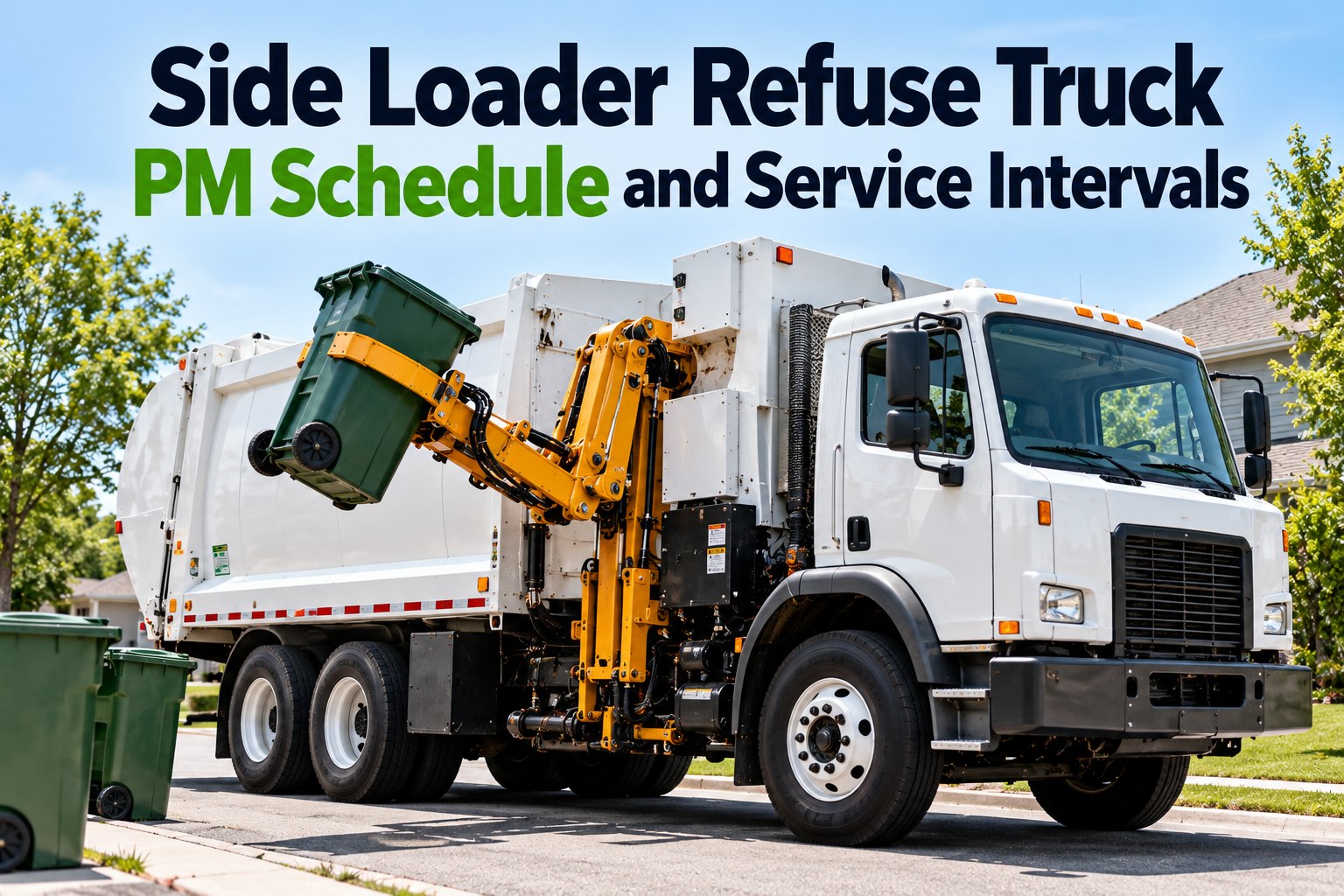
A side loader PM schedule has to keep up with the hardest-working truck in a waste fleet. An automated side loader lifts a cart at nearly every stop, so its arm and hydraulics wear on the number of lifts, not on miles driven. Brakes and tires wear on stops, the engine wears on idle hours, and the grabber wears on cycles. Below are the service levels, intervals and arm checks that keep side loader refuse truck maintenance ahead of breakdowns. Schedule a call to see a side loader PM schedule built in FleetRabbit.
Automated side loaders · Waste & recycling fleets
Service every side loader on the meter that is actually wearing it out.
Miles for brakes and tires, engine hours for oil and filters, arm cycles for pivots, grabbers and hoses. Whichever runs out first sets the work order.
Miles
Brakes, tires, alignment
or
Engine hours
Oil, filters, transmission
or
Arm cycles
Pivots, grabber, hoses
whichever comes first
Why a Side Loader PM Schedule Needs Three Meters: Miles, Engine Hours and Arm Cycles
Mileage alone undercounts a collection truck. Heil's Joel Barnes told Truck Parts & Service that a side loader cycles about 3,000 times a day, picking up at roughly 1,000 homes, against about 300 cycles for a rear loader. The odometer barely moves while the arm, hydraulics and brakes work all shift.
Lifts per day by body type
Automated side loader
about 3,000
Front loader
about 100 containers
Figures given to Truck Parts & Service by Heil Environmental (side and rear loader) and Mid Atlantic Waste Systems (front loader). Real counts vary by route density.
Route density moves the number. A Labrie Automizer described by its auto-lube installer, Lube Technologies, runs its arm up to 1,600 cycles a day. Either way, the arm does far more work than the miles suggest.
Write Every Interval as "Whichever Comes First"
Engine makers already write intervals this way. Cummins' X15 chart sets the oil change for extreme severe duty, below 3 mpg, at 4,500 miles, 500 hours or 12 months, whichever comes first. A low-mileage side loader usually reaches the hour limit long before the mileage one, so a schedule that watches only the odometer runs late on every service.
Side Loader PM Schedule by Service Level: Daily, A, B, C and D Intervals for Refuse Trucks
Mack's Steve Gitner described a four-level service ladder for refuse trucks to Truck Parts & Service. The triggers below are his. The arm and body tasks are a starting grouping to check against your body maker's preventive maintenance and lubrication charts.
Swipe sideways to see every column
Level
Trigger
Chassis work
Arm and body work
Every shift
Pre-trip DVIR: brakes and air, tire pressure and damage, lights, steering
Grease arm pivots unless auto-lube is fitted; hydraulic oil full; filter light off; arm stows with grabber open
150 hours or 45 days
Light inspection, fluid levels, brake adjustment, tire wear
Grabber belts and pads, arm slides and pivots, hose routing and clamps, limit switches
300 hours or about 90 days
Detailed review; engine oil and filters as the engine chart requires
Hydraulic filters per body chart, oil sample, cylinder seals, packer wear strips
Twice a year
Deeper chassis service: suspension, steering linkage, cooling system
Arm structure and welds, cylinder mounts, controls and sensor wiring
Once a year
Comprehensive inspection and adjustment, plus the federal annual inspection
Full body inspection, hydraulic system review, long-interval items from the body chart
Triggers from Mack Trucks via Truck Parts & Service. Daily arm items follow Heil's DuraPack Python daily checklist.
The Longest Intervals Run on the Hour Meter Too
Transmission fluid shows why hours matter beyond the A and B services. Fleet Equipment reported that Allison's TES 295 fluid carries a 6,000-hour change interval in refuse service. That figure means nothing to a schedule that only tracks miles and months.
Put Your Side Loader PM Schedule on Hours, Miles and Days at Once
Each truck gets its next A, B, C or D service from whichever trigger runs out first.
Automated Side Loader Arm Maintenance: Pivots, Grabber, Sensors and Hydraulic Hoses
The arm is where side loader refuse truck maintenance differs most from other bodies. Barnes notes it has more pivot points than other refuse bodies and needs greasing daily. At around 3,000 movements a day, a joint run dry quickly damages close-tolerance parts.
01
Pivots and bearings
On one Labrie Automizer on a Mack LR, 30 of 72 grease points sat on the side arm. Grease daily or confirm the auto-lube system is feeding every point.
02
Grabber belts and pads
Grabbers squeeze carts with rubber belts that wear at a fairly high rate, Barnes says. Check for tears, glazing and missing pads before carts start slipping.
03
Limit and proximity switches
Common replacements on refuse bodies. A failing sensor shows up as an arm that stops short, won't stow or hesitates mid-cycle.
04
Hoses and controls
Heil's arm runs two air-over-hydraulic circuits tied to a PLC. Check hoses are routed and clamped, and confirm the air regulator reads 90 PSI on the Python.
When Auto-Lube Makes Sense on a Side Loader
With dozens of grease points and thousands of cycles a day, many fleets fit automatic lubrication. It doesn't remove the check. The reservoir, the lines and each point still belong on the daily and A-service lists, because one blocked line leaves a pivot running dry.
Warning Signs Your Side Loader Is Overdue for Preventive Maintenance
Drivers see these first. Each one should open a work order the same day rather than wait for the next scheduled service.
What the driver notices
What to check
Arm slow, jerky or noisy through the cycle
Grease points, hydraulic oil level, filter condition
Carts slipping in the grabber
Belt and pad wear, grabber pressure
Filter warning light on in the cab
Hydraulic filter in bypass. Heil's Python limits the pump once bypass runs past six hours
Arm stops short or won't return to transit
Limit and proximity switches, connectors, wiring
Fresh oil on the arm or body
Hose chafe at pivots, fittings, cylinder seals
ABS light after a landfill run
Sensor and wiring damage from rough ground
Truck pulls or tires wear unevenly
Brake adjustment, alignment, suspension
What Skipping Side Loader Preventive Maintenance Costs a Waste Fleet
No one publishes a single downtime cost for side loaders, but fleets that have shared their numbers show where the money goes.
About 40%
of the City of Phoenix refuse fleet's maintenance cost went to the lift and packer mechanisms, its fleet manager told FleetOwner.
4 brake jobs
per truck per year was Waste Management's average, alongside four sets of drive tires and three sets of steer tires.
No. 1 and No. 2
Tires are the top refuse maintenance item and brakes come next, according to Mack's Gitner, both driven by constant stopping.
Wear parts replaced on schedule are a simple job. Mid Atlantic Waste Systems' Ray Leary made the point about packer wear strips: swap them before they fail and it is basic work; run them until the structure is damaged and the repair becomes far more involved.
Common Side Loader Failures and the PM Task That Prevents Each One
Most mid-route side loader failures trace back to one missed task. These three come up most on automated arms.
Failure
A dry arm pivot seizes mid-route
Failure
A clogged hydraulic filter slows the arm
Failure
Worn grabber belts let carts slip
How FleetRabbit Runs a Side Loader PM Schedule on Miles, Engine Hours and Cycles
FleetRabbit holds each side loader's meters, service levels and inspection results in one record, so the next job is always clear.
1
Add each truck with its meters
Miles, engine hours and, if your body controller shows one, a cycle count logged as its own meter.
2
Load your service levels
Daily, A, B, C and D tasks from your OEM charts, each due on whichever trigger comes first.
3
Drivers inspect on the phone
DVIR plus arm and grabber checks with photos. A failed item opens a work order for the shop.
4
Parts ready before the bay
Filters, belts and switches linked to each service, so stock is checked before the truck comes in.
5
See what's due and overdue
A fleet view sorted by next service, with every inspection and repair kept for DOT and audit review.
Cut Arm and Hydraulic Breakdowns With a Side Loader PM Schedule Built on Hours, Miles and Days
Service levels that trigger themselves, arm checks drivers complete on their phones and a parts list ready before each job.
Free for up to 3 assets · No credit card needed
Side Loader Refuse Truck Maintenance: Questions Fleet Managers Ask
How often should a side loader refuse truck be serviced?
Run daily pre-trip and arm checks, then layered services. Mack's refuse ladder uses an A service at 150 hours or 45 days, a B service at 300 hours or about 90 days, a C service twice a year and a D service annually. Add your body maker's arm and hydraulic tasks to each level.
Should garbage truck PM be based on miles or engine hours?
Both, plus calendar days, with whichever comes first triggering the service. Collection trucks idle and cycle the body for hours while covering few miles, so engine hours usually come due first. Engine makers write severe-duty intervals this way, with mile, hour and month limits side by side.
How often should a side loader arm be greased?
Daily, unless an automatic lubrication system is fitted and working. Heil's Joel Barnes notes the arm has more pivot points than other refuse bodies and cycles around 3,000 times a day, so a missed greasing can damage close-tolerance parts. Check auto-lube lines and reservoirs daily instead.
How often should hydraulic filters be changed on a side loader?
Follow your body maker's chart, and set the interval on engine hours rather than miles. Change the filter at once if the in-cab filter light shows bypass; Heil's Python limits pump operation after six hours in bypass. Oil sampling at the B service helps confirm the interval suits your routes.
What wears out fastest on an automated side loader?
On the body, grabber belts and pads, arm pivots and slide bearings, and limit or proximity switches. On the chassis, tires and brakes lead because of constant stopping. Waste Management reported averaging four brake jobs per truck per year, which is why brake checks belong on every pre-trip.
Can PM software schedule refuse trucks on engine hours?
October 26, 2026By Derek Goes
All Blogs