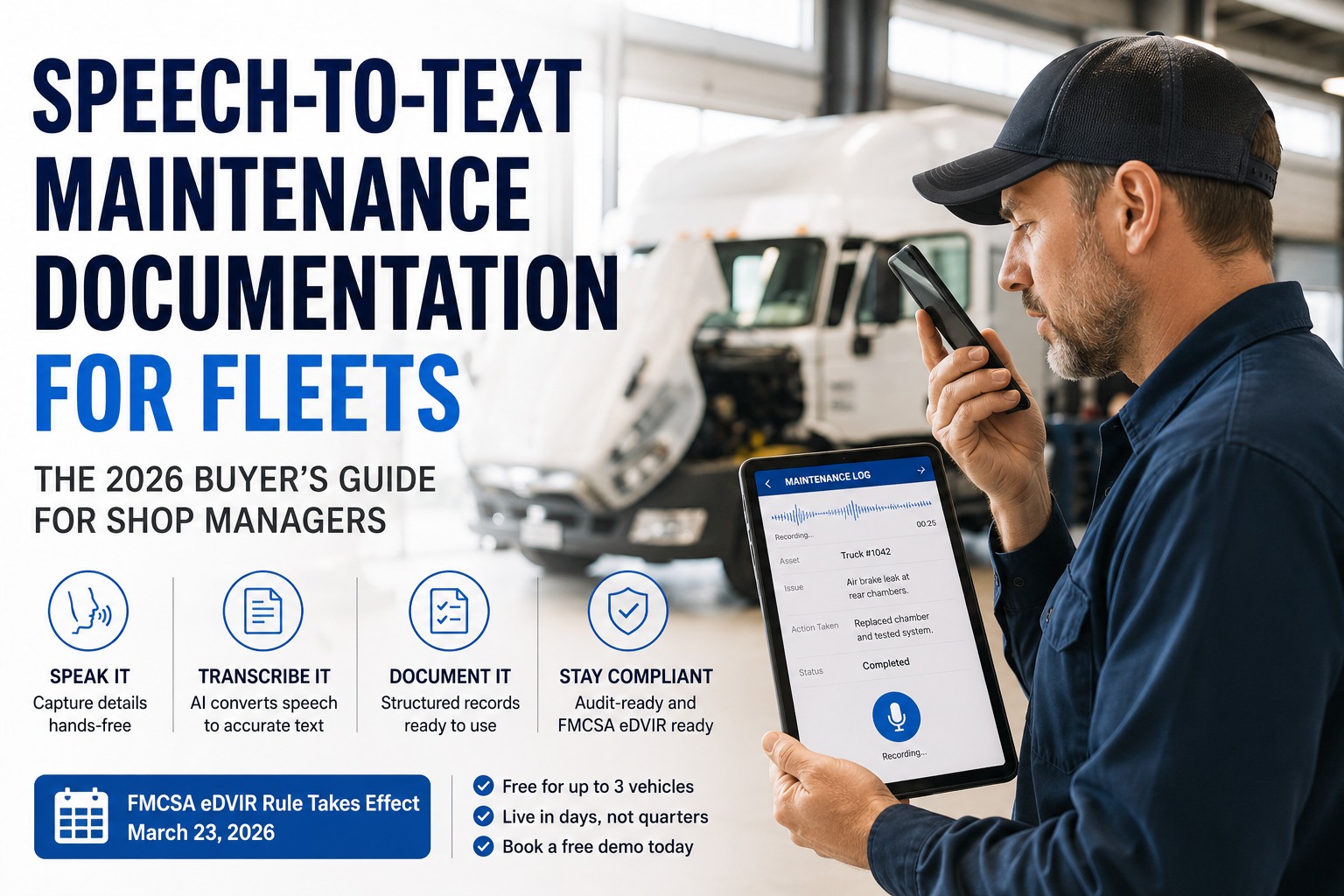
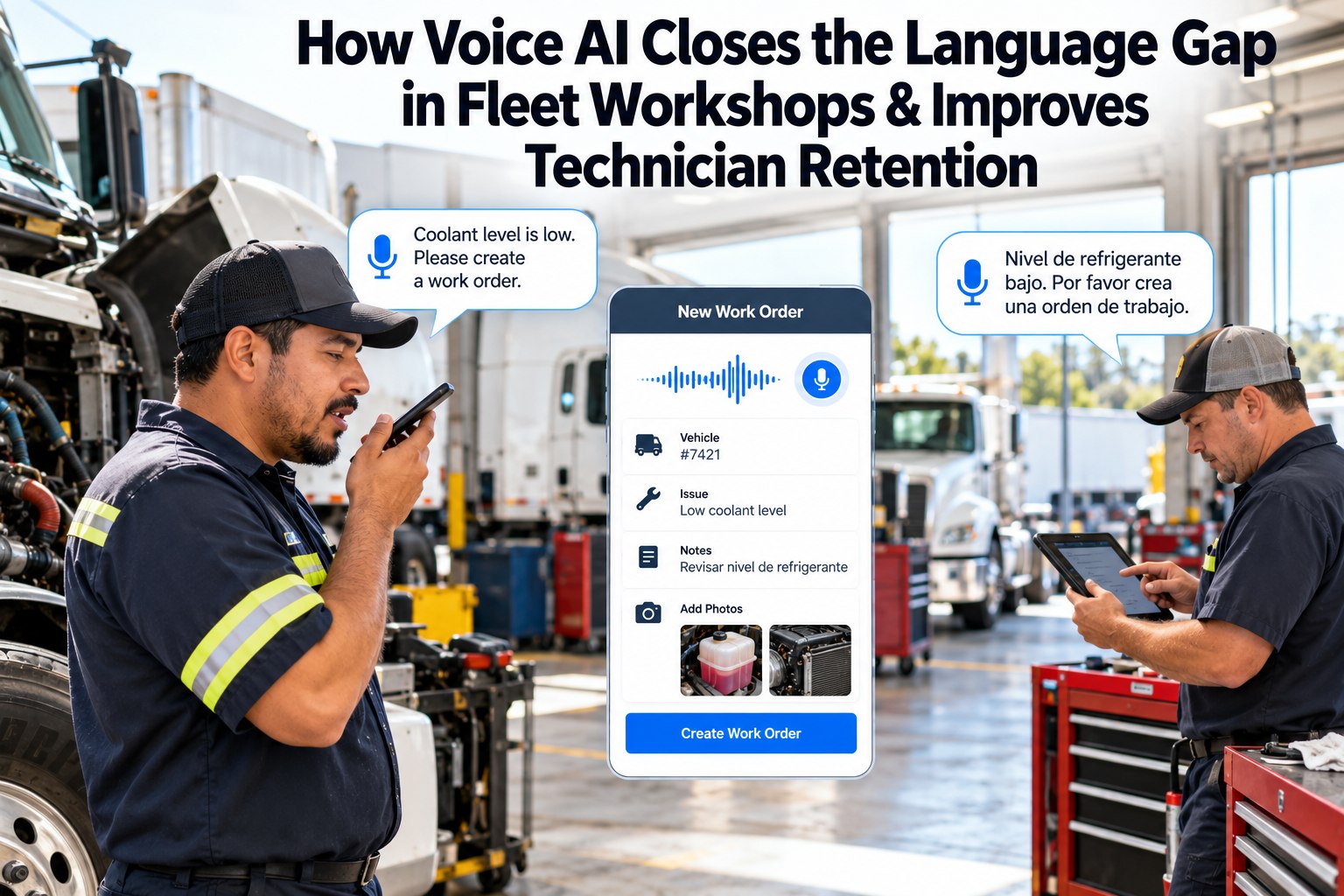
If you manage a fleet shop, documentation is the quiet tax on every hour your technicians work — and speech-to-text is the most direct way to stop paying it. Instead of a mechanic breaking off a job to type a repair note, they speak it, and the words become a structured maintenance record. Done well, that saves 30 or more minutes per technician per day and produces cleaner, more complete records than end-of-shift recall ever will. But "speech-to-text" covers everything from a free phone dictation button to a purpose-built fleet system, and the gap between them is enormous once you leave a quiet room. This buyer's guide is written for the shop manager doing the evaluating: it explains why 2026 is the moment this matters — the FMCSA eDVIR rule takes effect March 23, 2026 — walks the five things that actually separate a usable system from a frustrating one, and gives you a scorecard to judge any vendor. Start a free trial or book a demo to test speech-to-text documentation on your own shop's audio.
2026 BUYER'S GUIDE · FOR SHOP MANAGERS
Speech-to-Text Maintenance Documentation for Fleets
Speech-to-text is the entry point to hands-free fleet documentation — but not every system survives a real shop floor. This is the shop manager's guide to evaluating it: what to test, what the noise floor does to accuracy, and how the 2026 compliance shift raises the stakes.
WHY 2026
The Timing Is Not a Coincidence
Two forces are converging on fleet shops at once. The documentation burden keeps growing with every vehicle added, and the compliance bar is rising: the FMCSA eDVIR final rule (Docket FMCSA-2025-0115) takes effect March 23, 2026, making electronic maintenance records the audit-ready standard. Speech-to-text sits precisely at that intersection — it's the fastest way to produce complete, timestamped, instantly retrievable digital records without adding admin staff.
Mar 23, 2026
eDVIR rule takes effect — electronic records the standard
48 hrs
Window to produce records on FMCSA request
7%
Of carriers pass a maintenance audit clean — records are the gap
Five Things That Actually Separate Good From Bad
Every vendor claims high accuracy and easy setup. These are the five dimensions where speech-to-text systems genuinely diverge — evaluate a purchase against all five, not just the headline accuracy number.
1
Accuracy on your audio, not clean audio
The best models hit 95–98% on clean studio recordings, but that number collapses with accents, background noise, and speakerphone-quality input. Below roughly 90% accuracy, the time you spend correcting errors cancels the time you saved dictating. Always test with your own production audio — same devices, same bays, same technicians — before you commit.
2
Noise handling on a real shop floor
Standard voice recognition starts failing above 75dB, and shop floors routinely run 85–95dB with air tools, compressors, and running engines. A system without a noise-cancelling layer trained on industrial acoustics will be unusable where the work happens. Purpose-built fleet voice holds 94–96% accuracy at 85dB; consumer dictation does not.
3
Domain vocabulary
Generic transcription mangles the words that matter most — part numbers, component names, unit codes, fault codes. A custom maintenance dictionary closes most of that gap, so the system should let you feed it your jargon, your parts, and your asset IDs rather than guessing at them.
4
Structure, not just a transcript
A block of transcribed text still has to be sorted into fields by hand. The systems worth buying use language processing to route the spoken words into the correct work-order and DVIR fields automatically — turning speech into a structured record, not a paragraph someone else cleans up.
5
Compliance fit and retrieval
The record has to satisfy FMCSA: timestamped, driver- and technician-identified, retained for the required period, and producible within 48 hours of a request. Cloud-stored digital records that retrieve in seconds are exactly what the 2026 audit standard rewards — and what paper cannot deliver.
The only honest accuracy test uses your shop's audio, not a vendor's demo.
Fleet Rabbit's speech-to-text is built for fleet noise and maintenance vocabulary — the best way to judge it is to run it in your own bays, which is exactly what a demo lets you do.
The Accuracy Reality Most Vendors Skip
Accuracy is the number every vendor advertises and almost none test honestly. Understanding how it's actually measured protects you from marketing math.
The metric to ask for
WER
Word Error Rate
(Substitutions + Insertions + Deletions) ÷ total words
Lower is better. A vendor quoting a precise accuracy figure with no methodology is quoting marketing.
Consumer app in shop noise
Below ~90% accuracy, correction time cancels the speed you gained by speaking. That's why the noise floor — not the clean-audio headline — decides whether a system is worth deploying.
Speech-to-Text Options, Compared
Not every "voice" tool is the same category of product. Here's how the tiers a shop manager will encounter actually stack up. Swipe the table horizontally on mobile.
← Swipe to see all columns →
The Shop Manager's Scorecard
Take this to any vendor demo. If a system can't check most of these boxes on your own audio and your own compliance needs, keep looking.
1
Tested at 90%+ accuracy on our devices, bays, and technicians
2
Holds accuracy at the 85–95dB our shop floor actually runs
3
Accepts a custom dictionary of our parts, codes, and asset IDs
4
Outputs structured work orders and DVIRs, not raw transcripts
5
Produces eDVIR-compliant, timestamped, retained records
6
Retrieves any record within the 48-hour FMCSA window — in seconds
7
Runs on devices we already own, no new hardware
8
Transparent pricing and a free tier to trial before committing
Score Fleet Rabbit Against Your Own Shop
Fleet Rabbit is purpose-built fleet speech-to-text — tuned for shop noise, loaded with maintenance vocabulary, and structured into eDVIR-compliant records that retrieve in seconds. Run it against the scorecard on your own audio: free for up to three vehicles, then $5/vehicle/month, live in days not quarters, with no hardware to install.
Built for shop noise
Custom vocabulary
eDVIR-compliant records
Free for 3 vehicles
Documentation ROI at a Glance
The business case a shop manager takes upstairs comes down to reclaimed time and reduced audit risk. Swipe the table horizontally on mobile.
← Swipe to see all columns →
Frequently Asked Questions
Is speech-to-text accurate enough for real fleet documentation?
It depends entirely on the system and the environment. The best models reach 95–98% on clean audio, but the number that matters is accuracy in your shop, where 85–95dB of tool and engine noise lives — and a demo on your own audio is the single best way to find out, which is what you can
book a demo to run. Purpose-built fleet systems with a noise-cancelling layer hold 94–96% accuracy at 85dB, comfortably above the roughly 90% break-even where correction time starts canceling the speed you gained. A generic dictation app, by contrast, will fall apart on the floor.
How is speech-to-text accuracy actually measured?
The industry standard is Word Error Rate, or WER — the percentage of words wrong, calculated as substitutions plus insertions plus deletions divided by total words. Lower is better, and any vendor quoting a precise accuracy figure without a methodology behind it is quoting marketing rather than measurement. The honest way to compare systems is to run them on the same fixed sample of your own production audio — a test you can set up when you
book a demo — rather than trusting clean-audio numbers that rarely reflect a shop floor.
Will it understand maintenance terminology and part numbers?
Only if it's built to. Generic transcription tends to mangle exactly the words that matter — component names, part numbers, unit codes, and fault codes — because they're outside its training. A purpose-built fleet system lets you load a custom dictionary of your parts, your jargon, and your asset IDs, and that's what you can
book a demo to test with your own terminology. Feeding the system your vocabulary closes most of the accuracy gap on the high-value words a work order actually depends on.
How does this relate to the 2026 FMCSA eDVIR rule?
Directly. The eDVIR final rule (Docket FMCSA-2025-0115) takes effect March 23, 2026 and makes electronic DVIRs the audit-ready standard under 49 CFR 396.11 and 396.13, with electronic records permitted across FMCSA categories under 390.31. Speech-to-text is simply the fastest way to produce those digital records — timestamped, identified, and retained — and seeing how the spoken record satisfies the rule is something you can
book a demo to review in detail. Records must be producible within 48 hours of a request, and cloud-stored digital records retrieve in seconds where paper takes hours.
How much technician time does it really save?
Documented savings run to 30 or more minutes per technician per day, because speaking a record takes seconds where typing it takes minutes and end-of-shift write-ups take even longer. Across a full crew that's a meaningful block of hours moved from paperwork back to billable work — and running the math against your own headcount is exactly what you can
book a demo to do. The gain compounds because records captured live are also more complete, which reduces the rework and audit exposure that thin documentation creates.
Do we need special hardware or a long implementation?
No on both counts. A purpose-built fleet speech-to-text system runs on the smartphones and Bluetooth headsets your team already carries, so there's nothing to buy or install, and deployment happens in days rather than the quarters a hardware project would take. Fleet Rabbit goes live within 72 hours, and you can walk through that rollout timeline when you
book a demo. The absence of hardware is also what keeps it a low-risk purchase rather than a capital project.
What does it cost, and can we trial it first?
It's built to be tried before it's bought. Fleet Rabbit is free for up to three vehicles with no credit card, then $5 per vehicle per month with no hardware and no setup fee, so you can compare pricing and prove the accuracy in your own bays before committing anything — the exact scenario a
demo is designed for. That low barrier matters because, as this guide stresses, the only trustworthy evaluation is one run on your shop's real audio rather than a vendor's clean recording.
Is it worth it for a smaller fleet or single shop?
Often more so, because a small shop feels every lost technician hour and every audit risk more acutely than a large one. The same 48-hour production window and eDVIR standard apply no matter your size, so audit-ready digital records aren't optional — and the free tier for up to three vehicles lets a small operation reach that standard at almost no cost, which you can set up when you
book a demo. The time a small crew reclaims from paperwork tends to matter proportionally more, since there's less slack to absorb it.
Evaluate Speech-to-Text on Your Own Terms
Fleet Rabbit is purpose-built fleet speech-to-text documentation — tuned for shop noise, loaded with your maintenance vocabulary, and structured into eDVIR-compliant records that retrieve in seconds. Test it against the scorecard on your own audio: free for up to three vehicles, then $5/vehicle/month, integrated in 5–7 working days, live in days not quarters, with no hardware required.
Free tier for up to 3 vehicles · No credit card required · No hardware installation
July 29, 2026By Emily Davis
All Blogs