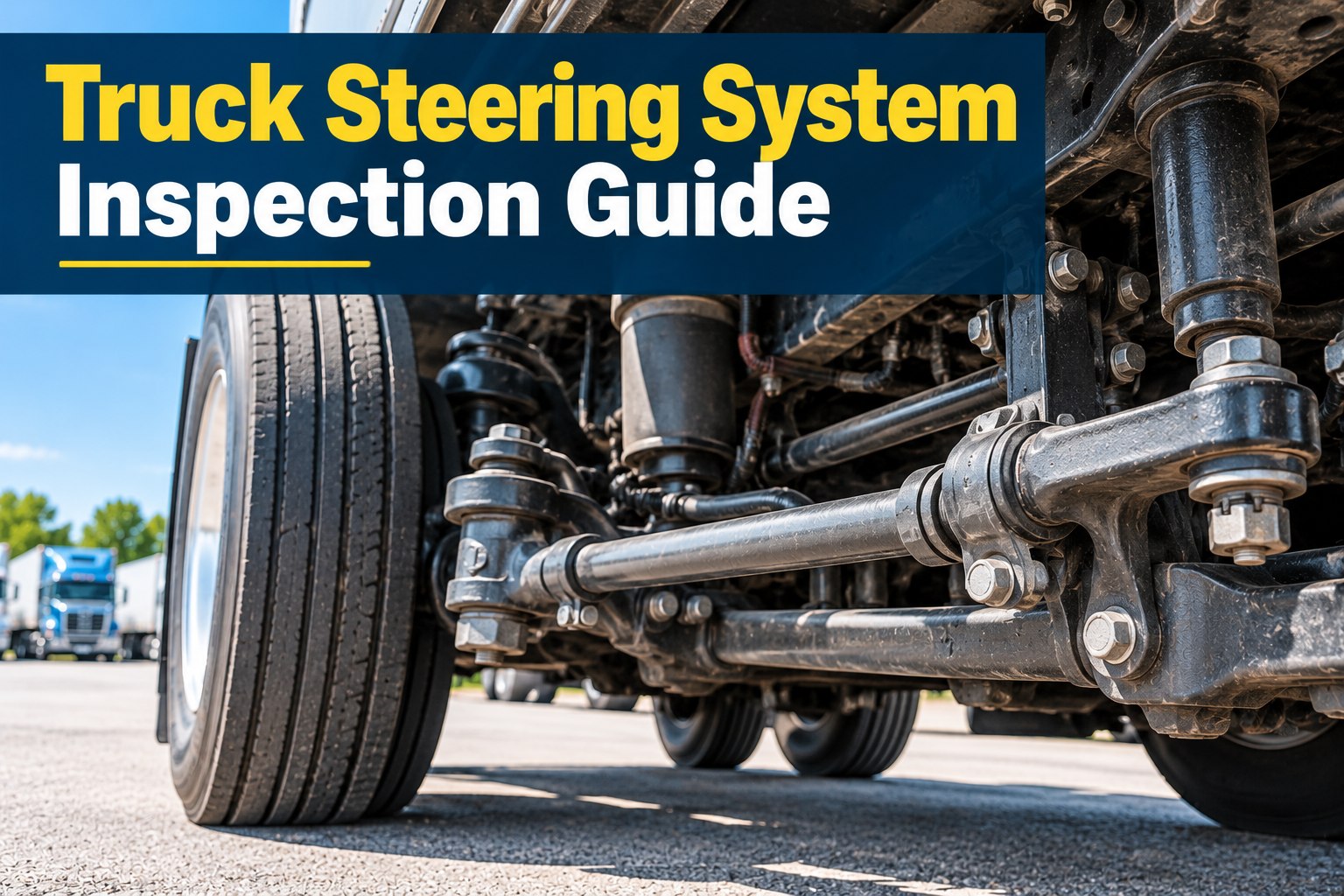
Steering is one of the few systems a driver checks with their hands rather than their eyes. Too much play in the wheel, a clunk over a pothole or a pull to one side are usually the first signs that a tie rod end, drag link or gearbox mount is wearing out. Federal rules set exact limits for steering wheel lash, list the linkage defects that park a truck, and make steering one of the eleven items every driver vehicle inspection report has to cover. This guide turns those rules into a pre-trip steering checklist, a two-minute lash test and a record trail that holds up in an audit. If you'd like to see the records and reminders running for your own trucks, set up a short walkthrough with our team.
Steering is on every DVIR, so a missed defect is also a missed signature
Unlike suspension or exhaust, the steering mechanism is named in 49 CFR 396.11 as one of the eleven items a driver's vehicle inspection report must cover. That changes what a defect costs. A worn tie rod end that a driver feels but doesn't write up is a mechanical problem and a paperwork problem at once, and a reported defect that never gets a repair certification is a third. Steering is also listed in the annual inspection standard in Appendix G to Part 396, and roadside inspectors check lash and linkage on full inspections.
The rules work in two tiers. Section 393.209 sets the limit a truck must meet to be in compliance. The North American Standard out-of-service criteria set a higher limit at which the truck is parked on the spot. The gap between them is the space where a fleet should already have found and fixed the problem.
Steering inspection matrix: what the rule requires and when the truck is parked
Use this matrix as the backbone of the steering section in your inspection template. The shaded column is the quick check a driver can do without tools.
| Component | What 393.209 requires | Out-of-service line | Quick driver check |
|---|---|---|---|
| Steering wheel | Secured to the column; no spoke cracked through or missing | Wheel not properly secured | Push and pull the rim; look at each spoke |
| Wheel lash | Within the table for wheel size, manual or power | Lash at or above the out-of-service table | Two-minute lash test, engine running on power steering |
| Column and U-joints | Column securely fastened; U-joints not worn, faulty or welded | Missing column fastener, worn or repair-welded U-joint | Watch the shaft while a helper turns the wheel |
| Steering gear | All mounting bolts present and tight; no cracks in box or brackets | Loose or missing mounting bolts, cracks, any welded repair | Look for shiny bolt heads, rust trails, wet seals |
| Pitman arm | Not loose on the gear output shaft | Any looseness on the shaft, any welded repair | Watch the arm while the wheel is rocked |
| Ball and socket joints | Not worn or faulty; no welded repairs | More than ⅛ in movement at a linkage point by hand, or stud nut moving under load | Grab each joint while the wheel is rocked |
| Tie rods and drag link | Free movement through full travel | Loose clamps or clamp bolts, looseness in any threaded joint | Clamps tight, no bent rods, boots intact |
| Nuts and cotter pins | Components secure | Loose or missing nut on tie rod, pitman arm, drag link or steering arm | Every castle nut has its cotter pin |
| Power steering | Operating, no loose or broken parts, belt sound, no leaks, fluid adequate | Auxiliary assist cylinder loose | Fluid level, belt condition, wet hoses |
The two-minute steering lash test, step by step
Lash is the distance the rim of the steering wheel travels before the front tires start to move. It is the single best measure of wear across the whole steering train, because play anywhere from the column to the tie rod ends adds up at the wheel.
Wheels straight, on level ground
Run it on power steering
Mark the rim
Turn until the tire moves
Repeat to the right and measure
Compare and record the number
The figure matters more than the pass mark. A truck that measured 1½ inches last month and 2¼ inches today is still legal, but something in the steering train is wearing fast, and that trend is the early warning a fleet wants. Recording the number on every report is what makes the trend visible.
Lash limits by steering wheel size, and what to check under the hood
Measure the wheel before you rely on a number. Most heavy trucks run 18 to 20 inch wheels, but replacement wheels and older units vary, and the limit moves with the diameter.
Power steering checks
- Fluid in the reservoir at the correct level, engine at the temperature the cap specifies
- Belt not frayed, cracked or slipping, and tensioned correctly
- No leaks at the pump, hoses, gear box seals or assist cylinder
- Hoses not chafed against the frame or engine
- Assist cylinder mounted tight at both ends
- No whine or groaning when the wheel is turned at idle
Front axle linkage: six places wear hides between the gear box and the tires
Most steering wear lives in the linkage. These six checks are where a driver's hand-on inspection and a technician's PM inspection overlap. Ball-joint play beyond one-eighth of an inch at a linkage point, moved by hand, is an out-of-service condition.
Steering records cross-checks an auditor will run
Individual reports can each look complete. Problems show up where the records meet. These comparisons take minutes in a digital system and are exactly what a compliance review or an attorney after a crash will look at. A digital DVIR and DOT inspection workflow keeps them linked automatically.
Steering inspection checklist you can tick on the walk-around
Tick these on screen or print the page and use it as your steering inspection template. The last group is the record checks, where most audit findings come from.
How FleetRabbit shows steering condition across the whole fleet
A fleet manager needs to see which trucks are drifting toward a limit before an inspector does. FleetRabbit scores each unit's steering inspections by component and rolls them into one fleet view, so the next PM goes where the risk is. The map below is an illustrative five-truck fleet. Pair it with preventive maintenance scheduling and the follow-up work books itself.
- Building the steering section of your DVIR with a lash field
- A driver reporting tie rod play with a photo
- The defect becoming a work order that holds dispatch
- Reading the fleet steering heat map
- Pulling a truck's steering history for an audit
Steering wear rarely stays in one part. A truck that keeps showing up amber for lash usually needs a look at the gear box adjustment, the drag link and the kingpins together, and FleetRabbit's fleet maintenance tools keep those parts, labour and repair notes on the same unit record so the pattern is visible.