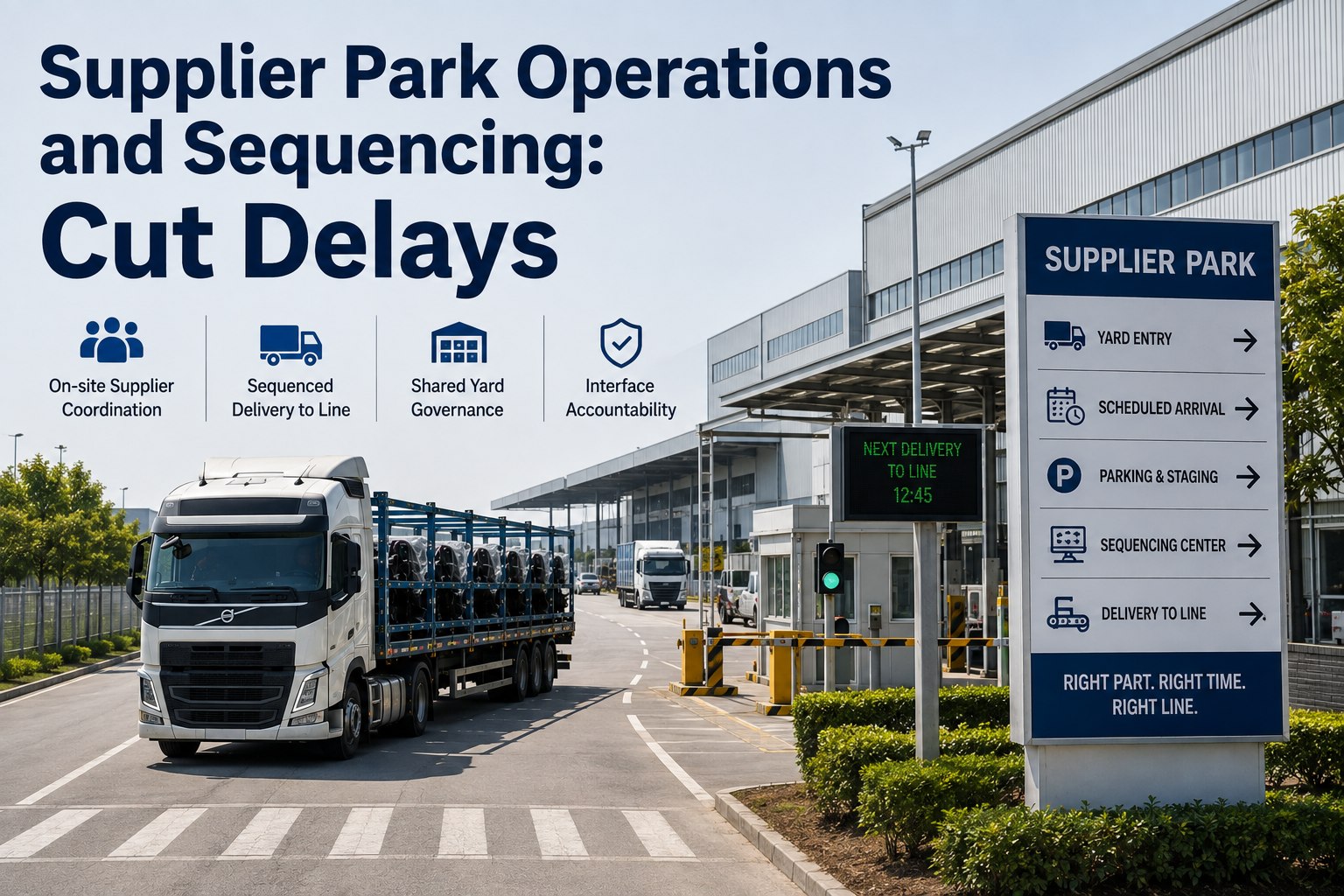
A supplier park solves the transport problem and creates a governance problem. Once a Tier 1 sits fifty metres from your body shop and delivers sequenced modules over a conveyor, there is no truck, no packaging, no loading and unloading, and no line-side storage — but there is also no clean boundary. Material flows are vertically integrated while ownership is vertically disintegrated, which means assets are concentrated in one place and fragmented between two companies, and the organisational boundary of the firm genuinely blurs. That is fine while everything works. It becomes expensive the first time a drop station backs up at 03:40 and nobody can say within ten minutes whose stoppage it is. Park operations are therefore mostly interface work: defining who owns which metre of conveyor, which yard slot, which data handoff and which minute of downtime, before the situation arises that forces an answer. Request the integration datasheet to map the interfaces at your own site.
INTEGRATION GUIDE · SUPPLIER PARKS
Supplier Park Operations and Sequencing
On-site supplier coordination, sequenced delivery straight to the line, shared yard governance, and interface accountability written down before it is tested — for parks running conveyors, tunnels and trucks side by side.
Physical interfaceConveyor, tunnel, gate, drop station
Data interfaceScheduling link, call-off, sequence confirmation
Commercial interfaceDowntime attribution, shared services, tenancy
Where Your Park Sits on the Integration Spectrum
Four co-location forms, increasing in integration. The distinction that matters operationally is the last column — who is responsible for the assembly line itself, because that single fact determines where almost every accountability argument lands.
Loosest
Supplier community
Dedicated co-location of suppliers in the region of a vehicle maker, performing scattered and varied activities. No shared site, no shared infrastructure.
Line owned byOEM · delivery by truck over distance
Adjacent
Supplier park
Suppliers on a dedicated site adjacent to the plant, making complex components, sequencing parts or building modular sub-assemblies — seats, doors, instrument panels, bumper systems, engine dress-up, body parts.
Line owned byOEM · delivery by conveyor, tunnel or short truck
Under roof
Industrial condominium
Suppliers reside and operate under the same assembly shop roof, in space the OEM no longer needs adjacent to the final assembly track. Tier 1s feed modules directly onto the line.
Line owned byOEM · supplier delivers to it
Tightest
Modular consortium
Suppliers perform the assembly themselves within the OEM's facility. Asset ownership is concentrated in one place but fragmented between the parties, and the organisational boundary of the firm effectively dissolves.
Line owned bySupplier consortium · OEM coordinates
Why the label matters more than it sounds
Parks drift up this spectrum over time — a supplier takes on a sub-assembly, then a sequencing step, then a piece of line-side work — without anyone revisiting the governance written for the original arrangement. If your contracts describe a supplier park and your operation is functionally a condominium, the accountability model is already out of date and you will find out during an incident rather than during a review.
The Three Interfaces
Every dispute in a supplier park is a dispute about one of these. Define each with a named owner on both sides and a stated failure protocol, and most escalations never start.
Physical interface
Conveyor sections, tunnel segments, drop stations, gates, yard slots, and the exact point at which custody of a module transfers. Usually well defined at build and never revisited after the first modification.
The question to answer in advanceWhen the conveyor stops, whose maintenance responds, on what response time, and who carries the downtime until it restarts?
Data interface
Dedicated electronic links into the OEM's production scheduling systems, carrying sequence, call-off and confirmation. This is what makes components arrive in the precise order and at the precise time needed rather than merely nearby.
The question to answer in advanceIf the sequence feed fails, how long does the supplier keep building, and against what fallback order?
Commercial interface
Tenancy, shared services, shared testing facilities, and above all downtime attribution. Responsibilities and performances become amalgamated, which is precisely why the commercial terms need to be sharper here than in an arm's-length relationship, not looser.
The question to answer in advanceWhat evidence settles an attribution dispute, and who holds it?
Proximity removes the transport problem. It does not remove the accountability problem — it concentrates it.
The integration datasheet covers the scheduling link, sequence confirmation, custody transfer events and the evidence set that settles attribution between park tenants and the plant.
Delivery Mechanisms and What Each One Changes
Parks typically run more than one of these simultaneously, and each carries a different failure mode. The governance has to be written per mechanism rather than per supplier.
Enclosed overhead conveyor
Connects supplier buildings to individual drop stations in the final assembly area, delivering modules in production sequence directly to the line. No packaging, no loading or unloading from trucks, no storage of components at the line.
Fails asA single point of failure with no alternative route. Sequence integrity is guaranteed by the mechanism, so a stoppage is total rather than partial.
Tunnel system
Delivers parts directly into the press and body shops, upstream of final assembly. Typically higher volume and lower variant complexity than the conveyor route.
Fails asUpstream starvation that reaches final assembly indirectly, so the causal chain is longer and attribution harder.
Short-haul truck within the park
Still the mechanism for the majority of park tenants, and for regional parks delivering over longer distances. Retains packaging, loading and yard handling.
Fails asA conventional inbound problem — but inside a shared yard where slot contention is with your other tenants rather than with external carriers.
Reverse flow to the supplier
Frequently overlooked. At Ford's Valencia plant, basic foam mouldings for seat backrests and cushions are formed inside the Ford plant and sent through the conveyor to the supplier, who builds frame, controls and mountings and returns completed seats over the same conveyor in production sequence.
Fails asA bidirectional dependency where the OEM can starve its own supplier. Governance written one-way misses this entirely.
Shared Yard Governance
The park yard is the most reliably contested resource on site, because every tenant has a legitimate claim and none of them owns it. These are the decisions to settle in writing. Our analytics and reporting module carries the shared metrics.
← Swipe to see all columns →
Custody Events Worth Capturing
Attribution disputes are settled by timestamps or by seniority, and only one of those improves the relationship. These are the events that make an evidence-based answer possible.
1Sequence published to tenantTimestamped transmission over the scheduling link, with acknowledgement returned
2Reverse-flow component issuedWhere the OEM feeds the supplier, this is the point their clock starts
3Module released onto the interfaceConveyor entry, tunnel entry or gate departure. Custody transfers here
4Interface segment transitIntermediate reads where maintenance ownership changes along the route
5Drop station arrivalDelivery confirmed at the station, in sequence position order
6Station consumptionThe only unambiguous proof the right module reached the right build
Event three is the one most parks fail to capture cleanly, because a conveyor feels like a continuous process rather than a series of handovers. It is a handover — arguably the most consequential one on site — and instrumenting it converts every future attribution argument into a query.
Metrics for a Park, Not a Plant
Standard inbound metrics assume trucks and gates. In a conveyor-fed park several of them are meaningless and different ones matter.
Interface availability by segmentUptime of each conveyor or tunnel section against its owning party. Replaces carrier on-time performance for tenants that never touch a truck.
Sequence adherence at the drop stationMeasured where the module lands, not where it was despatched. Conveyor delivery guarantees order, so any deviation traces to build order at the tenant.
Reverse-flow starvation eventsOccasions when the OEM failed to feed a tenant. Rarely tracked, and the fastest way to lose credibility in an attribution discussion.
Shared yard slot contention rateHow often two tenants wanted the same slot. Rising contention predicts the next governance dispute more reliably than any complaint.
Attribution disputes per quarterAnd the share settled from evidence rather than negotiation. The second number is the health of the governance model.
Line-side inventory at park-fed stationsShould be close to zero, since the model removes storage of components at the assembly line. Any accumulation means the interface is not trusted.
Map the Interfaces Before the Next Incident Does
The integration datasheet covers scheduling-link design, sequence confirmation at drop stations, custody event capture across conveyor and tunnel segments, shared yard governance, and the evidence set that settles downtime attribution between park tenants and the plant.
Custody event model
Shared yard governance
Attribution evidence set
Reverse-flow tracking
Frequently Asked Questions
What is the difference between a supplier park and an industrial condominium?
Proximity versus shared roof. In a supplier park, tenants occupy a dedicated site adjacent to the plant and deliver in by conveyor, tunnel or short truck. In a condominium they reside and operate under the same assembly shop roof, in space the OEM no longer needs beside the final assembly track. In both, the OEM remains responsible for the assembly line — which is what separates them from a modular consortium, where suppliers perform the assembly themselves. The governance implications differ substantially, so it is worth naming which one you actually run.
Does a park eliminate inbound logistics work?
For conveyor and tunnel-fed tenants it comes close — no packaging, no loading and unloading from trucks, and no storage of components at the assembly line. For everyone else it does not, and most parks have a majority of tenants still moving material by short-haul truck through a shared yard. The mistake is designing park operations around the conveyor tenants and treating the truck tenants as an exception; in headcount and slot terms they are usually the main event.
Who should own the shared yard?
A park operator, with the OEM holding priority and arbitration rights. Gate admission, slot allocation, yard positions, shunt moves and the empty pool all work better as shared services than as per-tenant arrangements, because each tenant optimising independently produces peak collision and idle capacity simultaneously. But when slots are contended, priority has to follow line demand, and only the OEM holds the sequence that defines it. Write that override explicitly rather than relying on goodwill.
How do we settle downtime attribution?
Agree the evidence set rather than the verdict. Timestamped custody events — sequence published and acknowledged, module released onto the interface, segment transit, drop station arrival, station consumption — let a dispute be resolved as a query rather than a negotiation. Because responsibilities and performances are amalgamated in a park, the temptation is to settle by seniority, which works once and poisons the relationship afterwards. Instrument the handovers and the arguments largely stop happening.
What happens if the sequence data link fails?
Decide in advance, because the default is worse than either option. Tenants are directly linked to the OEM's production scheduling systems so components arrive in the precise order and time needed, which means a feed failure leaves the supplier building to a stale order with no signal that anything is wrong. Define how long a tenant may continue on the last received sequence, what fallback order applies afterwards, and who is authorised to stop them. The alternative is discovering the answer with a shift of wrongly sequenced modules already built.
Is the reverse flow really worth tracking?
Yes, and it is routinely missed. Where the OEM feeds material to a tenant — foam mouldings formed in the plant and sent to a seat supplier who builds frame, controls and mountings, then returns completed seats in production sequence — the dependency runs both ways. A park where only supplier-to-plant flow is measured will attribute every resulting stoppage to the supplier, including the ones the plant caused. Tracking it is inexpensive and it changes the tone of every subsequent performance review.
Does a park need its own system, or can the plant's extend?
Extend, with tenant-scoped access. The park shares a yard, a gate and a set of interfaces with the plant, so running separate systems reproduces the fragmentation the park was built to remove — and makes attribution impossible because the two sides hold different timestamps. What is needed is tenant-level visibility boundaries within one operational picture, so each supplier sees their own material and the operator sees the shared resources. Our
integrations overview covers the connectivity model.
Write the Interfaces Down First
One shared yard with stated ownership, sequence delivered over instrumented interfaces with custody captured at every handover, reverse flow measured as carefully as forward flow, and attribution settled from evidence rather than from seniority.
Tenant-scoped visibility · Works alongside existing scheduling links · Site-level configuration
August 13, 2026By Alex Rowan
All Blogs