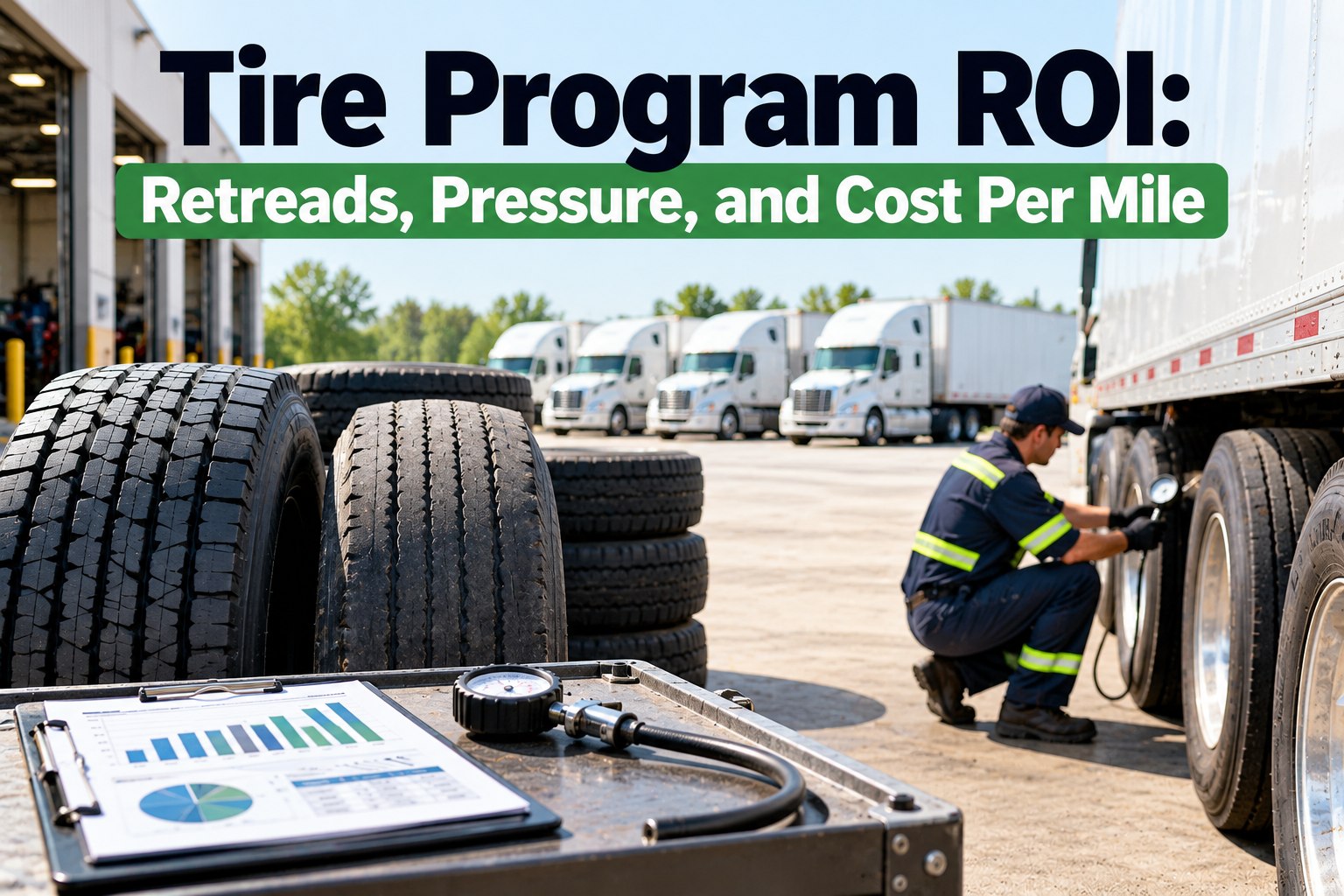
A tire program earns its return from three levers that work together: keeping pressure at target so tires last and fuel burns less, retreading good casings to cut the cost of each tire, and tracking cost per mile so you can see whether it is working. This page gives the figures behind each lever, a worked per-truck example with every assumption shown and a checklist to build the program. Schedule a call to build a tire program and track its cost per mile.
TIRE PROGRAM ROI · PRESSURE, RETREADS AND COST PER MILE
Tires Are Five Cents a Mile, So Small Gains Add Up Across Every Truck
The four numbers behind a tire program, a per-truck example with assumptions shown and a checklist to build yours.
THREE LEVERS IN A TIRE PROGRAM
PressureFuel and tire life
RetreadsCost per tire
TrackingCost per mile
Check every figure against your own records.
Where Tires Sit in Your Cost per Mile
Tires are a small line, but one of the few that rose faster than most in 2025
The American Transportation Research Institute reported tires at about $0.05 a mile for 2025, up 6.4 percent, with early 2026 figures showing a 4.8 percent drop. That is small beside fuel and driver pay, yet it is a controllable line, and tire condition also affects fuel and safety.
SELECTED OPERATING COSTS PER MILE, 2025. ATRI, AS REPORTED BY FLEETOWNER
Repair and maintenance
$0.22
The Four Numbers Behind a Tire Program
Pressure and retreads each have a published range you can test against your own fleet
0.5-1.0%
Fuel when all tires are 10 psi low
Running every tire 10 psi under target raises fuel consumption by about this much.
NACFE, 2020
5-12%
Tire wear life lost per tire 10 psi low
An individual underinflated tire loses this share of its wear life.
NACFE, 2020
30-50%
Typical retread saving versus new
One trade body says a retread costs this much less than a new tire.
TRIB via Beverage Industry, 2017
$750-$1,000+
Projected saving per vehicle a year from pressure systems
Historical payback estimates run from under 1 year to about 3.
NACFE, 2020
Ranges, not guarantees. The pressure figures come from the North American Council for Freight Efficiency (NACFE) and the retread saving from the Tire Retread and Repair Information Bureau (TRIB), a retread industry group. Both are industry sources, so confirm against your own tire spend.
Lever 1: Keep Pressure at Target
Most tires are not at target, and underinflation hurts fuel, tire life and casings
NACFE reports that only 46 percent of tractor tires and 38 percent of trailer tires were within 5 psi of target, and about one in five tractors and trailers has at least one tire 20 psi low. NACFE's historical payback estimates for pressure systems run from under a year to about three, with projected savings of $750 to over $1,000 a vehicle. Retrofits cost about twice as much as factory installation.
TIRE PRESSURE CONDITION IN THE FIELD, PERCENT OF VEHICLES OR TIRES. NACFE, 2020
Tractor tires within 5 psi of target
46%
Trailer tires within 5 psi of target
38%
Tractors with 1+ tire 20 psi low
About 20%
Trailers with 1+ tire 20 psi low
About 20%
Want pressure checks and tire services on every truck's schedule? Schedule a call and we will set it up.
Pressure, tread depth and rotation tasks tied to each unit's record.
Lever 2: Retread Good Casings
A retread costs a fraction of a new tire, and the casing decides how many times you can do it
The sources agree on the direction and differ on the numbers. TRIB says a retread typically costs 30 to 50 percent less than new. A trade article puts a retread at about half of a new tire, and about a quarter if the fleet supplies the casing, with no source named. Casing life depends on how the tire was run, because heat from underinflation is what makes casings fail inspection.
| Retread fact | Figure | Source |
|---|
| Cost versus a new tire | 30-50% less | TRIB via Beverage Industry, 2017 |
| Cost if you supply the casing | About 25% of a new tire | Fleet Equipment article, unsourced |
| Retreads per casing, linehaul | About 2 (up to 3) | Fleet Equipment; TRIB says 1 to 3 |
| Retreads per casing, local or P&D | 3 to 4, or 5 or more | Fleet Equipment; TRIB |
| Casing killer | Heat from underinflation | Fleet Equipment |
Worked Example: One Truck, One Year
Assumptions are stated, so you can swap in your own and rerun the math
Assumptions: 100,000 miles a year, tires at $0.05 a mile ($5,000), and a retread program covering 10 percent of tire spend at 40 percent off. The pressure system saving is NACFE's projection and not a measured result. The totals are my arithmetic. The pressure and wear figures overlap in practice, so the true total may be lower.
| Line (per truck, one year) | Conservative | Higher |
|---|
| Tire spend at $0.05/mi, 100,000 mi | $5,000 | $5,000 |
| Wear life recovered (5% to 12%) | $250 | $600 |
| Pressure system saving (NACFE, projected) | $750 | $1,000 |
| Retread share saving, 10% of spend at 40% off | $200 | $200 |
| Total per truck | $1,200 | $1,800 |
At 30 trucks, the conservative case is about $36,000 a year and the higher case about $54,000, before the cost of the program itself. Pressure-system payback of under one to three years comes from NACFE, and cost depends on the system.
Tire Program Checklist
Measure, maintain, retread and review
Track Tire Cost per Mile and Every Tire Service by Truck: Run Your Tire Program in FleetRabbit
FleetRabbit keeps PM schedules, inspections, work orders and costs for every vehicle in one record, so pressure and tread checks happen on time and tire cost per mile is visible by truck. Free for up to 3 vehicles, then $5 per vehicle per month.
Tire checks on PM schedules
Cost per vehicle
Inspections and defects
Free for 3 vehicles
Frequently Asked Questions
Quick answers on tire program ROI
How much do tires cost per mile?
About $0.05 a mile in 2025, according to ATRI as reported by FleetOwner. Your own figure may differ with tire type and application.
How much fuel does underinflation waste?
NACFE reports that all tires running 10 psi low raises fuel consumption by about 0.5 to 1.0 percent.
How much tire life does low pressure cost?
NACFE reports an individual tire 10 psi underinflated loses 5 to 12 percent of its wear life.
How much cheaper is a retread?
TRIB says typically 30 to 50 percent less than a new tire. Another article says about half, and about a quarter if you supply the casing.
How many times can a casing be retreaded?
Sources say about two for linehaul, and more for local or pickup-and-delivery use, depending on casing condition.
How fast does a pressure system pay back?
NACFE estimates under one year to about three, with $750 to over $1,000 projected savings a vehicle.
What does FleetRabbit cost?
FleetRabbit is free for up to three vehicles and $5 per vehicle per month after that.
Track 3 vehicles free.
Turn Tire Maintenance Into a Measured Program With a Cost per Mile You Can Track
Hold pressure, retread what is worth retreading and watch tire cost per mile by truck so you know the program is paying.
Free tier for up to 3 vehicles · No credit card required · Tire records stored per vehicle
October 17, 2026By Alex Rowan
All Blogs