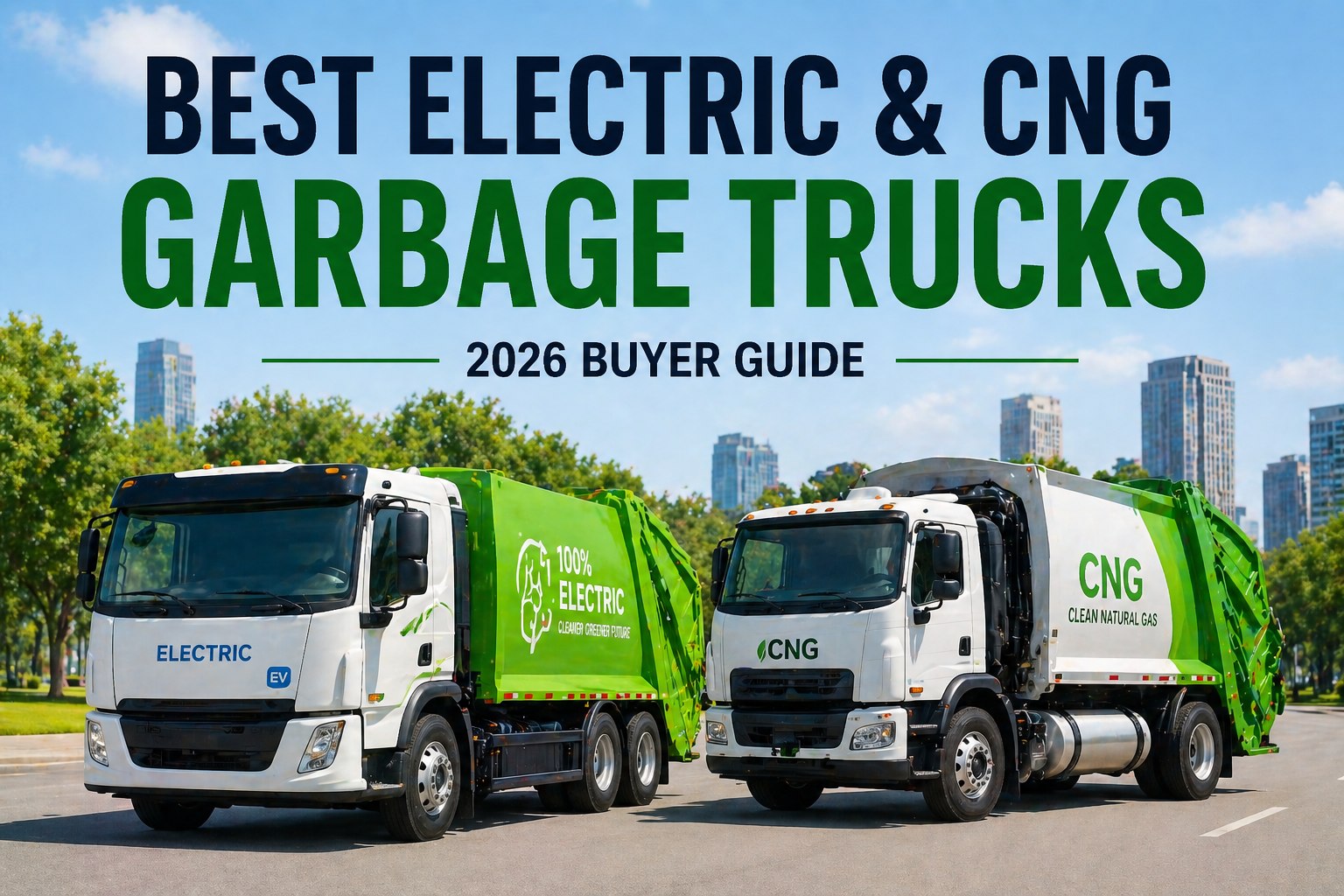
The 2026 refuse truck market is the first year in history where electric and natural gas options compete directly with diesel on cost, range, and operational fitness for waste collection routes. Stop-and-go duty cycles the worst possible scenario for diesel fuel economy — are precisely where battery-electric and CNG-powered trucks shine. Regenerative braking on EVs recovers energy at every bin pickup. CNG fuel costs run 30-40% below diesel per gallon-equivalent. EPA regulations are tightening (NOx limits dropping 90% from current standards), California's Advanced Clean Fleets rule is forcing fleet electrification timelines, and federal tax credits make zero-emission trucks materially cheaper than the sticker price. Anchorage, San Antonio, Los Angeles, and Republic Services have all deployed Peterbilt 520EVs and Mack LR Electrics in production routes. This guide compares the top electric and CNG garbage trucks available to US fleets in 2026 — Mack LR Electric, Peterbilt 520EV, BYD 8R, Battle Motors LET2, and the Cummins X15N natural gas option on Peterbilt 520 — with the spec sheets, TCO analysis, and decision matrix that show which truck wins for which fleet.
The Year Electric Refuse Trucks Stopped Being Theoretical.
Mack LR Electric. Peterbilt 520EV. BYD 8R. Battle Motors LET2 EV. Cummins X15N CNG. Production-ready powertrains, real sticker prices, real TCO curves — and one truck that wins for your specific route profile. Compare specs, range, payload, charging, and 5-year cost head-to-head.
Why 2026 Is the Tipping Point for Alt-Fuel Refuse
Three forces are pushing waste fleets off diesel simultaneously: regulatory pressure, fuel-cost economics, and operational fit. Stop-and-go routes are the worst possible duty cycle for diesel — and the best possible cycle for both electric and CNG trucks.
California's Advanced Clean Fleets rule mandates 100% zero-emission Class 8 sales by 2036. Public fleets must phase in ZE purchases starting now. 17 other states use CARB rules.
CNG runs 30-40% cheaper than diesel per gallon-equivalent. EV electricity for refuse routes runs ~$0.15/mi vs ~$0.50/mi for diesel — a 70% reduction in per-mile fuel cost.
Refuse routes average 1,100 stops/day. Regenerative braking recovers ~30% of consumed energy. Diesel idling at every stop wastes fuel; EVs and CNG don't idle at all.
Federal Section 45W commercial clean vehicle credit up to $40K per truck. EPA Clean Heavy-Duty Vehicles Program $1B grant pool. State VW Mitigation Trust funds for EV refuse.
Quick Comparison — Diesel vs CNG vs EV Refuse Trucks
Before comparing specific models, the powertrain decision shapes everything else. Here's the head-to-head at a glance for waste collection duty cycles specifically.
The headline trade-off: CNG wins on day-one operational fit and range, EV wins on lifetime cost and zero-emission compliance. Most fleets in 2026 are running mixed deployments — CNG for long-route or hilly territory, EV for dense urban routes that fit charging windows. See How Fleet Rabbit Tracks Mixed Powertrain Fleets →
Top 4 Electric Refuse Trucks for 2026
The four production-ready electric refuse trucks competing for fleet orders in 2026. Specs sourced from manufacturers and dealer listings.
Mixed-Fuel Fleets Need Mixed-Fuel Telemetry. One Dashboard.
Battery state-of-charge from EVs. Methane gauge from CNG. Diesel mileage from the rest. Fleet Rabbit unifies all three powertrains in a single platform with PM scheduling adapted to each.
Top 3 CNG Refuse Truck Configurations for 2026
CNG remains the highest-volume alternative-fuel refuse choice in 2026 because the fueling infrastructure is mature (600+ Clean Energy stations nationally), range is operationally unconstrained, and refuel time matches diesel. The Cummins X15N is the engine driving the latest CNG wave.
5-Year Total Cost of Ownership — Same 25K Mi/Year Route
The sticker price gap closes fast over five years. Below is an illustrative side-by-side TCO comparison for a typical residential collection truck running 25,000 miles/year. Numbers are estimates based on industry averages — actual costs vary by region, electricity/fuel rates, route profile, incentives, and labor markets.
| Cost Component | Diesel | CNG | Electric |
|---|---|---|---|
| Sticker (after incentives) | $245,000 | $280,000 | $420,000 |
| 5-yr fuel | $62,500 | $37,500 | $18,750 |
| 5-yr maintenance | $48,000 | $45,000 | $28,000 |
| Brake replacement | $12,000 | $12,000 | $4,000 |
| DEF / aftertreatment | $8,000 | $0 | $0 |
| Charging / fueling infra | $0 | $8,000 | $25,000 |
| Resale value (Y5) | −$60,000 | −$70,000 | −$95,000 |
| 5-YEAR TCO | $315,500 | $312,500 | $400,750 |
CNG and diesel essentially break even over 5 years for a 25K-mi residential route — with CNG winning on emissions/regulatory tail. EV remains $85K more expensive on shorter routes but flips to cheaper than diesel on routes >30K mi/year due to fuel-cost compounding. Higher-mileage commercial fleets cross the EV break-even line in year 4. Calculate Your Fleet's Powertrain TCO →
Decision Matrix — Which Truck Wins for Your Fleet
No single truck wins for every operation. Match your route profile to the powertrain that fits — and then to the model that fits within that powertrain.
- Routes < 80 miles/day
- Operations in CARB / ZEV mandate state
- 4+ hour midday or overnight charge window
- Federal/state grant funding accessible
- Long-term vehicle hold (8+ years)
or Mack LR Electric (heaviest duty)
- Routes > 100 miles/day
- Existing CNG fueling station within 25 mi
- Hilly terrain (range/recharge concerns)
- 5-year vehicle replacement cycle
- RNG procurement available
or Mack LR + L9N (lower sticker)
- Both urban & suburban routes
- Phased ZE compliance timeline
- Multiple service yards
- Diverse route mileage profiles
- Want to hedge powertrain risk
CNG for ≥100mi routes, retire diesel
How Fleet Rabbit Manages Mixed-Powertrain Refuse Fleets
Switching to alt-fuel doesn't just change the truck — it changes the data flowing into your maintenance system. Battery state-of-charge replaces fuel level. Charge cycles replace fill-ups. Regenerative braking changes brake-pad PM intervals. Fleet Rabbit handles all three powertrains in one platform.
Pre-built PM schedules for diesel, CNG, and EV refuse trucks. EVs skip oil/DEF/aftertreatment but add battery thermal checks. CNG adds methane sensor and tank inspection items.
State-of-charge logged per shift. Charge cycles tracked toward warranty replacement thresholds. DC fast vs Level 2 charging logged for battery degradation analysis.
Live cost-per-mile comparison across powertrains in your fleet. Diesel #47 vs EV #88 vs CNG #112 — same route, different fuel costs visible in real time. Validates your TCO model with actual operating data.
EVs need to start each shift at >90% SOC. Fleet Rabbit alerts dispatchers if a truck pulled less than full charge — preventing the mid-route range failures that doomed early EV pilots.
EVs recover ~30% of consumed energy via regen. Fleet Rabbit tracks regen efficiency per driver per truck — identifies drivers who don't use regen optimally and adjusts brake-pad PM intervals to actual wear.
Federal Section 45W, EPA Clean Heavy-Duty, state VW Mitigation Trust applications need documented telematics data. Fleet Rabbit produces the operational reports that grant programs require.
Fleets running mixed-powertrain refuse operations report 25-35% reduction in per-truck operating cost variance once Fleet Rabbit centralizes the powertrain data — and significantly faster grant-application turnaround. Schedule an Alt-Fuel Fleet Walkthrough →
Frequently Asked Questions
Yes — Anchorage Solid Waste Services has been running Peterbilt 520EVs since 2024 in Alaska. Cold-weather range derates by 15-25% but stays within operational windows for typical residential collection. Battery preconditioning and heated battery enclosures mitigate most cold-climate concerns.
Manufacturer-rated 80-150 miles depending on battery configuration (single-pack vs dual-pack), terrain, and ambient temperature. Typical residential route in moderate climate hits 1,100 trash bin pickups on a single charge — equivalent to a full collection shift.
Level 2 charging (~$15K per port + ~$30K install for switchgear) handles overnight charging on most depot setups. DC fast charging (150-350 kW, $80K-$150K per port) needed for split-shift operations. Most fleets start with Level 2 at the depot and add DC fast when expanding EV count beyond 5 trucks. See How Fleet Rabbit Tracks Charge Sessions →
Yes — RNG sourced from landfill methane capture or dairy digesters has a negative carbon intensity (-300 to -150 gCO2e/MJ on California LCFS pathways) because the alternative was venting methane to atmosphere. CNG fleets running RNG can claim carbon-negative operation while keeping diesel-equivalent operational fit.
EV trucks become 25-30% more expensive to operate vs CNG over a 5-year hold without incentives. CNG remains cost-competitive against diesel even without subsidies because of fuel-cost economics alone. The hedge is mixed-fuel deployment: EV where grants apply, CNG everywhere else.
Same $3/vehicle/month for diesel, CNG, or EV — no powertrain surcharge. Free tier supports up to 3 assets indefinitely. Includes powertrain-specific PM templates, SOC tracking, charging logs, and per-truck cost analytics. Book a Demo to See Pricing →
Pick the Right Truck. Then Run the Fleet.
Mack LR Electric. Peterbilt 520EV. BYD 8R. Battle Motors LET2. Cummins X15N CNG. Whatever you buy, Fleet Rabbit unifies the maintenance, charging, fueling, and TCO data into one dashboard with powertrain-specific PM templates and live per-truck cost analytics. Used by waste fleets running 100% diesel, 100% CNG, 100% electric, and every mix in between.