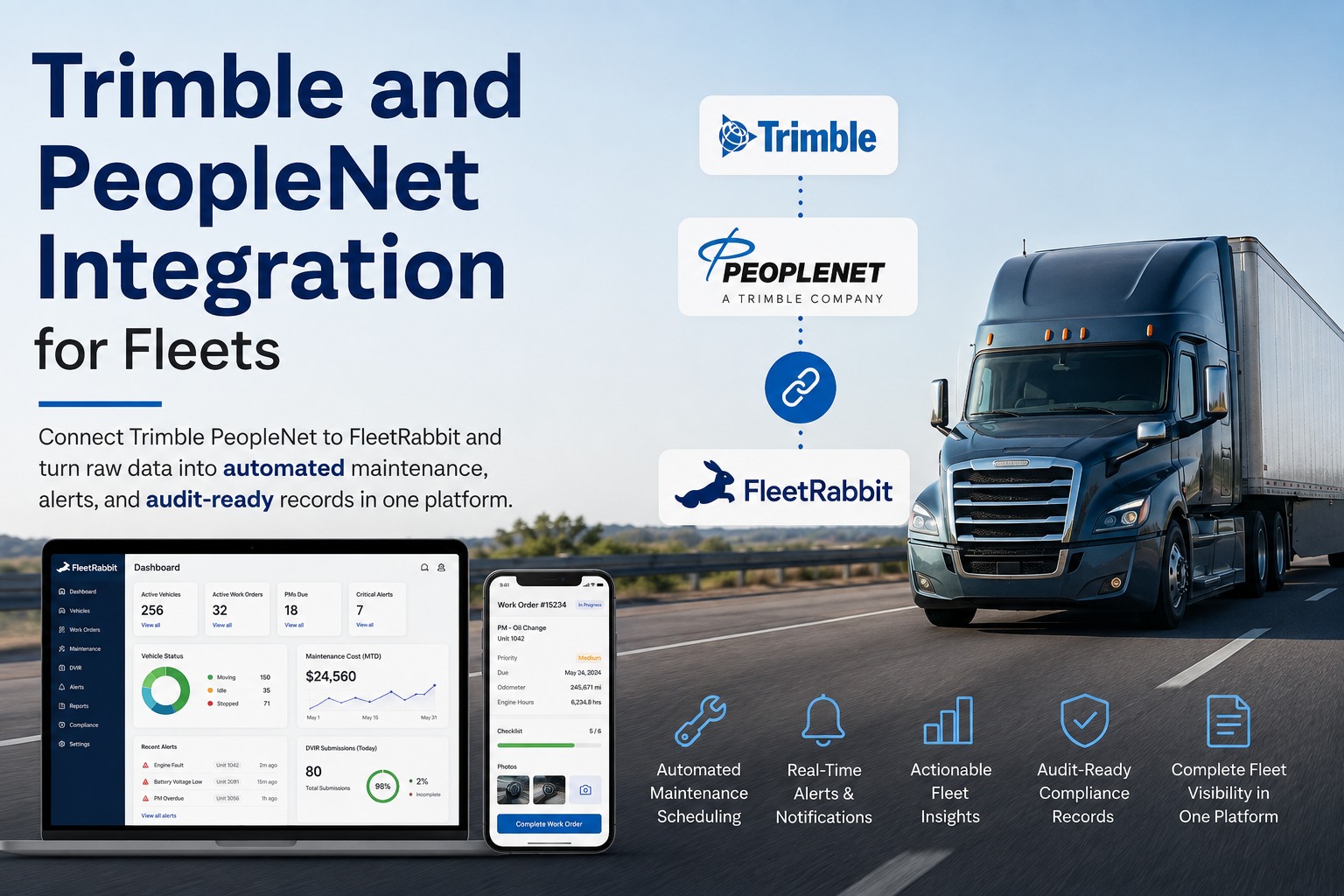
If your trucks run Trimble — or PeopleNet hardware that now carries the Trimble name — they're generating an enormous stream of raw data every mile: GPS position, engine diagnostics, fault codes, Hours of Service, and DVIR records from one of the most capable enterprise telematics platforms in the industry. But raw data isn't the same as action. A fault code is only useful when it becomes a scheduled repair; a DVIR defect only matters when it becomes a tracked work order; engine hours only help when they drive the next preventive-maintenance service. That refinement — from raw telematics to automated maintenance — is what FleetRabbit does. Connect Trimble PeopleNet to FleetRabbit and its data stops being a firehose of readings in a reporting dashboard and becomes automated maintenance, alerts, and audit-ready records in one platform. This page shows the brand lineage, how the data-to-action pipeline works, what connects, and why refined data beats raw data. Start a free trial or book a demo to see Trimble PeopleNet data turned into action.
INTEGRATION · TELEMATICS & MAINTENANCE
Trimble and PeopleNet Integration for Fleets
Connect Trimble PeopleNet to FleetRabbit and turn raw telematics into automated maintenance, alerts, and audit-ready records in one platform. Refined data, not a firehose of readings.
Trimble and PeopleNet: One Platform, Two Names
Trimble acquired PeopleNet in 2011 and rebranded the platform to Trimble Transportation Mobility in 2018 — though some in-cab devices still display the PeopleNet logo, which is why fleets often use the names interchangeably. Whichever badge is on your hardware, it's the same enterprise-class telematics system, and the FleetRabbit integration connects to it the same way: pulling GPS, engine diagnostics, fault codes, Hours of Service, and DVIR data into automated maintenance.
From Raw Data to Refined Action
Trimble PeopleNet is exceptional at capturing data. FleetRabbit is built to refine it — taking the raw telematics stream and turning each reading into a specific maintenance action. Here's the pipeline.
Raw Input
Trimble PeopleNet Captures
GPS location & engine hours
Engine diagnostics & fault codes
Hours of Service & DVIR data
Driver behavior & acceleration
Refined Action
FleetRabbit Produces
Usage-based PM schedules
Fault codes to repair work orders
Audit-ready compliance records
Defect alerts routed to techs
What Trimble PeopleNet Feeds the Pipeline
Each stream Trimble PeopleNet captures becomes a specific maintenance output once connected. Here's what powers the refinement.
GPS & Engine Hours
Real-time location and engine-hour data drive usage-based preventive maintenance, so services trigger on how hard each truck actually works.
Engine Diagnostics & Fault Codes
The eDriver Logs device collects real-time engine diagnostics and fault codes — early warnings that FleetRabbit turns into scheduled repairs before a breakdown.
HOS & DVIR Compliance
FMCSA-compliant Hours of Service and automatically generated DVIRs — with defects that become tracked work orders and records that feed one audit trail.
150+ Integrations
Trimble's platform is built for enterprise interoperability with a broad integration ecosystem, so connecting its data into FleetRabbit's maintenance layer fits how the system is designed to work.
Raw data fills a dashboard. Refined data fixes a truck.
FleetRabbit takes Trimble PeopleNet's readings and turns each one into a scheduled service, a routed work order, or an audit record — action, not just information.
What Connects Between Trimble PeopleNet and FleetRabbit
The integration passes the telematics, diagnostic, and compliance data that matters, and refines each into a maintenance outcome. Swipe the table horizontally on mobile.
← Swipe to see all columns →
Turn Trimble PeopleNet Data Into Action
Connect Trimble PeopleNet to FleetRabbit and refine raw telematics into automated maintenance — fault codes becoming repair work orders, engine hours driving preventive maintenance, and HOS and DVIR data feeding one audit-ready record. Data that acts, not just reports. At $5/vehicle/month, no hardware, live within 72 hours, free for up to three vehicles.
Fault codes to work orders
Usage-based PM
Audit-ready records
Enterprise-ready
Why Refined Data Beats Raw Data
Trimble PeopleNet gives you the readings. The value comes from what happens next — and that's where the pipeline pays off.
Action, Not Just Reporting
A fault code in a dashboard needs someone to notice and act. A fault code refined into a work order assigns itself — the difference between data you watch and data that works.
Proactive Maintenance
Early fault codes and real engine hours become scheduled service before failure, shifting the fleet from reactive breakdowns to planned maintenance.
One Audit-Ready Record
HOS, DVIR, and completed repairs refined into one connected trail means a compliance request is answered from a single source.
Enterprise Depth, Kept
You keep Trimble's industrial-strength telematics and TMS depth and add the maintenance-refinement layer — no capability lost, action gained.
Frequently Asked Questions
Is Trimble the same as PeopleNet?
Effectively yes — they're the same platform under different names. Trimble acquired PeopleNet in 2011 and rebranded it to Trimble Transportation Mobility in 2018, but some in-cab hardware still displays the PeopleNet logo, which is why fleets use the names interchangeably. Whichever badge your devices carry, the FleetRabbit integration connects to the same underlying telematics system the same way, pulling its data into automated maintenance. Seeing that connection on your specific hardware is something you can
book a demo to confirm.
What does the Trimble PeopleNet integration do?
It connects your Trimble PeopleNet telematics to FleetRabbit and refines its raw data into maintenance action. Engine fault codes become repair work orders, GPS and engine-hour data drives usage-based preventive maintenance, and HOS and DVIR records feed one audit-ready compliance trail. Instead of readings sitting in a reporting dashboard, each one becomes a specific, tracked outcome. Seeing that data-to-action pipeline run on your fleet is exactly what you can
book a demo to do.
Does FleetRabbit replace Trimble PeopleNet?
No — it complements it. Trimble PeopleNet is an enterprise-class telematics and ELD platform with deep capability in tracking, dispatch, routing, and compliance. FleetRabbit connects to it and refines its data into automated maintenance, work orders, and audit records — the action layer on top of the data layer. You keep Trimble's industrial-strength telematics and add the maintenance refinement that turns its readings into completed work, which you can
book a demo to see in action.
How do Trimble's fault codes become repairs?
The Trimble eDriver Logs device collects real-time engine diagnostics and fault codes, and when that data flows into FleetRabbit, a fault code becomes a routed repair work order with the vehicle's history attached. Instead of an alert someone has to notice in a telematics dashboard and remember to act on, it's automatically turned into an assigned, tracked repair — often before the issue escalates into a roadside breakdown. Seeing fault codes refined into scheduled repairs is something you can
book a demo to review.
Does it use engine hours for preventive maintenance?
Yes. Trimble PeopleNet continuously captures GPS and engine-hour data, and feeding that into FleetRabbit lets preventive maintenance schedule on each vehicle's real usage rather than a fixed calendar. A truck that runs harder is serviced sooner and one that sits isn't serviced needlessly, optimizing both cost and uptime. It turns the telematics data you already collect into a precise maintenance-scheduling input, which you can
book a demo to see driving PM on your own vehicles.
Will this work for a large enterprise fleet?
Yes — Trimble PeopleNet is built for large and international fleets with deep, industrial-strength capability, and FleetRabbit's maintenance-refinement layer scales alongside it. A large operation generates the most raw data, which means it has the most to gain from refining that data into automated maintenance and one audit-ready record rather than manually acting on dashboard readings. Discussing how the integration fits an enterprise workflow and rollout is something you can
book a demo to work through for your operation.
How does this help with audits and compliance?
By refining compliance data into one connected record. When Trimble PeopleNet's HOS and DVIR data, engine diagnostics, and the repairs that resolved each issue all live together in FleetRabbit, a DOT or insurance request is answered from a single audit-ready trail instead of exporting and reconciling separate systems. The raw compliance readings become a defensible, connected history, which you can
book a demo to see assembled end to end.
How quickly can we connect Trimble PeopleNet?
FleetRabbit goes live within 72 hours with no hardware, running on devices your team already has, so once the data connection to Trimble PeopleNet is configured you can start turning raw telematics into automated maintenance quickly. You keep all your existing Trimble or PeopleNet hardware and subscriptions and simply add the refinement layer that acts on the data — there's no rip-and-replace. Planning that connection and mapping how the data should drive your work orders and PM is exactly what you can
book a demo to set up.
Refine Trimble PeopleNet Data Into Maintenance
Connect Trimble PeopleNet to FleetRabbit and turn raw telematics into automated maintenance, alerts, and audit-ready records in one platform — fault codes becoming work orders, engine hours driving PM, and compliance data refined into one trail. Data that acts, not just reports. Integrated in 5–7 working days, at $5/vehicle/month, free for up to three vehicles, with no hardware required.
Free tier for up to 3 vehicles · No credit card required · No hardware installation
August 7, 2026By Derek Goes
All Blogs