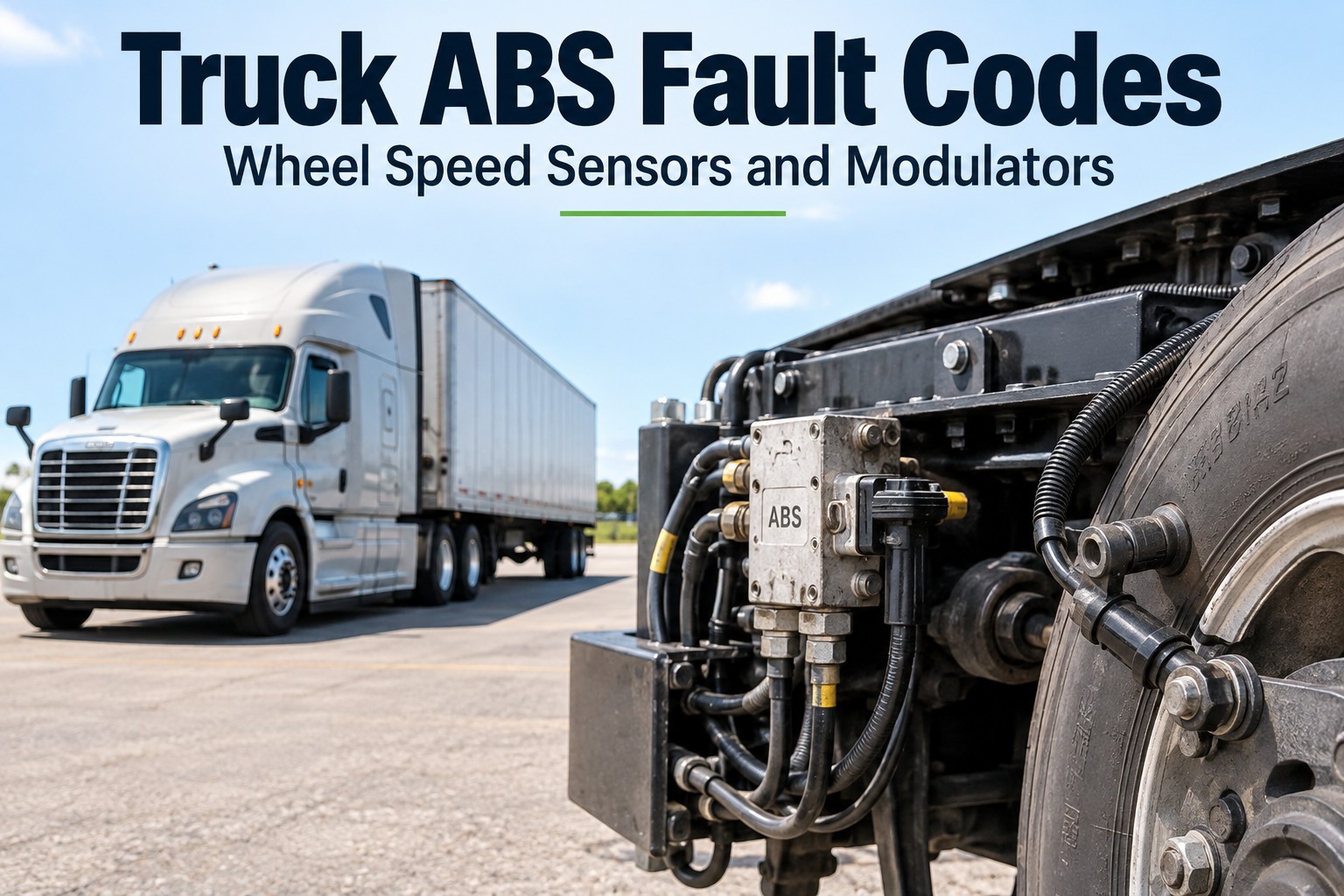
Truck ABS fault codes almost always point to one of four things — a wheel speed sensor, the tone ring it reads, a modulator valve, or the wiring between them and the ABS control unit — and most are fixed at the wheel end, not in the computer. The code tells you which wheel or valve and how it failed; the fix is usually a sensor pushed back against its tone ring, a corroded connector or a worn wheel bearing, while a new modulator or ECU is the exception. This guide follows the signal from wheel to cab, shows how a code is built, gives you a symptom matrix, a check order, a priority scale and an escalation rule for codes that keep coming back. Book a demo to see ABS codes turn into scheduled work orders, or start free with 3 vehicles.
ABS fault code guide
Truck ABS Fault Codes: Wheel Speed Sensors and Modulators
The lamp is on the dash. The fault is usually at the wheel.
Read the code, check the cheap things first, and schedule ABS repairs before they become inspection violations.
What a violation weighs in CSA
Severity weights in FMCSA's Vehicle Maintenance category. ABS findings rarely put a truck out of service, but every one counts.
Follow the Signal From Wheel to Cab
An ABS code is raised wherever the signal chain breaks, and the chain starts at the wheel. Air-brake ABS reads each monitored wheel, and if a link fails it lights the lamp and falls back to normal braking on that wheel — the truck still stops, just without anti-lock control there. You can log each ABS component against its unit on a free account.
Layouts are named for sensors and modulators: a typical tractor runs 6S/4M — six sensors, four modulators — while two-axle trucks often use 4S/4M.
How an ABS Code Is Built
Every ABS code has two halves, and the second half is the one that saves money. The first names the component and wheel position; the second, the failure mode identifier (FMI) in J1939 terms, says how it failed — which tells the technician where to start. We can read your own ABS codes with you in a demo.
| FMI | What the ABS unit is saying | Where to look first | Usual fix |
|---|---|---|---|
| 1 | Wheel sensor — air gap | Sensor position, wheel bearing play | Reseat sensor, replace clip or sleeve |
| 5 | Wheel sensor — impedance | Coil resistance, cable, connector | Repair wiring or replace sensor |
| 7 | Wheel sensor — pole wheel | Tone ring teeth and corrosion | Clean or replace tone ring |
| 8 | Wheel sensor — no trigger | No signal: seating, wiring, ring | Work down the check order |
| 13 | Wheel sensor — tire combination | Mismatched tire sizes | Match tires or reset parameters |
| 3 / 5 / 6 | Valve — short to battery, open, short to ground | Modulator connector and harness | Repair harness; replace valve if coil fails |
Failure types from WABCO's diagnostic code table in a manufacturer service bulletin filed with NHTSA. Meanings vary by ABS maker and model; confirm with the manufacturer's service data. Swipe the table on mobile.
Match the Symptom to the Likely Cause
Read across the row that matches what your driver or technician sees; filled dots show where to look first. These are typical starting points drawn from manufacturer troubleshooting guidance, not a substitute for the code. Log symptoms with each ABS work order free. Swipe the table on mobile.
| What you see | Sensor seating | Tone ring | Wheel bearing | Wiring and connectors | Modulator valve | ECU or power |
|---|---|---|---|---|---|---|
| ABS lamp stays on after a normal start | ||||||
| Lamp comes and goes over bumps | ||||||
| Same sensor code returns after a new sensor | ||||||
| Code on one wheel after brake or hub work | ||||||
| Valve code: short, open or ground | ||||||
| Codes on several wheels at once |
What to Check First
Start where the cause is most likely and the check is cheapest. The order follows a truck maker's wheel speed sensor procedure published by NHTSA — wheel-end play, tone ring, then sensor seating — with wiring pulled forward because it is quick to rule out. WABCO's sensor test calls for 900 to 2,000 ohms across the pins with no path to ground. We can build this order into your work orders in a demo.
Our assessment on a 1-to-5 scale for a typical air-brake tractor. Trucks on salted roads see more connector and tone ring corrosion.
Set a Priority for Every ABS Fault
Treat ABS faults by what they mean for the truck on the road, not by how the code looks on a screen. These priorities are suggested starting points; the stop-or-go decision always follows your own brake policy and DVIR rules. Set these priorities up free on 3 vehicles.
ABS fault together with a brake problem: air leak, pull, dragging or poor stopping
ABS lamp on steady with an active code, tractor or trailer
Inactive or intermittent codes found when reading codes at a PM
Tire-size or parameter codes with no braking symptom
Put your ABS codes through this priority scale
In a 30-minute demo we'll load a few of your open codes into FleetRabbit, set their priority and show the work orders they create.
When a Code Keeps Coming Back
A repeat code means the cause is still there, so each return should move the repair up a level instead of repeating the last fix. A worn wheel bearing, for example, lets the hub wobble and pushes a new sensor out of its sleeve until the bearing is fixed. Keeping every code on the unit's work order history is what makes the pattern visible. See repeat-code tracking in a demo.
Push the sensor fully in, clean and seal the connector, record the code, then clear it.
Measure bearing play and inspect the tone ring before touching the sensor.
Resistance and AC output against the maker's spec; replace with the clip and sleeve.
Trace the harness and check ECU power and ground before any valve is replaced.
Use the ABS maker's diagnostic software; only now consider the modulator or ECU.
The 30-day window is a suggested trigger; set your own based on how often your trucks return to the shop.
ABS Standards to Put in Your Work Order Template
Most repeat ABS work comes from steps that were skipped, not parts that were wrong, so write the steps into the template. Pull stored codes straight from the truck through OEM telematics, and schedule the wheel-end checks with preventive maintenance. Add these standards to your templates free.
Code, wheel position and failure type saved on the work order before any code is cleared.
Bearing play, tone ring and sensor seating checked before any part is ordered.
Intermittent faults caught before they become a steady lamp.
Every brake or hub job ends with sensors pushed in and connectors sealed.
Tractor and trailer ABS lamps should light at key-on and go out.
Different sizes across axles can set speed-comparison codes.
A second code on the same wheel within 30 days escalates automatically.
Trailers built since March 1998 have their own ABS; since 2001 the tractor shows its lamp in the cab.
Frequently Asked Questions
What causes most truck ABS fault codes?
Wheel-end problems: a sensor pushed away from its tone ring, a corroded or damaged tone ring, loose wheel bearings, or corroded connectors and damaged wiring. Modulators and the ECU fail far less often. See your codes by wheel position.
Is it safe to drive with the ABS light on?
The truck keeps normal service braking but loses anti-lock control on the affected wheels, which matters most on wet or slippery roads. Report it on the DVIR and schedule the repair promptly. Track ABS defects free.
Will an ABS light put my truck out of service?
Generally no, but it is a recorded violation under 49 CFR 393.55 with a CSA severity weight of 4, so repeat findings raise your score. ABS has been required on air-brake tractors built since March 1997 and other air-brake vehicles since March 1998. Review your open ABS defects with us.
How do I test a truck ABS wheel speed sensor?
Check the sensor is fully seated, then measure resistance across its pins against the maker's range — WABCO lists 900 to 2,000 ohms with no path to ground — and check for AC voltage while turning the wheel. Log test results on work orders free.
What does fixing an ABS fault typically cost?
It depends on where the fault is: reseating a sensor or repairing a connector costs little beyond labor, a sensor or tone ring costs more, and a modulator or ECU costs the most. Diagnosing from the wheel inward avoids paying for expensive parts you didn't need. Track ABS repair costs per unit with us.
Turn Every ABS Code Into a Scheduled Repair
FleetRabbit puts each ABS code on the right unit with its wheel position, failure type and priority, so your technician starts at the wheel end and the repair is done before the next inspection.
- Codes from your trucks become work orders
- Repeat faults on the same wheel flagged
- ABS lamp checks built into every DVIR