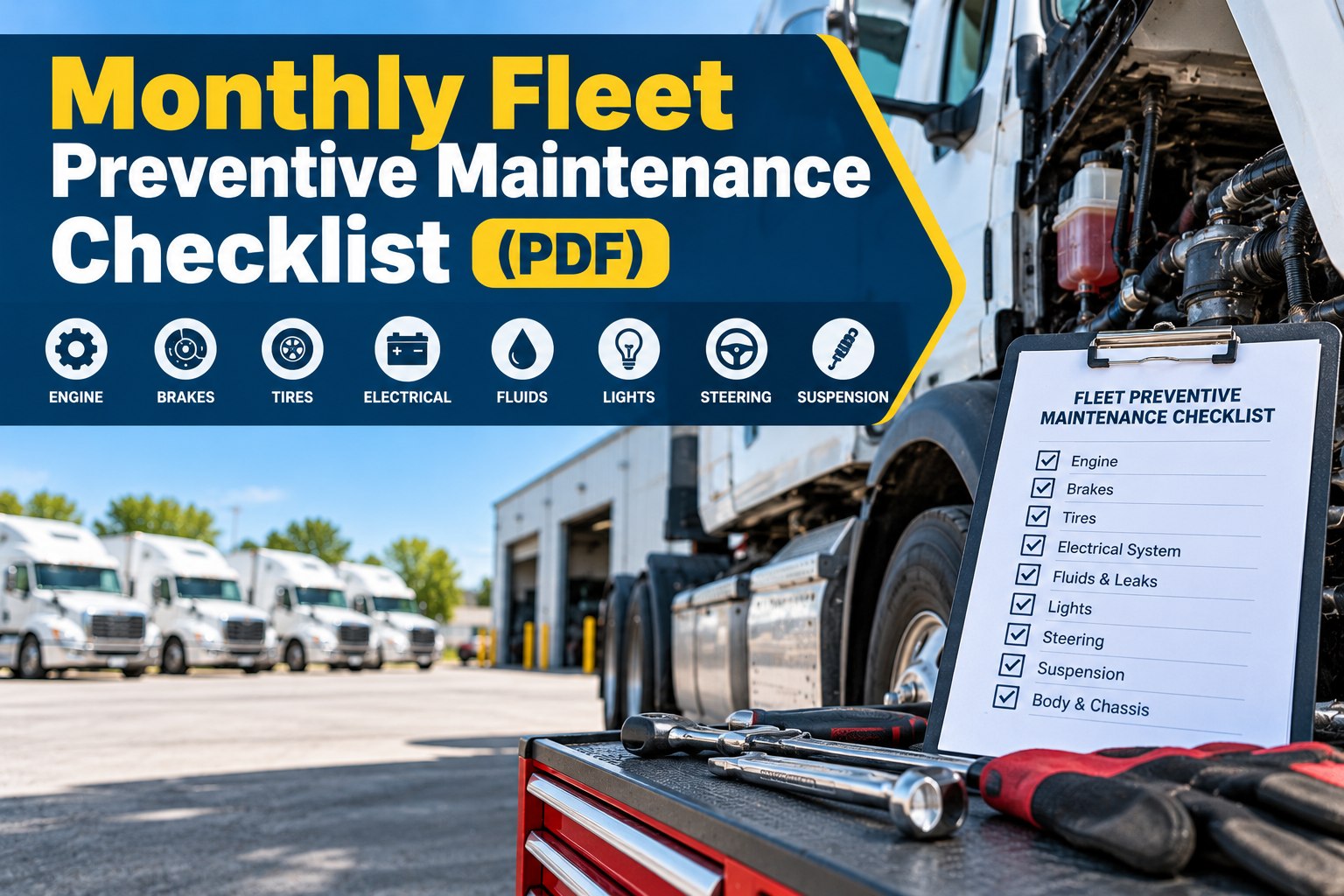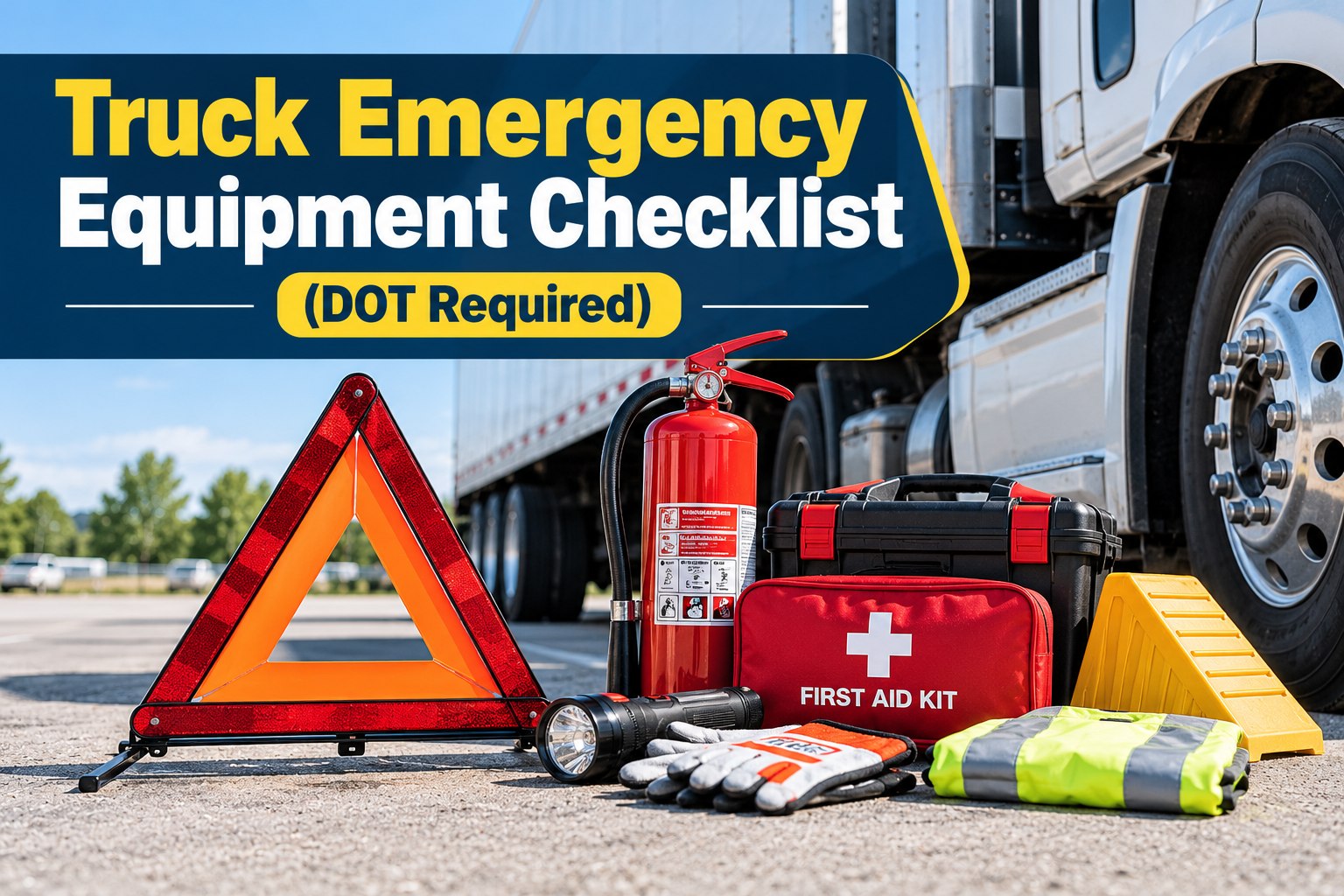
Emergency equipment is the shortest section of the federal parts and accessories rules, and one of the easiest to get cited on. Every truck and tractor needs a properly rated, charged and mounted fire extinguisher and a set of warning devices, and "emergency equipment" is one of the eleven items every driver vehicle inspection report has to cover. The list also changed this year: since April 20, 2026, spare fuses are no longer required. This checklist covers exactly what 49 CFR 393.95 asks for today, how to place triangles within the ten minutes 392.22 allows, which trucks can't carry flares, and a tick-off template drivers can run on every pre-trip. You can run it paperless on three vehicles at no cost while you test it.
Spare fuses came off the federal list on April 20, 2026
For decades, 393.95(b) required trucks to carry spare fuses for any required part or accessory. FMCSA removed that paragraph in a final rule published on February 19, 2026, which took effect on April 20. The agency's reasoning was that fuses rarely fail in normal operation, blown fuses are usually diagnosed by technicians rather than drivers, and spares are sold at almost every truck stop. It estimated roughly 9,000 roadside violations a year for missing spare fuses between 2021 and 2024.
Two things haven't changed. Section 392.7 still bars driving when required electrical equipment isn't working, so a blown headlamp fuse is still a problem. And older checklists, training decks and inspection forms still list spare fuses, so update them to avoid writing up a defect that no longer exists.
Fire extinguisher: the rating, the gauge, the mount and the reach
The extinguisher rule has four parts, and an inspector can check all of them in under a minute. The rating depends on what the truck is carrying.
The rule also requires an extinguishing agent that doesn't need freeze protection and meets EPA toxicity limits, which standard dry-chemical units satisfy. Driven units in driveaway-towaway operations are exempt from the extinguisher requirement.
Warning triangles: three devices, ten minutes, and where each one goes
Section 393.95(f) requires three bidirectional reflective triangles meeting FMVSS 125, or at least six fusees. Section 392.22 says how to use them: switch on the hazard flashers immediately, then place the devices as soon as possible and within ten minutes. The flashers stay on until the triangles are out and while they're being picked up.
Forty paces is the field measure for 100 feet
The rule itself gives paces alongside feet: four paces for the device at about 10 feet and forty paces for about 100 feet. Drivers who practise the walk once in the yard place triangles faster and more accurately at night.
Triangles that won't stand up don't count for much
Check that each triangle unfolds, locks and stands on its base, that the reflective faces aren't cracked or faded, and that all three are in the case. A set of two is a violation.
At night, walk facing traffic and hold the triangle in front of you
Placing triangles is one of the most exposed moments in a driver's day. Put on a high-visibility vest before leaving the cab, walk on the shoulder facing oncoming traffic, and carry the triangle out in front so its reflectors show before you do. Place the farthest device first only if the shoulder is wide and safe; otherwise work outward from the truck.
Which trucks can't carry flares: explosives, flammable tankers and gas-fuelled units
Fusees are an alternative to triangles, but 393.95(g) bans any flame-producing signal on three kinds of vehicle. These trucks must carry triangles.
Where fusees are allowed, each must burn for at least 30 minutes and carry the UL symbol, and none may be lit near a fuel or flammable leak.
Placarded hazmat loads add emergency paperwork to the kit
A truck hauling placarded hazardous materials needs the larger 10 B:C extinguisher, and it also has to carry emergency response information for the materials on board under 49 CFR 172.602. The shipping papers that hold it must be within the driver's immediate reach while at the controls, and on the seat or in the door pouch when the driver is out of the cab, so responders can find them. Treat those papers as part of the emergency equipment check on hazmat units: present, current for this load, and in the right place.
When an extinguisher gets used, the truck is short until it's replaced
A discharged extinguisher, even a partly used one, no longer meets the "filled" requirement. The common failure isn't the fire; it's what happens afterwards. The driver uses the extinguisher on a brake fire or helps at another crash, tosses the empty unit in the cab, and the truck runs for weeks without a working one. Make the loop explicit: the driver reports the use on the next DVIR, the unit gets a replacement before it's dispatched again, and the new extinguisher's rating and charge are checked on the following pre-trip. The same loop works for a triangle that gets left on the roadside.
The annual inspection skips the kit, so the pre-trip has to catch it
The annual inspection standard in Appendix G to Part 396 covers brakes, steering, suspension, tires and other mechanical systems, but not the fire extinguisher or warning devices. That leaves two places emergency equipment gets checked: the driver's pre-trip and post-trip, and a roadside inspection. If the driver doesn't look, nobody in the fleet does. Many fleets add a monthly visual extinguisher check to the PM schedule, the same interval NFPA 10 sets for portable extinguishers in buildings, and swap any unit whose gauge, seal or hose looks wrong.
DOT emergency equipment requirements at a glance
This table is the reference behind the checklist below: what the rule says, how a driver confirms it on the pre-trip, and what typically gets written up.
| Item | Requirement | Pre-trip check | Common write-up |
|---|---|---|---|
| Fire extinguisher rating | 5 B:C (or two 4 B:C); 10 B:C if placarded hazmat | Read the UL label | Wrong rating after a load change |
| Charge | Fully charged, visually checkable | Gauge in the green, pin and seal intact | Discharged or gauge in the red |
| Mounting | Secured against sliding, rolling or vertical movement | Bracket tight, strap closed | Loose on the floor or seat |
| Access | Readily accessible | Reachable from the cab or door without unloading | Buried in a side box |
| Warning devices | Three reflective triangles (FMVSS 125) or six fusees | Count three, unfold one | One or two missing, broken stand |
| Flame signals | Not on explosives, flammable cargo tanks or gas-fuelled units | Confirm triangles on those units | Fusees on a CNG truck |
| Spare fuses | No longer required (since 20 Apr 2026) | Optional; keep if your policy says so | Outdated forms still listing them |
| Hazard flashers | On immediately when stopped on road or shoulder | Test with the lights check | Flasher inoperative |
Emergency equipment checklist: tap each checkpoint on the pre-trip
Each tile below is a clickable checkpoint. Tick them on a phone or print the page as your emergency equipment checklist template. The final group isn't required by federal rules, but most fleets add it.
Emergency equipment is a daily item, not a PM item, but it pays to audit kits fleet-wide when you schedule preventive maintenance, because extinguishers get used and not replaced, and triangles walk from truck to truck. A digital DVIR and DOT inspection workflow keeps every result tied to the unit it came from.
FleetRabbit turns "kit OK" into a line-by-line record you can show an auditor
- Item-level DVIR: extinguisher rating, charge, mount and each triangle answered separately
- Photo on fail: the missing triangle or red gauge is attached to the report
- Work order and replacement: a fail opens a job and tracks the part to the truck
- Hazmat-aware templates: placarded units get the 10 B:C and no-flare checks automatically
- Searchable history: every kit check per unit, ready for a compliance review
Missing kit is one of the quickest things to fix and one of the easiest to lose track of across a large fleet. FleetRabbit's fleet maintenance tools show which units have open emergency-equipment defects so nothing goes out short.