The commercial transportation industry is standing at the edge of its most significant operational transformation in decades. Truck platooning — the technology that enables multiple trucks to travel in electronically synchronized convoys — is moving from pilot programs into real commercial deployments in 2026 with fleets reporting fuel savings of up to 15% and safety improvements that no human-driven convoy can match. For fleet managers, logistics operators, and transportation executives, platooning is no longer a future consideration. It's a present-day competitive advantage that's beginning to separate efficient operations from expensive ones. Book a demo to see how FleetRabbit helps you prepare your fleet for platooning integration →
Truck platooning uses V2V (Vehicle-to-Vehicle) communication to electronically link trucks into coordinated convoys that travel 15–50 feet apart, reducing aerodynamic drag and delivering 7–15% fuel savings per platoon. In 2026, the global truck platooning market is valued at $1.77 billion and growing at 21.5% CAGR, with 63% of US Class 8 truck miles occurring at speeds suitable for platooning. The technology simultaneously improves highway safety by reducing reaction time from 1.5 seconds (human) to under 0.1 seconds (automated system).
What Is Truck Platooning?
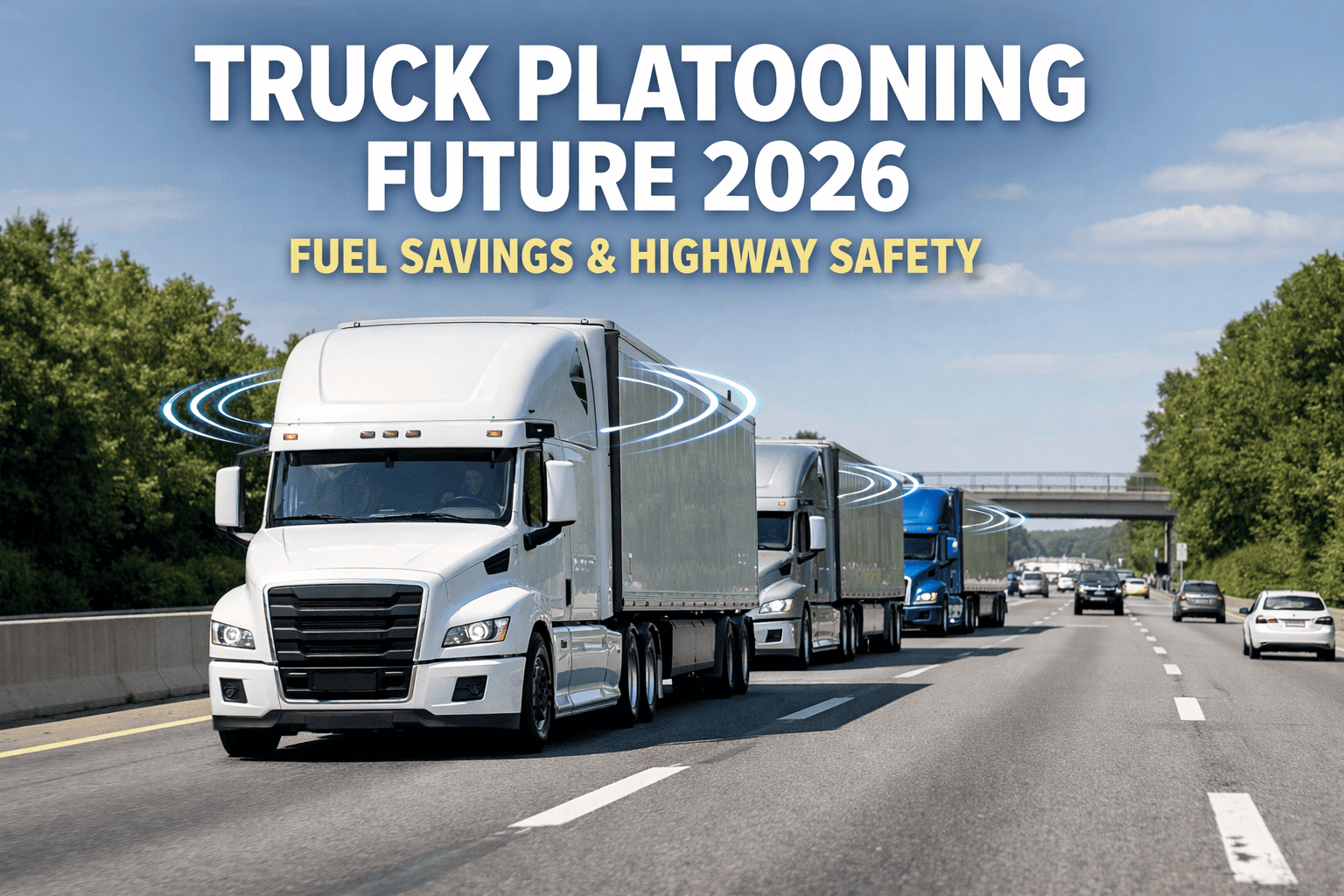
Truck platooning is the coordinated operation of two or more commercial trucks traveling in a tight convoy, electronically linked through V2V communication systems that allow them to function as a single coordinated unit. The lead truck's driver controls speed and steering while following trucks automatically match every movement — acceleration, braking, and speed changes — through cooperative adaptive cruise control (CACC). The result is a convoy that maintains precise 15–50 foot following distances with millisecond coordination that no human driver can replicate.
The Role of V2V Communication in Truck Platooning
Vehicle-to-Vehicle (V2V) communication is the foundational technology that makes truck platooning possible — and the reason platooning delivers safety improvements that traditional close-following convoys cannot. Without V2V, trucks traveling 20 feet apart would be dangerously dependent on human reaction times. With V2V, they become a coordinated mechanical system that responds to hazards before drivers consciously perceive them. See how FleetRabbit's telematics layer prepares your fleet for V2V integration →
DSRC operates on the 5.9 GHz band specifically reserved for vehicle safety communications. It transmits data packets 25 times per second with latency under 10 milliseconds — far faster than 4G or WiFi. Each packet contains the transmitting vehicle's precise GPS location, speed, heading, brake status, and acceleration. Following trucks receive this data continuously and adjust their systems automatically, with no human decision-making in the loop. DSRC works in rain, fog, and low-visibility conditions where cameras and radar alone may be unreliable.
5G cellular V2X (C-V2X) is emerging as the successor to DSRC for long-range and infrastructure-integrated platooning. While DSRC handles direct truck-to-truck communication, 5G enables trucks to communicate with traffic management systems, highway infrastructure, and fleet dispatch — allowing platoons to receive real-time merge advisories, weather alerts, and lane closure information before they arrive at the affected zone. Fleet management platforms like FleetRabbit serve as the 5G bridge: connecting real-time V2V data to back-office analytics, compliance records, and driver performance tracking in a single operational view.
Fuel Savings and Efficiency Benefits
Fuel is the largest controllable cost in commercial trucking — typically 25–35% of total operating expense. Platooning attacks this cost through aerodynamic physics: the lead truck breaks the air wall, and following trucks travel in the resulting low-pressure zone, experiencing dramatically less drag. US Department of Energy field tests confirm fuel savings of up to 10% for following trucks at optimal following distances, with industry deployments targeting 7–15% reductions depending on speed, spacing, and route conditions.
FleetRabbit's telematics integration, route analytics, and driver performance tracking create the operational foundation that platooning technology requires — so when you deploy V2V systems, your fleet management infrastructure is already ready.
Highway Safety Improvements
Driver fatigue contributes to over 100,000 police-reported crashes annually in the US. Long-haul truckers — the drivers most likely to benefit from platooning — are statistically the most fatigue-affected commercial vehicle operators, logging hours of monotonous highway driving that degrades reaction time and situational awareness. Platooning addresses this through automated response systems that never tire, combined with active safety features that reduce the consequences of human error when it does occur.
A truck driver following at 65 mph with 200-foot following distance has approximately 2.1 seconds before reaching a stopped vehicle. The average human reaction time — seeing the hazard, deciding to brake, applying the pedal — is 1.5 seconds. That leaves 0.6 seconds for braking from 65 mph, which is insufficient to stop a loaded Class 8 truck. Even alert, rested drivers are operating at the edge of physics in these scenarios.
V2V systems detect the lead truck's brake activation in under 0.1 seconds and simultaneously trigger following truck braking — before the following driver's eyes have even registered the lead truck's brake lights. The 15x faster response allows following trucks to travel at 20-foot gaps safely, because their stopping process begins effectively simultaneously with the lead truck's. European trials documented 35% fewer safety incidents in platooned convoys versus traditional following patterns.
Human-driven convoys exhibit accordion behavior — speed variations cascade backward through the convoy, amplifying with each truck. When the lead truck slows by 3 mph, the last truck in a 10-vehicle convoy may slow by 15 mph or brake suddenly. This unpredictable behavior creates merge confusion for passenger vehicles and contributes to chain-reaction incidents.
Electronically linked trucks accelerate and decelerate as a single unit, eliminating accordion effects entirely. The platoon maintains consistent spacing and predictable behavior, making it easier for other drivers to safely merge, pass, and interact with the convoy. Traffic flow simulations show platooned convoys improve overall highway throughput by 15–20% compared to equivalent individually-driven truck volumes.
The Future of Truck Platooning in 2026 and Beyond
The commercial platooning market is transitioning from pilot programs to revenue-generating deployments in 2026. In April 2025, Kratos Defense expanded platooning operations on Ohio and Indiana highways with DriveOhio and INDOT. Aurora demonstrated autonomous trucks operating safely in rain and fog. An Ohio company began offering paid freight service using truck platooning in December 2023. The infrastructure is being built and the early commercial results are validating the technology. Schedule a consultation to map your fleet's platooning readiness →
Challenges in Truck Platooning Implementation
Despite compelling economics and safety data, truck platooning faces real implementation barriers that fleet managers need to understand and plan around. These aren't reasons to avoid the technology — they're the planning constraints that determine deployment timelines and strategy.
There is no federal standard governing truck platooning operations in the US. Each state has its own following distance laws, with many requiring minimum gaps of 100–300 feet that make platooning's 15–50 foot spacing technically illegal. States like Texas, Nevada, and Ohio have passed platooning-specific legislation, but interstate routes cross multiple regulatory jurisdictions, creating complex compliance requirements. Federal harmonization is expected by 2027–2028 but remains the single largest barrier to national-scale deployment.
Retrofitting existing Class 8 trucks with DSRC/C-V2X communication systems, radar, cameras, and CACC hardware currently costs $10,000–$25,000 per vehicle. For a 50-truck fleet, that's $500,000–$1.25 million in upfront investment before fuel savings begin accruing. New trucks with factory-integrated platooning hardware from Volvo, Daimler, and Scania are expected by 2027–2028, reducing this barrier significantly. Fleet managers should factor platooning compatibility into new vehicle purchasing decisions made in 2025–2026.
FleetRabbit's fleet analysts assess your current telematics infrastructure, route profiles, and operational patterns to determine which routes are best candidates for early platooning deployment — and what system upgrades will maximize your ROI.
Automation and Connectivity: The Road Ahead
Truck platooning in 2026 is the entry point of a technology trajectory that leads to fully autonomous freight networks within a decade. The fleet managers investing in platooning infrastructure today are building the operational experience, data history, and driver familiarity that will accelerate their autonomous transition — while their competitors start from zero. Start building your connected fleet infrastructure with FleetRabbit today →
5G's ultra-low latency (under 1ms) and massive device connectivity enables platoons of 5–10 trucks to communicate simultaneously with each other and with highway infrastructure — traffic signals, merge advisories, weather systems, and weight stations. IoT sensors on trucks provide real-time mechanical health data that fleet management systems like FleetRabbit use to predict maintenance needs before they become roadside failures. A truck flagged for developing brake issues gets pulled from the platoon for scheduled maintenance, not emergency roadside service.
Designated platooning corridors on high-volume freight routes — I-70, I-80, I-10 — will feature V2X infrastructure that communicates directly with platoon systems: real-time lane availability, merge point coordination, weigh station pre-clearance, and weather-adaptive speed advisories. Smart city logistics zones will enable platooned trucks to receive delivery time windows, dock assignments, and routing updates before arrival, eliminating the dock wait times that consume hours of driver hours-of-service daily.
AI algorithms matching compatible trucks for platoon formation — same origin, compatible destinations, aligned departure times, compatible speed profiles — are being deployed now by companies like Peloton Technology and Locomation. Fleet management platforms will integrate platoon matching as a dispatch feature: identifying opportunities for two or more fleet vehicles departing for similar routes within the same time window and automatically coordinating platoon formation. FleetRabbit's route analytics already surface this kind of operational pattern — the platoon matching layer is the next evolution.
Frequently Asked Questions
Truck platooning is transitioning from technology demonstration to commercial reality in 2026. Fleet managers who build their operational infrastructure now — connected telematics, route analytics, driver performance data — will deploy platooning faster and capture fuel savings sooner than those starting from scratch. FleetRabbit is the fleet management platform designed for this transition.