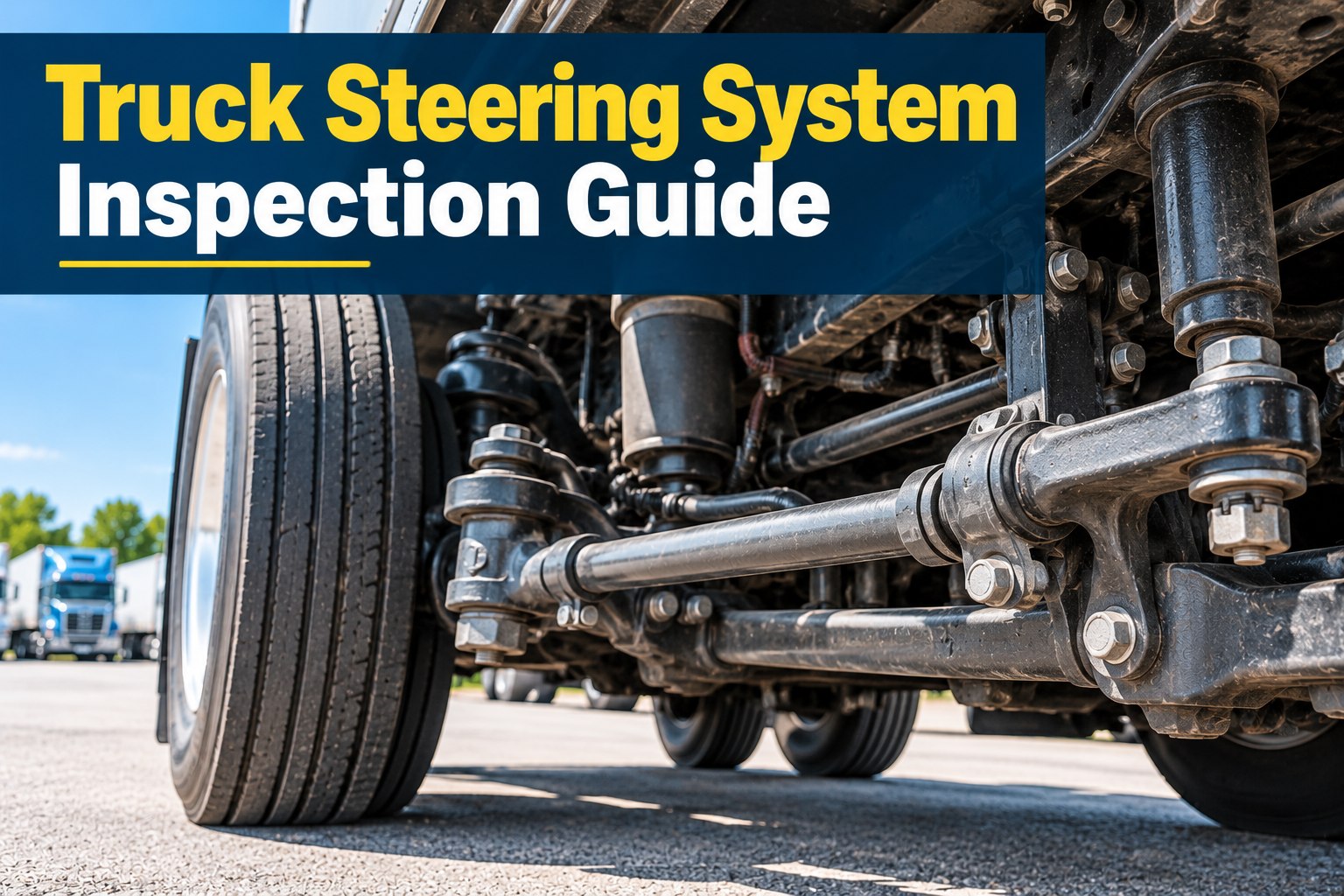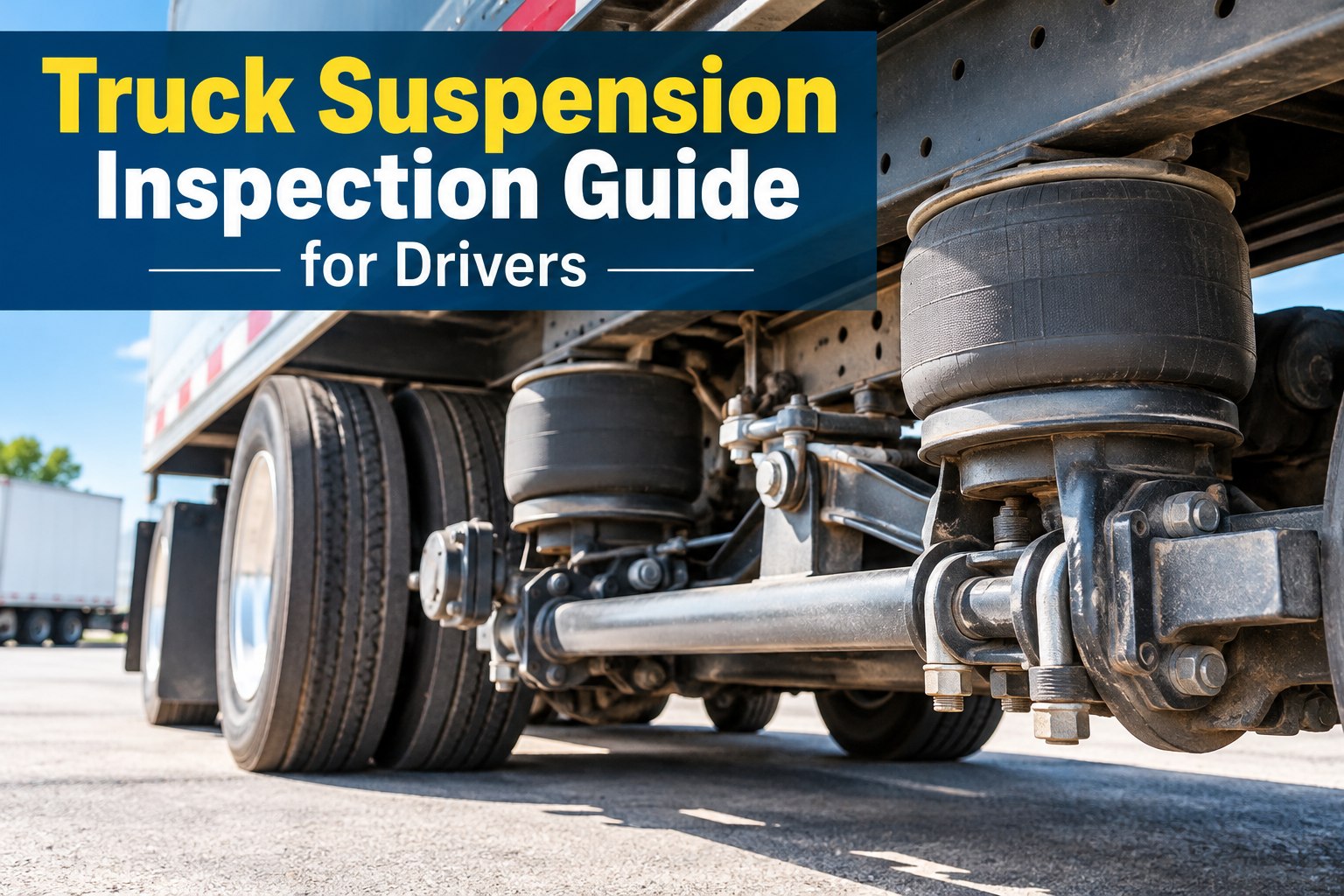
A cracked leaf spring rarely announces itself. The truck still drives, and the defect sits between the U-bolts until a roadside inspector slides under the frame and finds it. Suspension problems regularly park trucks during CVSA's International Roadcheck, yet suspension isn't one of the eleven items drivers must report on a DVIR, so it often gets a quick glance from the cab step instead of a real look with a flashlight. This guide gives drivers and fleet managers a zone-by-zone suspension inspection checklist built on 49 CFR 393.207 and the out-of-service criteria inspectors use, shows which defects mean "write it up" versus "park it," and how to keep every record. If you want to see it on a phone first, walk through it with our team.
Suspension isn't on the 11-item DVIR list, and that's exactly why inspectors keep finding it
Under 49 CFR 396.11, a driver's post-trip report has to cover service brakes, parking brake, steering, lights and reflectors, tires, horn, wipers, mirrors, coupling devices, wheels and rims, and emergency equipment. Suspension is missing from that list. It's still covered by law: 393.207 sets the condition every axle, spring and air system must be in, and 396.7 bars running a vehicle likely to break down or crash. But because the form doesn't force the question, many drivers never ask it.
Roadside inspectors do ask it. Coverage of the 2019 Roadcheck blitz reported that roughly 500 trucks had been placed out of service for suspension problems the year before, and the troopers interviewed said the leaf spring was the usual culprit, often cracked right between the U-bolts where a quick look from the side won't catch it. State CDL skills tests already require springs, mounts, air bags, shocks and torque arms on the pre-trip; fleets that get this right add the same items to their own walk-around.
Walk the truck in four zones so no hanger, rod or air spring gets skipped
Stop treating suspension as one checklist line and break it into the four places the components live. Same order, both sides, every time, with a flashlight even in daylight, because most of what matters sits in shadow behind the wheels.
- Leaf pack: cracks, missing or shifted leaves
- Front and rear spring hangers and shackles
- U-bolts and nuts: tight, no fresh rub marks
- Shock absorbers: mounts secure, no oil streaks
- Leaf packs or air springs on both axles, both sides
- Torque rods and bushings: cracks, play, missing bolts
- Equalizer beam or walking-beam ends
- Axle alignment: wheels tracking straight, no offset
- Spring packs or air springs, hangers and slider pins
- Locking pins on sliding tandems fully engaged
- Trailing arms and their pivot bushings
- Trailer leaning left or right at rest
- Air bags: cuts, bulges, cracking, pinhole leaks
- Air lines: chafing, kinks, rubbing on frame or tires
- Height control valve linkage intact and connected
- Truck sits level once pressure is up
Pass, write it up, or park it: the three verdicts for every suspension defect
Not every finding is an emergency, and treating them all alike buries the real ones. The out-of-service criteria draw the park-it line; your maintenance policy fills in the middle.
- All leaves present, aligned and uncracked
- U-bolts tight with no movement marks
- Air bags full, truck level, no audible leaks
- Shocks dry, mounts secure
- One broken support leaf, below the one-fourth line
- Worn or loose torque rod bushings
- Leaking or weak shock absorber
- Air line chafed but cover not worn through
- One-fourth or more of the leaves broken
- Any main leaf broken, or a leaf missing
- Cracked, loose or missing U-bolt or hanger that lets the axle shift
- Deflated air suspension
Leaf springs: the one-fourth rule, the main leaf, and the crack hiding between the U-bolts
Leaf springs carry the load and, on many trucks, are what keeps the axle square to the frame. Section 393.207(c) says no leaf may be cracked, broken, missing or shifted out of position.
Count the leaves before you call it: two broken in an eight-leaf pack is out of service
The out-of-service line is one-fourth or more of the leaves in any spring assembly broken. On an eight-leaf pack that's two leaves; on a four-leaf pack it's a single leaf. Separately, any broken main leaf, or any leaf or part of a leaf missing or separated, parks the truck regardless of how many leaves there are. Count from the side, then look from underneath, because a break can hide on the inner edge or under the clamp. A broken support leaf often shows as slight sag; a broken main leaf as obvious lean and less tire clearance.
A shifted leaf that can reach the tire, rim, drum or frame parks the truck
Leaves that have walked out of the pack sideways are a defect even if none is broken. Once a displaced leaf could contact a tire, rim, brake drum or the frame, it's an out-of-service condition. Look for a stair-step pattern on the leaf edges and missing rebound clips.
Shiny U-bolts mean the spring pack is sliding on the axle seat
Loose U-bolts let the pack move, wear and eventually crack. Bright metal, rust trails and polished spots around the nuts and axle seat are signs of movement. Manufacturers typically call for a re-torque after break-in, and new U-bolts when a spring is replaced. The driver doesn't torque them, but is usually first to see the evidence.
Air suspension: the 55 psi rule, the level-ride check and 3 psi in five minutes
A leaf spring cracks; an air spring slowly stops holding pressure. Section 393.207(f) gives three tests a driver can actually perform.
The regulator must hold air back until the brakes have 55 psi
The pressure protection valve on the suspension supply must not let air flow to the suspension until at least 55 psi is in the brake system. On a cold start, if the truck rises well before the brake system builds pressure, write up the valve.
At normal pressure, the truck sits level and leaks no more than 3 psi in five minutes
Once the gauge shows normal operating pressure, the vehicle must not tilt to one side, and air leakage from the suspension can't exceed 3 psi in a five-minute period. A truck leaning at rest points to a leaking bag, a damaged line or a height control valve that's out of adjustment. A completely deflated air suspension is out of service. Listen around each bag with the engine off, and check lines for chafing near the frame and tires, one of the most common roadside findings.
Torque rods, hangers and shocks: the parts that keep the axle where it belongs
Springs and bags hold the truck up; a second group holds the axle in place. Under 393.207(a), no axle positioning part may be cracked, broken, loose or missing, and the axles have to be in proper alignment.
A cracked or missing torque rod is out of service; a loose bushing is a write-up
Torque, radius and tracking rods stop the axle from twisting and moving forward or back. Any one that is cracked, loose, broken or missing is an out-of-service defect. Worn bushings are excluded from that criterion but still cause pulling and tire wear, so report them.
Spring hangers crack at the frame first
Hangers and shackles connect the spring ends to the frame, and stress cracks tend to start where the hanger meets the rail or around the bolt holes. A cracked, broken, loose or missing hanger that lets the axle shift from its normal position is out of service. On sliding tandems, 393.207(b) requires every locking pin engaged.
A leaking shock can be found with a hand, and a dead one with a thermometer
Shocks aren't an out-of-service item alone, but a failed one speeds spring, tire and bushing wear. Oil below the seal is the classic sign; after a long run, a dead shock reads noticeably cooler than its neighbours on an infrared thermometer.
The suspension inspection checklist: what to check, and when it becomes out of service
Use this as the suspension section of your pre-trip or post-trip template. The middle column is the driver's job; the right column is the line an inspector will use.
| Component | What the driver checks | Out-of-service trigger |
|---|---|---|
| Leaf spring pack | Count leaves on both sides; look for cracks, gaps, missing or displaced leaves and rebound clips | One-fourth or more leaves broken, a main leaf broken, or any leaf missing or separated |
| Displaced leaf | Leaves stepped out of line with the pack | Leaf positioned so it could contact a tire, rim, brake drum or frame |
| U-bolts and nuts | Tightness, shiny wear marks, rust trails, cracks | Cracked, broken, loose or missing in a way that lets the axle shift |
| Spring hangers and shackles | Cracks at the frame and bolt holes, missing bolts, worn eyes | Cracked, broken, loose or missing, letting the axle shift |
| Torque, radius and tracking rods | Cracks, bent rods, missing fasteners, bushing wear | Any rod cracked, loose, broken or missing (worn bushings excluded) |
| Coil springs and torsion bars | Visible cracks or breaks | Coil spring or torsion bar broken |
| Air springs | Cuts, bulges, cracking, audible leaks, clearance to nearby parts | Air suspension deflated |
| Air lines and leveling | Chafing, kinks, height valve linkage, truck level at pressure | Leakage over 3 psi in 5 minutes or vehicle tilting is a 393.207 violation |
| Sliding axle locking pins | Every pin fully through the rail | Pin missing or not engaged |
| Shock absorbers | Oil leaks, broken mounts, missing bushings | Not an out-of-service item alone; write up for repair |
A printed template or a mobile DVIR: what happens to the defect after the walk-around
A suspension inspection PDF taped to a clipboard is better than nothing, and plenty of fleets start there. The problem shows up after the inspection. A paper sheet records a cracked leaf; it doesn't tell the shop, doesn't stop dispatch, and is hard to find three months later. Federal rules require DVIRs and repair certifications to be kept for three months, and a digital DVIR and DOT inspection workflow keeps them together without a filing cabinet.
- Checkbox says "suspension OK," with no detail on which axle
- Defect reaches the shop only if the sheet does
- No photo, so the mechanic re-inspects to find it
- Truck can be dispatched before the repair is signed
- Records scattered across cabs, folders and trays
- Each zone and component answered on its own, by axle and side
- Defect becomes a work order the moment it's submitted
- Photo and note attached so the shop knows what to bring
- Out-of-service items hold the unit until it's certified
- Every report searchable by truck, date and defect
FleetRabbit turns a cracked leaf found at 5 a.m. into a repair finished before the next dispatch
- Building your suspension section of the DVIR, zone by zone
- A driver submitting a broken-leaf defect with a photo
- How that defect becomes a work order and blocks dispatch
- Setting PM reminders for U-bolt torque and air spring age
- Pulling three months of DVIRs for a single truck in seconds
Repeat defects tell a different story: the same truck cracking springs every few months points to overloading, alignment or worn hangers the walk-around alone won't fix. Tying driver reports into preventive maintenance scheduling puts those trends in front of the person who plans the repairs, and FleetRabbit's wider fleet maintenance tools keep parts, labour and history on the same unit record.