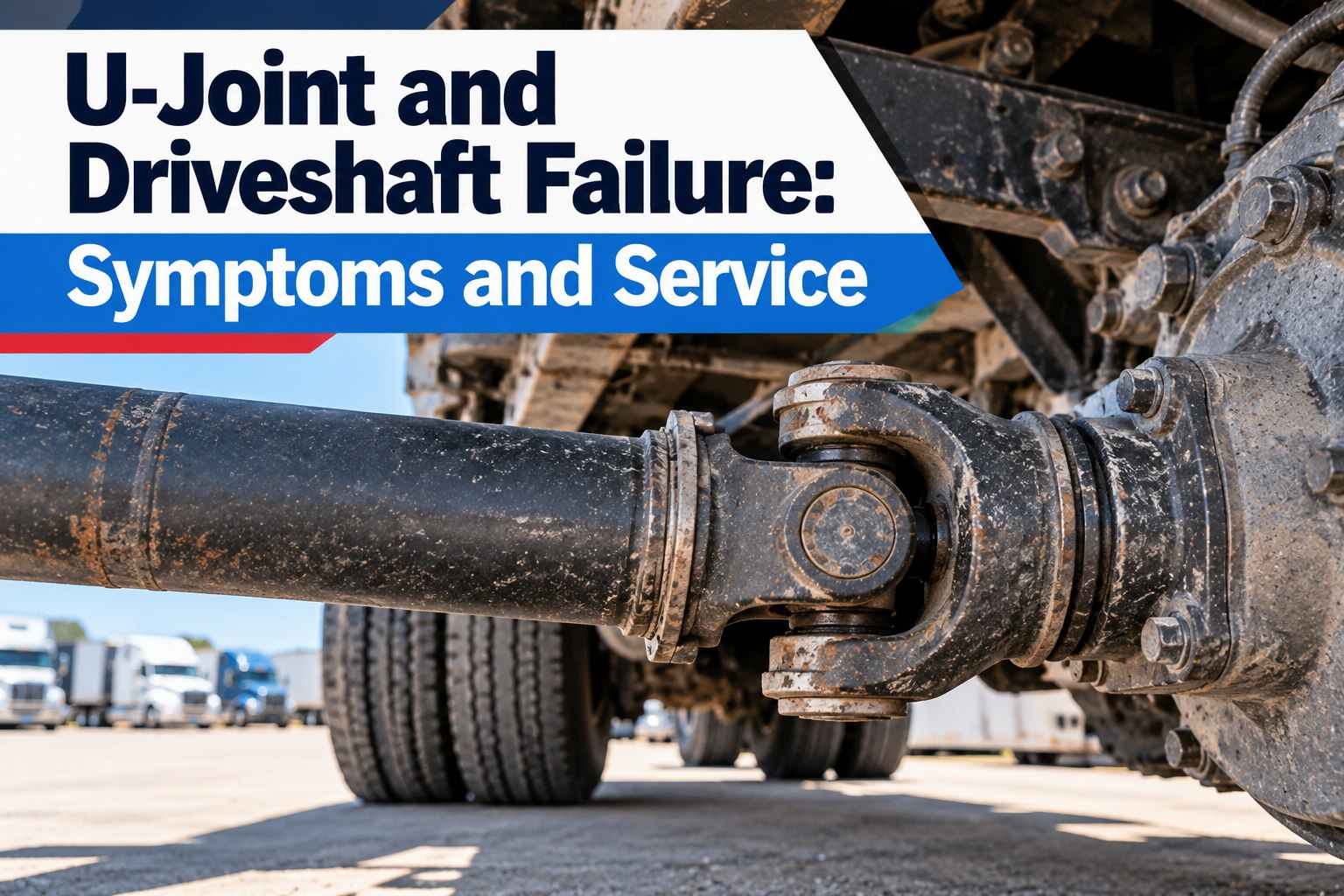
U-Joint and Driveshaft Failure: Symptoms and Service
By Sam Parker on October 10, 2026
U-joint failure on a diesel truck means a universal joint in the driveshaft has gone dry, worn or loose, and the shaft can no longer turn smoothly through the suspension's movement. The first signs are a clunk when the driver shifts into gear, a squeak at low speed or a vibration at a set road speed, and the last sign can be a dropped shaft. This page covers how the driveline works, the symptoms, the causes, the inspection, the fix, the cost and a PM checklist. Schedule a call to put driveline inspections on a PM schedule.
DRIVELINE DIAGNOSTICS · SHOPS AND FLEET MANAGERS
The Joint That Moves the Truck Is the One Nobody Greases
A U-joint is a small part with a big job, and it gets skipped because it hides under the truck. When it goes, the shaft can drop, and the repair is no longer a joint.
How Driveshafts and U-Joints Work, and Where Failure Starts
U-joints let the shaft keep turning while the axle moves with the suspension
Each joint is a cross with four needle-bearing cups, and it carries the full engine torque through a changing angle. The cups need fresh grease, because a dry joint is the leading cause of early failure.
Four parts wear together, so a failure in one shortens the life of the rest
U-JOINT
Cross and needle bearings
Dry or worn bearings give play, a clunk on shifts and a squeak at low speed.
SLIP YOKE
Splined sliding joint
A dry yoke can bind or seize, and looseness in the splines shows as radial play.
CARRIER BEARING
Supports the middle of a two-piece shaft
A cracked rubber isolator or rumble lets the shaft run off-center and kills U-joints.
YOKE EARS
Where the U-joint cups sit
Worn ears destroy new joints quickly, so they must be checked at every replacement.
U-Joint Failure Symptoms: What Drivers Notice and Technicians Confirm
Start with the driver's report, because clunks, squeaks and vibration come first
Drivers describe a sound or a shake, and each one points to a part. Use the table to turn the report into a likely cause and a deadline.
WHAT YOU NOTICE
WHAT IT POINTS TO
WHAT TO DO
WHAT YOU NOTICEMetallic clunk when shifting into drive or reverse
WHAT IT POINTS TOLash in a worn U-joint
WHAT TO DOInspect within days
WHAT YOU NOTICESqueak at low speed or at start-up
WHAT IT POINTS TODry U-joints or a dry slip yoke
WHAT TO DOGrease and re-check
WHAT YOU NOTICEVibration at certain road speeds
WHAT IT POINTS TOWorn joint, imbalance or a failed carrier bearing
WHAT TO DOInspect immediately
WHAT YOU NOTICERumble or grinding that changes with speed
WHAT IT POINTS TOFailing carrier bearing
WHAT TO DOInspect immediately
WHAT YOU NOTICERust streaks from the cups
WHAT IT POINTS TOFailed seals, so the joint is losing grease
WHAT TO DOReplace the joint
Then match the vibration pattern to the part, so you fix the right component
Vibration is the symptom most often blamed on the wrong part. Note when it happens before opening a wrench.
SPEED-RELATED
Same road speed in every gear
Points to driveline imbalance, worn U-joints or a failed carrier bearing.
RPM-RELATED
Follows engine speed, not road speed
Points to the engine or transmission, such as a misfire, flywheel imbalance or a failed mount.
LOAD-RELATED
Only on acceleration or deceleration
Points to a U-joint working-angle problem.
U-Joint Failure Causes: Why Joints Die Before Their Time
Lack of grease leads the list, and bad geometry or worn neighbors come next
Dry joints
→
The leading cause of early failure. Needle bearings burn and the joint seizes or loosens.
Reused worn yokes
→
New joints wear out fast in old yoke ears, so the failure repeats.
Failed carrier bearing
→
The shaft runs off-center and destroys the adjacent joints.
Working angle outside about 1 to 3 degrees
→
Steep angles wear needle bearings, and shallow angles flat-spot the trunnions.
Undersized joint series
→
A joint too small for the engine torque fails rapidly.
Wrong phasing or lost balance weights
→
Vibration builds and loads every joint on the shaft.
U-joint lubrication overdue? Schedule the grease job before the joint runs dry.
Set driveline lube and inspection reminders per truck, and log every driver report against the unit.
Run four checks in order, because grease flow alone does not prove a joint is healthy
1
Play check
Grip each side of a joint and try to rotate one side against the other. Any play means replace it.
→
2
Grease check
Pump grease until fresh grease shows at all four cup seals. A seal with none points to a blocked channel.
→
3
Rotation check
Turn the shaft through its angles. Binding, roughness or a click means internal damage.
→
4
Angles and balance
Check working angles after any ride-height change, and confirm balance weights are all present.
Set the checking interval by duty cycle, not by one mileage figure
Published intervals differ, so use the shortest that fits the truck's duty and follow the OEM. Vocational trucks are usually compressed by 30 to 50 percent against on-highway intervals.
DRIVELINE SERVICE INTERVALS FROM TWO PUBLISHED GUIDES, THOUSANDS OF MILES
Lubrication, severe-duty vocational
10k – 15k mi
Lubrication, one guide for all trucks
10k – 25k mi
Lubrication, on-highway greasable joints
40k – 50k mi
Detailed play and angle inspection
50k – 100k mi
Proactive U-joint replacement
250k – 400k mi
0k
100k
200k
300k
400k
U-Joint Failure Fix: Match the Repair to the Finding
Fix the root cause first, or the new joint will fail the same way
Replace joints in pairs on the same shaft. Tightening bolts or swapping a snap ring is only a temporary fix, so find out why the joint failed.
IF YOU FIND
Radial play in a joint
THEN
Replace the joints, in pairs on the same shaft.
IF YOU FIND
Worn yoke ears
THEN
Replace the yoke, or new joints will fail again.
IF YOU FIND
Cracked isolator or rumble
THEN
Replace the carrier bearing.
IF YOU FIND
Angles outside 1 to 3 degrees
THEN
Correct with shims, transmission-mount adjustment or axle repositioning.
IF YOU FIND
Dry or binding slip yoke
THEN
Grease it and check for seizing and spline looseness.
IF YOU FIND
Missing balance weight
THEN
Rebalance the shaft before returning it to service.
U-Joint Failure Cost: Parts, Labor and the Dropped-Shaft Risk
Parts and labor stay small next to the cost of a failure on the road
One truck guide puts U-joint parts at $50 to $200 each and labor at $100 to $300, with most trucks carrying four to six joints. The same guide compares a roughly $50 angle check with about $500 in premature failures.
ANGLE CHECK COMPARED WITH THE FAILURES IT PREVENTS, US DOLLARS
About $50
Angle check
About $500
Premature U-joint failures it can prevent
$50 – $200
per U-joint, parts only
$100 – $300
labor for the job
4 – 6
U-joints on most trucks
A dropped driveshaft can damage the parts around it and take the truck off the road
A failed shaft can dig into the pavement and can damage these parts as it separates, and the truck loses all drive power.
U-Joint Inspection Checklist for Fleet Preventive Maintenance
Check the driveline at the pre-trip, and again in depth at each PM service
At the driver's pre-trip
Look for shaft damage, dents and loose or missing U-joint caps
Check for grease leaking at the carrier bearing
Listen for clunks and squeaks at low speed
Log any driver report of vibration at a set speed
Note rust streaking from the cups
At each preventive maintenance service
Grease every joint and the slip yoke until fresh grease shows at the seals
Check radial play and rotation on every joint
Check the carrier bearing isolator and spline wear
Check working angles after suspension work
Set the next driveline inspection reminder
Prevent U-Joint Failure Downtime: Schedule Driveline Inspections and Log Every Repair
FleetRabbit turns a driver's note about a clunk or a vibration into a work order, then keeps the inspection, the grease job and the repair on that truck's record. PM reminders bring the next driveline check up before the joint runs dry, and repeat failures show up as history.
Quick answers on U-joint symptoms, causes, fixes and cost
What are the symptoms of U-joint failure?
A clunk when shifting into drive or reverse, a squeak at low speed, vibration at certain road speeds, rumble from the carrier bearing, and rust streaks from the cups.
What causes U-joint failure?
Mostly dry joints, then reused worn yokes, a failed carrier bearing, working angles outside about 1 to 3 degrees, undersized joints, wrong phasing and lost balance weights.
How do you fix a failed U-joint?
Replace the joints in pairs on the same shaft, and correct the cause, such as worn yokes, a bad carrier bearing or wrong angles.
How much does U-joint replacement cost?
One truck guide lists parts at $50 to $200 per joint and labor at $100 to $300. A lighter-vehicle source averages $200 to $500 for a replacement.
How often should truck U-joints be greased?
Guides range from every 10,000 to 25,000 miles to every 40,000 to 50,000 miles on highway, and more often on vocational trucks. Follow the OEM schedule.
Can I drive with a bad U-joint?
Only to get it repaired, and not far. A failed joint can let the shaft drop, damage the parts around it and leave the truck without drive power.
What does FleetRabbit cost?
FleetRabbit is free for up to three vehicles and $5 per vehicle per month after that. Start free with 3 vehicles.
Catch U-Joint Failure Early: Put Every Driveline Inspection on the PM Calendar
A joint that is greased, inspected and logged on schedule costs a few dollars of grease. One that runs dry can cost a shaft and everything it hits. Put the interval on the record and let the reminder do the remembering.