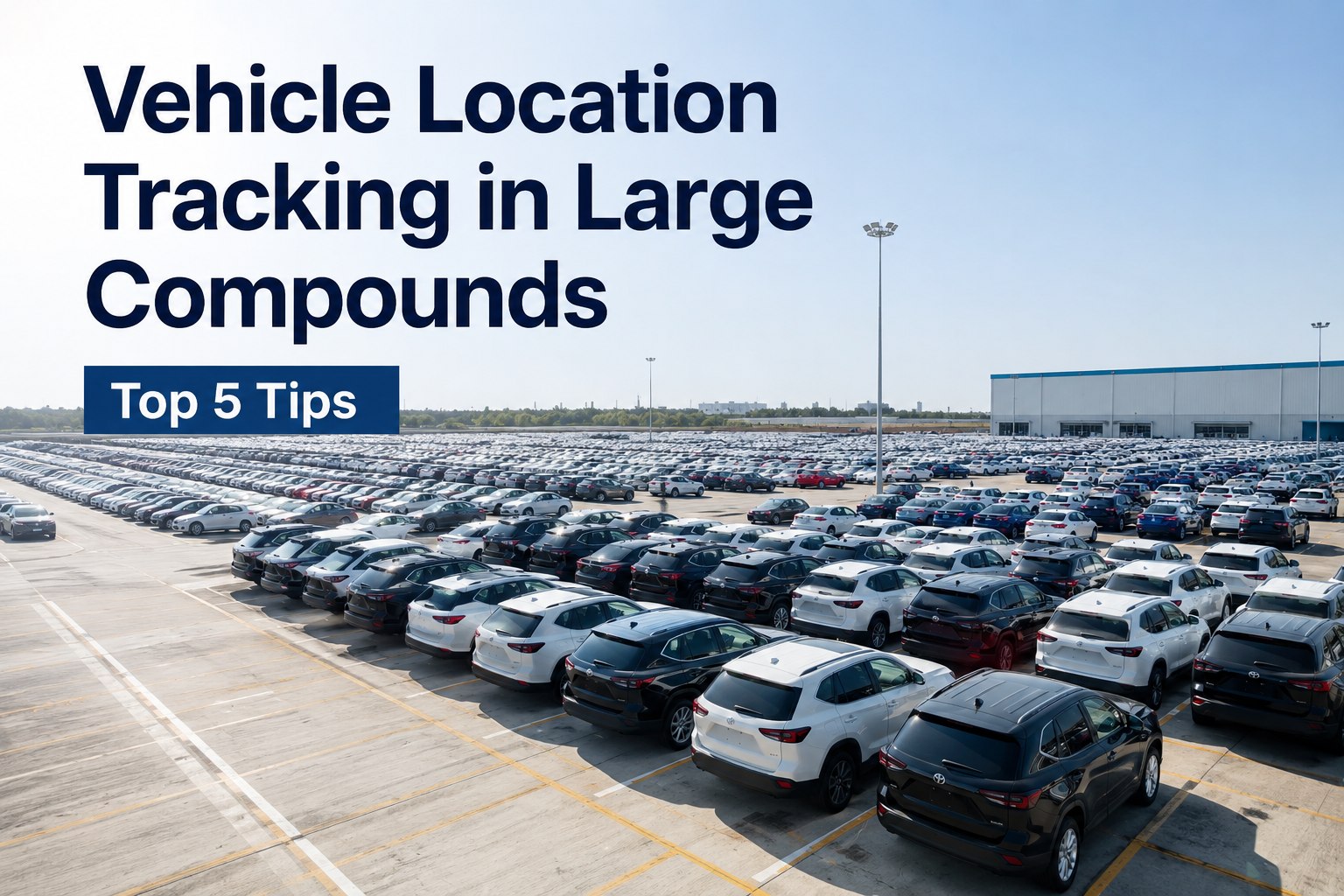
There is a failure mode every compound supervisor recognises and almost nobody measures: the dashboard says the unit is in Zone C, the driver is standing in Zone C, and the car is not there. A barcode scan tells you where something was when someone last scanned it. It does not tell you where it is now — and in an operation where vehicles are relocated repeatedly by people working against a clock, those two things diverge constantly. The consequence is search time, and search time is expensive in a way that never appears as a line item. In a typical warehouse, hunting for assets can consume up to 20% of a worker's shift; on a compound spanning hundreds of acres the arithmetic is worse, not better. The good news is that this is one of the few operational problems where the improvement is well documented and the technology choice is genuinely optional. Book a 30-minute session and bring one week of retrieval records — we'll calculate your actual misplacement rate and search time in Fleet Rabbit before you price a single tag.
TOP 5 · YARD LOCATION TRACKING
Vehicle Location Tracking in Large Compounds
Capture methods compared honestly, search time reduction with and without hardware, misplacement rate measured rather than guessed, and the real cost of a unit nobody can find.
Units in the compound
Not where the system says
Driver hours spent searching
Short-shipped loads, detention, missed dealer dates
Each stage is measurable and most compounds measure none of them. The rate at the second step is the number that decides everything below it.
What a Lost Unit Actually Costs
Not the vehicle — it is almost never genuinely lost. What you pay for is the time and the downstream consequences, and five costs stack on a single misplacement.
1Driver time searchingThe direct labour cost, and the largest recurring one. Search can consume up to a fifth of a shift in comparable operations, and on a multi-hundred-acre site the walk between zones is itself material.
2Carrier waiting timeA car carrier held while a unit is located converts your search into their detention claim, and into a reputation for slow turns that affects future scheduling.
3The short-shipped loadIf the unit is not found in time the load departs without it. Now you have a partial load, a stranded vehicle and a second movement to arrange.
4The dealer commitmentA dealership prepared for a vehicle that did not arrive. The cost is relationship rather than invoice, which is exactly why it never gets counted.
5The extra handlingEvery additional move to recover the situation is another damage opportunity on an open-air asset. This is the cost that occasionally becomes a claim rather than an inconvenience.
The paradox worth naming in your own operation
The system shows the unit is in the right zone, and the bay stands empty because the vehicle is physically misplaced or out of sequence. This is the ceiling of what coarse, scan-based tracking can achieve — a scan tells you where something was when someone last scanned it, and everything after that scan is an assumption. Recognising the gap between "last known" and "current" is the whole design problem.
Measure Misplacement Rate First
Almost no compound knows this number, and it is the input that determines whether you have a discipline problem or a visibility problem — which call for completely different spending.
How to measure it
Take a random sample of VINs from the system, at least a few hundred
Send someone to the recorded location and record found or not found
For not-found units, record where it actually was and how long the search took
Repeat across shifts and zones, because both vary more than expected
Two days of work, no capital spend, and the result reframes every subsequent conversation.
What the answer tells you
Misplacements clustered in specific zones point at layout or lane design
Clustered by shift or by driver points at scanning compliance
Clustered by move type points at a specific process step losing the update
Evenly distributed across everything points at the capture method itself
Only the last of these is a technology problem. The first three are cheaper to fix.
Five Ways to Cut Search Time
Ordered by cost. The first three require no hardware at all, and in many compounds they are enough.
01Confirm position at every move, not just at gate-in
A plan generated at check-in tells you where a car should be parked and knows nothing about the three relocations since. Requiring a scan confirmation on every move — including the hurried ones — is what keeps the record and the yard in agreement. Most misplacement is not a failed scan; it is a move nobody was asked to scan.
CostProcess change only. Usually the single largest improvement available
02Make the compliant path the fastest path
Scanning compliance collapses when the correct procedure is slower than the shortcut, and a driver behind schedule will always take the shortcut. Handheld or phone-based capture that takes seconds — with the location recorded automatically from the device rather than typed — removes the incentive to skip it.
CostLow. Passive capture needs no fixed positioning infrastructure at all
03Reduce the number of moves rather than tracking them better
Every relocation is a chance to lose a unit. Slotting by shipping schedule and destination cuts the relocations that generate most misplacement, which means the tracking problem shrinks before you have spent anything on tracking. Count moves per vehicle first and you will usually find the ratio surprising.
CostRules and layout. Reduces damage exposure and labour at the same time
04Add automated capture at the points that matter
Readers at gates, zone boundaries and dispatch lanes log movements without anyone doing anything. This does not tell you where a unit stopped, but it tells you which zone it entered and when — which narrows a compound-wide search to a zone-wide one, and that is most of the benefit for a fraction of full coverage cost.
CostModerate. Infrastructure at chokepoints rather than across the whole site
05Go continuous only where the numbers justify it
Real-time location closes the gap between last-known and current entirely, and the reported search-time reductions are substantial — comparable deployments report cutting search time by roughly 70% to 80%. It is also the highest-cost tier, and it should follow a measured misplacement rate rather than precede one.
CostHighest. Justified where search time, claim exposure and labour waste are already material
Find rate
You can measure your misplacement rate in two days and no capital.
Bring one week of retrieval records and a sample walk to a short call. We'll calculate find rate, average search time and the zone and shift distribution in Fleet Rabbit — and show you which of the four patterns above your data actually matches. Teams that do this before speccing hardware regularly discover the fix is in tips one to three.
Location Capture Methods Compared
Accuracy, coverage and cost move together. The right answer for a compound is usually a combination rather than a single technology.
← Swipe to see all columns →
Two practical notes for open compounds specifically. Ultra-wideband precision is engineered for dense indoor environments and its anchor density makes it expensive to blanket across hundreds of acres — reserve it for zones where sequence enforcement genuinely pays. And a wide-area network approach with GPS tags can cover an entire large yard from a couple of gateways, with a single gateway handling hundreds of devices, which is frequently the more sensible economics outdoors.
Design It as a Hybrid
Most successful deployments combine methods, matching each part of the operation to the technology that fits it rather than standardising on one.
Gates and dispatch lanesAutomated readers, because these are chokepoints every unit passes and the events are worth capturing without human involvement.
General storage zonesScan confirmation or cost-effective tags. Zone-level accuracy is sufficient when the zone is the search unit.
Sequencing and load lanesHigher precision where the exact position in a loading order has to be enforced rather than merely known.
Units leaving the siteGPS, since coverage has to extend beyond the fence for transit and multi-site movements.
Everything elseBarcode or QR as the baseline, captured on a phone with position taken from the device. No fixed infrastructure required.
Before you order more tags
List what your current setup already sees and what it misses. An existing deployment does not have to define the limits of your tracking — it can become one high-quality source inside a system covering far more of the site. Start from recurring problems such as misplacement and long dwell, define what you actually want to change, and only then select technology. Reversing that order is how compounds end up with precise visibility of an operation that is still moving cars unnecessarily.
What to Track Afterwards
Six figures. The first two are the programme; the rest tell you whether it is still working.
Find rateShare of units found at the recorded location on first attempt. The headline measure, sampled regularly rather than assumed from system confidence.
Average search time per retrievalFrom retrieval request to vehicle in hand. Converts a visibility problem into a labour number anyone can act on.
Scan compliance by move typeWhich movements get confirmed and which do not. Almost always reveals one specific move type as the source of drift.
Moves per vehicleBecause every move is a misplacement opportunity, and reducing moves reduces the problem without touching the tracking.
Retrieval time to gate-outEnd to end, so the improvement shows up where the carrier experiences it rather than only in an internal metric.
Short-shipped loadsLoads departing incomplete. The downstream consequence, and the number that makes the business case to anyone outside the yard.
Twenty minutes on your find rate, search time and move count
On the call we'll take one site's retrieval and movement records into Fleet Rabbit, produce the find-rate and search-time baseline, identify which move type is losing the position updates, and show what a scan-confirmation change alone would do before any hardware enters the conversation. You keep the baseline either way — it is the document that sizes the investment properly.
Frequently Asked Questions
Why isn't barcode scanning enough on its own?
Because a scan tells you where something was when someone last scanned it, not where it is now. In a compound where units are relocated repeatedly under time pressure, the gap between those two opens constantly — and the classic symptom is a system showing the vehicle in the right zone while the bay stands empty. Scanning is still the correct low-cost baseline, but it only holds if every move is confirmed, which is a process question rather than a technology one.
How do we measure our misplacement rate?
Sample a few hundred VINs from the system, send someone to each recorded location, and record found or not found — plus where the unit actually was and how long the search took for the misses. Repeat across shifts and zones. It takes about two days, costs nothing, and the distribution is as informative as the rate: clustering by zone points at layout, by shift or driver at scanning compliance, by move type at a process step, and even distribution at the capture method itself.
How much search time can tracking actually save?
Substantial, on the published evidence. Searching for assets can consume up to 20% of a worker's shift in comparable operations, and deployments moving from scan-based to continuous location report search-time reductions in the region of 70% to 80%. That said, the reductions available from process changes alone — confirming position on every move, making the compliant path the fastest path, and cutting the number of moves — are often large enough that the hardware case looks different afterwards.
Which location technology suits an outdoor compound?
Usually a combination. GPS is effective for outdoor vehicle tracking across large facilities; automated readers suit gates and zone boundaries; low-energy tags give cost-effective zone-level visibility with multi-year battery life; and centimetre-precision systems are worth reserving for lanes where sequence enforcement genuinely pays, since their anchor density makes site-wide coverage expensive. A wide-area network with GPS tags can cover a large yard from very few gateways, which is frequently the better outdoor economics.
What does one misplaced vehicle cost?
Five things stack on it: driver time searching, carrier waiting time that becomes a detention claim, a short-shipped load requiring a second movement, a dealer commitment missed, and the extra handling that adds damage exposure to an open-air asset. Only the first is easy to quantify and it is rarely the largest. Building the cost case on all five is what moves the conversation out of the yard and into a budget discussion.
Should we upgrade what we already have?
Very possibly. Before ordering more tags, list what your current setup sees and what it misses — an existing deployment does not have to define the limits of your tracking, and it can become one high-quality source inside a broader system. Keep precision where it supports a valuable process, use cost-effective tags where frequent automated updates are enough, add readers at chokepoints, and use scanning as the baseline everywhere else.
Where should we start?
With the recurring problem rather than the technology. Identify the issues you actually have — misplacement, long dwell, poor dispatch throughput — define what you want to change, then select the methods that fit your operating environment. Measure find rate and search time first so the investment is sized against a real number.
Book a working session with one week of retrieval records and we'll build that baseline with you before anything gets specified.
Measure the Miss Before You Buy the Fix
Find rate sampled rather than assumed, search time converted into a labour number, every move confirmed before any tag is ordered, methods matched to zones rather than standardised site-wide, and the cost case built on all five consequences instead of the one that is easy to count.
Bring one week of retrieval records to the call · Works with barcode, RFID, GPS and RTLS inputs · Free tier available
August 24, 2026By Alex Rowan
All Blogs