Verizon Connect does the big things well. Eighty-five thousand customers and around two million vehicles, compliance breadth covering US electronic logging, Canadian hours of service, fuel tax reporting and inspections in one platform, genuinely strong intrastate compliance handling, and driver-facing inspection tools that were extended this year so drivers can log every mechanical problem without leaving the mobile app. The tracking is good and the compliance coverage is broad. Where it gets awkward is the next step: an independent 2026 assessment notes that integrating with maintenance systems may require middleware or partner services beyond the base subscription. So a fleet that already captures a defect properly is then quoted a services engagement to make that defect become a repair — while sitting inside a thirty-six month minimum that reviewers describe as non-negotiable. Ask us what connecting actually involves before you accept a scoping call — the honest answer is shorter than you would expect.
Integration · Verizon Connect Reveal
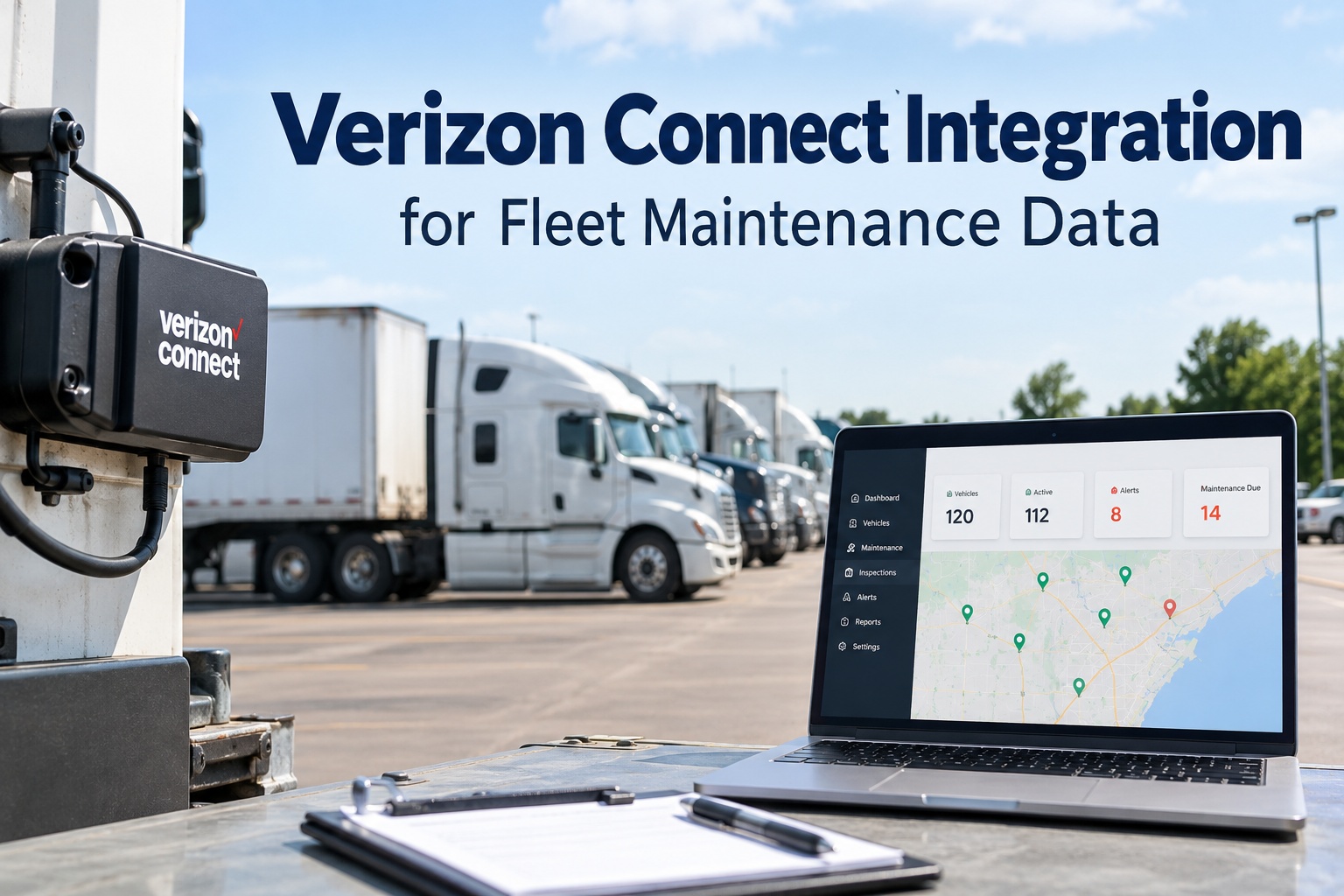
Verizon Connect Integration for Fleet Maintenance Data
The defect is already captured. Getting it into a work order should not need middleware, a partner engagement or a change to your agreement.
The Gap Is Specific and Documented
Not a vague complaint about depth — a named finding about what connecting costs.
What works
Capture is fine
Driver-facing inspection tools were extended so drivers log mechanical problems inside the app they already use. Maintenance reminders exist, vehicle maintenance reports are available, and diagnostics flow from the hardware. The data genuinely arrives.
What it costs to use it elsewhere
Possibly a services engagement
Independent assessment notes that integration with enterprise, visibility and maintenance systems may require middleware or partner services beyond base subscription fees — with implementation services pricing explicitly listed as not public. That turns a connection into a scoped project with an unknown number attached.
One reviewer puts the conclusion more bluntly than we would: for fleets primarily focused on maintenance and work orders rather than telematics, they point readers toward alternatives. We would put it differently — you do not need an alternative to Verizon Connect, you need something to receive what it already produces.
What Your Agreement Probably Says
Worth having in front of you, because it shapes which options are actually available this year.
36-month minimumDescribed as non-negotiable, with no annual or monthly billing option on the standard arrangement. Newer Reveal terms in some markets include discounted multi-month commitments that roll to month-to-month afterwards — worth checking which you signed.
Early terminationReported as paying the full remaining balance rather than a capped fee. That single term is why most Verizon Connect fleets evaluating options are looking to add rather than replace.
14-day cooling offCancellation available within fourteen days of activation. Useful to know at signing and irrelevant by the time most people read a page like this.
Renewal behaviourReviews continue to report auto-renewal, cancellation friction and post-promotional price increases. Diary your renewal window now, whatever else you decide.
This is precisely why the argument on this page is
addition rather than replacement. Nothing here touches your hardware, your contract or your account team. It runs alongside, which means the decision is reversible at any point and does not require a conversation you may not be looking forward to.
Tell us your renewal date and we'll plan backwards from it.
Where the Line Falls
Honest about the overlap, because Verizon Connect does more maintenance-adjacent work than people assume.
Swipe to see all columns
Read the top four rows and the situation is clearer than the marketing on either side suggests. You are not missing data. You are missing a destination for it — which is a smaller and cheaper problem than a platform replacement, and a different problem from the one a middleware quote is designed to solve.
Middleware
or
An afternoon
Before you scope a services engagement, find out what it takes without one
If someone has quoted you a partner integration to get Verizon Connect data into maintenance, get a second view first. We will tell you plainly what connects directly, what does not, and whether your situation genuinely needs custom work — including if the answer is that it does.
The Support Question, Handled Practically
It comes up in almost every review, so it is worth addressing rather than pretending otherwise.
ReportedSupport and billing are the recurring complaintsAcross hundreds of verified reviews: long hold times, unreturned emails, unresolved issues and billing disputes. One account describes more than forty hours spent on billing discrepancies. Verizon Connect does offer 24/7 phone support, which some fleets rate highly — experiences clearly vary.
ConsequenceEvery additional dependency is another support queueIf a maintenance integration runs through middleware or a partner, a broken data flow becomes a three-way conversation between you, the partner and the platform. A direct connection has one fewer party in it, which matters more when support latency is already your complaint.
PracticalKeep your maintenance record independent of thatWhatever happens with tickets or billing, your service history, inspections and work orders should sit somewhere you control and can export. That is ordinary prudence rather than a criticism of anyone.
Inside Fleet Rabbit: Where the Data Lands
Six capabilities, all downstream of what Verizon Connect already captures well.
01Inspection defects become assignable jobsThe defect a driver logged in the app arrives as work with an owner, a due date and a recorded outcome — closing the loop from reported to repaired to verified, which is what an auditor actually examines.
02Diagnostic codes raise candidate work ordersWith the asset, current odometer, open defects and service history already attached, so nobody retypes a vehicle number into a maintenance sheet. Which codes auto-create and which queue for review is yours to configure.
03Multi-interval preventive schedulingTime, distance and engine hours running simultaneously per asset class rather than a single reminder rule — trucks on mileage, plant on hours, trailers on date, fed by live usage data.
04Parts, labour and cost per assetInventory and consumption alongside labour captured against the job, with outsourced work and downtime attributed to a specific vehicle over its life. This is the ledger telematics does not attempt.
05Assets with no tracker in themTrailers, generators, attachments and yard equipment on the same maintenance system — because a service programme covers the whole fleet rather than only the units carrying hardware you pay a subscription for.
06Records you can export whenever you wantService history, inspection records and repair evidence in a format you own. Given how much of the review commentary concerns getting things out of contracts, having your maintenance record portable is worth something on its own.
The split respects what you have already paid for. Verizon Connect keeps tracking, diagnostics, driver behaviour monitoring, electronic logging, fuel tax and the inspection app your drivers already use. Nothing here changes what a driver sees or does, and no hardware is touched.
Connecting Without a Project
Four steps. Judge any alternative quote against this timeline.
1Confirm what your plan exposesWhich products you hold and what your account can share. Worth establishing first, since Verizon Connect bundles vary considerably and the answer determines what automated flow is possible.
2Build the asset registerYour tracked vehicles plus the trailers, plant and equipment that were never in Verizon Connect. Most fleets find this list is longer than expected and that the untracked half has no schedule at all.
3Set intervals and defect routingSchedules per asset class, and rules for which defect categories and diagnostic codes create work automatically. This is the hour that decides whether the system is useful or noisy, and it is the whole configuration effort.
4Run alongside for a fortnightKeep your current process going and compare after two weeks. Nothing has been switched off, nothing has been migrated and nothing needs unwinding if it does not suit you.
Three vehicles, free, and nobody has to approve anything
No card, no time limit, no contract and no conversation with your Verizon Connect account team. Put three units on it, route real inspection defects into real work orders for two weeks, and decide from what you see rather than from what anyone claims. For a fleet inside a three-year term, being able to evaluate something without a procurement cycle is most of the appeal.
Notes for Verizon Connect Fleets
Five things worth doing regardless of what sits alongside.
Diary your renewal windowReviews consistently mention auto-renewal and cancellation friction. On a three-year term with full-balance early termination, the notification window is the only leverage point you get and it comes round rarely.
Audit which products you pay forThe suite spans several named products plus add-ons like dispatch at a per-technician rate. Before renewal, list which your team opens weekly — that list is your negotiating position.
Ask what integration costs before agreeing to scope itImplementation services pricing is explicitly noted as not public. Get a number in writing before a discovery call turns into a statement of work, and compare it against connecting directly.
Keep maintenance records exportableWhatever platform holds your service history, make sure you can get it out in a usable format. Given the recurring commentary about contract exits, this is ordinary prudence.
Check the untracked half of your fleetTrailers, plant and equipment without a unit fitted are usually outside both the subscription and any schedule. That gap tends to be where the unplanned failures actually occur.
Frequently Asked Questions
Do we have to leave Verizon Connect?
No — and given the contract terms, most fleets reading this could not anyway. Verizon Connect keeps tracking, diagnostics, driver behaviour monitoring, electronic logging, fuel tax reporting and the driver inspection app. Fleet Rabbit handles what sits downstream: work orders, parts, multi-interval preventive scheduling and cost per asset. No hardware changes, no account conversations, nothing touching your agreement.
We were told integration needs middleware. Is that right?
It can be, and independent 2026 assessment does note that integration with enterprise, visibility and maintenance systems may require middleware or partner services beyond base subscription fees — with implementation services pricing listed as not public. Whether yours does depends on your products and what you are trying to move. Get a written number before agreeing to scope anything, and get a second view on whether custom work is genuinely required.
Verizon Connect already has maintenance reminders and DVIR. What is missing?
The destination. Inspection capture is good and was recently improved so drivers log mechanical problems without leaving the app, and maintenance reminders and reports exist. What is not there is the repair itself — work orders with assignment, parts and labour, closure evidence, multi-interval scheduling across time, distance and hours, and cost per asset. You are not missing data; you are missing somewhere for it to go.
What should we know about the contract?
Reviewers describe a thirty-six month minimum as non-negotiable with no annual or monthly billing on the standard arrangement, early termination reported as the full remaining balance, and a fourteen-day cooling-off period at activation. Newer Reveal terms in some markets include discounted multi-month commitments that roll to month-to-month afterwards, so check which you signed. Auto-renewal and post-promotional price increases also come up repeatedly — diary the renewal window.
Does the support situation affect this?
Indirectly, and worth thinking about. Support and billing are the most common complaints across verified reviews, though 24/7 phone support exists and experiences clearly vary. The practical implication is that every extra party in a data flow is another queue — a maintenance integration running through middleware or a partner turns a broken feed into a three-way conversation, while a direct connection has one fewer party in it.
Can we cover trailers and equipment?
Yes, and this is often where the immediate value sits. Assets without a tracking unit — trailers, generators, attachments, yard equipment — are outside your subscription and usually outside any maintenance schedule too. They go on the same system as your tracked vehicles with their own intervals, which for many fleets means scheduled maintenance covering the whole operation for the first time.
You Are Not Missing Data. You Are Missing a Destination.
Verizon Connect captures the defect, reads the diagnostic code and knows the odometer. What it does not do is turn any of that into an assigned job with parts against it and a recorded closure — and the documented route to connecting that elsewhere runs through middleware or partner services with pricing nobody publishes. Adding a destination should be an afternoon's configuration, not a statement of work, and it should not require touching an agreement you are three years into.