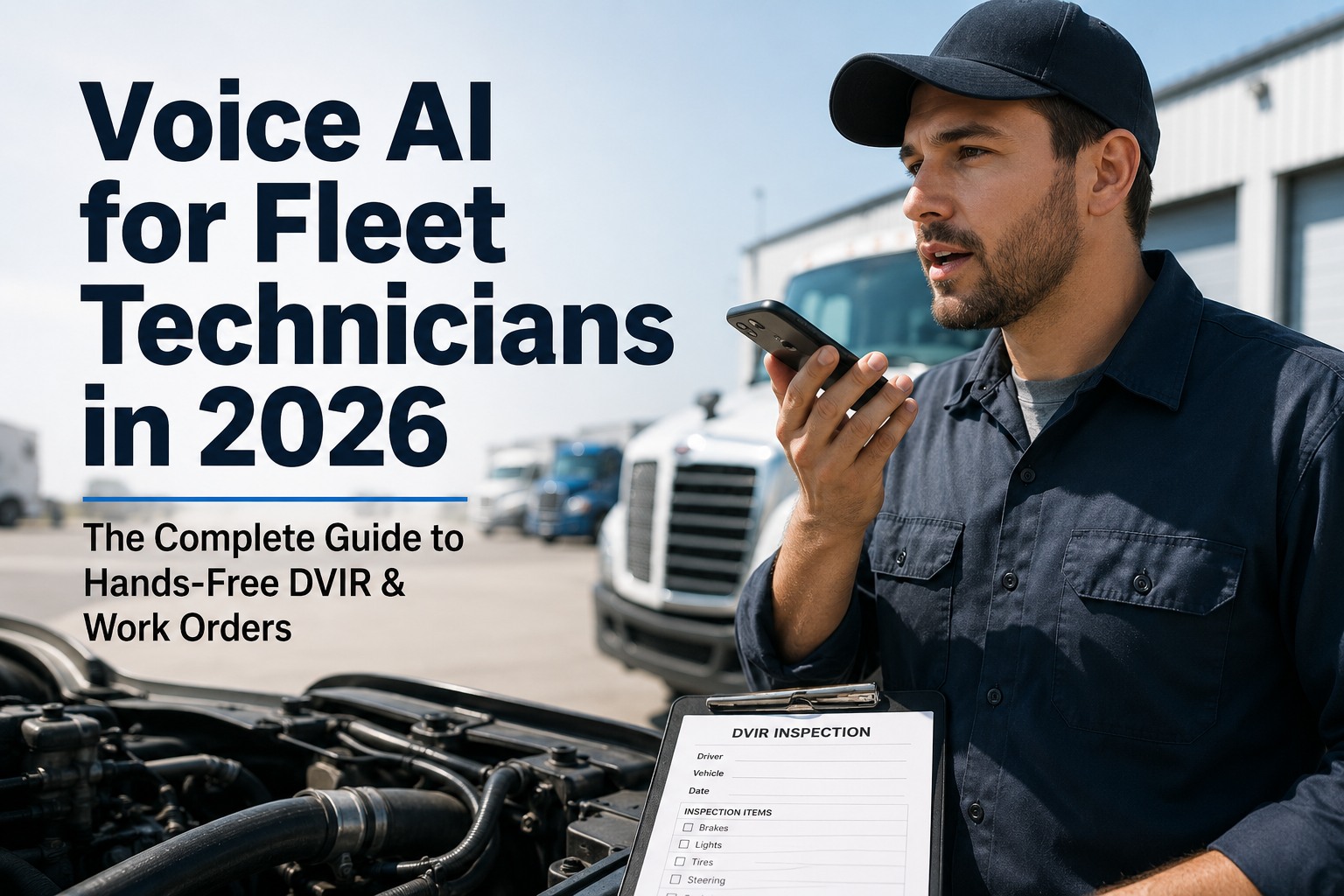
A fleet technician with both hands inside an engine bay and a defect to log faces the same small, expensive ritual dozens of times a shift: put down the wrench, peel off a glove, wake the screen, hunt for the right field, thumb-type the note, and pick the tools back up. That sequence costs eight to twelve minutes per job, and across a ten-technician shop running six jobs each it burns hundreds of minutes of wrench time every single day — pure documentation friction with no diagnostic value. Voice AI removes it. The technician speaks the observation, and purpose-built speech recognition turns the words into a structured DVIR line or a work-order field in real time, hands never leaving the job. This is the shift moving voice from a novelty to fleet infrastructure in 2026: the AI voice agent market is projected to grow from $2.54 billion in 2025 to $35.24 billion by 2033, and maintenance is one of the workflows where the payback is immediate and measurable. This guide defines voice AI for fleet technicians end to end — how a spoken observation becomes structured data, where the time savings are real, what accuracy looks like in a noisy diesel shop, and how to evaluate voice-enabled fleet software. Start a free trial or book a demo to see hands-free DVIR and work orders on your own fleet.
FLEET TECHNOLOGY · VOICE AI · 2026 GUIDE
Voice AI for Fleet Technicians: Hands-Free DVIR and Work Orders
The technician speaks; the system captures. Voice AI turns spoken fault descriptions, parts used, and inspection results into structured DVIR and work-order data in real time — no glove off, no screen, no lost wrench time. Here's how it works, what it's worth, and how to choose it.
Voice AI Has Moved From Pilot to Production
The market trajectory is the clearest signal that voice has become real infrastructure — and North America leads the adoption.
AI voice agent market size, per Grand View Research. North America held the largest share at 38.1% in 2025, with the U.S. leading the region.
8–12 min
Lost per job to the stop-type-resume documentation ritual
under 4 min
To complete a full voice DVIR with zero screen interaction
94%
Voice accuracy in high-noise diesel and highway environments
85%
Mobile DVIR adoption in 2025, up from 35% in 2019
What Voice AI for Fleet Technicians Actually Is
Voice AI for fleet technicians uses AI speech recognition to convert spoken technician input — fault descriptions, parts used, time logged, next steps, safety observations, and inspection results — directly into structured fleet-software data fields. This is not generic dictation bolted onto an app. Purpose-built voice capture understands maintenance-specific vocabulary, formats the content into the correct fields, and saves it without the technician ever touching the screen.
1. Technician Speaks
"Rear brake chamber leaking air, replaced service brake, ninety minutes labor." Spoken naturally, hands still on the truck.
→
2. Real-Time Transcription
Noise-cancelling speech recognition transcribes the words instantly, even over diesel engine and shop-floor noise.
→
3. Maintenance-Aware Parsing
The system recognizes the component, the defect, the part, and the labor, and maps each to the right structured field.
→
4. Structured Record Saved
A DVIR line or work-order entry is filed, timestamped, and a defect auto-routes into a priority work order.
Where the Time Actually Goes
The cost of manual documentation isn't the typing — it's everything around it. Voice collapses the whole sequence into a single spoken sentence, and the difference compounds across every job, every technician, every shift.
Manual Entry
Set down tools and stop the work
Remove gloves, often greasy
Wake and unlock the device
Navigate to the right screen and field
Thumb-type the note on a small keyboard
Re-glove and pick the tools back up
Voice Capture
Speak the observation while working
Gloves stay on, hands stay on the job
No screen to wake or unlock
System routes it to the right field
Transcribed and structured in real time
Work never stops
i
The math that makes this a budget line, not a novelty: a single technician saving roughly 30 minutes a day of documentation friction recovers real, loaded-labor value across a year — and a ten-technician shop running six jobs each can lose 480 to 720 minutes of wrench time daily to manual entry alone. That's most of a full technician's shift, evaporated into screen-tapping. Voice doesn't just make the work nicer; it gives back billable capacity you're already paying for.
See the recovered-hours math on your own headcount.
Hands-Free DVIR, Start to Finish
The inspection is where voice pays off most visibly, because a DVIR is a rigid checklist that maps perfectly to a spoken call-and-response. Here's the full flow, with zero screen taps from start to filed record.
1
The System Reads Each Item Aloud
Brakes, lights, tires, mirrors, coupling — the app speaks each checklist item in turn through the vehicle's Bluetooth audio, so the technician never looks at a screen.
2
The Technician Responds by Voice
A simple "Good" or "Defect" for each item, with the option to dictate a detailed observation on anything that needs it — all spoken, all hands-free.
3
Responses Are Timestamped and Filed
Each response is recorded, driver-identified, and timestamped, then filed to the system as the FMCSA-compliant DVIR record — a complete inspection in under four minutes.
4
Defects Auto-Create Work Orders
Any item marked "Defect" simultaneously generates a priority work order, so the finding routes to the shop the instant it's spoken instead of waiting on paperwork.
Every defect spoken is a work order created — no transcription gap, no lost finding.
Fleet Rabbit turns a voice DVIR defect straight into a priority work order with the driver, vehicle, and timestamp attached, so nothing falls between the inspection and the shop.
Does It Work in a Real Shop? The Accuracy Question
The reasonable objection to voice in a fleet setting is noise — diesel engines, HVAC fans, air tools, highway speed. Modern purpose-built systems are engineered for exactly that environment, not a quiet office. Swipe the table horizontally on mobile.
← Swipe to see all columns →
The Payoff Beyond Time Saved
Faster entry is the obvious win, but the compounding benefits are what move a fleet from interested to committed. Voice changes not just how fast data is captured, but how much and how well.
01
More Data Captured
When logging is effortless, technicians record the small observations they'd otherwise skip — the early signs that prevent the big failures.
02
Recovered Wrench Time
Documentation minutes go back into billable work, recovering capacity you already pay for across every technician and every shift.
03
Faster Defect Routing
A spoken defect becomes a work order instantly, closing the gap between finding a problem and getting it into the shop queue.
04
Fewer Errors and Gaps
Real-time structured capture beats end-of-day recall, cutting the missing fields and forgotten details that plague manual logs.
05
Shorter Onboarding
Speaking naturally is easier to learn than navigating software forms, so new technicians reach productivity faster with less training.
06
Cleaner Compliance Records
Timestamped, driver-identified DVIRs filed automatically create the audit-ready trail that manual paperwork so often leaves incomplete.
Put Voice AI to Work on Your Fleet
Fleet Rabbit brings hands-free DVIR and voice-captured work orders to your technicians — spoken observations become structured, timestamped, FMCSA-compliant records, and defects route straight into priority work orders. No glove off, no screen, no lost wrench time. Deploy at $5/vehicle/month, no hardware, live within 72 hours.
Hands-free voice DVIR
Voice-captured work orders
Auto defect routing
Noise-tuned accuracy
How to Evaluate Voice-Enabled Fleet Software
Not all "voice" features are equal — some are generic dictation with a fleet logo, others are purpose-built for the shop floor. Use these criteria to tell them apart. Swipe the table horizontally on mobile.
← Swipe to see all columns →
Frequently Asked Questions
What is voice AI for fleet technicians?
It's the use of AI speech recognition to turn a technician's spoken input — fault descriptions, parts used, labor time, next steps, and inspection results — directly into structured fleet-software data, without touching a screen. The key distinction from ordinary dictation is that purpose-built systems understand maintenance vocabulary and route the words into the correct DVIR or work-order fields rather than dumping raw text. Seeing that structured capture on your own workflow is exactly what you can
book a demo to watch in action.
How accurate is voice recognition in a noisy diesel shop?
More accurate than most people expect, because purpose-built fleet voice systems are engineered for noise rather than a quiet office. Using noise-cancelling audio processing from the Bluetooth microphone, testing across many fleet vehicle types has shown around 94% accuracy in high-ambient-noise environments, including diesel engine noise, HVAC fans, and road noise at highway speed. The system is tuned for the shop floor, not adapted from consumer software, and experiencing that accuracy on your vehicles is something you can
book a demo to test firsthand.
How long does a hands-free voice DVIR take?
A complete FMCSA-compliant voice DVIR takes under four minutes with zero screen interaction. The system reads each checklist item aloud — brakes, lights, tires, mirrors — and the technician responds "Good" or "Defect" for each, with the option to dictate detail on anything that needs it. Every response is recorded, driver-identified, and timestamped, then filed as the inspection record, and any defect simultaneously creates a priority work order. Watching that four-minute flow end to end is exactly what you can
book a demo to see.
How much time does voice capture actually save?
The savings come from eliminating the whole stop-type-resume ritual, not just faster typing. Manual entry costs roughly 8 to 12 minutes per job once you count setting down tools, removing gloves, waking the screen, and navigating fields, and a ten-technician shop can lose 480 to 720 minutes of wrench time a day to it. Even a conservative 30-minute daily saving per technician recovers meaningful loaded-labor value across a year. Running that recovered-hours math against your own headcount is something you can
book a demo to work through together.
Is a voice DVIR actually FMCSA-compliant?
Yes, when the system files a proper record. In a purpose-built voice DVIR, each spoken response is recorded, driver-identified, and timestamped, then filed as the FMCSA-compliant inspection record — the same legal document a manual DVIR produces, just captured hands-free. The compliance value is actually higher than paper, because the timestamps and driver identification are automatic and the record can't be backfilled from memory at the end of a shift. Confirming that compliance fit for your operation is something you can
book a demo to review in detail.
What's the difference between purpose-built voice AI and generic dictation?
Generic dictation transcribes speech into a block of text and leaves you to sort it into fields; purpose-built fleet voice AI understands what it's hearing. It recognizes that "rear brake chamber leaking air" is a component and a defect, that "replaced service brake" is a part, and that "ninety minutes" is labor time, and it routes each to the right structured field automatically. It's the difference between a transcript and a completed work order. Seeing that maintenance-aware parsing rather than raw transcription is exactly what you can
book a demo to compare.
Do technicians need training to use it?
Far less than for traditional software, which is one of its quieter advantages. Speaking naturally is closer to how technicians already communicate than navigating forms and dropdowns, so the learning curve is short and onboarding is faster — voice-directed workflows in adjacent industries have cut training time substantially. The best systems let technicians speak conversationally rather than memorize rigid commands. Seeing how quickly your team takes to it is something you can
book a demo to gauge with your own crew.
Is voice AI for fleets worth the investment in 2026?
The market signal and the shop-floor math both point the same way. The broader AI voice agent market is projected to grow from $2.54 billion in 2025 to $35.24 billion by 2033 as the technology moves from pilots to production, and in fleet maintenance specifically the recovered wrench time, faster defect routing, and cleaner compliance records deliver value from the first shift. With no hardware required and a low per-vehicle cost, the barrier to trying it is minimal, and evaluating that fit for your fleet is exactly what you can
book a demo to do.
Let Your Technicians Talk. Let the Software Type.
Fleet Rabbit gives your shop hands-free voice DVIR and voice-captured work orders — spoken observations become structured, timestamped, compliant records, and defects route straight to the shop, so technicians keep both hands on the truck and none on a keyboard. Integrated with your existing systems in 5–7 working days, at $5/vehicle/month, with no new hardware required.
Free tier for up to 3 vehicles · No credit card required · No hardware installation
July 29, 2026By Emily Parker
All Blogs