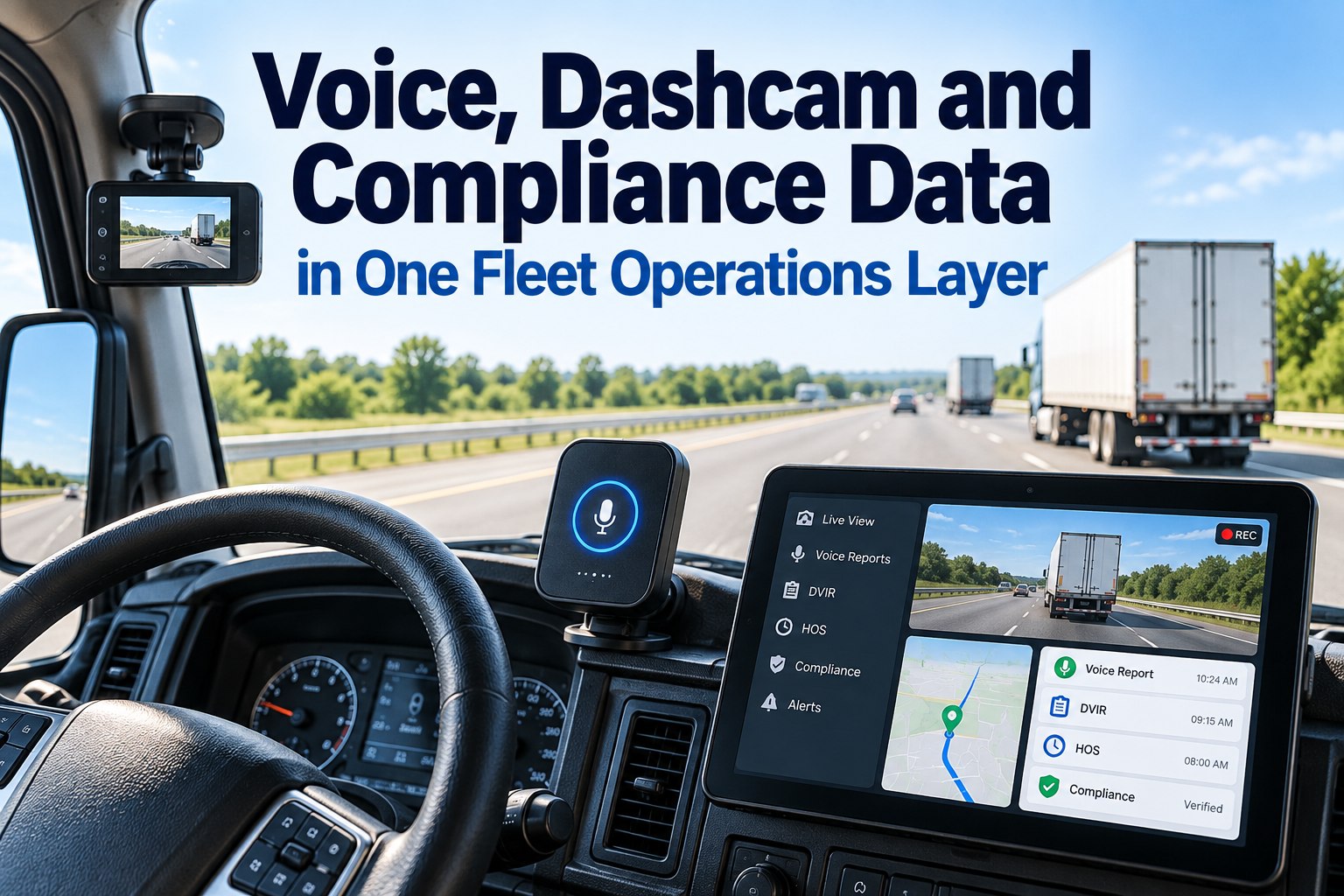
Drivers, cameras and compliance systems all produce signals during a shift — a spoken defect report, a hard-braking clip, an engine fault code, a DVIR entry, an expiring medical certificate — and in most fleets each one lands in a different place with a different owner. Unified fleet operations means one intake stream, one set of routing rules, and one record per unit, so a signal becomes a work order or a compliance task instead of a notification somebody may or may not open. The value shows up twice: fewer defects slip, and audit evidence is already assembled when someone asks for it. This guide covers the three signal families, the routing table that turns them into work, what an audit-ready bundle actually contains, where AI helps and where it must not decide, and a 60-day plan to get there. Book a 30-minute demo to see your own signals routed, or create a free account and start with three trucks.
Your Fleet Sends Hundreds of Signals a Day. The Ones That Matter Are Sitting in Four Different Inboxes.
For fleet managers, safety directors and maintenance leads: how to put voice reports, camera events and compliance records into one stream where every signal has an owner, a due time and a record.
Why Fractured Signals Cost More Than the Systems That Produce Them
Each tool works. The failure is between them: a driver re-enters the same defect in two places, a camera event waits in a portal nobody opens, and the compliance file only gets assembled when an auditor asks. You can bring all three streams onto one record with a free account.
Drivers report the same thing twice and eventually stop reporting the smaller items altogether.
A camera clip or fault code in a shared queue belongs to nobody, so it ages instead of being actioned.
Video, inspection records and repair history live apart until someone spends a day gathering them.
Repeated harsh braking on one unit is often a brake problem, not a driver problem.
The Three Signal Families a Unified Operations Layer Has to Handle
Every fleet signal falls into one of three families, and each arrives with different fidelity and different obligations attached. Treating them as one undifferentiated alert feed is what creates the noise. We'll map your own sources in a demo.
The richest detail and the earliest warning, but the easiest to lose if reporting takes effort. Feeds the DVIR chain.
High volume, precise timestamps, no judgment. Needs severity rules before it reaches a person.
Predictable and entirely preventable, yet the most common source of out-of-service findings.
The Routing Table That Turns Every Signal Into Work Somebody Owns
Write this once with safety, maintenance and operations in the room, and every later argument about an event becomes a question of which row it belongs to. Each row names a destination, an owner and the fields the record must carry. Build your own routing table free on 3 vehicles. Swipe the table on mobile.
| Signal | Destination | Owner | What the record must carry |
|---|---|---|---|
| Driver voice report: safety defect | Work order, same day | Shop lead | Unit, location, description, photo when parked |
| Driver voice report: delay or status | Dispatch update | Dispatcher | Location, expected delay, cause |
| Dashcam collision or hard impact | Evidence hold plus damage inspection | Safety manager | Clip locked, telematics window saved |
| Dashcam coaching event, repeated | Coaching task | Driver coach | Grouped by driver, not clip by clip |
| Engine fault code with derate risk | Work order before next long trip | Maintenance planner | Code, occurrence count, lamp status |
| DVIR defect at end of shift | Work order before dispatch | Shop lead | Defect, certification, next-driver review |
| Credential or inspection expiry | Compliance task | Compliance lead | Document, driver or unit, due date |
A starting model, our assessment. Tune thresholds and owners after 30 days of your own data.
What an Audit-Ready Evidence Bundle Actually Contains
The reason to unify isn't tidiness — it's that the evidence for a single event is normally scattered across four systems. When an incident, claim or audit arrives, this is the bundle that should already exist on the unit's record. We'll assemble one for a real event during the demo.
The driver's own words, with time, location and unit attached.
Clip, telematics window and fault codes for the same moment, locked rather than overwritten.
The DVIR entry and repair certification chain before the next dispatch.
Work order with parts, labor, who signed it off and whether the fault returned.
Who was notified, what they decided and when — the part most systems never keep.
Software assembles the evidence; the carrier still owns compliance
A unified record makes it far faster to produce DVIRs, inspection reports, maintenance history and hours-of-service documents on request. It does not make a fleet compliant on its own: drivers must still inspect and log accurately, repairs must be certified, and the carrier remains responsible for meeting the rules.
Bring One Week of Signals. We'll Show You What Would Have Been Actioned.
Voice reports, camera events, fault codes and expiring documents from seven days. In 30 minutes we'll route them through your own rules and show the work orders, coaching tasks and compliance tasks that would have existed by Friday.
Where AI Helps in a Unified Operations Layer, and Where It Must Not Decide
AI is useful for the clerical middle of this workflow: turning speech into structured fields, summarizing a long clip, drafting a work order description, spotting that a DVIR says fine while the engine reports a fault. It is not useful for deciding whether a truck is safe to drive. Keep the line explicit and write it down. Keep humans in the approval path, free.
Good uses
- Structuring a spoken report into fields
- Drafting work order descriptions and parts lists
- Summarizing footage into a short blurb
- Flagging contradictions between sources
- Grouping repeat events by driver or unit
Human decisions only
- Taking a truck out of service
- Certifying a repair as complete
- Signing an inspection report
- Editing an hours-of-service log
- Anything a driver or mechanic is accountable for
What to Measure Once the Streams Are Actually Unified
Take a baseline before you change any routing. The cost case rests on converting unplanned events into planned ones: industry benchmarking puts unplanned downtime at roughly $448 to $760 per truck per day before towing and repair, and ATRI puts 2025 repair and maintenance cost at $0.215 per mile, up 8.6%. Route low-severity signals into your PM schedule rather than an inbox. We'll set the baseline with you.
A 60-Day Plan to Move From Four Inboxes to One Stream
Unify in stages so the shop is never flooded. One signal family at a time, with a measured baseline before anything changes. Start stage one free on 3 vehicles.
List every source, who watches it today, and how long evidence assembly currently takes.
Driver reports and inspections into one intake with a work order at the end.
Camera events and fault codes, with severity rules and named owners before any alert fires.
Credential and inspection dates into the same stream, then compare against the baseline.
Unified Fleet Operations Questions Managers Ask Before Consolidating
What does a unified fleet operations layer actually unify?
Three signal families: driver reports and inspections, device events such as camera clips and fault codes, and compliance records such as credentials and inspection dates — into one routing model with one record per unit. See it on your own sources.
Do we have to replace our cameras or telematics?
No. FleetRabbit works with the providers you already run and turns their events into inspections, work orders and records. The consolidation happens in the workflow, not the hardware. Connect your providers free.
Won't unifying everything create more alerts?
Only without rules. Give each signal a destination, an owner and a due time, send low-severity items to history, and alert only what someone must act on. Set your tiers with our team.
Does this make us audit-proof?
No. It assembles the evidence — reports, clips, inspection records, repairs and decisions — so producing it is fast. Compliance responsibility stays with the carrier. Keep the records free on 3 vehicles.
Where does AI fit?
In the clerical middle: structuring reports, drafting descriptions, summarizing clips and flagging contradictions. Out-of-service calls, repair certification and signatures stay human. Review the boundary with us.
How long does consolidation take?
Plan about 60 days: ten to baseline, two weeks for driver signals, two for device signals, then records and measurement. Start the first stage free.
One Stream, One Owner per Signal, One Record per Truck
FleetRabbit takes driver reports, camera and telematics events and compliance dates from the systems you already run, routes them by your rules into work orders and tasks, and keeps the evidence together on the unit — so nothing waits in an inbox and nothing has to be assembled later.
No credit card required. Bring one week of signals and we'll route them live.