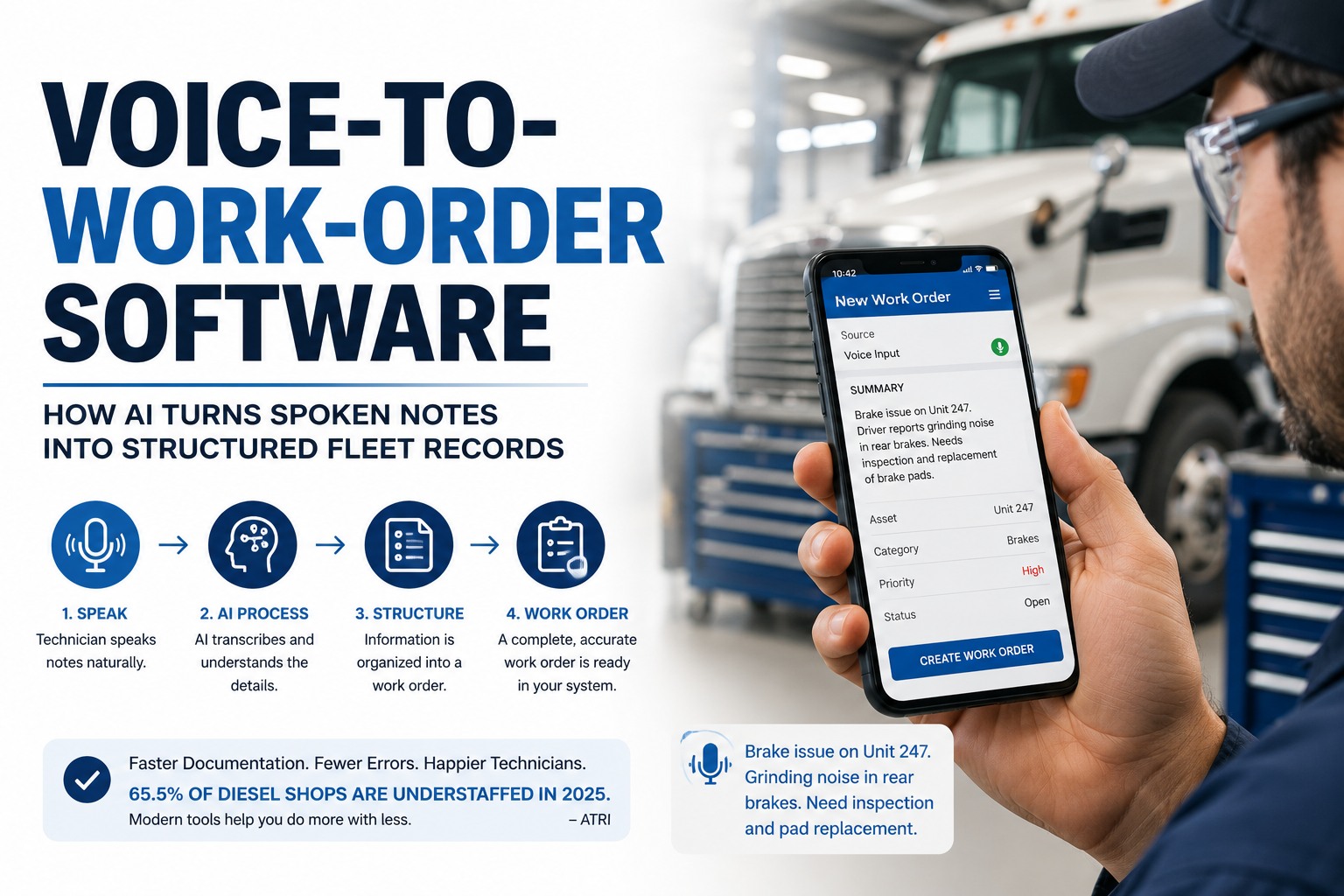
Voice-to-work-order software solves a problem the trucking industry can no longer staff its way out of. With 65.5% of diesel shops understaffed in 2025 and nearly one in five technician positions unfilled, the people you do have cannot afford to spend a quarter of their day typing repair notes into forms. Voice-to-work-order software removes that drag by turning spoken audio into a structured, ready-to-invoice work order automatically — but "it just listens and types" undersells what's actually happening. Between the technician's voice and a finished record sits a real technical pipeline: speech recognition transcribes the audio, natural language processing identifies the component, the symptom, the part, and the labor, and each is mapped to the correct field. This guide walks that path end to end, from raw spoken audio to a structured fleet record, explains why the difference between transcription and true extraction matters, and shows how a fleet can get it live in days rather than months. Start a free trial or book a demo to see spoken notes become structured work orders on your fleet.
FLEET TECHNOLOGY · HOW IT WORKS
Voice-to-Work-Order Software: From Spoken Note to Structured Record
It isn't just dictation. A real pipeline turns the technician's voice into a work order — speech recognition transcribes, language models extract the component, part, and labor, and each maps to the right field. Here's exactly how the audio becomes a record.
!
Why this matters now: the shops running this software are the ones running short-handed
65.5%
of diesel shops understaffed in 2025 (ATRI)
19.3%
average technician vacancy rate
44%
of techs considering leaving the field
$2.4B
annual lost revenue industry-wide
When you can't hire your way to more capacity, you recover it from the technicians you have — and documentation is the first place to look.
The Pipeline: Audio In, Work Order Out
The path from a spoken sentence to a structured work order runs through five distinct technical stages. Each one does a specific job, and the quality of the final record depends on all of them working together — not just the transcription everyone thinks of.
Audio Capture
A microphone — usually the vehicle's Bluetooth or a headset — picks up the technician's voice. Noise-cancelling processing isolates speech from engine, tool, and shop-floor noise before anything is transcribed.
Input: raw audio stream
Speech Recognition (ASR)
Automatic speech recognition converts the audio waveform into text in real time. This is the layer most people picture when they hear "voice" — but on its own it produces only an unstructured transcript.
Output: raw transcribed text
Language Understanding (NLP)
Natural language processing reads the transcript and performs intent recognition and entity extraction — identifying which words are the complaint, which are the cause, which name a part, and which state labor time.
Output: labelled entities and intent
Field Mapping & Validation
Each extracted entity is mapped to the correct work-order field, checked against known components and parts, and flagged if something looks incomplete — so the record is structured, not just transcribed.
Output: validated structured fields
Save, Route & Sync
The finished work order is filed against the vehicle and technician, timestamped, and routed onward — a defect becomes a priority job, and the record syncs to the rest of the fleet system.
Output: live work order in the system
The difference between stage 2 and stage 3 is the whole product.
Transcription gives you a paragraph to clean up. Extraction gives you a finished work order. Fleet Rabbit runs the full pipeline, not just the listening part.
Transcription Is Not Extraction
This is the single most important distinction in evaluating voice-to-work-order software, and it's where most "voice" features fall short. Watch what happens to the same spoken sentence under each approach.
What the Software Extracts From Each Job
A purpose-built system recognizes the distinct entities inside a repair narration and knows which field each belongs to. These are the elements it pulls from natural speech. Swipe the table horizontally on mobile.
← Swipe to see all columns →
Why Extraction Beats Manual Entry for Short-Handed Shops
The staffing math is what turns this from a nice-to-have into an operational necessity. When you can't fill the bays, you have to get more out of the technicians standing in them.
Capacity
Recover Hours Without Hiring
With one in five positions unfilled, the documentation time voice gives back is capacity you can't buy on the labor market — it comes straight from your existing crew.
Onboarding
Less Software to Learn
With 61.8% of techs entering without formal training and 357 hours needed to get productive, narrating a job beats teaching form navigation on top of everything else.
Consistency
Complete Records From Everyone
Extraction structures every job the same way regardless of who spoke it, so a green technician's work order is as complete as a veteran's.
Retention
Less of the Work Techs Hate
With 44% of technicians considering leaving, removing the paperwork they resent is a small, real lever on the job satisfaction that keeps them in the bay.
Live in days, not months — because there's no hardware to install.
Fleet Rabbit runs the full voice-to-work-order pipeline at $5 per vehicle per month, with a free tier for up to three vehicles and deployment live within 72 hours.
Evaluating a Voice-to-Work-Order System
Because so much rides on the parts you can't see — the NLP layer, the validation, the routing — use these criteria to judge whether a system runs the real pipeline or just the first stage. Swipe the table horizontally on mobile.
← Swipe to see all columns →
Frequently Asked Questions
How does voice-to-work-order software actually work?
It runs a five-stage pipeline. A microphone captures the technician's voice, automatic speech recognition transcribes the audio into text, natural language processing extracts the entities — complaint, cause, correction, part, and labor — from that text, each entity is mapped to the correct work-order field and validated, and the finished record is saved, routed, and synced. The transcription stage is only one part; the language-understanding stage is what turns words into a structured record. Seeing that full path run on a real job is exactly what you can
book a demo to watch.
What's the difference between transcription and extraction?
Transcription converts speech to text and stops there, leaving you a paragraph someone still has to read and sort into fields. Extraction goes further: it identifies which words are the complaint, which name a part, and which state labor time, then populates each field directly, producing a work order that's ready to invoice. It's the difference between a note you have to process and a record that's already done, and comparing the two on the same spoken sentence is something you can
book a demo to see side by side.
Why is this especially valuable given the technician shortage?
Because you can't hire your way out of the problem right now. With 65.5% of diesel shops understaffed in 2025 and roughly one in five positions unfilled, the capacity you recover by removing documentation drag is capacity you can't buy on the labor market — it comes from the technicians you already have. On top of that, with most new techs entering without formal training, narrating a job is far easier to learn than form navigation. Working through that capacity math for your own shop is something you can
book a demo to do.
Does it need special hardware?
No. A purpose-built voice-to-work-order system runs on the mobile devices and Bluetooth audio your fleet already uses, with no separate hardware to buy or install. That's what lets deployment happen in days rather than the months a hardware rollout would take — Fleet Rabbit goes live within 72 hours at $5 per vehicle per month with a free tier for up to three vehicles. Confirming that fit for your setup is something you can
book a demo to review.
How accurate is the extraction in a noisy shop?
Accuracy depends on the system being built for the environment, not adapted from consumer software. Purpose-built fleet voice uses noise-cancelling processing to isolate the technician's speech from engine, tool, and shop-floor noise before transcription, and the NLP layer is trained on maintenance vocabulary so it recognizes components, parts, and labor correctly rather than guessing. The combination is what keeps the extracted fields accurate in real conditions, and testing that on your own vehicles is something you can
book a demo to do firsthand.
Will it integrate with our existing fleet records?
A fleet-native system doesn't need to integrate with a separate records tool because the work orders it creates live in the same platform as your maintenance history, DVIRs, and compliance records. That avoids the brittle third-party connections a bolt-on voice app requires, and keeps every voice-created record searchable alongside everything else. Seeing how the voice output lands directly in your fleet records is exactly what you can
book a demo to explore.
How long does it take to get up and running?
Days, not months. Because there's no hardware to install and the system uses devices your team already carries, Fleet Rabbit deploys live within 72 hours, with fuller integration into existing systems typically completed in five to seven working days. The short timeline is a direct consequence of the no-hardware design, and mapping out that rollout for your fleet is something you can
book a demo to plan.
Is voice-to-work-order software worth it for a small fleet?
Often more so than for a large one, because small fleets feel the technician shortage hardest — they wait behind mega-fleets for time on the rack and can least afford to lose their few technicians' hours to paperwork. With a free tier for up to three vehicles and low per-vehicle pricing beyond that, the barrier to trying it is minimal, and the recovered capacity matters proportionally more when every bay counts. Evaluating that fit for a smaller operation is exactly what you can
book a demo to do.
Turn Every Spoken Note Into a Finished Work Order
Fleet Rabbit runs the full voice-to-work-order pipeline — speech recognition, entity extraction, field mapping, validation, and routing — so a technician's spoken narration becomes a structured, ready-to-invoice record without touching a keyboard. Live within 72 hours, integrated in 5–7 working days, at $5/vehicle/month, with no new hardware required.
Free tier for up to 3 vehicles · No credit card required · No hardware installation
July 29, 2026By Grace Morgan
All Blogs